#dusk $DUSK @Dusk What caught my attention in Dusk wasn’t another privacy claim. It was the separation between what needs to be hidden and what still needs to be visible.
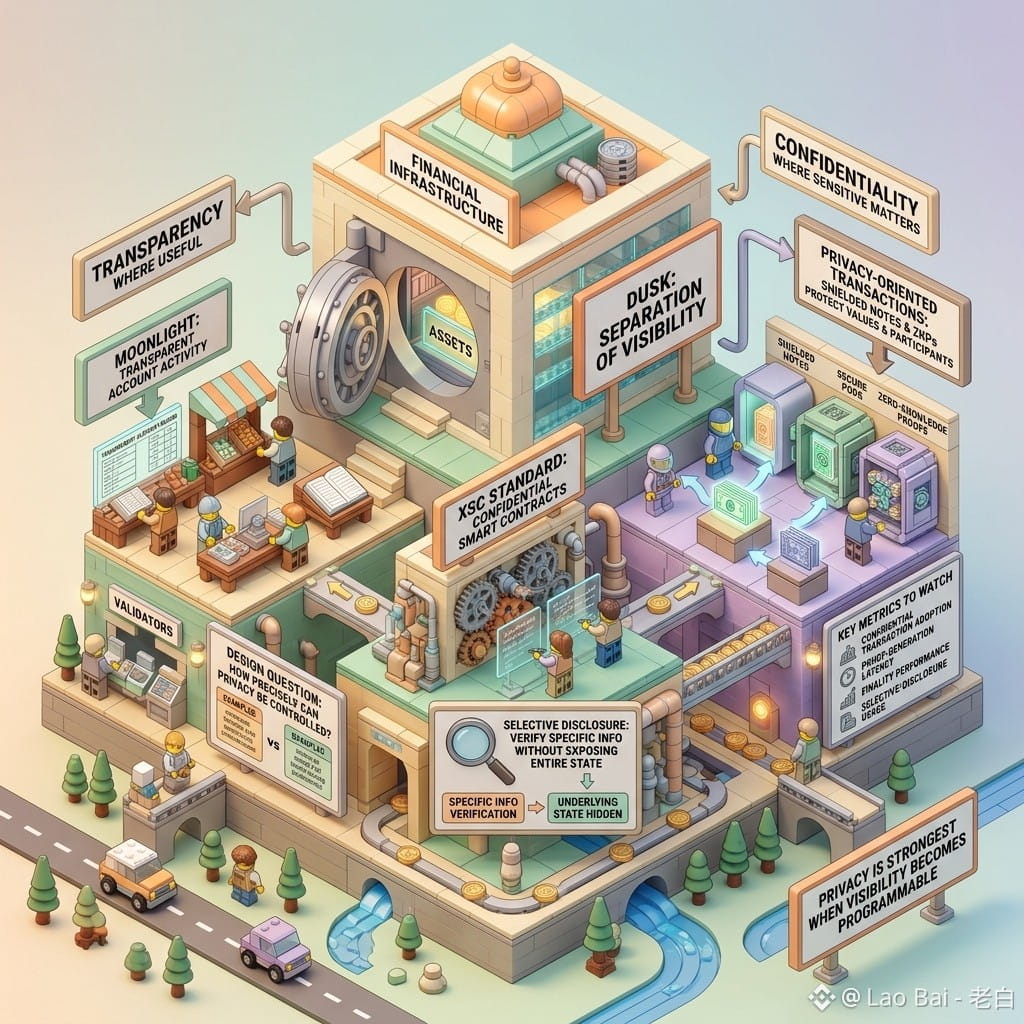
At first I assumed a privacy-focused L1 would simply encrypt everything. But that model is awkward for financial infrastructure. A vault protects the assets inside. it doesn’t make the whole building disappear. Dusk takes a more selective approach allowing transparency where it remains useful and confidentiality where sensitive information actually matters.
Moonlight supports transparent account-based activity while privacy oriented transaction mechanisms use shielded notes and zero-knowledge proofs to protect sensitive values and participants. The XSC standard extends confidential execution to smart contracts, while selective disclosure can let specific information be verified without exposing the entire underlying state.
That creates a different design question: not Is Dusk private? but How precisely can privacy be controlled?
I’d watch confidential transaction adoption, proof generation latency finality performance
and selective disclosure usage.
Privacy is not strongest when everything disappears. It is strongest when visibility becomes programmable.
At first I assumed a privacy-focused L1 would simply encrypt everything. But that model is awkward for financial infrastructure. A vault protects the assets inside. it doesn’t make the whole building disappear. Dusk takes a more selective approach allowing transparency where it remains useful and confidentiality where sensitive information actually matters.
Moonlight supports transparent account-based activity while privacy oriented transaction mechanisms use shielded notes and zero-knowledge proofs to protect sensitive values and participants. The XSC standard extends confidential execution to smart contracts, while selective disclosure can let specific information be verified without exposing the entire underlying state.
That creates a different design question: not Is Dusk private? but How precisely can privacy be controlled?
I’d watch confidential transaction adoption, proof generation latency finality performance
and selective disclosure usage.
Privacy is not strongest when everything disappears. It is strongest when visibility becomes programmable.