@Dusk I went into Dusk expecting to spend the afternoon reading about Kadcast and validator networking.
Instead, I found something much more interesting.
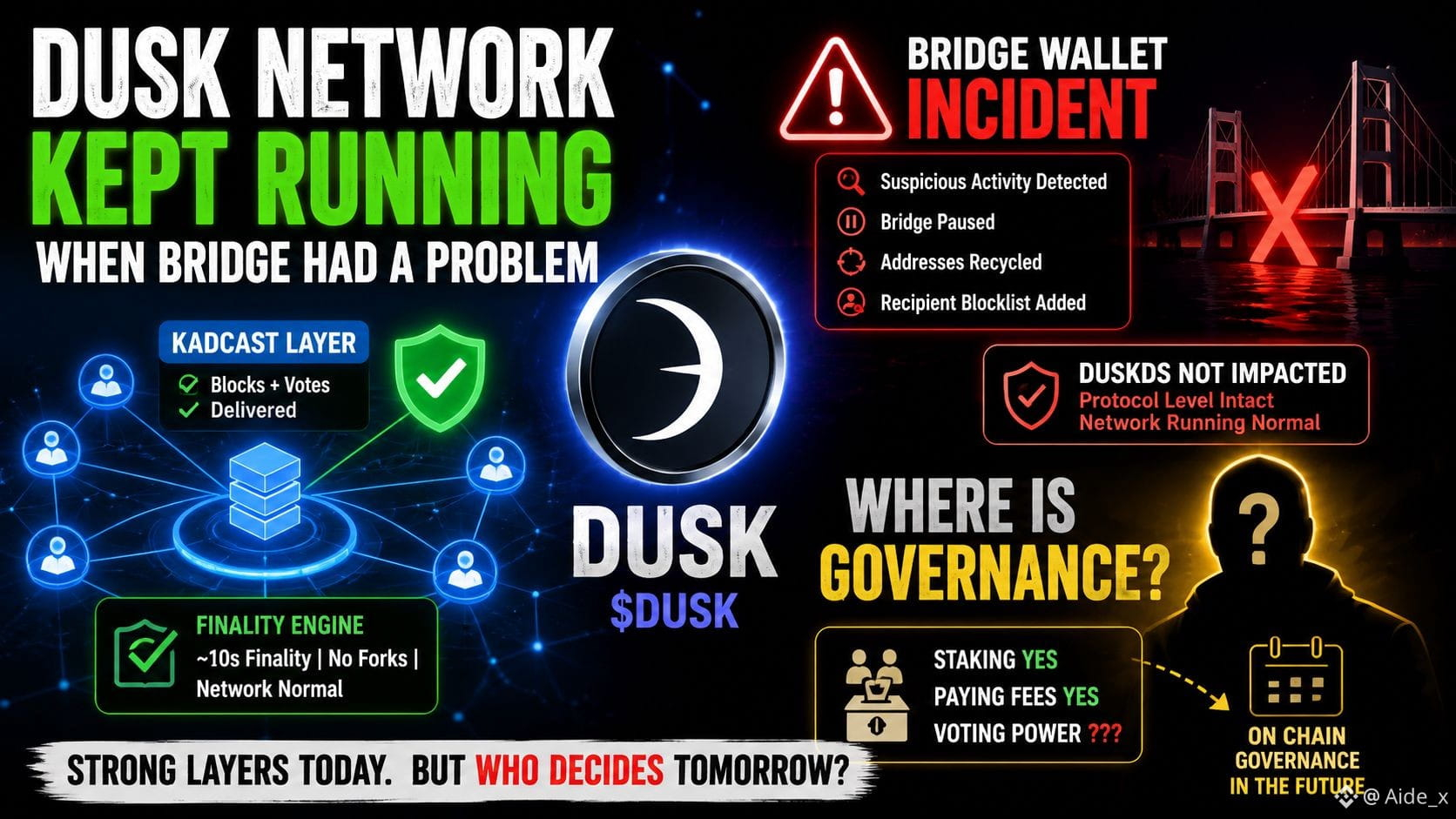
A bridge wallet incident happened. The bridge was paused, addresses were recycled, and a recipient blocklist was added.
But the Dusk network itself kept running.
That distinction matters.
Kadcast is focused on moving blocks and votes between validators fast enough for Dusk’s finality mechanism to do its job. It doesn't control bridge wallets, custody, or external integrations.
So when the bridge layer had a problem, the consensus layer basically stayed boring.
And honestly, boring was exactly what I wanted to see.
But then another question started bothering me.
DUSK holders can stake and pay for network activity, yet formal on-chain governance is still described as something for the future.
For a project positioning itself around regulated assets and institutional infrastructure, I keep asking:
Who actually gets the final say when the protocol needs to change?
The recent incident showed that Dusk has meaningful separation between layers.
The governance question shows that there may still be separation between using the network and controlling its direction.
I’m not calling that a failure.
I’m watching it.
Because in crypto, the parts that look boring today can become the most important parts during the next real stress test.
@Dusk $DUSK #DUSK
Instead, I found something much more interesting.
A bridge wallet incident happened. The bridge was paused, addresses were recycled, and a recipient blocklist was added.
But the Dusk network itself kept running.
That distinction matters.
Kadcast is focused on moving blocks and votes between validators fast enough for Dusk’s finality mechanism to do its job. It doesn't control bridge wallets, custody, or external integrations.
So when the bridge layer had a problem, the consensus layer basically stayed boring.
And honestly, boring was exactly what I wanted to see.
But then another question started bothering me.
DUSK holders can stake and pay for network activity, yet formal on-chain governance is still described as something for the future.
For a project positioning itself around regulated assets and institutional infrastructure, I keep asking:
Who actually gets the final say when the protocol needs to change?
The recent incident showed that Dusk has meaningful separation between layers.
The governance question shows that there may still be separation between using the network and controlling its direction.
I’m not calling that a failure.
I’m watching it.
Because in crypto, the parts that look boring today can become the most important parts during the next real stress test.
@Dusk $DUSK #DUSK