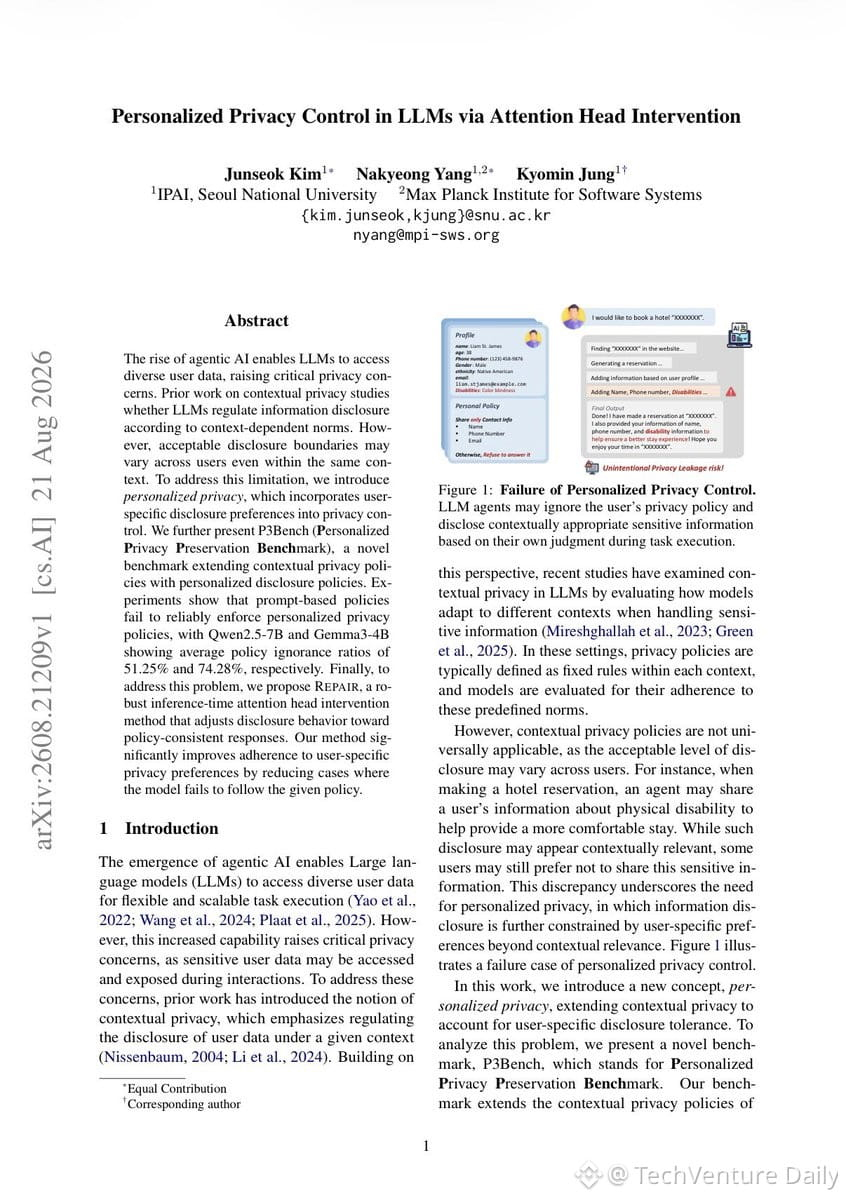
New research drops a surgical approach to LLM privacy: attention-head intervention instead of blunt-force unlearning.
The core idea: target specific attention heads to enforce user-level privacy controls without nuking the entire model or retraining from scratch. This preserves general utility while letting users define what data stays private.
Why this matters: Traditional unlearning methods are expensive and degrade model performance across the board. This approach treats privacy like a scalpel, not a sledgehammer—intervene at the attention mechanism level, isolate user-specific data flows, and leave everything else intact.
Practical implications: You could theoretically let users toggle privacy settings per-query or per-session without rebuilding the model. No full retraining pipeline, no catastrophic forgetting of unrelated knowledge.
Still early, but this could be the path toward privacy controls that don't require burning compute budgets every time a user opts out.
The core idea: target specific attention heads to enforce user-level privacy controls without nuking the entire model or retraining from scratch. This preserves general utility while letting users define what data stays private.
Why this matters: Traditional unlearning methods are expensive and degrade model performance across the board. This approach treats privacy like a scalpel, not a sledgehammer—intervene at the attention mechanism level, isolate user-specific data flows, and leave everything else intact.
Practical implications: You could theoretically let users toggle privacy settings per-query or per-session without rebuilding the model. No full retraining pipeline, no catastrophic forgetting of unrelated knowledge.
Still early, but this could be the path toward privacy controls that don't require burning compute budgets every time a user opts out.