
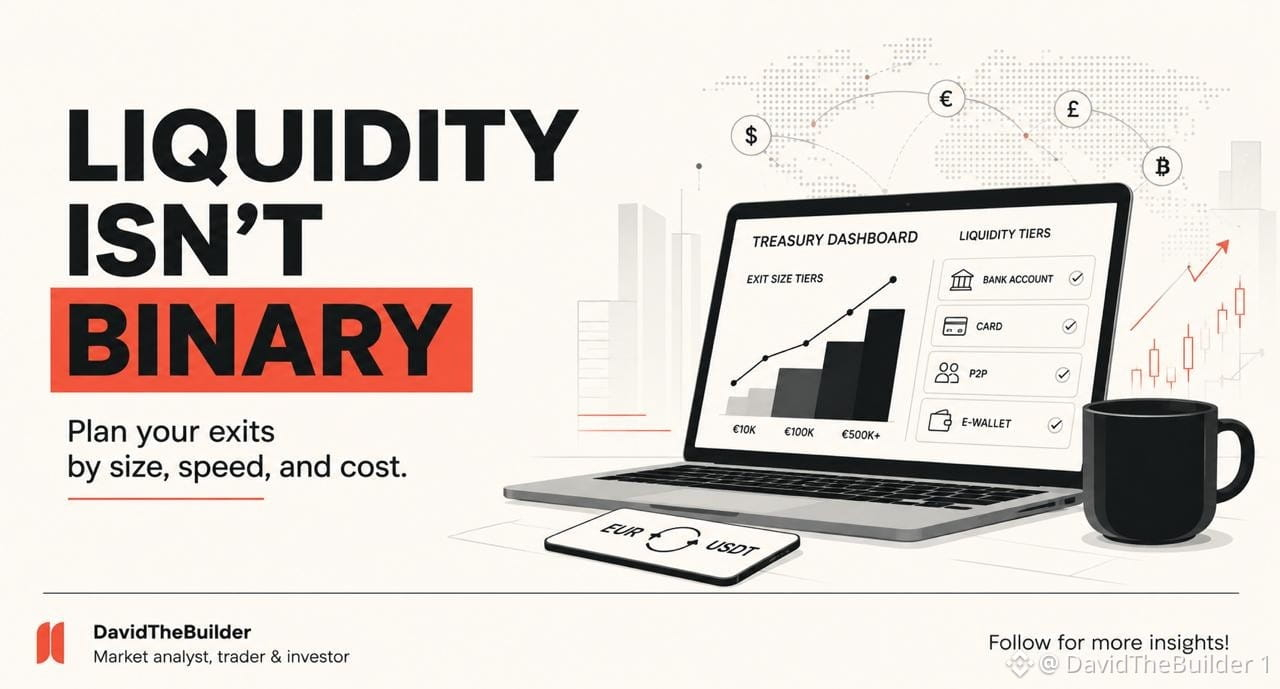
🔥 "We Can Always Exit" and Other Jokes We Tell Ourselves In early 2026, the institutional crypto market faced its first real stress test. All those assumptions about a "low-volatility phase" shattered in just a few weeks. We all felt it when $BTC swung from almost $100K down to $60k. I recently saw a Web3 CFO present a treasury plan assuming a EUR exit was available "on demand." A board member asked: at what size, over what timeline, and through what mechanism? The CFO froze. 🔥 The problem here is that liquidity isn't binary. It exists on a spectrum of size, speed, and cost. A CFO who has successfully exited €15,000 a few times hasn't validated exit liquidity for €500,000. I always say: a solid treasury plan must clearly separate the tiers. How do we exit €10k? €100k? What about €500k+? Each tier requires completely different gateways. If you have one scenario for all amounts, you don't have a plan. That's exactly the tier most treasury plans miss - and this is where OpenPayd On/Off-Ramp could be considered as an option to close that "institutional tier." https://www.openpayd.com/on-off-ramp/?utm_source=coinmarketcap&utm_medium=openoffon_david&utm_campaign=post It's not a proof of concept either - the infrastructure behind it processes over $240bn annually across 1100+ clients, including leading digital asset businesses, with instant settlement and market-leading rates. You trade via API, dashboard, or OTC desk backed by an in-house trading team, moving between fiat and crypto without the usual operational friction. This isn't a "one-size-fits-all" magic fix - it's more of a tool you should probably test before writing "we can always exit" into your slides. Disclaimer: This is not financial or investment advice. Do your own research before making any decisions. Use at your own risk. #BTC Price Analysis# #Bitcoin Price Prediction: What is Bitcoins next move?#

Đăng
Tuyên bố miễn trừ trách nhiệm: Nội dung bao gồm cả quan điểm của bên thứ ba, không phải lời khuyên. Có thể sử dụng nội dung do Binance Ai đưa ra nhưng không được đảm bảo. Xem Điều khoản & Điều kiện.