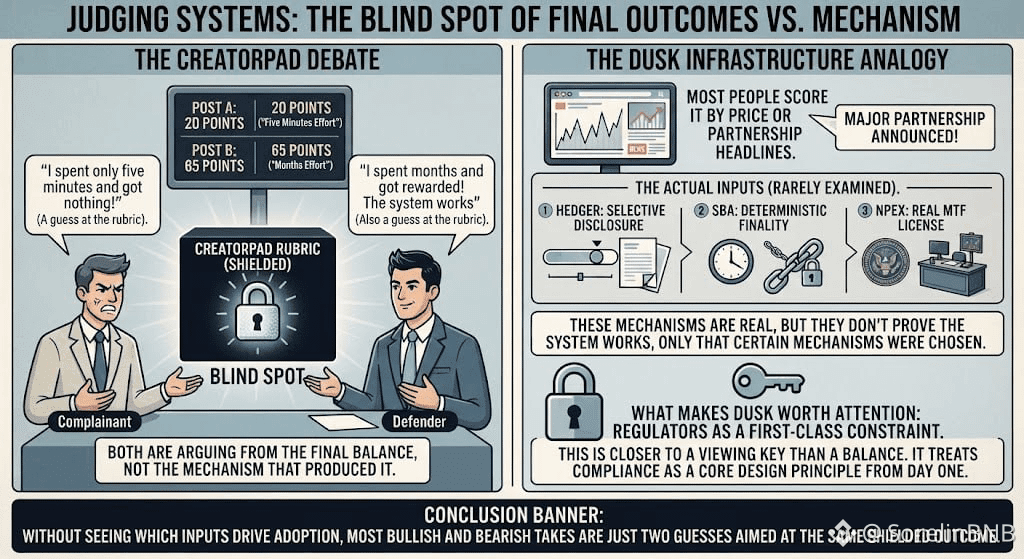
I keep coming back to the same blind spot in how people judge both reward systems and infrastructure: they argue from the final balance, not the mechanism that produced it.
In the creatorpad debate, “five minutes” and “months” are just two guesses pointed at a shielded rubric.
Dusk presents a similar problem in crypto.
Most people score it by price or partnership headlines, but the actual inputs—Hedger’s selective disclosure, SBA’s deterministic finality, NPEX holding a real MTF license—are rarely examined.
Those specifics are real, but they don’t prove the system works; they only prove certain mechanisms were chosen.
What makes Dusk worth attention isn’t privacy alone, but the decision to treat regulators as a first-class constraint from day one.
That is closer to a viewing key than a balance. And without seeing which inputs actually drive adoption, most bullish and bearish takes are still just two guesses aimed at the same shielded outcome.
$DUSK @Dusk $PROM #dusk $BTCS.US
In the creatorpad debate, “five minutes” and “months” are just two guesses pointed at a shielded rubric.
Dusk presents a similar problem in crypto.
Most people score it by price or partnership headlines, but the actual inputs—Hedger’s selective disclosure, SBA’s deterministic finality, NPEX holding a real MTF license—are rarely examined.
Those specifics are real, but they don’t prove the system works; they only prove certain mechanisms were chosen.
What makes Dusk worth attention isn’t privacy alone, but the decision to treat regulators as a first-class constraint from day one.
That is closer to a viewing key than a balance. And without seeing which inputs actually drive adoption, most bullish and bearish takes are still just two guesses aimed at the same shielded outcome.
$DUSK @Dusk $PROM #dusk $BTCS.US