#dusk $DUSK @Dusk
What Dusk Taught Me About Selective Disclosure
For a long time I had a simple assumption the more public a blockchain is, the more trustworthy it is. If everyone can see the data and check the transactions themselves, there's not much room to hide anything.
That made sense until I started looking into Dusk.
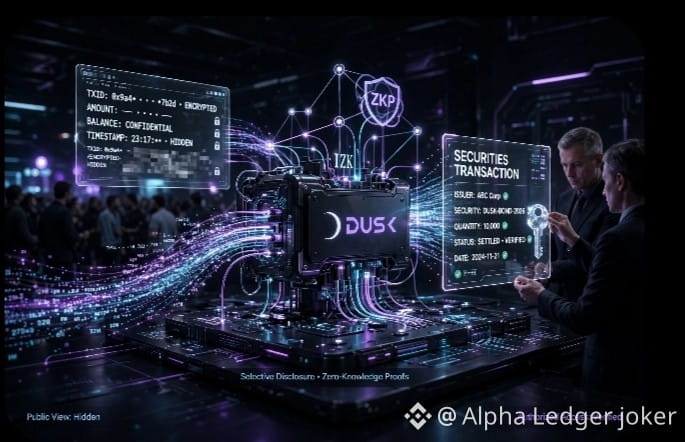
What stuck with me is they don't treat privacy like a total blackout. Their focus is selective disclosure - the data can stay hidden from the general public, but still be opened up to the specific parties who are authorized to verify it. Combined with zero-knowledge proofs and confidential transfers, it made me realize the real question isn't public vs. private. It's who can see what, and under what conditions.
That just makes sense for finance. A securities deal shouldn't have to broadcast every detail to the whole market up front, but a regulator should still be able to verify it when there's a legitimate reason to. If a blockchain can't do both at once, putting real finance on-chain is going to stay an idea on paper.
So Dusk changed how I think about privacy. It's not about making transactions unknowable to everyone. It's about building a system where access to information is part of the infrastructure itself.
I'm still curious to see how this plays out when you have a lot of institutions and real-world assets actually involved. Everything always looks clean on paper the real market is always messier.
$EVAA $RICE
What Dusk Taught Me About Selective Disclosure
For a long time I had a simple assumption the more public a blockchain is, the more trustworthy it is. If everyone can see the data and check the transactions themselves, there's not much room to hide anything.
That made sense until I started looking into Dusk.
What stuck with me is they don't treat privacy like a total blackout. Their focus is selective disclosure - the data can stay hidden from the general public, but still be opened up to the specific parties who are authorized to verify it. Combined with zero-knowledge proofs and confidential transfers, it made me realize the real question isn't public vs. private. It's who can see what, and under what conditions.
That just makes sense for finance. A securities deal shouldn't have to broadcast every detail to the whole market up front, but a regulator should still be able to verify it when there's a legitimate reason to. If a blockchain can't do both at once, putting real finance on-chain is going to stay an idea on paper.
So Dusk changed how I think about privacy. It's not about making transactions unknowable to everyone. It's about building a system where access to information is part of the infrastructure itself.
I'm still curious to see how this plays out when you have a lot of institutions and real-world assets actually involved. Everything always looks clean on paper the real market is always messier.
$EVAA $RICE