My cousin caught me mid-argument in a group chat about privacy-chain architecture and just laughed — "you guys have been fighting about this for a week." She's not technical, but she made me explain it out loud instead of just typing at strangers.
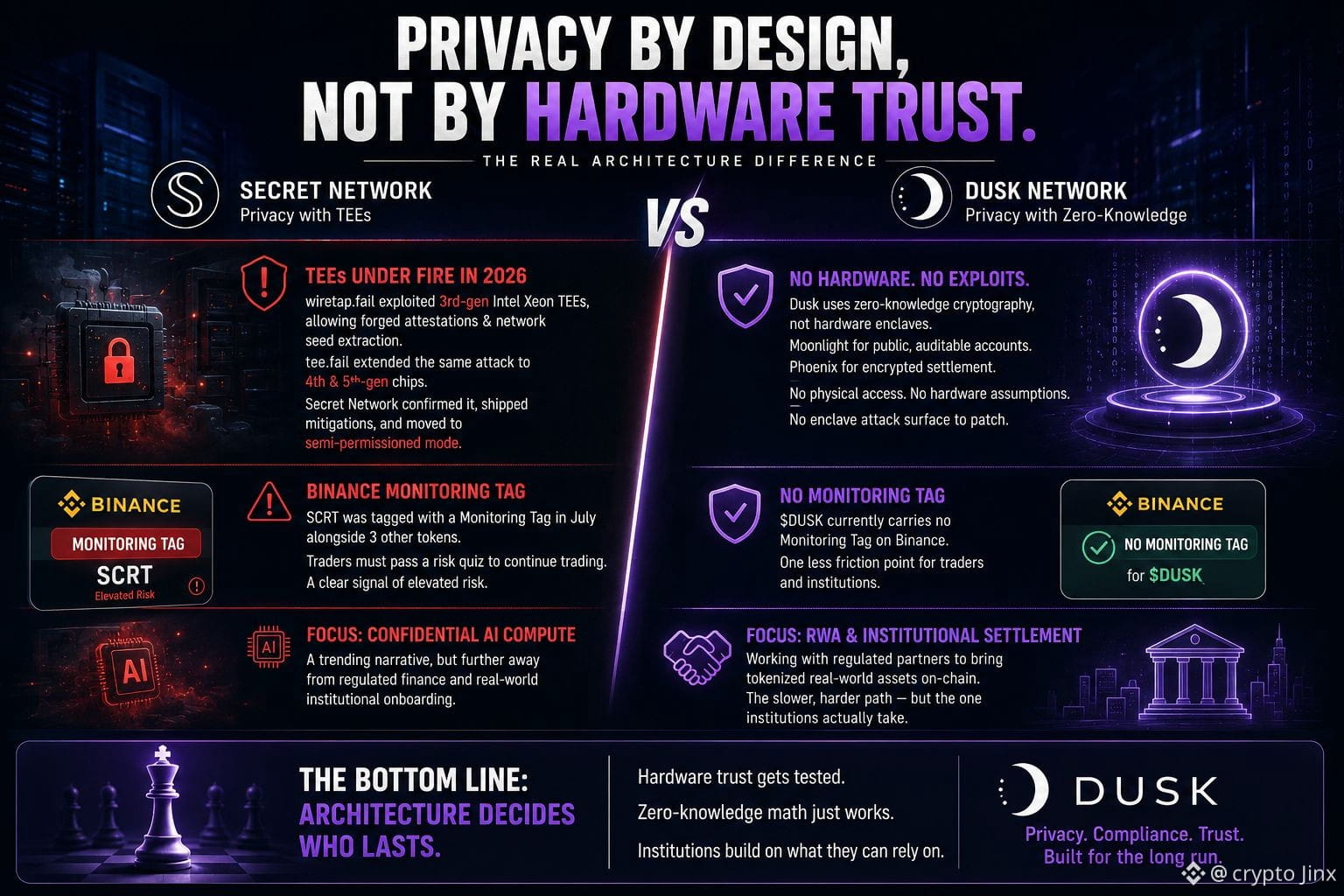
Here's the split once you strip the marketing away. Secret Network's privacy runs on TEEs — Intel hardware enclaves keeping data encrypted while it's processed. Sounds solid until you remember 2026's been rough for that category: wiretap.fail hit 3rd-gen Intel Xeon chips first, letting anyone with physical machine access forge attestations and pull the network seed, and tee.fail extended the same attack to 4th and 5th-gen chips months later. Secret's team confirmed it and moved the network to semi-permissioned mode as a stopgap — a real, published vulnerability class, still being patched.
Dusk doesn't carry that exposure because it isn't betting on hardware trust. Moonlight handles public, auditable accounts; Phoenix handles encrypted settlement — both running on zero-knowledge math instead of a chip vendor's enclave.
The institutional signal is blunt: Binance slapped SCRT with a Monitoring Tag this July, alongside three other flagged tokens — traders now pass a risk quiz just to keep trading it. That's exactly the friction that makes due-diligence teams walk before reading the whitepaper. $DUSK carries no such flag right now.
Where each project spends effort tells its own story too — Secret's pushing into confidential AI compute, trendy but further from licensed finance. Dusk's leaning into RWA settlement through regulated partners, slower but the actual path institutions walk.
My cousin's take: "so it's not really a fair fight right now." Not quite — less about who's louder, more about who's still standing once the hardware assumptions get tested.
@Dusk $DUSK #dusk
Here's the split once you strip the marketing away. Secret Network's privacy runs on TEEs — Intel hardware enclaves keeping data encrypted while it's processed. Sounds solid until you remember 2026's been rough for that category: wiretap.fail hit 3rd-gen Intel Xeon chips first, letting anyone with physical machine access forge attestations and pull the network seed, and tee.fail extended the same attack to 4th and 5th-gen chips months later. Secret's team confirmed it and moved the network to semi-permissioned mode as a stopgap — a real, published vulnerability class, still being patched.
Dusk doesn't carry that exposure because it isn't betting on hardware trust. Moonlight handles public, auditable accounts; Phoenix handles encrypted settlement — both running on zero-knowledge math instead of a chip vendor's enclave.
The institutional signal is blunt: Binance slapped SCRT with a Monitoring Tag this July, alongside three other flagged tokens — traders now pass a risk quiz just to keep trading it. That's exactly the friction that makes due-diligence teams walk before reading the whitepaper. $DUSK carries no such flag right now.
Where each project spends effort tells its own story too — Secret's pushing into confidential AI compute, trendy but further from licensed finance. Dusk's leaning into RWA settlement through regulated partners, slower but the actual path institutions walk.
My cousin's take: "so it's not really a fair fight right now." Not quite — less about who's louder, more about who's still standing once the hardware assumptions get tested.
@Dusk $DUSK #dusk