#termmax @TermMax
I used to think that vaults in DeFi weren’t anything particularly special. Users deposit funds, the protocol searches for yield on their behalf, and in the end they receive a portion of the profits. It sounds like a neatly packaged box—except the box lives on the blockchain.
But when I looked into TermMax’s Vault and Curator model, I started to realize that this understanding was a bit superficial. The Curator isn’t simply someone who “seeks high APY.” They have to decide which market the capital should go into, what maturity to choose, and what level of risk to take on. Especially in fixed-rate lending, capital allocation is also tied to maturity. A good yield but poor liquidity—or an unsuitable term—may not actually be the best choice.
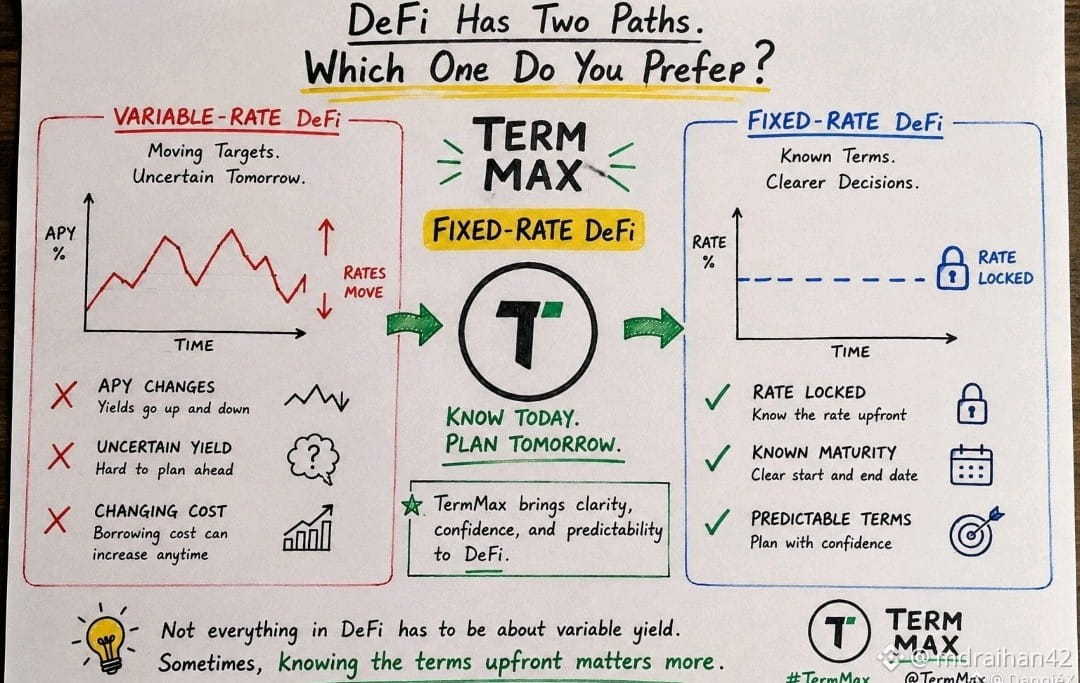
This made me rethink fixed-rate lending. Previously, I often compared protocols using the APY numbers shown on-screen. But if capital is allocated across multiple markets with different terms, the more important question might be: where does that yield come from, and what trade-offs is the curator making to achieve it?
I like how this model makes a fairly invisible problem—capital risk and allocation—more apparent. Users want passive yield, but that “passiveness” doesn’t mean risk disappears. It simply gets transferred from the user to another layer of management.
I still want to observe how TermMax’s vaults handle periods of highly volatile markets. Because a strategy that seems very reasonable when liquidity is abundant may only truly be tested once maturities begin to diverge and users want to withdraw capital at the same time.
I used to think that vaults in DeFi weren’t anything particularly special. Users deposit funds, the protocol searches for yield on their behalf, and in the end they receive a portion of the profits. It sounds like a neatly packaged box—except the box lives on the blockchain.
But when I looked into TermMax’s Vault and Curator model, I started to realize that this understanding was a bit superficial. The Curator isn’t simply someone who “seeks high APY.” They have to decide which market the capital should go into, what maturity to choose, and what level of risk to take on. Especially in fixed-rate lending, capital allocation is also tied to maturity. A good yield but poor liquidity—or an unsuitable term—may not actually be the best choice.
This made me rethink fixed-rate lending. Previously, I often compared protocols using the APY numbers shown on-screen. But if capital is allocated across multiple markets with different terms, the more important question might be: where does that yield come from, and what trade-offs is the curator making to achieve it?
I like how this model makes a fairly invisible problem—capital risk and allocation—more apparent. Users want passive yield, but that “passiveness” doesn’t mean risk disappears. It simply gets transferred from the user to another layer of management.
I still want to observe how TermMax’s vaults handle periods of highly volatile markets. Because a strategy that seems very reasonable when liquidity is abundant may only truly be tested once maturities begin to diverge and users want to withdraw capital at the same time.