
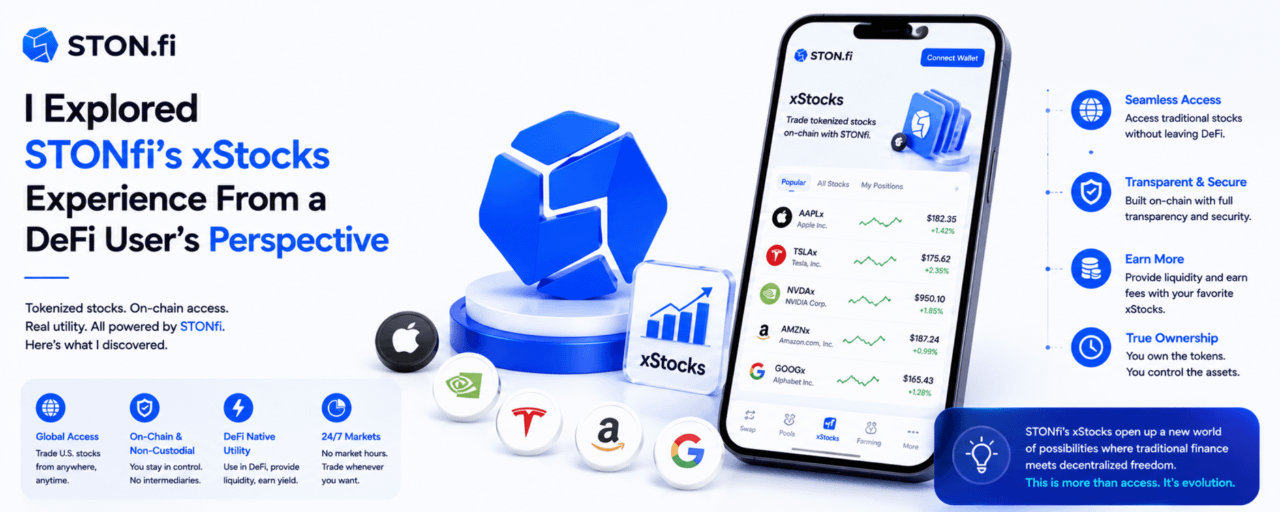
For someone who is already familiar with DeFi, interacting with tokenized stocks creates an interesting experience.
I am used to connecting a wallet, selecting a token, checking the available route, reviewing the amount, and confirming a transaction. So when I started exploring xStocks on STONfi, what caught my attention was how familiar the process felt despite the underlying asset being very different from the tokens I normally trade.
Instead of looking at xStocks purely as a new type of investment product, I wanted to understand what the experience actually feels like from a DeFi user’s perspective.
THE FIRST THING I NOTICED
The biggest difference is the asset itself.
Most of my DeFi activity revolves around crypto native assets. I am used to seeing tokens, liquidity pools, farms, and other blockchain based financial products.
xStocks introduce tokenized representations of traditional financial assets into that environment.
That immediately made me curious about how naturally these assets could fit into an interface designed around DeFi.
What I discovered is that the user experience is relatively familiar.
The asset is different, but the interaction starts to feel like something I already understand.
WHAT ARE xSTOCKS?
xStocks are tokenized representations of traditional financial assets.
Instead of accessing exposure to a traditional stock only through a conventional brokerage platform, tokenized versions can exist within blockchain infrastructure and be interacted with through compatible applications.
That creates a different way of thinking about financial assets.
A stock is no longer something I only associate with a brokerage account.
Its tokenized representation can become part of a blockchain based environment.
Of course, this does not mean a tokenized stock is automatically identical to directly owning the underlying security through a traditional brokerage. The structure, rights, availability, and applicable restrictions depend on the specific product.
That distinction is important.
EXPLORING xSTOCKS THROUGH A DEFI LENS
What interested me most was not simply seeing a stock represented as a token.
It was seeing how that token fits into a DeFi workflow.
As a DeFi user, I naturally think in terms of wallets and swaps.
I want to connect my wallet, choose what I currently hold, select what I want to receive, review the transaction, and confirm it.
STONfi brings that familiar interaction model to supported xStocks.
That makes the concept easier to understand because I don’t have to completely change the way I interact with blockchain assets.
THE WALLET BECOMES THE STARTING POINT
One of the biggest differences between this experience and traditional brokerage access is the starting point.
With a traditional broker, you generally begin with a brokerage account.
With a DeFi application, the wallet is central to the experience.
Your wallet is already where you manage your blockchain assets, approve transactions, and interact with decentralized applications.
So when xStocks are made available through a DeFi interface, they become much closer to the other digital assets I’m already familiar with.
That creates a much more natural experience for crypto native users.
THE SWAP EXPERIENCE
The actual interaction is one of the parts I found most interesting.
Instead of navigating through a completely separate financial platform, I can approach a supported xStock through the same basic swap concept I already understand.
I select the asset I want to use.
Then I select the xStock I want to receive.
I enter the amount and review the transaction details before confirming.
The interface handles much of the complexity, while the user remains focused on the assets being exchanged.
That simplicity matters.
IT FEELS FAMILIAR, BUT THE ASSET IS DIFFERENT
This is probably the easiest way I can describe the experience.
The interaction feels familiar.
The asset is different.
I’m still using a wallet.
I’m still reviewing a transaction.
I’m still thinking about liquidity and execution.
But instead of swapping one crypto asset for another, I am interacting with a tokenized representation of a traditional financial asset.
That combination is what makes xStocks interesting from a DeFi perspective.
WHY TOKENIZATION IS INTERESTING
Tokenization can change how traditional assets interact with digital financial infrastructure.
A traditional stock generally exists within established financial market systems.
A tokenized representation exists within a blockchain environment.
That creates the possibility for traditional financial exposure to become more programmable and composable.
For DeFi users, this is particularly interesting because blockchain based assets can potentially interact with other applications and infrastructure.
Instead of keeping traditional assets and crypto assets in completely separate worlds, tokenization creates a potential connection between them.
COMPOSABILITY IS THE BIG IDEA
The concept of composability is one of the things I found most interesting during my research.
In DeFi, different protocols can interact with one another.
A token can be swapped.
It can potentially be used in another application.
Liquidity can be provided.
Other financial functions can be built around the asset.
Tokenized assets bring the possibility of extending some of these ideas beyond crypto native assets.
The important point is that this depends on the specific xStock and the applications that support it.
Tokenization creates the foundation, but the ecosystem around the asset determines what can actually be done with it.
STONfi MAKES THE EXPERIENCE LESS INTIMIDATING
For someone who already understands DeFi, the familiar interface makes xStocks easier to approach.
For someone who is completely new to blockchain based finance, there is still a learning curve.
You need to understand wallets, networks, transaction approvals, tokenized assets, and the risks involved.
But I think the simplicity of the interface helps reduce some unnecessary friction.
The user doesn’t need to understand every piece of infrastructure before making sense of the basic interaction.
That is an important product decision.
WHAT I PAID ATTENTION TO
While exploring the experience, I wouldn’t just look at how easy it is to complete a swap.
I would also pay attention to the details behind the asset.
Before interacting with any xStock, I would want to understand:
What exactly does the token represent?
What rights are associated with it?
Where is it available?
What liquidity is available?
What fees apply?
What risks are associated with the product?
These questions are just as important as the convenience of the interface.
THIS ISN’T A REPLACEMENT FOR BROKERAGE ACCOUNTS
One thing I don’t think should be overlooked is that xStocks and traditional brokerage accounts serve different purposes.
A traditional brokerage provides access to securities through established financial institutions and market infrastructure.
Tokenized stocks introduce a blockchain based way of representing financial assets.
The two models have different structures, protections, access requirements, and risks.
So I wouldn’t describe xStocks simply as a replacement for traditional investing.
I see them as another way of interacting with financial exposure through blockchain infrastructure.
THE RISKS STILL MATTER
The fact that an asset is available through DeFi doesn’t make it risk free.
The underlying asset can lose value.
Liquidity can change.
The tokenized product can have its own risks.
There can also be smart contract, counterparty, infrastructure, and regulatory considerations depending on the specific product.
That means the convenience of swapping an xStock should never replace proper research.
A simple interface doesn’t mean the underlying financial product is simple.
WHAT STOOD OUT TO ME
The biggest thing I noticed was how easily the concept fits into an existing DeFi workflow.
I didn’t have to completely change the way I think about interacting with blockchain assets.
The same basic principles still apply.
Connect the wallet.
Choose the asset.
Review the transaction.
Understand what you’re receiving.
Confirm only when everything looks correct.
The major difference is that the asset being accessed represents something from traditional finance.
WHY THIS COULD MATTER FOR DEFI
DeFi started largely around crypto native assets.
As tokenization develops, that universe can become much broader.
Imagine a future where users don’t have to think of crypto assets and traditional financial assets as completely separate categories.
Instead, different forms of financial value could exist within the same programmable infrastructure.
That’s the bigger idea I see behind xStocks.
It’s not simply about putting a stock ticker on a blockchain.
It’s about creating financial assets that can interact with blockchain based infrastructure.
MY TAKE
Exploring xStocks from a DeFi user’s perspective gave me a different understanding of what tokenization can actually mean.
The most interesting part wasn’t simply seeing familiar companies represented as tokens.
It was seeing how those assets could fit into an environment where wallets, swaps, liquidity, and decentralized infrastructure already exist.
STONfi makes that experience feel familiar because the interaction follows a DeFi workflow that crypto users already understand.
At the same time, the underlying asset requires a different level of research because a tokenized stock isn’t automatically the same thing as directly owning the underlying security through a traditional brokerage.
For me, that’s what makes the experience interesting.
xStocks don’t just bring traditional financial exposure into a crypto interface. They show how traditional assets could become part of a broader, programmable financial ecosystem.
And from a DeFi user’s perspective, that’s the part worth paying attention to.
Explore - @STONfi DEX
$BTC