
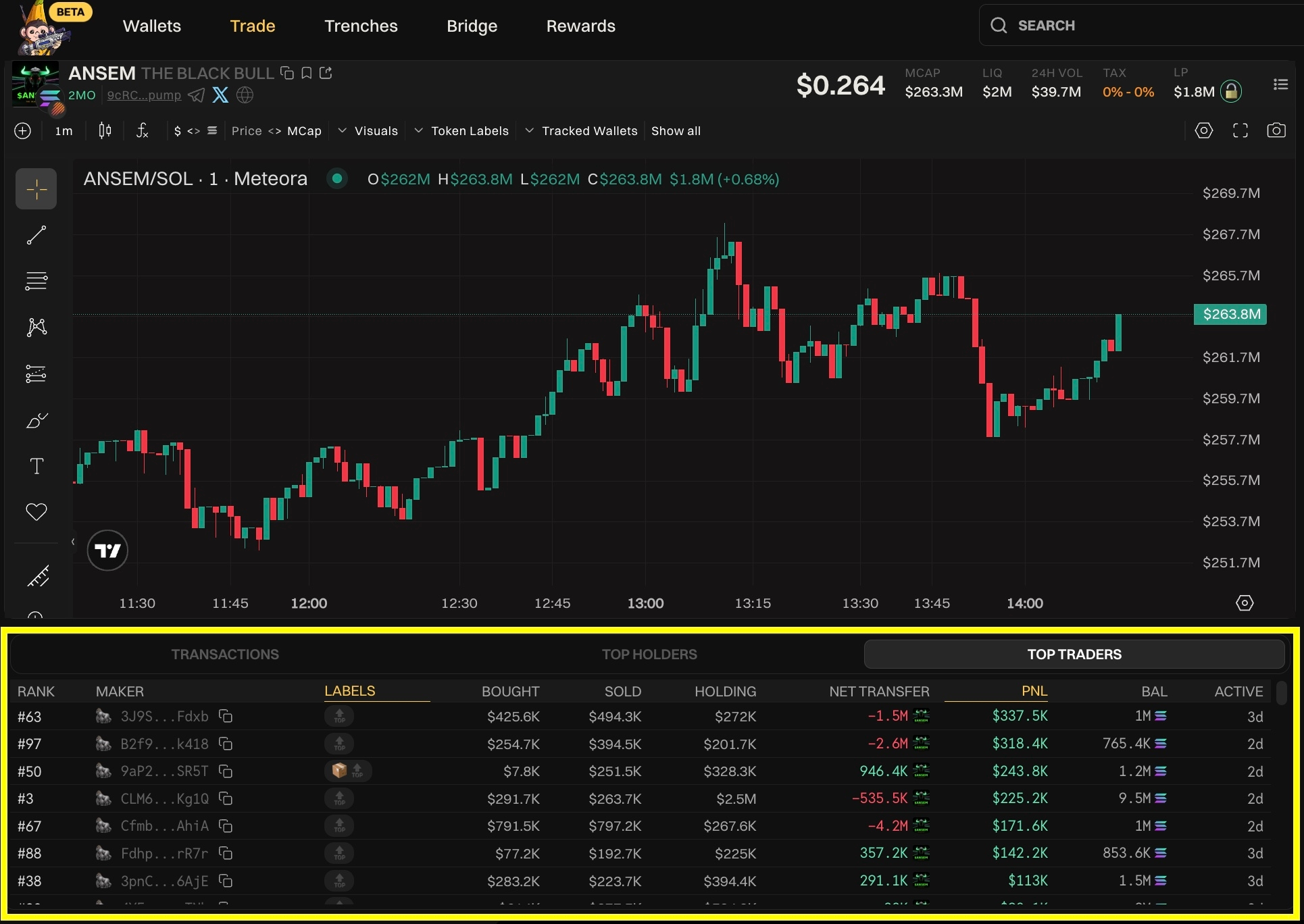
Every wallet leaderboard on $SOL shows you the same thing: addresses that are up. That sounds obvious until you think about what it means for the decision you are about to make.
A ranking of winners is not a ranking of good traders. It is a ranking of whoever survived the last stretch of market, and those two groups overlap far less than the interface suggests.
The wallets you cannot see are the point
For every address sitting near the top of a profit ranking, a much larger number ran a near identical strategy and ended flat or down. They are not on the board, so they never enter your thinking.
This matters because the strategy and the outcome get conflated. You look at a wallet that turned a small balance into a large one and read it as skill. Some of it is. Some of it is one position that happened to work, applied at size, during a window where that approach paid.
The same approach run by a hundred wallets produces a distribution. You are shown the right tail and asked to treat it as the average.
High risk looks like high skill from the outside
There is a specific version of this that catches new copy traders.
Aggressive position sizing produces the most extreme results in both directions. A wallet that puts a large share of its balance into single low cap tokens will either post spectacular numbers or disappear. The ones that disappear stop being visible.
So the leaderboard systematically over represents the riskiest style of trading, and presents it as the most successful one. Copy that wallet and you inherit the risk profile, not the outcome. The outcome already happened.
Position sizing on your side is the defence. A fixed buy amount, set in advance, means a followed wallet going all in on something does not translate into you doing the same.
What to look at instead of the profit column
Ranked profit is the least useful number on the page. A few others are worth more.
Look at how many trades produced the result. A wallet up heavily across two hundred trades is telling you something different from one up heavily across six. The first is a process. The second is an event.
Look at the losing trades, if the interface shows them. A wallet with no visible losses is usually a wallet whose losses are still open, sitting unrealised in tokens nobody wants.
Look at how long the address has been active. A wallet that only exists inside the current market has never been tested by a different one, and the market that made it will not last forever.
Look at the size of the largest single win relative to the total. If one trade carries the entire record, you are copying a lottery ticket that already paid.
The interpretation nobody puts on the marketing page
Copy trading works. It works for a narrower reason than most people assume.
It does not transfer skill. It transfers trade selection, which is one input among several, and it arrives with a delay and without the context that produced it.
What you get is exposure to a style. Whether that style suits your capital, your risk tolerance and your attention span is a separate question no leaderboard on $SOL can answer for you.
Understood that way, the screening job changes. You are not hunting for the highest number. You are looking for a wallet whose behaviour you would be comfortable repeating for the next three months, including in the weeks it loses.
Tools that let you bound what gets copied matter more than tools that rank wallets. Minimum and maximum market cap filters in Banana Gun, for example, decide which of a followed wallet's trades reach you at all, which quietly does more for your outcome than picking a slightly better address.
Pick for consistency, not for the top of the board
The wallet that ends up worth following is rarely the one at the top. It is usually somewhere in the middle: fewer spectacular numbers, more trades, a visible pattern you can describe out loud.
Boring is easier to copy. Boring is also easier to size correctly, because you can predict roughly what the next trade will look like.
The addresses at the top of the board got there partly by taking risks that will eventually catch up with some of them. You do not have to be standing behind them when it does.
What do you screen for before following a wallet, and has a leaderboard ever talked you into one you regretted?
#CopyTrading #Solana #SmartMoney #CryptoTrading