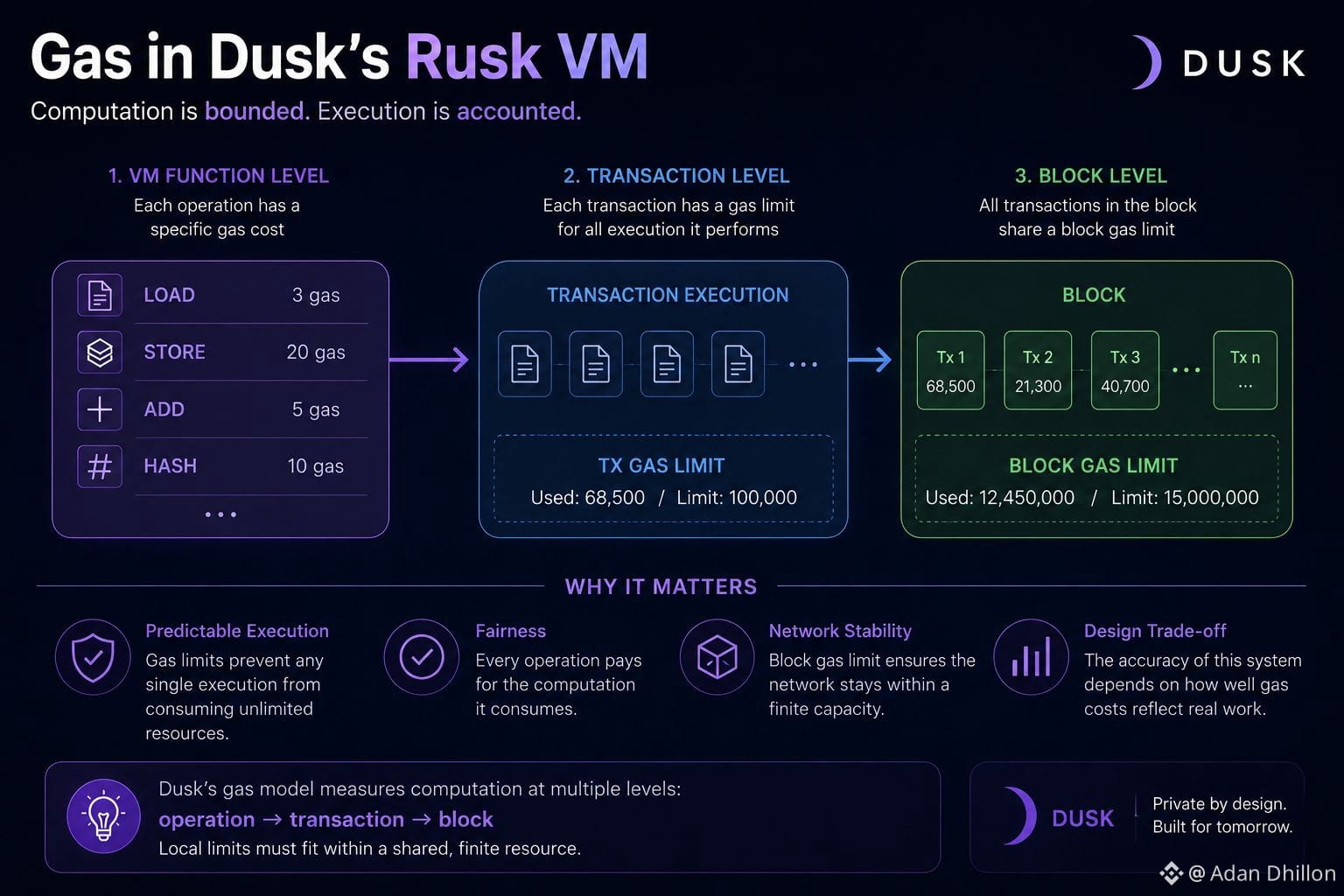
At first I assumed gas in Dusk’s Rusk VM was mainly a safeguard against contracts consuming too much computation. But the more I looked, the more the accounting boundary caught my attention. Each VM function has a gas cost, while transactions have their own gas limits and blocks also operate within a gas limit. What caught my attention is that computation is therefore being bounded at several levels, not just inside one contract call. A transaction has to stay within its own budget, but it also becomes part of a larger block-level resource constraint. That creates a small dependency I hadn’t really considered before: local execution limits still have to fit into a shared capacity. A transaction can be valid within its own allowance while still contributing to the finite computation available to the block as a whole. Maybe that is simply the trade-off of keeping general computation bounded. So the quieter question is how these local limits should be calibrated when every transaction ultimately shares the same block?
#dusk $DUSK @Dusk
#dusk $DUSK @Dusk