The first time I looked inside Dusk’s stack, I expected encryption.
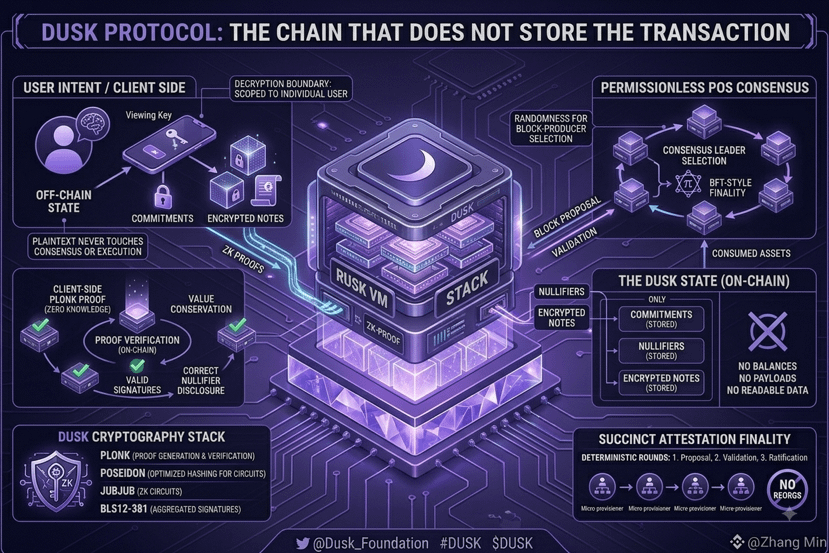
I found something stranger: absence. Looking at RUSK, the WebAssembly VM, the first thing I notice is that on-chain state isn’t balances or payloads; it’s commitments, nullifiers, and encrypted notes.
I don’t have to trust a node operator not to peek, because there is nothing readable to peek at.
Every transition is proven in zero knowledge via PLONK, so I can verify value conservation, valid signatures, and correct nullifier disclosure without seeing amounts, recipients, or contract inputs.
I’m not depending on a quorum of operators to agree; I’m depending on a proof that can be checked by anyone, while the underlying plaintext never touches consensus or execution.
The permissionless proof-of-stake consensus with BFT-style finality and cryptographic randomness for block-producer selection doesn’t require a decryptor, a custodian, or a trusted enclave at the protocol’s core.
That’s the part I keep coming back to: Dusk doesn’t split trust between parties the way some architectures do. It removes the object of trust from the chain itself.
My only open question is whether the off-chain viewing-key and decryption boundary stays as tightly scoped as the on-chain commitments, because if it does, then the strongest property here isn’t privacy.
It’s that there is no single on-chain secret for any one party to leak, move, or reconstruct unilaterally.
@Dusk #dusk $DUSK
I found something stranger: absence. Looking at RUSK, the WebAssembly VM, the first thing I notice is that on-chain state isn’t balances or payloads; it’s commitments, nullifiers, and encrypted notes.
I don’t have to trust a node operator not to peek, because there is nothing readable to peek at.
Every transition is proven in zero knowledge via PLONK, so I can verify value conservation, valid signatures, and correct nullifier disclosure without seeing amounts, recipients, or contract inputs.
I’m not depending on a quorum of operators to agree; I’m depending on a proof that can be checked by anyone, while the underlying plaintext never touches consensus or execution.
The permissionless proof-of-stake consensus with BFT-style finality and cryptographic randomness for block-producer selection doesn’t require a decryptor, a custodian, or a trusted enclave at the protocol’s core.
That’s the part I keep coming back to: Dusk doesn’t split trust between parties the way some architectures do. It removes the object of trust from the chain itself.
My only open question is whether the off-chain viewing-key and decryption boundary stays as tightly scoped as the on-chain commitments, because if it does, then the strongest property here isn’t privacy.
It’s that there is no single on-chain secret for any one party to leak, move, or reconstruct unilaterally.
@Dusk #dusk $DUSK