
Introduction
Bitcoin is one of the most revolutionary financial technologies of the 21st century. It introduced a new idea: a form of digital money that can operate without a central bank, government, or traditional financial institution controlling it.
Since its launch in 2009, Bitcoin has transformed from an experiment among computer enthusiasts into a global financial asset recognized by individuals, companies, and institutions around the world.
But what exactly is Bitcoin? How did it start? And what could its future look like?
Let's explore.
What Is Bitcoin?
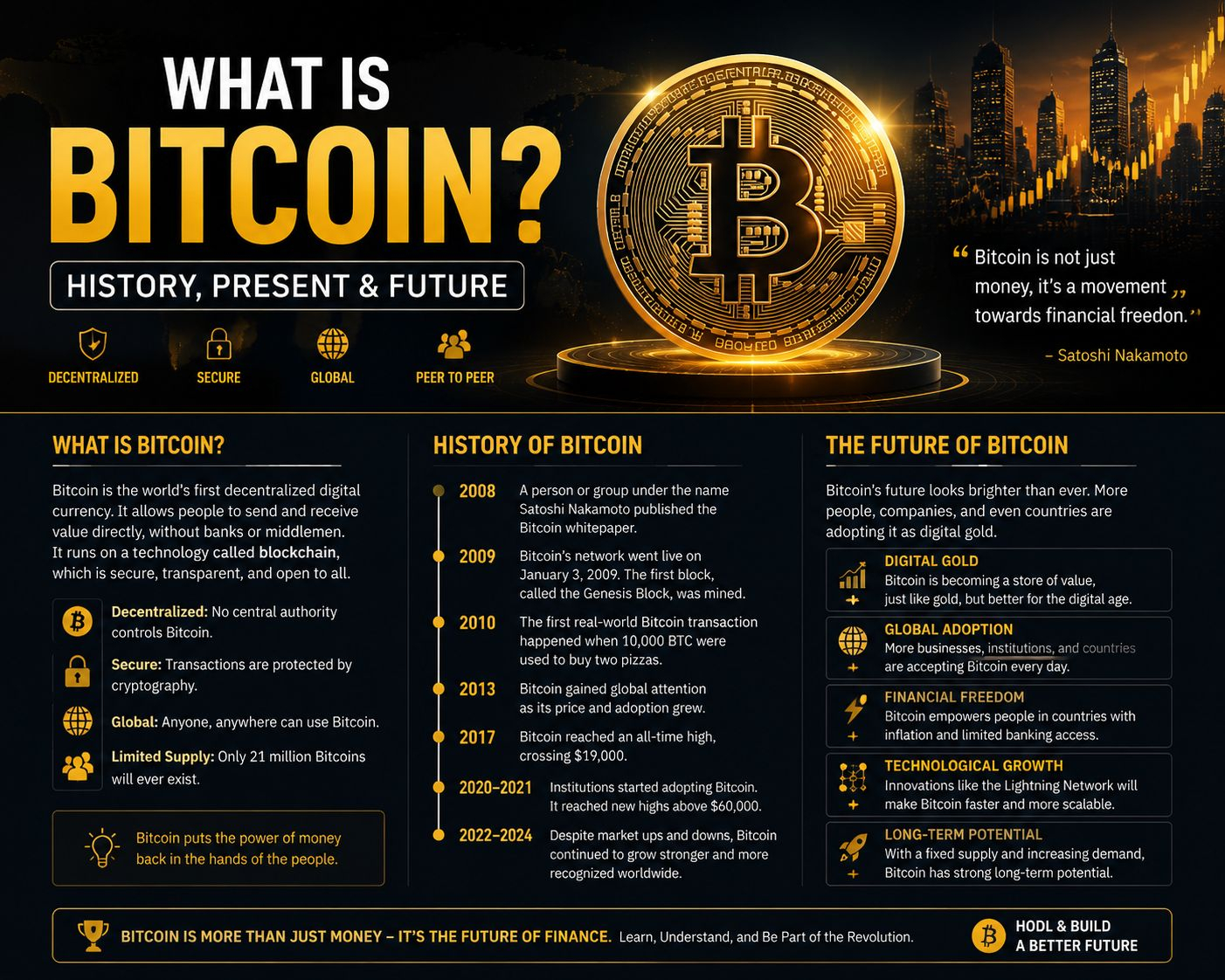
Bitcoin is a decentralized digital currency that allows people to send and receive value directly through the internet without needing a bank or middleman.
Unlike traditional currencies such as the US dollar or Pakistani rupee, Bitcoin is not controlled by any single organization. Instead, it operates through a global network of computers using blockchain technology.
Key Features of Bitcoin:
1. Decentralization
Traditional money is controlled by central banks and governments.
Bitcoin works differently:
No central authority controls it
Transactions are verified by a worldwide network
Anyone can participate
This makes Bitcoin resistant to censorship and centralized control.
2. Blockchain Technology
Bitcoin runs on a technology called blockchain.
A blockchain is a digital record of transactions stored across thousands of computers worldwide.
Every Bitcoin transaction is:
✅ Transparent
✅ Secure
✅ Permanent
✅ Verified by the network
Once information is recorded on the Bitcoin blockchain, it is extremely difficult to change.
3. Limited Supply
One of Bitcoin's most important features is its limited supply.
There will only ever be:
21 Million Bitcoins
Unlike traditional currencies, governments cannot simply print more Bitcoin.
Because of this scarcity, many people compare Bitcoin to digital gold.
4. Peer-to-Peer Transactions
Bitcoin allows users to transfer money directly from one person to another.
For example:
Person A → Bitcoin Network → Person B
No bank approval is required.
History of Bitcoin
2008: The Beginning
In October 2008, an unknown person or group using the name Satoshi Nakamoto published the Bitcoin whitepaper:
"Bitcoin: A Peer-to-Peer Electronic Cash System"
The paper explained a system for creating digital money without relying on banks.
2009: Bitcoin Network Launch
On January 3, 2009:
The Bitcoin network officially started
The first Bitcoin block was created, known as the Genesis Block
This marked the beginning of a new era in digital finance.
2010: The First Real-World Bitcoin Purchase
One of the most famous moments in Bitcoin history happened in 2010.
A programmer named Laszlo Hanyecz purchased two pizzas using:
10,000 BTC
At that time, Bitcoin had very little value.
Today, this event is remembered as the first major real-world Bitcoin transaction.
2013–2017: Global Attention
During this period:
More people discovered Bitcoin
Cryptocurrency exchanges became popular
Bitcoin prices increased significantly
New cryptocurrencies entered the market
In 2017, Bitcoin reached around $20,000 for the first time.
2020–2021: Institutional Adoption
Bitcoin gained attention from major financial companies.
Important developments:
Large companies started investing in Bitcoin
More investors considered Bitcoin a store of value
Bitcoin reached a new all-time high above $60,000
2024 and Beyond
Bitcoin continued becoming part of mainstream finance.
Major developments include:
Increased institutional interest
Growth of Bitcoin investment products
Greater awareness among individuals and businesses
How Does Bitcoin Work?
Bitcoin uses three important technologies:
1. Cryptography
Cryptography protects transactions and ownership.
It ensures that:
Only the owner can spend Bitcoin
Transactions cannot easily be changed
2. Mining
Bitcoin miners use computers to verify transactions and secure the network.
They solve complex mathematical problems and receive Bitcoin rewards.
Mining helps maintain the security of the Bitcoin blockchain.
3. Consensus Mechanism
Bitcoin uses Proof of Work (PoW).
This system allows thousands of computers to agree on the correct transaction history without needing a central authority.
Why Do People Buy Bitcoin?
People have different reasons for owning Bitcoin:
1. Store of Value
Many investors believe Bitcoin can protect wealth because of its limited supply.
2. Alternative Financial System
Bitcoin provides access to digital money without depending completely on traditional banking systems.
3. Global Accessibility
Anyone with internet access can use Bitcoin.
It can be transferred across borders without traditional banking limitations.
4. Investment Opportunity
Some investors buy Bitcoin because they believe its adoption may increase in the future.
However, Bitcoin prices can be highly volatile, and investors should understand risks before investing.
Challenges Facing Bitcoin
Bitcoin also has challenges:
1. Price Volatility
Bitcoin prices can rise and fall significantly in short periods.
2. Regulation
Different countries have different approaches toward cryptocurrency regulation.
3. Energy Usage
Bitcoin mining requires significant computing power, which has created discussions about energy consumption.
4. Scalability
The Bitcoin network continues developing solutions to improve transaction speed and efficiency.
The Future of Bitcoin
Nobody can predict the exact future price of Bitcoin, but several trends may influence its development.
1. Digital Gold Narrative
Many investors see Bitcoin as a modern alternative to gold because of:
Limited supply
Global accessibility
Decentralized nature
2. More Institutional Adoption
If more companies and financial institutions adopt Bitcoin, it could increase mainstream acceptance.
3. Improved Technology
Technologies such as the Lightning Network aim to make Bitcoin transactions faster and cheaper.
4. Global Financial Innovation
Bitcoin has inspired thousands of blockchain projects and changed how people think about money, ownership, and financial systems.
Final Thoughts
Bitcoin is more than just a cryptocurrency. It represents a new approach to money — one based on decentralization, transparency, and digital ownership.
From a small experiment in 2009 to a globally recognized financial asset, Bitcoin has already changed the world of finance.
Whether Bitcoin becomes the future of money or remains a valuable digital asset, one thing is clear:
Bitcoin has permanently changed the way the world thinks about currency and technology.
Disclaimer: This article is for educational purposes only and is not financial advice. Always research and understand risks before investing in cryptocurrency.
#Bitcoin #BTC #CryptoEducation #Blockchain #Web3 #BinanceSquare #Cryptocurrency