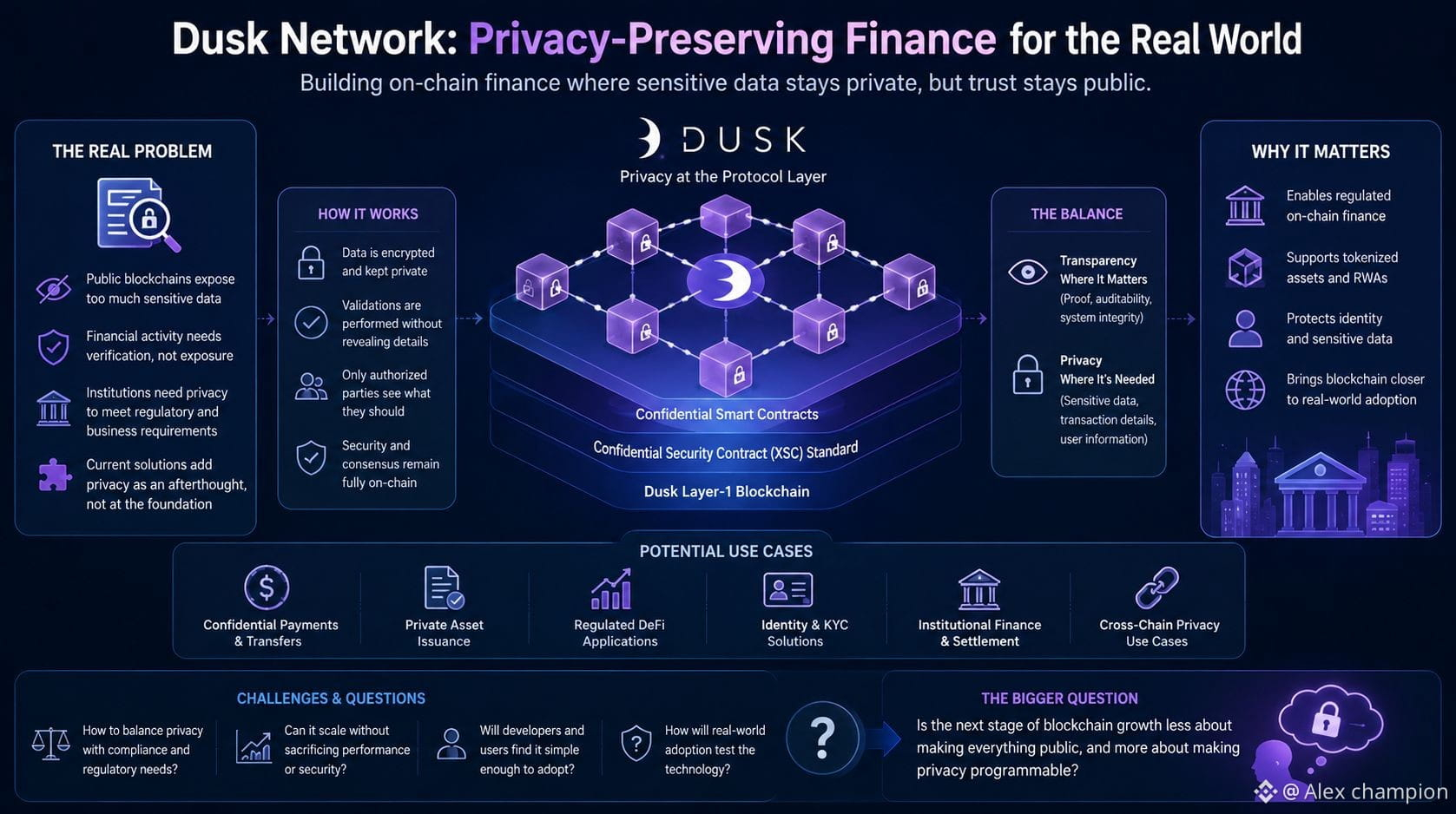
Crypto has spent years moving through cycles of faster chains, cheaper transactions, AI narratives, and increasingly complex financial applications, but one issue keeps coming back: how do you build useful on-chain finance without putting every piece of sensitive information in public view? That is what made me look more closely at Dusk Network. What caught my attention is that Dusk approaches this problem at the blockchain layer itself, rather than treating privacy as something added later. As a Layer-1, it is designed around confidential smart contracts and the Confidential Security Contract (XSC) standard, which creates an interesting structure for financial applications that may need transparency in some areas while still protecting sensitive data. I started thinking about how important that balance could become as blockchain moves beyond speculation toward regulated markets, tokenized assets, and real-world financial infrastructure. At the same time, privacy on public blockchains is not a simple problem. There are trade-offs around compliance, scalability, usability, and how different participants verify information without seeing everything. I wonder if Dusk can prove that confidential transactions can remain practical while meeting the expectations of institutions and regulators. What interests me most is not whether privacy sounds valuable, but whether this architecture can handle real adoption without becoming too complicated. Perhaps the bigger question is whether the next stage of blockchain growth depends less on making everything public and more on deciding what truly needs to remain private.
@Dusk #dusk $DUSK
@Dusk #dusk $DUSK