
What Is Worldcoin (WLD)? Why Has Sam Altman’s Project Fallen More Than 97%?
Worldcoin (WLD) emerged as one of the most ambitious crypto projects aiming to distinguish real humans from bots on the internet and create a global digital identity network during a period of rapid AI development.
At the center of the project are World ID, World App, World Chain, and the WLD token. Users can verify that they are unique humans through a specialized biometric device called the Orb and, in eligible countries, earn WLD tokens.
The project attracted significant attention even before launch because OpenAI CEO Sam Altman was among its co-founders.
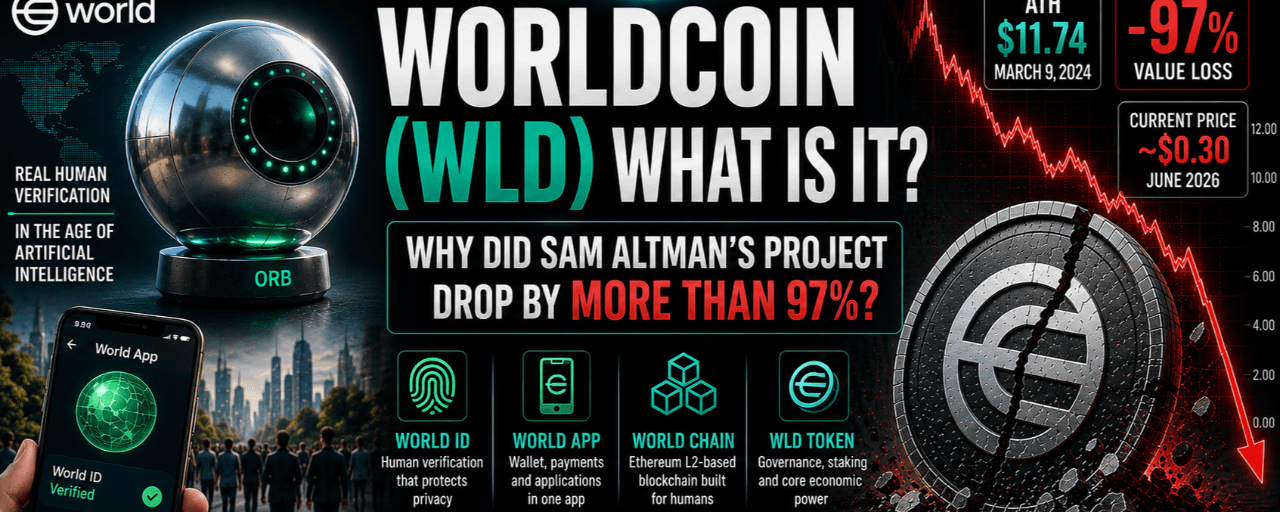
However, WLD’s price performance developed in the opposite direction of the expectations created by the project. WLD reached an all-time high of approximately $11.74 in March 2024. In 2026, it is trading around $0.30. This represents a loss of approximately 97% from its ATH.
What Is Worldcoin (WLD)?
Worldcoin is a blockchain ecosystem focused on human verification and digital identity that now operates under the broader name World Network.
Its main components are:
World ID: A digital identity that allows users to prove they are real and unique humans.
World App: A mobile application providing access to World ID, a wallet, crypto assets, and applications.
World Chain: An Ethereum-based Layer-2 blockchain designed for human-centered use.
WLD: The native token of World Network.
The primary purpose of World ID is to prove that you are a “real human” online without revealing your personal identity. The system aims to accomplish this using zero-knowledge proofs and biometric verification infrastructure.
How Did Worldcoin Emerge?
The foundations of Worldcoin were laid in 2019 with the establishment of Tools for Humanity.
Its co-founders include Sam Altman, Alex Blania, and Max Novendstern.
After years of development and beta testing, the project officially launched on July 24, 2023.
Alongside the launch, the WLD token was introduced and token distribution began for millions of users who had previously been verified through the Orb.
What Did Worldcoin Promise?
The vision presented by Worldcoin was much broader than that of a traditional cryptocurrency project.
The core idea was:
Being able to prove that you are human on the internet in the age of AI.
The project’s promises included:
Global digital identity
Human verification against bots and fake accounts
Privacy-focused identity system
Global financial access
Broad distribution of WLD
Human-centered blockchain infrastructure
“Proof of Humanity” in the age of AI
Long-term infrastructure for the concept of an AI-supported universal basic income
World’s own documentation describes one of the fundamental goals of WLD as distributing a large portion of the tokens to unique humans.
What Is Sam Altman’s Role in Worldcoin?
Sam Altman is one of Worldcoin’s co-founders.
However, there is an important distinction.
While the independent governance of World Network is managed by World Foundation, Tools for Humanity plays an important role in technology development and products such as World App.
Tools for Humanity CEO Alex Blania, while Sam Altman serves as chairman of the company.
Therefore, describing Worldcoin as “Sam Altman’s company” would technically be an oversimplification.
However, Altman’s role as a co-founder was a major factor in Worldcoin gaining global recognition.
What Is the Orb?
One of Worldcoin’s most controversial and notable technologies is the biometric device called the Orb.
Users visit a physical location where an Orb is available.
The device uses biometric characteristics to verify that a person is a real and unique human.
Following verification, the user receives a World ID.
According to World’s technical explanation, the system uses cryptographic methods and zero-knowledge proofs designed to protect raw biometric data.
However, this biometric structure is precisely what created one of Worldcoin’s biggest controversies.
Why Did Worldcoin Generate So Much Hype?
Worldcoin’s biggest difference from other crypto projects was its direct connection to the AI narrative.
Sam Altman’s global recognition through OpenAI and ChatGPT helped turn Worldcoin into more than an ordinary altcoin.
During 2023 and 2024, investors focused on the following scenario:
AI will increase the number of bots on the internet → humans will need to prove they are real humans → World ID will become a standard → WLD will gain significant value as a result.
This narrative created very strong speculative demand for WLD.
Why Did WLD Reach $11.74?
WLD’s biggest rally occurred during the first months of 2024.
The combination of the AI and Worldcoin narratives, the broader bull market in crypto, and expectations for global expansion of World ID generated significant demand for the token.
WLD reached an all-time high of approximately $11.74 on March 9, 2024.
At these levels, the market began pricing Worldcoin not merely as a token, but as a potential major component of future global digital identity infrastructure.
However, token economics and regulatory issues gradually became more prominent afterward.
Why Has WLD Fallen More Than 97%?
Several factors contributed to WLD’s collapse following its all-time high.
The most important include:
Very high token supply and continuous unlocks
Early investor and team tokens entering circulation
WLD’s real-world usage falling short of expectations
Regulatory issues surrounding World ID
Biometric data controversies
Weakness across the broader altcoin market
The AI narrative failing to translate directly into token price
Declining investor expectations around its high valuation
Token unlocks in particular created significant selling pressure on WLD for an extended period.
Why Did Token Unlocks Become Such a Major Problem for WLD?
WLD was designed with a total supply of 10 billion tokens.
Not all of the tokens were initially in circulation.
According to data released by World in April 2026, approximately 4.9 billion WLD had been unlocked at that time, with 3.3 billion in circulation.
The total daily unlock rate, previously around 5.1 million WLD, was planned to fall to approximately 2.9 million WLD on July 24, 2026.
This represents an approximately 43% reduction in emissions.
However, the daily unlock mechanism has not completely ended.
This is important for WLD investors because the entry of new tokens into the market can create selling pressure when demand does not grow at the same pace.
Why Has Worldcoin’s Tokenomics Been Criticized?
One of Worldcoin’s fundamental goals was to distribute WLD as broadly as possible among the global population.
However, this distribution model had an important consequence:
Token supply grew rapidly over the years.
On one side, there were WLD tokens distributed to millions of users, while team and investor allocations also needed to enter circulation over time.
Therefore, WLD’s price needed more than simply attracting new users to rise.
Growth in new users and usage needed to exceed the amount of new tokens entering the market.
That balance could not be maintained for an extended period.
Biometric Data Controversies
One of Worldcoin’s biggest problems emerged not from the technology itself but from regulation.
Scanning irises through the Orb led to investigations in several countries over data privacy and consumer rights.
In Spain, the data protection authority temporarily halted Worldcoin’s collection of biometric data in 2024.
Portugal similarly imposed a 90-day suspension on data collection.
The Spanish data protection authority later initiated a process seeking the deletion of iris data collected by Worldcoin.
These developments became one of the most important factors slowing Worldcoin’s global expansion.
Was Worldcoin Really Created to Scan People’s Eyes?
The project’s primary purpose is not simply to collect biometric data.
The fundamental idea advocated by World Network is that as AI develops, distinguishing humans from bots on the internet will become increasingly difficult, creating a need for a global “Proof of Personhood” infrastructure.
However, the use of biometrics for this infrastructure naturally brings serious privacy and centralization debates.
Therefore, Worldcoin’s success depends not only on whether the Orb works technically, but also on whether societies and regulators accept the technology.
Worldcoin Became World Network in 2024
In October 2024, the project underwent a major rebranding.
Worldcoin is now positioned as World Network / World.
The new structure consists of three core components:
World ID + World Chain + Worldcoin (WLD)
This repositioned the WLD token from being the entirety of the project to being the economic component of a broader human-verification and financial network.
World Chain was also launched as the mainnet during the same period.
Does Worldcoin Really Have That Many Users?
World announced that the network had reached more than 20 million participants by the end of 2024.
However, there is an important distinction here:
A “World App user,” a “World ID holder,” and a “unique human verified through the Orb” are not the same metrics.
Therefore, directly interpreting the total number of users announced by the project as the number of active users can be misleading.
World’s primary goal is to increase the number of verified humans globally and make this identity usable across third-party applications.
Was Worldcoin Promoted in Türkiye?
Worldcoin also became one of the projects closely followed by crypto communities in Türkiye.
The “scan your eyes and earn WLD” model and the free-token narrative attracted the attention of individual users in Türkiye.
However, available public sources reviewed do not provide sufficient evidence showing that JrKripto, Paradotor, or another major Turkish crypto influencer conducted a verified paid and organized investor campaign for Worldcoin.
Therefore, it would not be accurate to portray a specific Turkish influencer as having “brought people into WLD.”
Worldcoin’s expansion in Türkiye appears to have occurred primarily through global interest in the project, free WLD distribution, social media, and crypto communities.
Why Did WLD Investors Suffer Losses?
The fundamental problem experienced by Worldcoin investors is not that the project completely disappeared.
The problem is the huge gap between the expectations created by the project and the economic performance of the WLD token.
For an investor who bought WLD at $11.74 in 2024, the decline to around $0.30 represents a loss of approximately 97%.
During the same period, World ID and World Chain continued to be developed.
In other words, this is not a case of “the product disappeared”; rather, the token value collapsed while the product continued to develop.
This distinction places Worldcoin in a completely different category from Terra, SafeMoon, or FTX.
What Are the Expectations for Worldcoin?
Worldcoin’s story is not over yet.
The growth of bots and fake-account problems driven by AI could increase the need for technologies capable of proving that someone is a real human.
If World ID can be used across social media, finance, gaming, ticketing, and other internet services, the project could become an important infrastructure provider.
World Network is also continuing to expand its Orb infrastructure and integrate World ID into different applications in 2026.
However, for WLD to deliver a strong performance again from an investment perspective, two problems need to be solved:
Real growth in World ID usage and the ability of demand to absorb the selling pressure created by increasing token supply.
What Is Worldcoin’s Biggest Risk?
For Worldcoin, the biggest risk is no longer simply the crypto market.
The project’s future also depends on biometric data regulations and social acceptance.
The global expansion of highly sensitive technology such as iris scanning will continue to attract the attention of governments and data protection authorities.
Indeed, investigations and restrictions have occurred in different countries regarding Worldcoin’s Orb operations.
Therefore, if Worldcoin fails, the reason may not be the token price alone.
Failure of regulators or users to sufficiently adopt the project’s underlying identity model could also limit its growth.
Conclusion
Worldcoin is one of the most unusual projects in the crypto market.
On one side, there are extremely powerful narratives involving Sam Altman, artificial intelligence, biometric verification, World ID, and global digital identity.
On the other side, there is a more than 97% decline in token price, billions of new WLD entering circulation, and regulatory problems across different parts of the world.
WLD fell from its approximately $11.74 ATH to around $0.30, losing approximately 97% of its value.
However, it would not be accurate to consider Worldcoin a “dead coin.”
World Network is still being developed, the use cases for World ID are being expanded, and the Orb infrastructure continues to grow.
The real question now is:
Can Worldcoin’s technology for verifying real humans become the standard for the internet of the future, or will WLD remain another major altcoin disappointment left behind by the AI and Sam Altman hype of 2024?
What will determine WLD’s future is not simply its price; it is whether a sustainable balance can be established between real users, real usage, and token economics.