
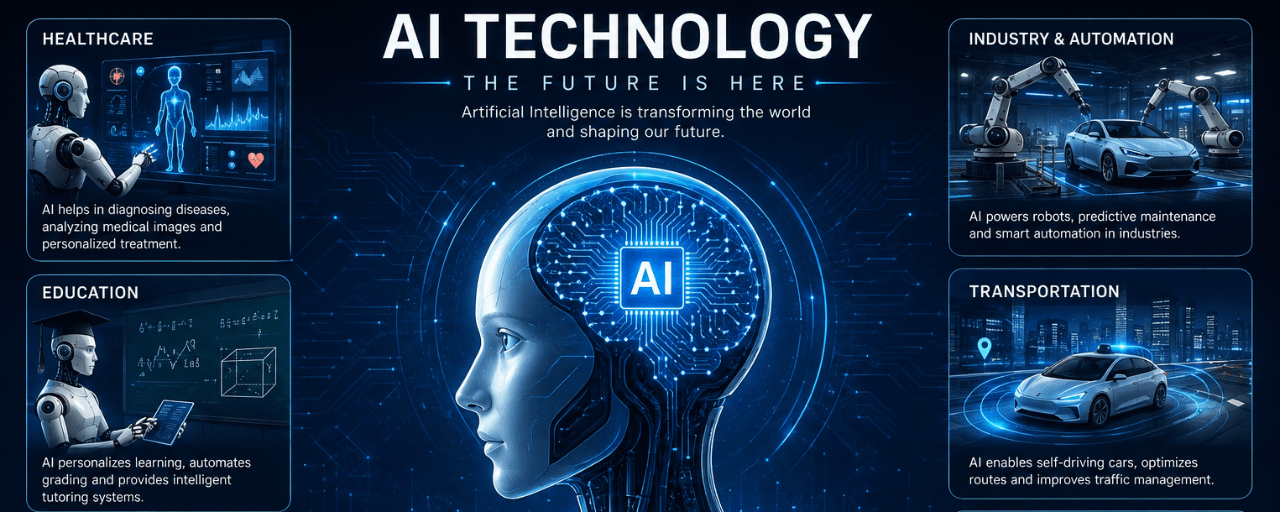
Artificial Intelligence, commonly known as AI, has moved from being a futuristic idea to becoming one of the most important technologies of the modern era. From smartphones and search engines to healthcare, finance, education, transportation, entertainment, and business, AI is increasingly becoming part of everyday life. What once seemed like science fiction is now being used to solve real-world problems, automate complex tasks, analyze enormous amounts of information, and help people make better decisions.
The rapid development of AI is changing not only how computers work but also how humans interact with technology. Traditional software follows instructions created by programmers, while modern AI systems can learn patterns from data, understand language, recognize images, generate content, and adapt to different situations. This ability has opened the door to a new generation of intelligent applications.
What Is Artificial Intelligence?
Artificial Intelligence refers to computer systems designed to perform tasks that traditionally require human intelligence. These tasks can include understanding language, recognizing objects, solving problems, making predictions, learning from experience, and generating new content.
AI is not a single technology. It is a broad field that includes machine learning, deep learning, natural language processing, computer vision, robotics, speech recognition, generative AI, and many other areas.
Machine learning allows computers to learn from data instead of relying entirely on manually programmed rules. Deep learning takes this concept further by using large neural networks capable of identifying extremely complex patterns.
Generative AI is another major development. Instead of simply analyzing existing information, generative AI can produce new text, images, audio, video, software code, and other forms of content. This has dramatically expanded the ways individuals and organizations can use AI.
The Rise of Generative AI
One of the biggest changes in technology in recent years has been the growth of generative AI. AI assistants can now answer questions, summarize information, help write documents, translate languages, generate software code, brainstorm ideas, and support creative projects.
The significance of generative AI goes beyond chatbots. It represents a shift toward more natural interaction between humans and computers. Instead of learning complicated software interfaces, people can increasingly communicate with computers using ordinary language.
For businesses, this creates opportunities to automate repetitive knowledge-work tasks. Employees can use AI to analyze documents, prepare reports, organize information, assist customers, and generate initial drafts of content.
For individuals, AI can act as a personal productivity assistant. Students can use it to understand difficult concepts, developers can use it for programming assistance, and entrepreneurs can use it to research ideas and create business materials.
However, generative AI also introduces important challenges. AI systems can sometimes produce inaccurate information, misunderstand context, or confidently generate incorrect answers. This means human judgment remains essential, especially when AI is used for important decisions.
AI in Healthcare
Healthcare is one of the areas where AI could have an enormous long-term impact.
Medical professionals deal with huge quantities of information, including medical images, laboratory results, patient records, scientific publications, and clinical guidelines. AI can help analyze this information and identify patterns that may be difficult to detect manually.
AI-powered systems can assist with medical imaging, drug discovery, disease research, patient monitoring, and administrative tasks. In some applications, machine-learning models can help identify potential abnormalities in scans or prioritize cases for further review.
AI can also accelerate pharmaceutical research. Developing new medicines traditionally requires significant amounts of time and money. Machine learning can help researchers analyze biological data and identify promising compounds more efficiently.
However, healthcare requires particularly careful use of AI. Patient privacy, accuracy, safety, transparency, and human oversight are critical. AI should generally support qualified medical professionals rather than replace professional judgment in high-stakes situations.
AI and Education
Education is another field being transformed by artificial intelligence.
Traditional education often follows a standardized approach, where students receive similar materials regardless of their individual strengths and weaknesses. AI could help create more personalized learning experiences.
An intelligent educational assistant can explain a concept in multiple ways, generate practice questions, provide feedback, and adjust explanations according to a student's level of understanding. This could make learning more flexible and accessible.
Teachers can also use AI to reduce administrative workloads. AI tools may assist with lesson planning, creating educational materials, generating quizzes, organizing information, and providing initial feedback.
At the same time, schools and universities must address the risks of overdependence on AI. Students should still develop critical thinking, creativity, communication, research skills, and the ability to solve problems independently.
The most valuable educational model may therefore be one in which AI acts as a powerful assistant rather than replacing the teacher or the student's own thinking.
AI in Business
Businesses are rapidly adopting AI because of its potential to increase productivity and reduce operational costs.
Customer service is one example. AI-powered assistants can answer common questions, provide information, and help customers navigate services. More complex issues can then be transferred to human representatives.
AI can also help companies analyze customer behavior, predict demand, detect unusual transactions, optimize supply chains, and automate repetitive office tasks.
Marketing is another area experiencing major change. AI can help businesses understand audiences, generate content ideas, analyze campaigns, and personalize communication.
Small businesses may benefit particularly from these technologies because AI can provide capabilities that previously required large teams. A small company can potentially use AI for research, customer support, content creation, software development, data analysis, and administrative work.
AI and the Future of Work
One of the most discussed questions surrounding AI is whether it will replace human workers.
The answer is more complicated than simply saying yes or no.
Historically, technological advances have often automated particular tasks rather than eliminating entire occupations. AI is likely to follow a similar pattern, although the scale may be significant because modern AI can perform many cognitive tasks.
Some jobs may be heavily transformed. Workers who regularly perform repetitive digital tasks may increasingly rely on AI tools. At the same time, new roles are likely to emerge around AI development, implementation, supervision, security, data management, and governance.
The most valuable skill may increasingly become the ability to work effectively with AI.
People who understand how to ask good questions, evaluate AI-generated information, verify results, combine AI with domain knowledge, and use AI responsibly may have a significant advantage.
This does not mean everyone needs to become an AI engineer. Instead, basic AI literacy could become as important as basic computer literacy is today.
AI and Robotics
AI becomes even more powerful when combined with physical machines.
Robotics allows intelligent systems to interact with the physical world. Robots can potentially operate in factories, warehouses, hospitals, agricultural environments, homes, and dangerous locations.
Modern robots can use computer vision and machine learning to recognize objects, navigate environments, and perform increasingly sophisticated tasks.
Manufacturing has already benefited significantly from robotics, but future developments could make robots more flexible and capable of working alongside humans.
AI-powered robots may eventually assist with tasks such as logistics, construction, agriculture, cleaning, inspection, and disaster response.
The combination of advanced AI models and capable robotics could become one of the most important technological developments of the coming decades.
AI in Finance
Financial institutions process enormous amounts of data, making finance a natural application area for AI.
Machine-learning systems can analyze market information, identify unusual transactions, detect potential fraud, assess risks, and automate certain customer-service functions.
Banks and financial companies can use AI to identify suspicious activity and improve security. Investment firms can use algorithms to analyze large datasets and identify patterns.
However, financial AI systems must be carefully designed. Errors, biased data, poor assumptions, and unexpected market behavior can create significant risks.
AI can improve financial decision-making, but it does not eliminate uncertainty. Human oversight and appropriate risk-management systems remain essential.
AI and Cybersecurity
As technology becomes more connected, cybersecurity becomes increasingly important.
AI can help security teams analyze enormous quantities of network activity and identify unusual patterns. It can potentially detect threats faster than traditional systems that rely entirely on predefined rules.
At the same time, attackers can also use AI to improve their capabilities. This creates an ongoing technological competition between defenders and attackers.
Future cybersecurity systems will likely depend heavily on AI-assisted monitoring, automated threat detection, anomaly analysis, and rapid response.
This makes responsible development and strong security practices increasingly important.
The Importance of AI Ethics
The rapid development of AI raises serious ethical questions.
One major concern is bias. AI systems learn from data, and if the data contains historical biases or represents certain groups poorly, an AI system may reproduce or amplify those problems.
Privacy is another major issue. AI systems can process enormous amounts of information, making it important to establish clear rules around how personal data is collected, stored, and used.
Transparency is also important. When an AI system makes a recommendation or decision, people may need to understand why that result was produced, particularly in sensitive areas.
There are also questions surrounding copyright, misinformation, deepfakes, employment, surveillance, and accountability.
These challenges demonstrate that technological progress alone is not enough. Society needs responsible policies, effective security measures, ethical standards, and human oversight.
AI and Creativity
Some people once believed that creativity would remain uniquely human. Generative AI has challenged that assumption.
AI can now create artwork, music, stories, advertisements, designs, software, and videos. This does not necessarily mean human creativity is becoming irrelevant.
Instead, AI may become another creative instrument.
A designer can use AI to explore visual concepts. A writer can use AI for brainstorming. A filmmaker can experiment with generated scenes. A programmer can use AI to explore alternative solutions.
The human role may increasingly shift toward directing, evaluating, refining, and combining ideas.
The strongest creative results may come from collaboration between human imagination and machine-generated possibilities.
AI and Scientific Discovery
Perhaps one of the most exciting applications of AI is scientific research.
Scientists are increasingly using computational models to analyze complex systems, identify patterns, simulate possibilities, and process large datasets.
AI can potentially accelerate discoveries in areas such as biology, chemistry, materials science, climate research, astronomy, and physics.
Scientific research often involves enormous datasets that are difficult for humans to analyze manually. AI can help researchers identify relationships and generate hypotheses that can then be tested through experiments.
In this sense, AI may not simply automate existing scientific processes. It could help expand the range of questions scientists are able to investigate.
The Challenges Ahead
Despite its enormous potential, AI is not a magic solution to every problem.
AI systems require significant computing resources, high-quality data, engineering expertise, and careful testing. More powerful models can also create new security and reliability challenges.
Another challenge is misinformation. AI can make it easier to generate realistic-looking text, images, audio, and video. Society will need better methods for verifying information and identifying manipulated content.
There is also the challenge of unequal access. If advanced AI becomes available only to wealthy organizations or countries, technological inequality could increase.
Education and workforce development will therefore be essential. People need opportunities to learn how AI works and how to use it effectively and responsibly.
The Future of AI
The future of AI will likely involve increasingly capable systems that can understand multiple forms of information and perform more complex tasks.
AI may become more deeply integrated into operating systems, websites, vehicles, workplaces, educational platforms, scientific laboratories, and personal devices.
Rather than interacting with separate applications for every task, people may increasingly use intelligent assistants that can coordinate multiple activities.
For example, an AI assistant could help organize information, prepare documents, analyze data, communicate with different services, and assist with planning. The important development is not simply that AI becomes better at answering questions, but that it becomes better at helping people accomplish goals.
The next stage of AI may therefore focus heavily on reliability, reasoning, personalization, multimodal capabilities, and the ability to work with tools.
Conclusion
Artificial Intelligence is one of the defining technologies of the twenty-first century. Its impact is already visible, but many of its most important applications may still be ahead.
AI has the potential to improve healthcare, education, business, scientific research, cybersecurity, finance, manufacturing, and countless other fields. At the same time, it creates significant challenges involving privacy, employment, misinformation, bias, security, and accountability.
The future should not be viewed simply as a competition between humans and machines. A more useful perspective is to consider how humans can use intelligent technologies to extend their capabilities.
The people and organizations that learn to use AI thoughtfully will likely be better positioned for the future. The key will not only be having access to powerful AI systems, but knowing when to trust them, when to question them, and how to combine their capabilities with human judgment.
AI is not merely another software trend. It represents a fundamental change in how we interact with information and technology. Its ultimate impact will depend not only on how powerful these systems become, but on how responsibly humanity chooses to build and use them.