
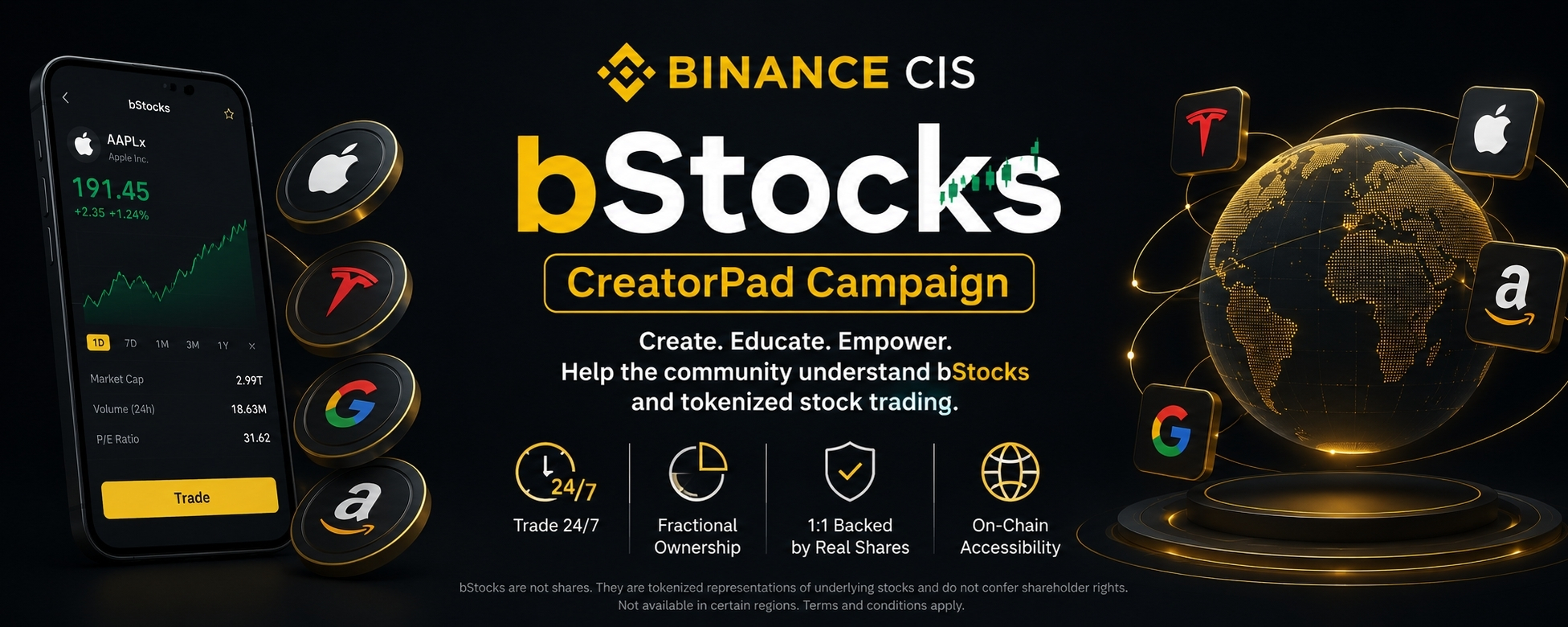
There is a detail about Binance bStocks that is easy to miss if you only look at the trading screen.
The token may look like another BEP-20 asset but the important question is not really what the token looks like. It is what sits behind it.
Binance’s current documentation says each bStock is backed 1:1 by the corresponding US share held with a regulated custodian. The bStock itself is issued by BTech Holdings Limited, a Binance group affiliate, and is structured as a Certificate representing certain Financial Instruments under the ADGM framework. That distinction matters because a bStock is not the same thing as directly owning the underlying company’s shares.
That changes how I would think about the product.
With a normal stock position the brokerage and traditional securities infrastructure sit between you and the market. With bStocks, the underlying share remains in regulated custody while the economic exposure is represented by a blockchain token. The blockchain therefore becomes part of the transfer and trading layer, rather than replacing the underlying regulated custody arrangement.
That is a much more interesting design than simply putting stocks on chain.
The 1:1 backing is also something users can independently pay attention to. Binance says the collateral backing can be checked through its Proof of Collateral page. In other words, the system is not based on the idea that a token should magically equal a stock because an oracle says so. The underlying share is part of the structure.
But there is an important trade-off here.
Holding a bStock does not give you the same legal position as holding the company’s ordinary shares directly. Binance explicitly states that bStocks provide exposure to the price performance and certain economic benefits of the underlying stock, but they do not represent direct ownership or shareholder voting rights. That is probably one of the first things anyone researching tokenized equities should understand before looking at the technical advantages.
Then the blockchain side starts making more sense.
bStocks are BEP-20 tokens on BNB Smart Chain. They can be traded on Binance Spot around the clock and can be withdrawn to compatible BNB Smart Chain wallets. Binance also says the tokens integrate with BEP-677 functionality intended to support real-world assets, which opens the door to potential DeFi usage such as lending or staking where supported.
So the real change is not necessarily the asset itself.
A share that previously lived inside traditional market infrastructure can now have a blockchain representation that is transferable through a public network and compatible with crypto-native infrastructure.
That creates some practical differences.
For example, Binance says bStocks generally settle in under a second and trade 24/7 on its Spot market. Fractional exposure can also start from as little as $5. Those features remove some of the traditional friction around market hours, settlement windows and minimum position sizes.
Corporate actions are another interesting piece.
Dividends are not simply sent to the holder as cash. Binance says the net dividend value is automatically reinvested into the underlying stock, with the bStock balance adjusted through an on-chain mechanism called the Multiplier. Stock splits are handled through the same mechanism by adjusting token balances to reflect the new share ratio. During certain corporate-action processes, conversions and transfers may temporarily pause.
That last part is worth noticing because it shows where the “on-chain” story has limits.
Blockchain settlement can be fast, but the token still depends on off-chain financial infrastructure. There is an issuer. There is regulated custody. There are conversion rules. There are corporate actions. There are jurisdictional restrictions.
So tokenization does not eliminate intermediaries.
It changes where and how those intermediaries interact with the asset.
There is also a technical limitation that I would not ignore. Binance currently states that bStock deposits and withdrawals use BNB Smart Chain, and transfers remain subject to smart-contract controls, transfer restrictions, sanctions screening and applicable law. Third-party DeFi integrations are also responsible for enforcing geographic restrictions.
That means “self-custody” should not be interpreted as “permissionless in every sense.”
You can hold the token in a compatible wallet, but the asset still operates inside a regulated securities framework with compliance controls.
For me, that is the part of bStocks worth researching more closely.
The interesting experiment is not whether a stock price can be represented by a token. That part is already straightforward.
The harder question is whether regulated custody, blockchain settlement, programmable token standards and compliance restrictions can coexist without making the system unnecessarily complicated.
If that balance works, tokenized equities become more than a different trading interface. They become a new settlement and distribution layer for traditional financial exposure.
And that is a much bigger idea than simply trading a stock after market hours.