
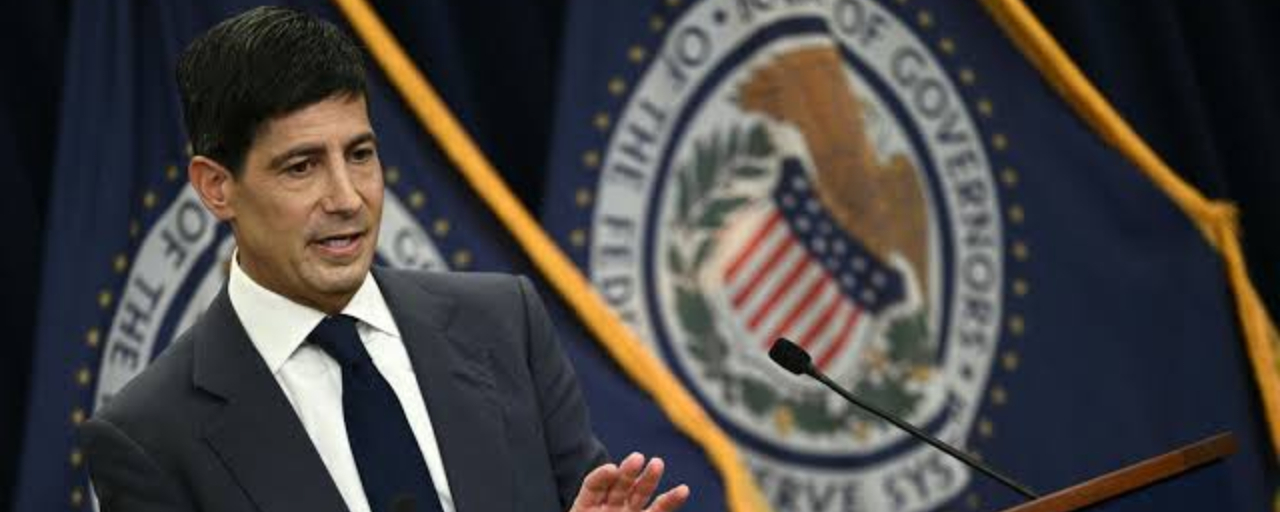
Chairman of the Federal Reserve Board of Governors Kevin Warsh, who holds a permanent voting seat on the Federal Open Market Committee (FOMC) in 2026, faced reporters after the FOMC voted 9-3 to hold rates at 3.50%-3.75%, with Beth Hammack, Neel Kashkari and Lorie Logan dissenting in favor of a 25-basis-point hike — a hawkish revolt rather than the usual dovish pushback.
Warsh made clear the hold was no retreat: "the decision today is the beginning of the story, not the end of it," he said, rejecting any framing of the move as a pause and warning that markets would take the other side of that bet. Rates, he noted bluntly, sit higher today than they did 42 days ago.
On inflation, Warsh pushed back on the idea that the Fed had gone soft on its target, dismissing what he called a "misimpression that we were more tolerant of a somewhat higher inflation target." He said the Committee is now looking beyond the headline PCE gauge, watching a broader set of inflation data even as PCE remains "our number, and we're sticking with it."
The June core CPI print, he added, barely moved the needle — what matters, he stressed, is the trend, not any single data point. That data dependence cuts both ways, he acknowledged: "the problem with data dependence is the data and the dependence," and he was careful not to leave the impression the Fed is "breathlessly waiting" on each new release.
Turning to markets, Warsh struck a watchful but non-reactive tone. He said the Fed "will not be constrained by market prices," even as he conceded that Treasury yields, the dollar and broader financial conditions have tightened and are "not saying all clear."
He read that same market signal as a vote of confidence in the Fed's credibility to deliver on its mandate. Despite the sharp three-way dissent, Warsh downplayed any sense of discord, calling the debate "collegial" and saying he'd asked for "a good family fight" — and gotten one. He closed by flagging Jackson Hole as the next marker to watch, though he said he has "not begun to consider" what the speech will cover.
Key Quotes:
Monetary Policy
Fed decision today is the beginning of the story, not the end of it.
If you were to describe this as a pause, financial markets would take the other side of that.
Rates are higher today than 42 days ago.
What we made today was the farthest thing from inertia that I can imagine; expect thinking in the months ahead to advance significantly.
In the period ahead, we have important decisions to make.
Who knows what we will say in January about strategy.
I don't believe our mandates are at war with each other.
We're doing pretty well as a country on full employment, doing considerably less well on prices.
Inflation
If inflation stays high, rates could be part of the solution.
I think there was a misimpression that we were more tolerant of a somewhat higher inflation target.
We got some encouraging inflation data, and we will be watching over the period ahead.
Core CPI print for June didn't influence the decision much — what matters is the trend.
To achieve 2% inflation, I am looking at a broader set of inflation data than just PCE.
PCE is our number, and we're sticking with it.
We are looking at the extent to which these shocks are broadening inflation.
A lot of our focus was on understanding underlying inflation dynamics amid shocks.
Shocks at this juncture make the job a little tougher.
Fed Transparency & Accountability
On forward guidance: surprise is not the objective function, and surprise is not what the Fed is solving for.
Between now and year-end, I am committing to press conferences this year.
I would like at Jackson Hole to frame the big questions.
Have not begun to consider what will go into the Jackson Hole speech.
Financial Conditions
Market prices are one of many ways policy affects the economy; we will continue to watch that market information.
Markets in the intervening period have a lot to decide.
Even if we haven't done much, markets have quite a bit.
We don't endorse any market move but watch them with keen interest.
I was comforted that markets were not responding to us, to dots, but to real-time events.
We are not going to be constrained by market prices.
If you look broadly at market prices, they are not saying all clear — they have tightened financial conditions.
If I look at the Treasury curve, the dollar, what they are broadly saying is the FOMC does own it, has the credibility to deliver.
Markets can be a very good source of information; not a definitive source.
Fed Leadership
On dissenting votes within the FOMC: I asked for a good family fight and got one.
Discussion was collegial.
I will let dissenters speak for themselves.
There was a lot of agreement that I heard that we have the power to deliver stable prices.
Discussion showed a lot of agreement on hard questions.
It was an active, robust discussion.
Fed Process / Data Dependence
Problem with data dependence is the data and the dependence.
Don't want to leave the impression we are breathlessly waiting for incoming data.
It is not a perfect science, but we have a data project to separate noise from signal.
We have a reasonable sense of demand, inferring supply.
Just trying to make sure that the source of information is as direct and unfiltered as possible.
Will check in with inflation task force in a couple of weeks.
I selected 15 subject matter experts to tackle 5 questions; we are the decision makers.
On the Ground / Real Economy Feedback
I hear impatience from households and businesses; we are focused like a laser on delivering.
In terms of the reaction function, any central banker, when he sees stable employment and underlying inflation moving higher, is more inclined to tighten policy