
I’ve seen staking used as a security argument so many times that I barely react to it anymore.
A protocol says operators lock tokens, bad actors get slashed, and everyone is supposed to feel safer.
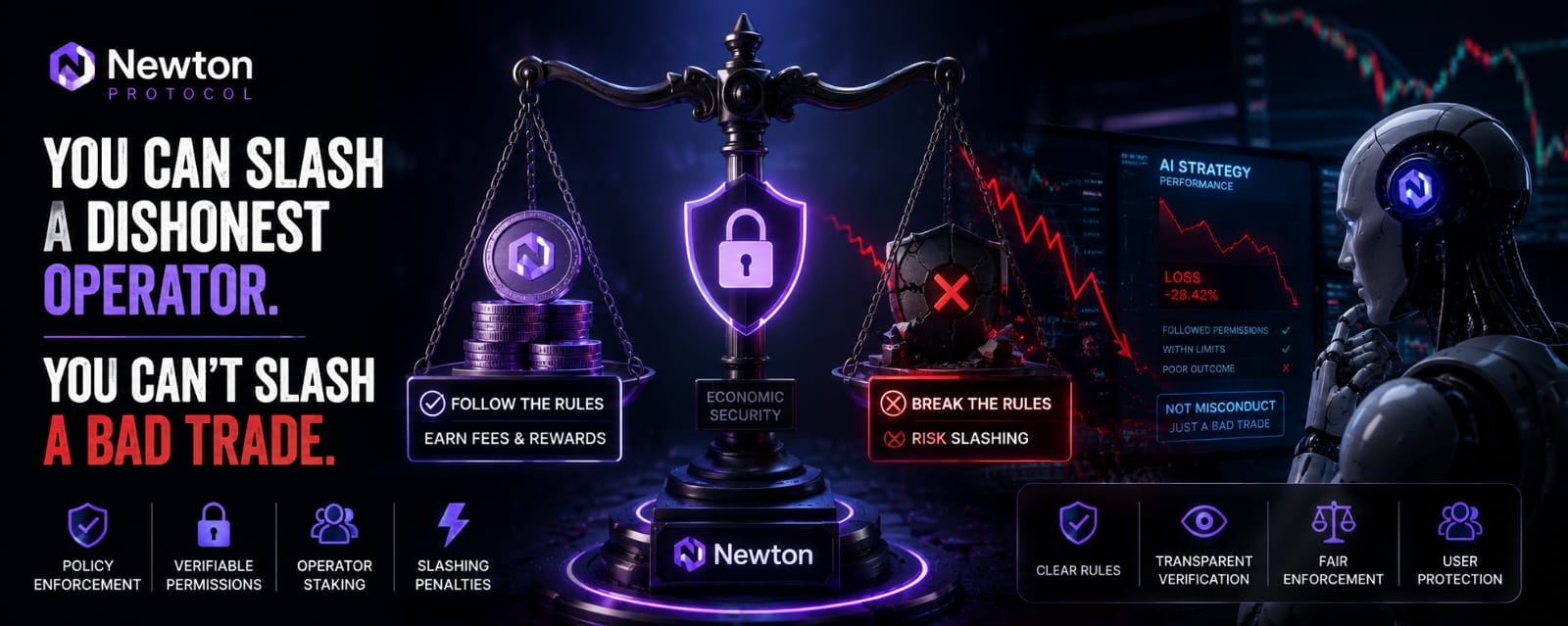
But the part I keep coming back to with Newton is much simpler: what exactly are we punishing?
That matters because Newton sits in an awkward place between infrastructure and decision-making. It wants to help AI agents execute strategies, move assets and act on behalf of users. Once money starts moving automatically, it becomes tempting to treat every bad outcome as some kind of failure that collateral can fix.
I don’t think it works that way.
A trading agent can follow every rule and still lose money. It can use the correct exchange, stay within the spending limit, trade only approved assets and still get the market completely wrong.
That is not necessarily misconduct.
Sometimes a strategy is just bad.
Sometimes liquidity disappears.
Sometimes the market moves faster than the model.
You cannot fairly slash an operator for that.
Where Newton becomes more interesting is when the failure is not about performance, but permission.
Was the agent allowed to make that trade?
Did it exceed the user’s limit?
Did it use an approved venue?
Did it act after the permission expired?
Those are questions a system can actually verify.
That is the real line Newton has to defend.
The value of its staking model is not that it can punish an AI for making a poor decision. It is that it may be able to punish operators who approve actions that clearly break the rules.
That sounds like a small distinction, but it changes the entire game theory.
An operator behaves honestly when cheating is more expensive than the reward.
That means the stake has to be large enough, the chance of detection has to be high enough, and the punishment has to happen quickly enough.
If an operator can make $100,000 from approving a malicious transaction but only expects to lose $20,000 if caught, the system is not secure. It is just offering a price for dishonesty.
This is why I pay more attention to detection than headline staking numbers.
Protocols love showing how much value is locked. What matters is how much of that value can actually be taken away, and whether the violation can be proved without argument.
Newton seems to understand this better than most.
Its policy checks are designed around clear rules. If a transaction exceeds a limit or breaks a defined condition, operators are not being asked for an opinion. They are being asked to evaluate the same instruction against the same policy.
That is much easier to enforce than asking whether an AI acted intelligently.
“Was this a good trade?” is subjective.
“Was this wallet allowed to transfer 50,000 USDC?” is not.
The first belongs to strategy.
The second belongs to security.
There is still a part of the model I’m watching carefully.
Newton talks about NEWT being used for operator participation, delegation and economic incentives, while parts of the technical architecture also point toward ETH or liquid staking tokens as slashable collateral.
I’m not sure yet how that balance will work in practice.
If NEWT carries most of the security burden, then the cost of attacking the system depends heavily on the token price. A falling token price can quietly make the network cheaper to corrupt.
If ETH or liquid staking tokens provide the real economic backing, then Newton may be less exposed to its own market cycle.
That could be a smarter design, but users need to know which asset is actually standing behind the promise.
“Operators stake tokens” sounds reassuring.
It does not mean much unless the collateral is large enough to cover the damage those operators could cause.
There is also a problem most staking models avoid discussing: slashing punishes the operator, but it does not automatically repay the user.
Imagine an operator approves a transaction that breaks a user’s policy. The user loses $500,000. The operator gets slashed for $100,000.
The protocol may say the system worked.
The user probably will not agree.
Punishment is not the same as protection.
A serious version of Newton may eventually need collateral requirements tied to the amount of value an agent can control. A strategy moving $10,000 should not be treated the same as one managing $10 million.
Higher exposure should mean tighter limits, larger bonds or some form of insurance.
Otherwise the system may punish bad behavior after the damage is already done.
I also think people focus too much on deliberate collusion.
The more realistic risk may be operators being wrong together.
Different operators can still depend on the same cloud provider, the same price feed, the same policy software or the same data source. They can all return the same bad answer without coordinating at all.
That is not collusion.
It is shared failure.
A majority vote does not help if the majority is reading the same broken input.
This is why operator diversity has to mean more than different wallet addresses. It should mean different infrastructure, different implementations and different failure points.
Otherwise the network may look decentralized while behaving like one machine.
The part of Newton that feels most credible to me is not the AI-trading angle.
I’ve seen enough projects promise smarter agents and better strategies. Most of that ends up sounding the same.
The stronger idea is much more practical: let an agent do something useful without giving it full control.
A user should be able to say:
Trade only these assets.
Use only these venues.
Never spend more than this amount.
Stop after this date.
Do not send funds anywhere else.
Then Newton’s job is not to decide whether the strategy is clever.
Its job is to make sure the agent stays inside those boundaries.
That is a much more believable role.
So I would not judge Newton by whether its agents make money.
I would judge it by whether an operator has more to lose from breaking a user’s rules than it could ever gain by ignoring them.
You can punish dishonesty.
You cannot punish the market for moving against you.