
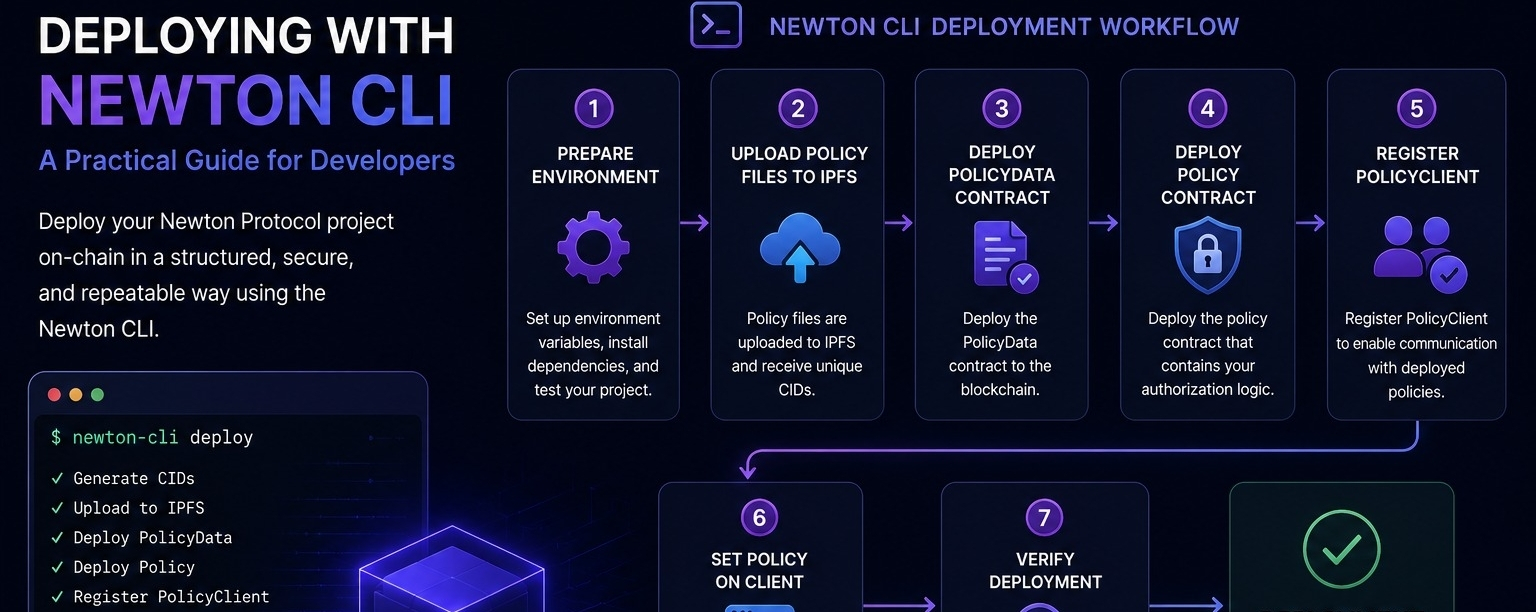
As I continued exploring the Newton Mainnet Beta developer documentation, I reached one of the most practical sections for builders: "Deploying with the Newton CLI". While many blockchain platforms provide graphical interfaces for deployment, Newton also offers a command-line workflow that gives developers greater flexibility and control over the deployment process.
For anyone building decentralized applications, deployment is one of the most important stages of development. Writing policies and data oracles is only part of the journey—the application must also be published, registered, and connected correctly before it can operate on-chain. The Newton CLI brings these steps together into a structured workflow that developers can follow with confidence.
Why Use the Newton CLI?
Command-line tools remain a favorite choice for many software developers because they provide speed, automation, and consistency. Instead of manually configuring every deployment through a web interface, the Newton CLI allows projects to be deployed using repeatable commands.
This is especially useful for teams working on larger applications or managing multiple environments. Developers can include deployment commands in scripts, automate updates, and integrate the entire workflow into continuous integration pipelines.
Rather than replacing the dashboard, the CLI provides another option for developers who prefer working directly from their development environment.
Preparing Before Deployment
Before deployment begins, the documentation recommends completing a few preparation steps.
The necessary environment variables should already be configured, required tools installed, and the project should be fully tested. Having everything prepared before deployment reduces the chance of unexpected errors later in the process.
This preparation stage may seem simple, but it plays an important role in ensuring that every deployment proceeds smoothly.
Publishing Policy Files to IPFS
One interesting aspect of Newton's deployment process is its use of 'IPFS'.
Instead of storing policy files directly on-chain, the CLI first uploads them to the InterPlanetary File System, where they receive unique Content Identifiers (CIDs). These identifiers allow the blockchain to reference policy files efficiently without storing large amounts of data directly on-chain.
Using IPFS helps improve scalability while keeping deployed resources verifiable and accessible.
This combination of decentralized storage and blockchain registration creates a balanced deployment model.
Deploying Core Components
Once the policy files are available through IPFS, the CLI continues by deploying the required blockchain components.
The documentation explains that developers deploy their PolicyData contracts first, followed by the policy contract itself. Afterward, the application's smart contract can be connected to the deployed policy infrastructure through PolicyClient registration.
Although several individual steps are involved, the documentation presents them in a logical sequence that makes the overall deployment process easier to understand.
Breaking deployment into smaller stages also makes troubleshooting much simpler if an issue occurs.
Registering the Policy Client
Another important step involves registering the PolicyClient.
This connection allows smart contracts to communicate with deployed policies during transaction execution. Without this registration, policies would exist on-chain but would not actively protect application logic.
The registration process ensures that policy evaluation becomes part of the application's authorization workflow, allowing transactions to be checked before execution.
This integration highlights how Newton treats policies as an active security layer rather than passive configuration files.
Verification After Deployment
Deployment does not end once contracts are published.
The documentation also recommends verifying the deployment to confirm that every component has been registered correctly. Policy parameters, deployed contracts, and client connections should all be reviewed before an application moves into production.
Taking time to verify deployments helps developers identify configuration mistakes early while increasing confidence in the final system.
Verification is often one of the most overlooked stages of blockchain development, yet it plays a major role in maintaining application reliability.
A Structured Workflow for Modern Development
One of the strongest impressions I gained from this section is how organized the deployment workflow feels.
Rather than expecting developers to manually connect dozens of independent components, Newton provides a clearly documented sequence that guides users from preparation through verification.
Whether someone is deploying a small demonstration project or preparing a larger production system, the CLI offers a repeatable process that encourages consistency and good development practices.
Final Thoughts
Deploying blockchain infrastructure can often feel intimidating, particularly when multiple smart contracts, policies, and external resources must work together. Newton Protocol reduces much of that complexity by providing a dedicated command-line tool that organizes deployment into clear, manageable steps.
From preparing the environment and uploading policy files to IPFS, to deploying contracts, registering PolicyClients, and verifying the final configuration, the Newton CLI supports a structured deployment experience designed for real-world applications.
For developers interested in understanding how policy-driven blockchain infrastructure is deployed, the documentation published by @NewtonProtocol provides an excellent overview of how the Newton Mainnet Beta manages secure and organized deployments. As the ecosystem continues to grow, tools like the Newton CLI will likely become an important part of efficient decentralized application development. $NEWT #Newt