What stopped me mid-task wasn't the automation pitch itself. It was one sentence buried in @OpenGradient x402 blog: "AI agents that autonomously spin up compute, pay per inference, verify their own outputs, and interact with each other — all without human-in-the-loop payment flows — aren't science fiction." Written in February 2026. By June, AWS had built exactly that with Bedrock AgentCore Payments. $OPG #OPG
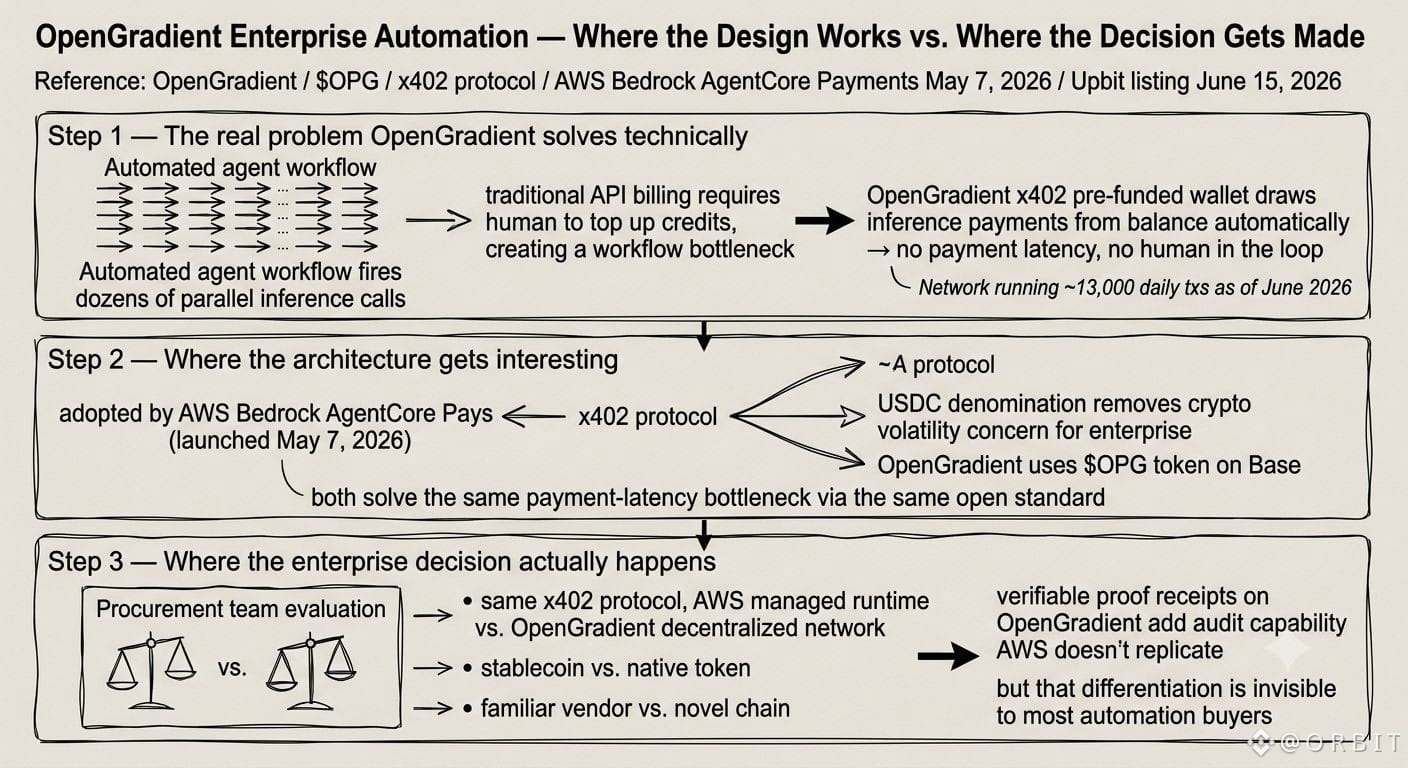
Here's the thing. OpenGradient's x402 implementation pre-funds a wallet so an agent can fire dozens of parallel inference calls without any payment latency blocking compute. That's a real operational design choice — not a whitepaper promise. And the problem it solves for enterprise automation is legitimate: most automated workflows still bottleneck at billing. An agent that needs to pay for inference mid-workflow currently stalls unless a human topped up the API credits. The pre-funded draw mechanism removes that stall. The network's running ~13,000 daily transactions with 197M $OPG now circulating post-Upbit listing on June 15, and the baseline activity underneath all that listing noise is genuinely steady.
I spent time cross-referencing this against how AWS is positioning AgentCore Payments, which launched May 7 and does the same x402 pattern with USDC, not OPG. Same protocol, different token. Enterprise teams will gravitate to whichever rail causes less friction in procurement.
…which raises the uncomfortable question for OpenGradient: if x402 is the standard and AWS implements it first with a stablecoin, what exactly does the $OPG payment rail add that tips the enterprise decision?
Here's the thing. OpenGradient's x402 implementation pre-funds a wallet so an agent can fire dozens of parallel inference calls without any payment latency blocking compute. That's a real operational design choice — not a whitepaper promise. And the problem it solves for enterprise automation is legitimate: most automated workflows still bottleneck at billing. An agent that needs to pay for inference mid-workflow currently stalls unless a human topped up the API credits. The pre-funded draw mechanism removes that stall. The network's running ~13,000 daily transactions with 197M $OPG now circulating post-Upbit listing on June 15, and the baseline activity underneath all that listing noise is genuinely steady.
I spent time cross-referencing this against how AWS is positioning AgentCore Payments, which launched May 7 and does the same x402 pattern with USDC, not OPG. Same protocol, different token. Enterprise teams will gravitate to whichever rail causes less friction in procurement.
…which raises the uncomfortable question for OpenGradient: if x402 is the standard and AWS implements it first with a stablecoin, what exactly does the $OPG payment rail add that tips the enterprise decision?