
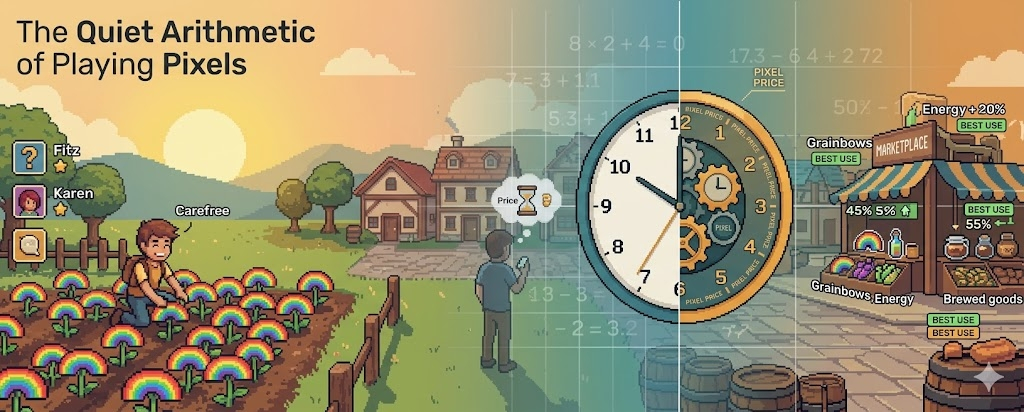
The Quiet Arithmetic of Playing Pixels
I thought the tokens were the point.That's where I started assuming that $PIXEL and BERRY were the thing the whole system was built around. Rewards you collect, values you watch, numbers that go up when you do the right things. I'd seen enough crypto projects to recognize the shape of it. Token goes in, token comes out. The game is just the container.
I was wrong about that. Not entirely but wrong enough that it took me a while to understand what I was actually experiencing.
The first few sessions in Pixels felt uncomplicated. I planted Grainbows. I harvested them. I spent Energy, earned BERRY, completed a quest chain that sent me from Fitz to Karen and back again. The loop was clear. The feedback was immediate. I logged off feeling like I understood the game.
What I didn't notice, at first, was that I was starting to remember things.
Not in the way you remember instructions. More in the way you remember prices the way you walk past a petrol station and know, without thinking, whether the number on the sign is high or low. Some baseline had formed without my permission. Twenty Energy for thirty Grainbows felt like a certain kind of exchange. The Winery on my friend's NFT Farm Land returned a certain kind of output. A marketplace trade that looked attractive started to feel, inexplicably, slightly off.
I hadn't built a spreadsheet. I hadn't taken notes. I'd just played and the system had quietly installed a sense of value inside me that I hadn't asked for.
After a while I started to wonder where it came from.
The closest parallel I can find isn't from gaming. It's from something much more mundane the way hourly billing changes how consultants experience their own time. There's a well-documented phenomenon where people who bill by the hour start converting everything into its equivalent cost. A lunch that runs long. A phone call that meanders. A meeting that could have been shorter. The billing structure doesn't just measure time. It reframes it. Makes it visible in a way that's impossible to unsee once you've seen it.
$PIXEL does something quieter but structurally similar inside Pixels.
It doesn't force you to optimize. Nothing in the game demands that you approach it like a resource allocation problem. You can wander. You can spend an afternoon exploring corners of Terravilla that yield nothing measurable. The game will let you do that without complaint. But the moment you've made enough transactions harvested enough crops, brewed enough goods, traded enough BERRY the token layer has already done its work. It has made your time legible to you. Priced it, faintly, in a currency you now recognize.
And once your time has a price, even an approximate one, every decision carries a shadow.
What stood out to me, gradually, was how different activities began to feel interchangeable in a way they clearly weren't designed to be. Farming and brewing and crafting are distinct skills with distinct requirements and distinct rhythms. But they're all denominated in the same units. Which means the system is always, somewhere in the background, running a quiet comparison. Always leaving space for the question: was that the best use of what I had?
It isn't pressure exactly. Nothing so blunt. It's more like a suggestion the environment keeps making the way a well-designed office makes you want to sit up straighter, not because anyone told you to, but because something about the space implies a standard.
The tension I keep sitting with is between what Pixels says it is and what it actually trains you to become. It says: explore freely, build at your own pace, contribute to the ecosystem in whatever way feels right. And I believe that. The freedom is genuine. Nobody in Terravilla is watching your Energy efficiency. No leaderboard is judging your BERRY-per-hour.
But the infrastructure of the game the way NFT Farm Lands create dependency, the way $PIXEL denominates contribution, the way the marketplace makes every resource comparable to every other resource that infrastructure has a logic. And if you spend enough time inside it, the logic starts to feel like your own thinking.
I noticed this most clearly on a day when I chose not to optimize.
I spent an hour doing something inefficient wandering, mostly, talking to NPCs I'd already met, watching other players move through spaces I'd already mapped. By every internal measure I'd developed, it was a low-yield session. I knew that. And the knowing sat there, quiet and uninvited, throughout the whole afternoon.
I hadn't felt that in the first session. The system had installed something in the intervening days. Not a rule. Not an obligation. Just a perspective I could no longer fully take off.
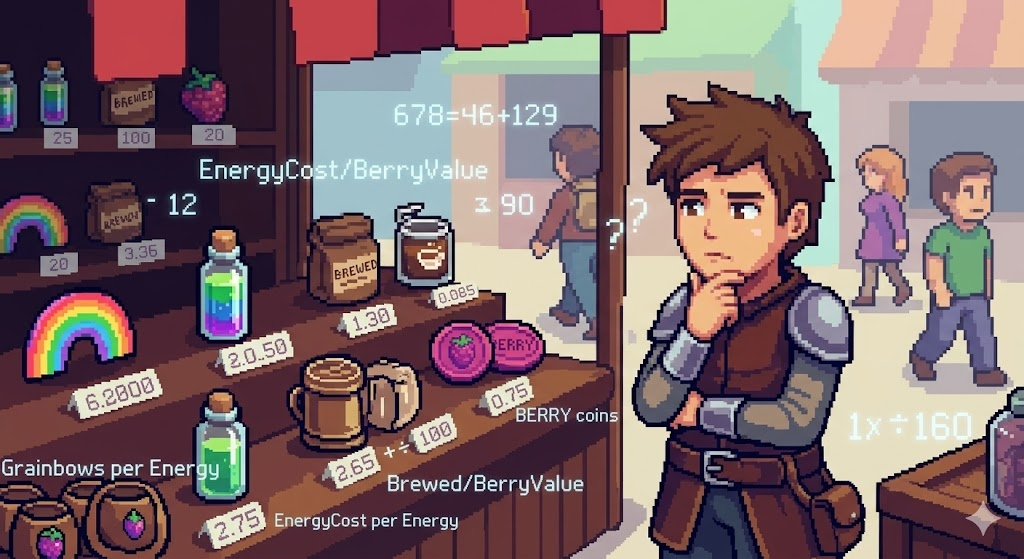
Maybe that's what a well-designed economy actually is not a set of incentives, but a way of seeing. A lens that, once adopted, makes certain things visible that you can't quite make invisible again.
I'm not sure yet whether that's the game working as intended, or something that just happens when tokens meet time.
What I keep coming back to is a simpler question one I didn't think to ask when I started: at what point does a way of playing become a way of thinking?
