
#bn2049
bn2049
27 lượt xem
8 đang thảo luận
Phổ biến
Mới nhất
·
--
Xem bản dịch
注册币安用了推荐码,手续费有折扣。虽然每笔省的不多,但如果经常交易,积累起来也是一笔钱。注册的时候记得用推荐码,这是免费的优惠不用白不用。
(我用的邀请码是BN2049,注册时填一下能返点手续费)
注册:https://www.binance.com/register?ref=BN2049
#币安 #BN2049
注册币安用了推荐码,手续费有折扣。虽然每笔省的不多,但如果经常交易,积累起来也是一笔钱。注册的时候记得用推荐码,这是免费的优惠不用白不用。
(我用的邀请码是BN2049,注册时填一下能返点手续费)
注册:https://www.binance.com/register?ref=BN2049
#币安 #BN2049
(我用的邀请码是BN2049,注册时填一下能返点手续费)
注册:https://www.binance.com/register?ref=BN2049
#币安 #BN2049
77
·
--
Bài viết
Xem bản dịch
Bitcoin Accumulation Strategy: Building a Position SlowlyA bitcoin accumulation strategy is a set of rules for building a BTC position over months or years instead of buying it all at once. The rules decide three things in advance: how much you buy, when you buy, and what makes you stop. I have run one for three years now, and the honest lesson is that the specific method matters far less than whether it survives the week the price drops 30% and everything on your feed says it is over.
This is a practical guide to how accumulation actually works, three methods that hold up in real use, and the mistakes that quietly destroy otherwise reasonable plans.
## What a bitcoin accumulation strategy actually means
Accumulation is the opposite of trading. A trader wants to be right about direction over days or weeks. An accumulator has already decided the direction over years, and is only optimising the process of getting there.
That difference changes what counts as success. If you are accumulating, a falling price is not a problem to solve. It is the mechanism by which you acquire more units for the same money. If a 40% drawdown makes you feel like your plan failed, you were not accumulating — you were trading with a longer time frame and a nicer name for it.
The arithmetic that makes accumulation work is unremarkable. A 50% loss needs a 100% gain to break even. An 80% loss needs 400%. Bitcoin has had several drawdowns beyond 70% since 2011. Any plan that ignores that history will meet it eventually.
## How does bitcoin accumulation work in practice
Three steps, in this order. The order is the part people get wrong.
**Step one: decide the total budget and the time frame.** Not "I want a lot of bitcoin" but "I intend to deploy this amount over the next 24 months." A budget without an end date turns into improvisation, and improvisation during volatility is where the losses come from.
**Step two: split the budget into fixed instalments.** Weekly or monthly. The instalment must be small enough that missing a good entry price does not tempt you into doubling it. If a single purchase feels significant, it is too large.
**Step three: automate the execution.** On Binance, recurring buys can be scheduled so the order fires without you opening the app. This sounds like a convenience feature. It is not — it is the whole strategy. A plan you must manually execute during a crash is a plan you will abandon during a crash. I have abandoned two.
Fund the account with a stablecoin such as USDT or with fiat via bank transfer, whichever is cheaper in your region. Card purchases carry noticeably higher fees, and over 24 monthly instalments that difference compounds into a real number.
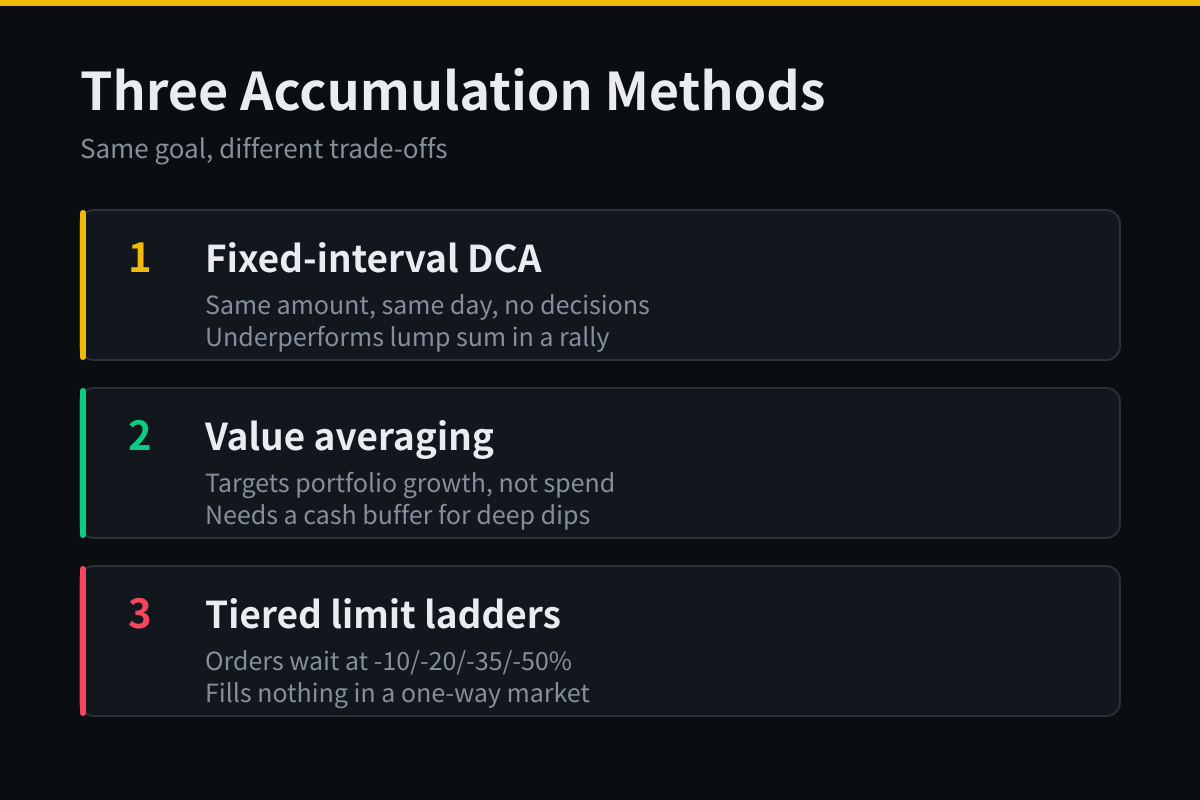
## Method 1: Fixed-interval DCA
Buy the same amount on the same day every week or month, regardless of price.
**Strength:** zero decisions. Nothing to get wrong, nothing to second-guess, nothing to renegotiate at 3am. You automatically acquire more units when prices fall and fewer when they rise.
**Weakness:** in a sustained rally you underperform a lump sum bought at the start. You are trading upside for a narrower range of outcomes.
**Who it suits:** anyone with regular income and no strong short-term view. This is the default, and the default is correct for most people.
## Method 2: Value averaging
Instead of a fixed spend, you target a fixed growth in portfolio value. If you want the position to grow by 500 units of value per month and the market rose so it already grew by 300, you buy 200. If the price fell and the position lost 200, you buy 700.
**Strength:** mechanically buys more into weakness than fixed DCA does, without requiring any prediction.
**Weakness:** the required purchase during a deep drawdown can spike well beyond your normal instalment. Without a cash reserve set aside in advance, the method breaks exactly when it is supposed to work. Cap each purchase at something like three times the base instalment.
**Who it suits:** people who already hold a cash buffer and can handle a spreadsheet each month.
## Method 3: Tiered limit ladders
Place standing limit orders below the current price at intervals — say 10%, 20%, 35% and 50% down — sized progressively larger as they go deeper. When volatility arrives, they fill without you being awake.
**Strength:** you accumulate at prices you consciously chose while calm, not prices you rationalised while panicking.
**Weakness:** in a market that only goes up, nothing fills and you accumulate nothing. Pair this with a smaller baseline DCA so the ladder is a supplement, not the entire plan.
**Who it suits:** people who have already sat through one full cycle and know how they behave.
## Is a bitcoin accumulation strategy safe
Safe is the wrong frame. Bitcoin's volatility does not disappear because you bought it slowly. What accumulation reduces is the risk of catastrophic timing — putting everything in at a local peak — and the risk of your own behaviour. Those are the two risks you actually control.
Everything else needs handling separately:
**Position size.** The workable test is whether a 70% drawdown would force you to sell. If it would, the position is too big, and no accumulation schedule fixes that.
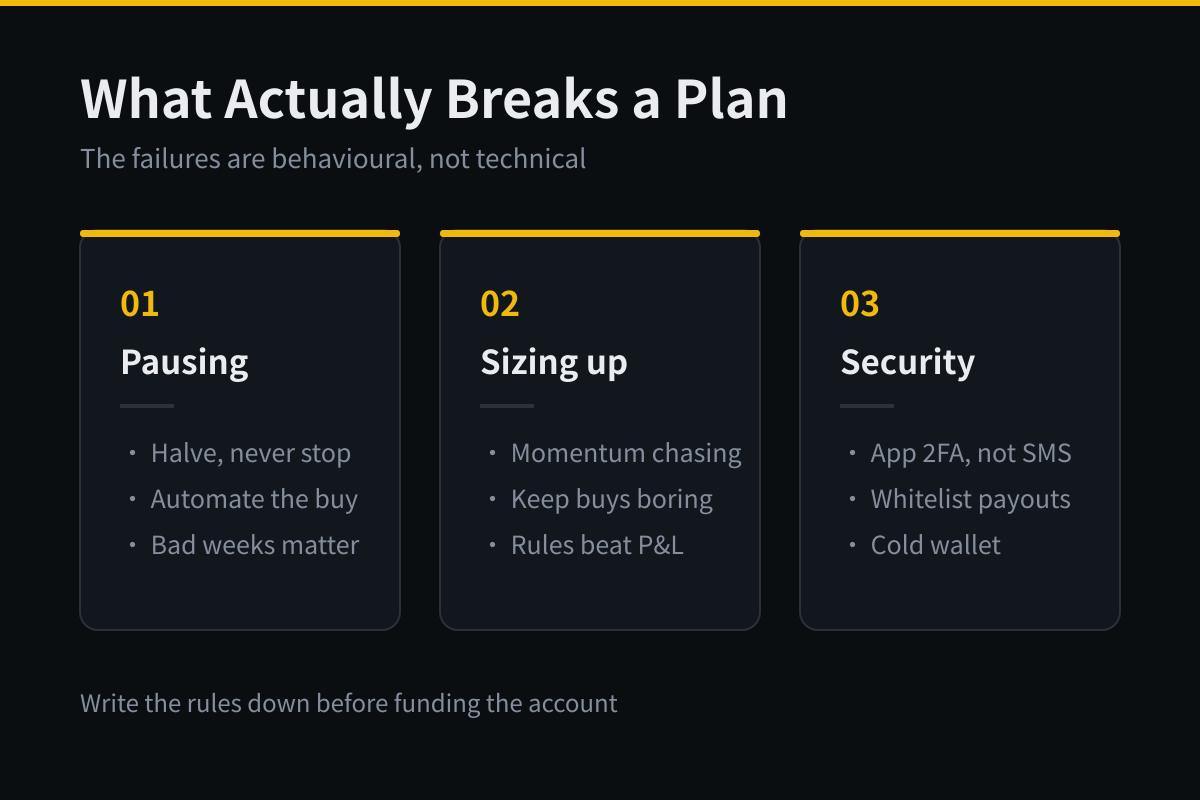
**Account security.** Use an authenticator app for two-factor authentication, not SMS. SIM swap attacks are routine and SMS-based codes do not survive one. Enable a withdrawal address whitelist — clipboard-hijacking malware swaps the destination address at the moment you paste, and attackers generate addresses whose first and last characters match yours. On-chain transfers are irreversible.
**Custody.** Once the position becomes material to you, move a portion to a hardware wallet such as Ledger or Trezor. Write the seed phrase on paper, never in a photo, never in a password manager, never in a cloud note. Test the recovery with a small amount before you trust it with the rest.
## The mistakes that actually cost money
**Pausing the schedule during a crash.** This is the single most common failure. The whole point of the plan is to keep buying when it feels worst. If you cannot, halve the instalment instead of stopping — a smaller position you maintain beats a larger one you abandon.
**Sizing up after a good run.** Three green months make people triple their instalment. That is not accumulation, that is momentum chasing with extra steps.
**Diversifying into forty tokens.** Adding ETH or a couple of large-cap alts is a reasonable choice. Spreading across dozens of small tokens is not diversification, it is dilution, and most of those positions will not survive a full cycle.
**Leaving everything on an exchange indefinitely.** Convenient for accumulation, less suitable as permanent storage for a position you intend to hold for years.
**Not writing the rules down.** A plan kept in your head is a plan you will renegotiate at exactly the wrong moment. Mine lives in a text file with the date I wrote it.
## FAQ
**How long should a bitcoin accumulation strategy run?**
Long enough to cover a full market cycle, historically around four years, anchored loosely to the halving schedule. Twelve to twenty-four months is a reasonable first commitment. Anything under six months is closer to timing than accumulating.
**Weekly or monthly instalments?**
The difference in outcome is small. Weekly smooths volatility slightly better; monthly is easier to align with a salary and creates fewer small transactions to track. Pick whichever you will not skip.
**Should I stop accumulating when the price is high?**
Only if you defined "high" in writing before you started. Deciding mid-cycle that the price is too high is prediction, and it is usually made after a rally has already run. If you want a rule, use rebalancing: trim back to your target allocation when it drifts past a set threshold.
**Is it better to accumulate bitcoin or ethereum?**
Different risk profiles. BTC has a longer track record and a simpler thesis; ETH carries additional protocol and execution risk in exchange for a broader use case. A split of both is defensible. What is not defensible is picking based on which chart looked better last month.
**What do I do with the coins once accumulated?**
Decide the exit rules the same way you decided the entry rules — in advance and in writing. Rebalancing is the most mechanical option because it takes profit automatically when the ratio drifts, removing the judgement call entirely.
## Bottom line
A bitcoin accumulation strategy is not clever. It is a schedule, a position size you can survive, and enough automation that your future self cannot interfere. The methods above differ in the details, but they all fail the same way — by being abandoned during the drawdown they were designed to handle.
Write the rules down, set the instalment small enough to be boring, secure the account before you fund it, and then do the genuinely difficult part, which is nothing at all.
注册(邀请码 BN2049,手续费永久返佣):https://www.binance.com/register?ref=BN2049
#Binance #BN2049 #Bitcoin $BTC #DCA
Bitcoin Accumulation Strategy: Building a Position Slowly
A bitcoin accumulation strategy is a set of rules for building a BTC position over months or years instead of buying it all at once. The rules decide three things in advance: how much you buy, when you buy, and what makes you stop. I have run one for three years now, and the honest lesson is that the specific method matters far less than whether it survives the week the price drops 30% and everything on your feed says it is over.
This is a practical guide to how accumulation actually works, three methods that hold up in real use, and the mistakes that quietly destroy otherwise reasonable plans.
## What a bitcoin accumulation strategy actually means
Accumulation is the opposite of trading. A trader wants to be right about direction over days or weeks. An accumulator has already decided the direction over years, and is only optimising the process of getting there.
That difference changes what counts as success. If you are accumulating, a falling price is not a problem to solve. It is the mechanism by which you acquire more units for the same money. If a 40% drawdown makes you feel like your plan failed, you were not accumulating — you were trading with a longer time frame and a nicer name for it.
The arithmetic that makes accumulation work is unremarkable. A 50% loss needs a 100% gain to break even. An 80% loss needs 400%. Bitcoin has had several drawdowns beyond 70% since 2011. Any plan that ignores that history will meet it eventually.
## How does bitcoin accumulation work in practice
Three steps, in this order. The order is the part people get wrong.
**Step one: decide the total budget and the time frame.** Not "I want a lot of bitcoin" but "I intend to deploy this amount over the next 24 months." A budget without an end date turns into improvisation, and improvisation during volatility is where the losses come from.
**Step two: split the budget into fixed instalments.** Weekly or monthly. The instalment must be small enough that missing a good entry price does not tempt you into doubling it. If a single purchase feels significant, it is too large.
**Step three: automate the execution.** On Binance, recurring buys can be scheduled so the order fires without you opening the app. This sounds like a convenience feature. It is not — it is the whole strategy. A plan you must manually execute during a crash is a plan you will abandon during a crash. I have abandoned two.
Fund the account with a stablecoin such as USDT or with fiat via bank transfer, whichever is cheaper in your region. Card purchases carry noticeably higher fees, and over 24 monthly instalments that difference compounds into a real number.

## Method 1: Fixed-interval DCA
Buy the same amount on the same day every week or month, regardless of price.
**Strength:** zero decisions. Nothing to get wrong, nothing to second-guess, nothing to renegotiate at 3am. You automatically acquire more units when prices fall and fewer when they rise.
**Weakness:** in a sustained rally you underperform a lump sum bought at the start. You are trading upside for a narrower range of outcomes.
**Who it suits:** anyone with regular income and no strong short-term view. This is the default, and the default is correct for most people.
## Method 2: Value averaging
Instead of a fixed spend, you target a fixed growth in portfolio value. If you want the position to grow by 500 units of value per month and the market rose so it already grew by 300, you buy 200. If the price fell and the position lost 200, you buy 700.
**Strength:** mechanically buys more into weakness than fixed DCA does, without requiring any prediction.
**Weakness:** the required purchase during a deep drawdown can spike well beyond your normal instalment. Without a cash reserve set aside in advance, the method breaks exactly when it is supposed to work. Cap each purchase at something like three times the base instalment.
**Who it suits:** people who already hold a cash buffer and can handle a spreadsheet each month.
## Method 3: Tiered limit ladders
Place standing limit orders below the current price at intervals — say 10%, 20%, 35% and 50% down — sized progressively larger as they go deeper. When volatility arrives, they fill without you being awake.
**Strength:** you accumulate at prices you consciously chose while calm, not prices you rationalised while panicking.
**Weakness:** in a market that only goes up, nothing fills and you accumulate nothing. Pair this with a smaller baseline DCA so the ladder is a supplement, not the entire plan.
**Who it suits:** people who have already sat through one full cycle and know how they behave.
## Is a bitcoin accumulation strategy safe
Safe is the wrong frame. Bitcoin's volatility does not disappear because you bought it slowly. What accumulation reduces is the risk of catastrophic timing — putting everything in at a local peak — and the risk of your own behaviour. Those are the two risks you actually control.
Everything else needs handling separately:
**Position size.** The workable test is whether a 70% drawdown would force you to sell. If it would, the position is too big, and no accumulation schedule fixes that.
**Account security.** Use an authenticator app for two-factor authentication, not SMS. SIM swap attacks are routine and SMS-based codes do not survive one. Enable a withdrawal address whitelist — clipboard-hijacking malware swaps the destination address at the moment you paste, and attackers generate addresses whose first and last characters match yours. On-chain transfers are irreversible.
**Custody.** Once the position becomes material to you, move a portion to a hardware wallet such as Ledger or Trezor. Write the seed phrase on paper, never in a photo, never in a password manager, never in a cloud note. Test the recovery with a small amount before you trust it with the rest.

## The mistakes that actually cost money
**Pausing the schedule during a crash.** This is the single most common failure. The whole point of the plan is to keep buying when it feels worst. If you cannot, halve the instalment instead of stopping — a smaller position you maintain beats a larger one you abandon.
**Sizing up after a good run.** Three green months make people triple their instalment. That is not accumulation, that is momentum chasing with extra steps.
**Diversifying into forty tokens.** Adding ETH or a couple of large-cap alts is a reasonable choice. Spreading across dozens of small tokens is not diversification, it is dilution, and most of those positions will not survive a full cycle.
**Leaving everything on an exchange indefinitely.** Convenient for accumulation, less suitable as permanent storage for a position you intend to hold for years.
**Not writing the rules down.** A plan kept in your head is a plan you will renegotiate at exactly the wrong moment. Mine lives in a text file with the date I wrote it.
## FAQ
**How long should a bitcoin accumulation strategy run?**
Long enough to cover a full market cycle, historically around four years, anchored loosely to the halving schedule. Twelve to twenty-four months is a reasonable first commitment. Anything under six months is closer to timing than accumulating.
**Weekly or monthly instalments?**
The difference in outcome is small. Weekly smooths volatility slightly better; monthly is easier to align with a salary and creates fewer small transactions to track. Pick whichever you will not skip.
**Should I stop accumulating when the price is high?**
Only if you defined "high" in writing before you started. Deciding mid-cycle that the price is too high is prediction, and it is usually made after a rally has already run. If you want a rule, use rebalancing: trim back to your target allocation when it drifts past a set threshold.
**Is it better to accumulate bitcoin or ethereum?**
Different risk profiles. BTC has a longer track record and a simpler thesis; ETH carries additional protocol and execution risk in exchange for a broader use case. A split of both is defensible. What is not defensible is picking based on which chart looked better last month.
**What do I do with the coins once accumulated?**
Decide the exit rules the same way you decided the entry rules — in advance and in writing. Rebalancing is the most mechanical option because it takes profit automatically when the ratio drifts, removing the judgement call entirely.
## Bottom line
A bitcoin accumulation strategy is not clever. It is a schedule, a position size you can survive, and enough automation that your future self cannot interfere. The methods above differ in the details, but they all fail the same way — by being abandoned during the drawdown they were designed to handle.
Write the rules down, set the instalment small enough to be boring, secure the account before you fund it, and then do the genuinely difficult part, which is nothing at all.
注册(邀请码 BN2049,手续费永久返佣):https://www.binance.com/register?ref=BN2049
#Binance #BN2049 #Bitcoin $BTC #DCA
This is a practical guide to how accumulation actually works, three methods that hold up in real use, and the mistakes that quietly destroy otherwise reasonable plans.
## What a bitcoin accumulation strategy actually means
Accumulation is the opposite of trading. A trader wants to be right about direction over days or weeks. An accumulator has already decided the direction over years, and is only optimising the process of getting there.
That difference changes what counts as success. If you are accumulating, a falling price is not a problem to solve. It is the mechanism by which you acquire more units for the same money. If a 40% drawdown makes you feel like your plan failed, you were not accumulating — you were trading with a longer time frame and a nicer name for it.
The arithmetic that makes accumulation work is unremarkable. A 50% loss needs a 100% gain to break even. An 80% loss needs 400%. Bitcoin has had several drawdowns beyond 70% since 2011. Any plan that ignores that history will meet it eventually.
## How does bitcoin accumulation work in practice
Three steps, in this order. The order is the part people get wrong.
**Step one: decide the total budget and the time frame.** Not "I want a lot of bitcoin" but "I intend to deploy this amount over the next 24 months." A budget without an end date turns into improvisation, and improvisation during volatility is where the losses come from.
**Step two: split the budget into fixed instalments.** Weekly or monthly. The instalment must be small enough that missing a good entry price does not tempt you into doubling it. If a single purchase feels significant, it is too large.
**Step three: automate the execution.** On Binance, recurring buys can be scheduled so the order fires without you opening the app. This sounds like a convenience feature. It is not — it is the whole strategy. A plan you must manually execute during a crash is a plan you will abandon during a crash. I have abandoned two.
Fund the account with a stablecoin such as USDT or with fiat via bank transfer, whichever is cheaper in your region. Card purchases carry noticeably higher fees, and over 24 monthly instalments that difference compounds into a real number.

## Method 1: Fixed-interval DCA
Buy the same amount on the same day every week or month, regardless of price.
**Strength:** zero decisions. Nothing to get wrong, nothing to second-guess, nothing to renegotiate at 3am. You automatically acquire more units when prices fall and fewer when they rise.
**Weakness:** in a sustained rally you underperform a lump sum bought at the start. You are trading upside for a narrower range of outcomes.
**Who it suits:** anyone with regular income and no strong short-term view. This is the default, and the default is correct for most people.
## Method 2: Value averaging
Instead of a fixed spend, you target a fixed growth in portfolio value. If you want the position to grow by 500 units of value per month and the market rose so it already grew by 300, you buy 200. If the price fell and the position lost 200, you buy 700.
**Strength:** mechanically buys more into weakness than fixed DCA does, without requiring any prediction.
**Weakness:** the required purchase during a deep drawdown can spike well beyond your normal instalment. Without a cash reserve set aside in advance, the method breaks exactly when it is supposed to work. Cap each purchase at something like three times the base instalment.
**Who it suits:** people who already hold a cash buffer and can handle a spreadsheet each month.
## Method 3: Tiered limit ladders
Place standing limit orders below the current price at intervals — say 10%, 20%, 35% and 50% down — sized progressively larger as they go deeper. When volatility arrives, they fill without you being awake.
**Strength:** you accumulate at prices you consciously chose while calm, not prices you rationalised while panicking.
**Weakness:** in a market that only goes up, nothing fills and you accumulate nothing. Pair this with a smaller baseline DCA so the ladder is a supplement, not the entire plan.
**Who it suits:** people who have already sat through one full cycle and know how they behave.
## Is a bitcoin accumulation strategy safe
Safe is the wrong frame. Bitcoin's volatility does not disappear because you bought it slowly. What accumulation reduces is the risk of catastrophic timing — putting everything in at a local peak — and the risk of your own behaviour. Those are the two risks you actually control.
Everything else needs handling separately:
**Position size.** The workable test is whether a 70% drawdown would force you to sell. If it would, the position is too big, and no accumulation schedule fixes that.
**Account security.** Use an authenticator app for two-factor authentication, not SMS. SIM swap attacks are routine and SMS-based codes do not survive one. Enable a withdrawal address whitelist — clipboard-hijacking malware swaps the destination address at the moment you paste, and attackers generate addresses whose first and last characters match yours. On-chain transfers are irreversible.
**Custody.** Once the position becomes material to you, move a portion to a hardware wallet such as Ledger or Trezor. Write the seed phrase on paper, never in a photo, never in a password manager, never in a cloud note. Test the recovery with a small amount before you trust it with the rest.

## The mistakes that actually cost money
**Pausing the schedule during a crash.** This is the single most common failure. The whole point of the plan is to keep buying when it feels worst. If you cannot, halve the instalment instead of stopping — a smaller position you maintain beats a larger one you abandon.
**Sizing up after a good run.** Three green months make people triple their instalment. That is not accumulation, that is momentum chasing with extra steps.
**Diversifying into forty tokens.** Adding ETH or a couple of large-cap alts is a reasonable choice. Spreading across dozens of small tokens is not diversification, it is dilution, and most of those positions will not survive a full cycle.
**Leaving everything on an exchange indefinitely.** Convenient for accumulation, less suitable as permanent storage for a position you intend to hold for years.
**Not writing the rules down.** A plan kept in your head is a plan you will renegotiate at exactly the wrong moment. Mine lives in a text file with the date I wrote it.
## FAQ
**How long should a bitcoin accumulation strategy run?**
Long enough to cover a full market cycle, historically around four years, anchored loosely to the halving schedule. Twelve to twenty-four months is a reasonable first commitment. Anything under six months is closer to timing than accumulating.
**Weekly or monthly instalments?**
The difference in outcome is small. Weekly smooths volatility slightly better; monthly is easier to align with a salary and creates fewer small transactions to track. Pick whichever you will not skip.
**Should I stop accumulating when the price is high?**
Only if you defined "high" in writing before you started. Deciding mid-cycle that the price is too high is prediction, and it is usually made after a rally has already run. If you want a rule, use rebalancing: trim back to your target allocation when it drifts past a set threshold.
**Is it better to accumulate bitcoin or ethereum?**
Different risk profiles. BTC has a longer track record and a simpler thesis; ETH carries additional protocol and execution risk in exchange for a broader use case. A split of both is defensible. What is not defensible is picking based on which chart looked better last month.
**What do I do with the coins once accumulated?**
Decide the exit rules the same way you decided the entry rules — in advance and in writing. Rebalancing is the most mechanical option because it takes profit automatically when the ratio drifts, removing the judgement call entirely.
## Bottom line
A bitcoin accumulation strategy is not clever. It is a schedule, a position size you can survive, and enough automation that your future self cannot interfere. The methods above differ in the details, but they all fail the same way — by being abandoned during the drawdown they were designed to handle.
Write the rules down, set the instalment small enough to be boring, secure the account before you fund it, and then do the genuinely difficult part, which is nothing at all.
注册(邀请码 BN2049,手续费永久返佣):https://www.binance.com/register?ref=BN2049
#Binance #BN2049 #Bitcoin $BTC #DCA
50
·
--
Xem bản dịch
第一次登录币安APP,弹出来各种功能推荐,我直接关掉全部,只找到「买币」按钮。新手阶段不需要那么多功能,把基础的用熟就够了,功能越多越乱。
还没注册的可以用我的码BN2049:https://www.binance.com/register?ref=BN2049
#币安新手 #BN2049
第一次登录币安APP,弹出来各种功能推荐,我直接关掉全部,只找到「买币」按钮。新手阶段不需要那么多功能,把基础的用熟就够了,功能越多越乱。
还没注册的可以用我的码BN2049:https://www.binance.com/register?ref=BN2049
#币安新手 #BN2049
还没注册的可以用我的码BN2049:https://www.binance.com/register?ref=BN2049
#币安新手 #BN2049
88
·
--
Bài viết
Xem bản dịch
玩了一年合约我才搞明白的六件事,说给刚入场的你听我不是什么分析师,就是个普通用户。去年这个时候我第一次开合约,两周亏掉了小一半本金。现在回头看,那些钱基本都是为常识交的学费——不是行情看错了,是有些基本规则我压根不知道。
写下来,希望你别再走一遍。
## 一、我以为的"手续费",根本不是大头
刚开始我只盯着开仓手续费,觉得万分之几无所谓。直到有一次拿了个多单过了三天,明明价格还在原地,账户却少了一截。
后来才知道那叫资金费率,永续合约每隔几小时结算一次,多头付给空头(或者反过来)。平时可能低到你注意不到,但市场一热、大家都在做多的时候,它会翻好几倍。
关键在于:**它是按仓位算的,不是按你的保证金算的。** 你用 5 倍杠杆,等于在为 5 倍的钱付这笔费用。我那次横盘三天,光资金费就吃掉了本金的百分之几。
现在我开仓前一定看一眼当前费率,再心算一下拿一周要付多少。这个动作花不了十秒。
## 二、杠杆不是"倍数",是"你离爆仓多远"
新手最容易理解错的地方。我一开始想的是"10 倍杠杆 = 赚得快 10 倍",没想过反过来。
实际上你该关心的只有一个数:**价格反向走多少,我会被强平。** 10 倍杠杆,大概反向 10% 就没了;20 倍,反向 5% 就没了。而 5% 的波动在币圈是什么概念?可能就是一条推特的事。
我现在的做法是先想清楚"这笔我最多能亏多少钱",再倒推仓位,杠杆倍数是算出来的结果,不是我挑的数字。
## 三、止损不设,是因为我不敢承认自己错了
这条最难。我知道要止损,但真到了那个价位,脑子里全是"再等等说不定就回来了"。
后来我发现,扛单的本质不是策略,是不愿意接受"我判断错了"这件事。一旦你把浮亏当成"还没实现的亏损",就会一直骗自己。
有用的办法是**开仓的同时就把止损挂上去**。不是在心里记一个数,是真的挂单。人在冷静的时候做的决定,比在亏钱的时候做的靠谱得多。
## 四、别在半夜做决定
我最大的两次亏损都发生在凌晨。行情剧烈波动的时候人是清醒不了的,那种"必须马上做点什么"的感觉,十次有九次是错的。
现在我给自己定了条规矩:**凌晨不开新仓。** 想不通的行情就睡觉,第二天还在的机会才是机会。
## 五、提现地址一定要设白名单
这条跟交易无关,但更重要。
有种恶意软件专门盯着剪贴板,你复制提现地址的时候,它悄悄换成别人的。而且骗子会生成一个开头几位跟你一模一样的地址,你扫一眼觉得对,就确认了。
链上转账没有撤回,没有客服能帮你追回来。
设了白名单以后,就算手机中招,钱也只能往你事先批准过的地址走,加新地址还有冷静期。这个功能开一次,管一辈子。
## 六、亏损是有记忆的,本金不是
一个很反直觉的算术:亏 50%,需要涨 100% 才能回本;亏 80%,需要涨 400%。
所以控制回撤远比抓住机会重要。我现在宁可少赚,也不让单笔亏损超过总资金的一小部分——因为只要没亏光,就还有下一次;亏光了,判断再准也没用。
## 写在最后
这六条没有一条是什么高深技巧,全是常识。但我确实是花了真金白银才真正记住的。
如果你也刚开始,建议先用最小的仓位跑几个月,把这些流程走熟了再加码。市场天天都在,不用急着今天就赚到钱。
我用的邀请码是 BN2049,注册的时候填一下手续费能返点:https://www.binance.com/register?ref=BN2049
#币安 #BN2049 #合约交易 #新手入门
玩了一年合约我才搞明白的六件事,说给刚入场的你听
我不是什么分析师,就是个普通用户。去年这个时候我第一次开合约,两周亏掉了小一半本金。现在回头看,那些钱基本都是为常识交的学费——不是行情看错了,是有些基本规则我压根不知道。
写下来,希望你别再走一遍。
## 一、我以为的"手续费",根本不是大头
刚开始我只盯着开仓手续费,觉得万分之几无所谓。直到有一次拿了个多单过了三天,明明价格还在原地,账户却少了一截。
后来才知道那叫资金费率,永续合约每隔几小时结算一次,多头付给空头(或者反过来)。平时可能低到你注意不到,但市场一热、大家都在做多的时候,它会翻好几倍。
关键在于:**它是按仓位算的,不是按你的保证金算的。** 你用 5 倍杠杆,等于在为 5 倍的钱付这笔费用。我那次横盘三天,光资金费就吃掉了本金的百分之几。
现在我开仓前一定看一眼当前费率,再心算一下拿一周要付多少。这个动作花不了十秒。
## 二、杠杆不是"倍数",是"你离爆仓多远"
新手最容易理解错的地方。我一开始想的是"10 倍杠杆 = 赚得快 10 倍",没想过反过来。
实际上你该关心的只有一个数:**价格反向走多少,我会被强平。** 10 倍杠杆,大概反向 10% 就没了;20 倍,反向 5% 就没了。而 5% 的波动在币圈是什么概念?可能就是一条推特的事。
我现在的做法是先想清楚"这笔我最多能亏多少钱",再倒推仓位,杠杆倍数是算出来的结果,不是我挑的数字。
## 三、止损不设,是因为我不敢承认自己错了
这条最难。我知道要止损,但真到了那个价位,脑子里全是"再等等说不定就回来了"。
后来我发现,扛单的本质不是策略,是不愿意接受"我判断错了"这件事。一旦你把浮亏当成"还没实现的亏损",就会一直骗自己。
有用的办法是**开仓的同时就把止损挂上去**。不是在心里记一个数,是真的挂单。人在冷静的时候做的决定,比在亏钱的时候做的靠谱得多。
## 四、别在半夜做决定
我最大的两次亏损都发生在凌晨。行情剧烈波动的时候人是清醒不了的,那种"必须马上做点什么"的感觉,十次有九次是错的。
现在我给自己定了条规矩:**凌晨不开新仓。** 想不通的行情就睡觉,第二天还在的机会才是机会。
## 五、提现地址一定要设白名单
这条跟交易无关,但更重要。
有种恶意软件专门盯着剪贴板,你复制提现地址的时候,它悄悄换成别人的。而且骗子会生成一个开头几位跟你一模一样的地址,你扫一眼觉得对,就确认了。
链上转账没有撤回,没有客服能帮你追回来。
设了白名单以后,就算手机中招,钱也只能往你事先批准过的地址走,加新地址还有冷静期。这个功能开一次,管一辈子。
## 六、亏损是有记忆的,本金不是
一个很反直觉的算术:亏 50%,需要涨 100% 才能回本;亏 80%,需要涨 400%。
所以控制回撤远比抓住机会重要。我现在宁可少赚,也不让单笔亏损超过总资金的一小部分——因为只要没亏光,就还有下一次;亏光了,判断再准也没用。
## 写在最后
这六条没有一条是什么高深技巧,全是常识。但我确实是花了真金白银才真正记住的。
如果你也刚开始,建议先用最小的仓位跑几个月,把这些流程走熟了再加码。市场天天都在,不用急着今天就赚到钱。
我用的邀请码是 BN2049,注册的时候填一下手续费能返点:https://www.binance.com/register?ref=BN2049
#币安 #BN2049 #合约交易 #新手入门
写下来,希望你别再走一遍。
## 一、我以为的"手续费",根本不是大头
刚开始我只盯着开仓手续费,觉得万分之几无所谓。直到有一次拿了个多单过了三天,明明价格还在原地,账户却少了一截。
后来才知道那叫资金费率,永续合约每隔几小时结算一次,多头付给空头(或者反过来)。平时可能低到你注意不到,但市场一热、大家都在做多的时候,它会翻好几倍。
关键在于:**它是按仓位算的,不是按你的保证金算的。** 你用 5 倍杠杆,等于在为 5 倍的钱付这笔费用。我那次横盘三天,光资金费就吃掉了本金的百分之几。
现在我开仓前一定看一眼当前费率,再心算一下拿一周要付多少。这个动作花不了十秒。
## 二、杠杆不是"倍数",是"你离爆仓多远"
新手最容易理解错的地方。我一开始想的是"10 倍杠杆 = 赚得快 10 倍",没想过反过来。
实际上你该关心的只有一个数:**价格反向走多少,我会被强平。** 10 倍杠杆,大概反向 10% 就没了;20 倍,反向 5% 就没了。而 5% 的波动在币圈是什么概念?可能就是一条推特的事。
我现在的做法是先想清楚"这笔我最多能亏多少钱",再倒推仓位,杠杆倍数是算出来的结果,不是我挑的数字。
## 三、止损不设,是因为我不敢承认自己错了
这条最难。我知道要止损,但真到了那个价位,脑子里全是"再等等说不定就回来了"。
后来我发现,扛单的本质不是策略,是不愿意接受"我判断错了"这件事。一旦你把浮亏当成"还没实现的亏损",就会一直骗自己。
有用的办法是**开仓的同时就把止损挂上去**。不是在心里记一个数,是真的挂单。人在冷静的时候做的决定,比在亏钱的时候做的靠谱得多。
## 四、别在半夜做决定
我最大的两次亏损都发生在凌晨。行情剧烈波动的时候人是清醒不了的,那种"必须马上做点什么"的感觉,十次有九次是错的。
现在我给自己定了条规矩:**凌晨不开新仓。** 想不通的行情就睡觉,第二天还在的机会才是机会。
## 五、提现地址一定要设白名单
这条跟交易无关,但更重要。
有种恶意软件专门盯着剪贴板,你复制提现地址的时候,它悄悄换成别人的。而且骗子会生成一个开头几位跟你一模一样的地址,你扫一眼觉得对,就确认了。
链上转账没有撤回,没有客服能帮你追回来。
设了白名单以后,就算手机中招,钱也只能往你事先批准过的地址走,加新地址还有冷静期。这个功能开一次,管一辈子。
## 六、亏损是有记忆的,本金不是
一个很反直觉的算术:亏 50%,需要涨 100% 才能回本;亏 80%,需要涨 400%。
所以控制回撤远比抓住机会重要。我现在宁可少赚,也不让单笔亏损超过总资金的一小部分——因为只要没亏光,就还有下一次;亏光了,判断再准也没用。
## 写在最后
这六条没有一条是什么高深技巧,全是常识。但我确实是花了真金白银才真正记住的。
如果你也刚开始,建议先用最小的仓位跑几个月,把这些流程走熟了再加码。市场天天都在,不用急着今天就赚到钱。
我用的邀请码是 BN2049,注册的时候填一下手续费能返点:https://www.binance.com/register?ref=BN2049
#币安 #BN2049 #合约交易 #新手入门
7
Đăng nhập để khám phá thêm nội dung
Tham gia cùng người dùng tiền mã hóa toàn cầu trên Binance Square
⚡️ Nhận thông tin mới nhất và hữu ích về tiền mã hóa.
💬 Được tin cậy bởi sàn giao dịch tiền mã hóa lớn nhất thế giới.
👍 Khám phá những thông tin chuyên sâu thực tế từ những nhà sáng tạo đã xác minh.
Email / Số điện thoại
Chủ đề thịnh hành
1
#BinanceP2PAnToan
118,236 lượt xem
1,567 đang thảo luận
2
#TheoDõiFOMC
8,266 lượt xem
129 đang thảo luận
3
#45NgayTuDoTaiChinh
798,845 lượt xem
2,354 đang thảo luận
4
#USJulyJobsUnexpectedlyFall
17,507 lượt xem
440 đang thảo luận
5
#AlphabetPlansToIssue$25BBonds
5,448 lượt xem
46 đang thảo luận
6
#SpaceXMarketCapTops$1.613TPassingMeta
12,134 lượt xem
170 đang thảo luận
7
#USSolarStocksRisePremarket
73,238 lượt xem
1,098 đang thảo luận
8
#SKHynixToInvest19.1TWonInM17Plant
179,156 lượt xem
1,456 đang thảo luận
9
#TSEPlansReReviewForMajorBusinessChanges
77,981 lượt xem
1,200 đang thảo luận
10
#BrentClimbs3.8%To$82.49
28,797 lượt xem
198 đang thảo luận