
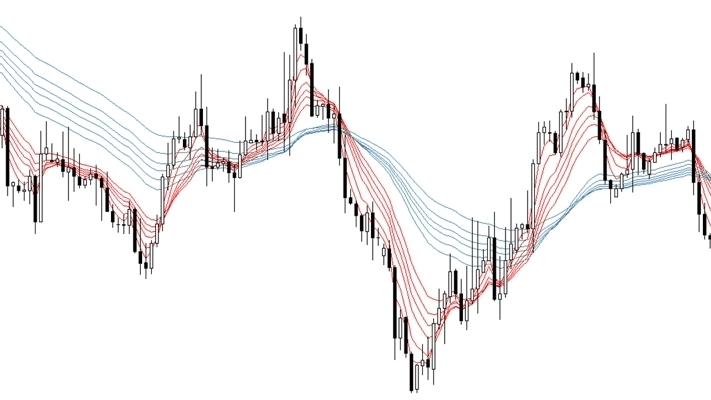
Guppy moving average, proposed by Australian Guppy, usually consists of 12 moving averages (some say 14). The parameters are fixed and divided into two groups: short-term group 3, 5, 8, 10, 12, 15; and the long-term group 30, 35, 40, 45, 50, 60 (the 14-wire one has an extra 1 and 55, which is valid regardless of the method of use, but there is no 13-wire Guppy moving average).
The basic points of Guppy moving average: the short-term group represents the short-term market rise and fall, and the long-term group represents the trend.
The Guppy moving average uses EMA, which is a weighted moving average, not SMA. Guppy Moving Average sets all the moving averages in the short-term moving average group to one color, and sets all the moving averages in the long-term moving average group to another color. Do not use rainbow lines (each moving average uses a different color), which will cause confusion. Guppy moving average does not emphasize the role of a single moving average, but uses moving average groups to exert its effect. In addition to paying attention to the direction of the moving average group, you also need to pay attention to the degree of aggregation and dispersion of the moving averages in the moving average group.
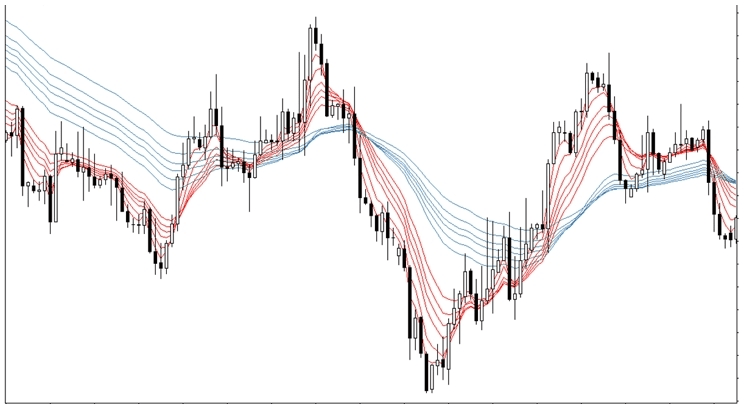
The long-term group pays attention to the direction. If it is upward, it indicates that the trend is upward. When the moving averages in the long-term group converge, it means that the trend has yet to be confirmed. Once the moving averages change from convergence to divergence, the trend is confirmed. If the moving averages change from divergence to convergence, it indicates that the trend has slowed down and the market is undergoing a deeper correction. However, as long as the overall direction remains unchanged, the trend direction remains unchanged. The same is true for the long moving average group downward. If it points horizontally, it tends to be neutral regardless of divergence or convergence.
The short moving average group pays more attention to the convergence and divergence. If the moving average diverges upward, it means that the current market is rising. If it changes from diverging upward to converging, it means that the market is correcting. The same idea applies to the other direction; if it continues to converge horizontally, the market will fluctuate in a narrow range.
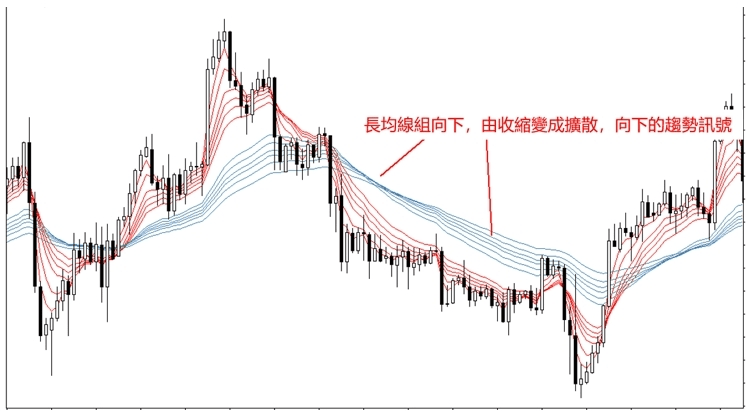
After judging the market situation through the moving average pattern, you can look for entry opportunities. As a moving average, you still need to consider the golden cross, death cross and other opportunities. However, due to the large number of Gubbi moving averages, the golden cross and death cross need to be more clearly defined.
Golden cross: when all the moving averages of the short moving average group come above all the moving averages of the long moving average group, consider going long.
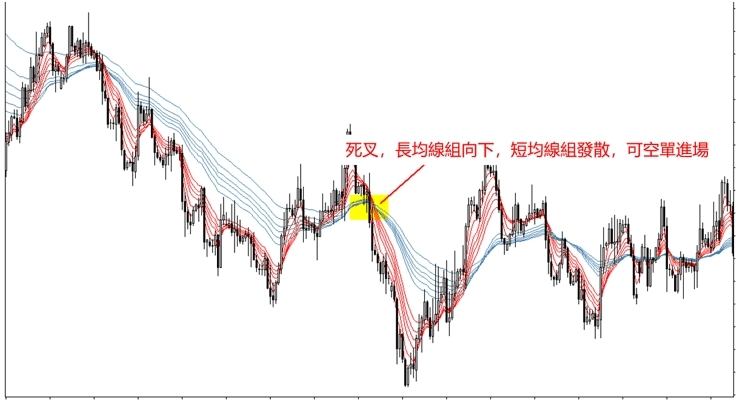
Death cross: when all the moving averages of the short moving average group come below all the moving averages of the long moving average group, consider shorting.
When entering the market, while grasping the golden cross or death cross, you should also pay attention to: the golden cross is accompanied by the long moving average group upward (regardless of convergence or divergence) and the short moving average group diverges upward; the death cross is accompanied by the long moving average group downward (regardless of convergence or divergence) and the short moving average group diverges downward.
In addition to the golden cross and death cross, you can also find the entry opportunity through the position of the long moving average group moving average. That is, the moving average of the long moving average group can not only indicate the trend direction, but also provide support and resistance. When the market pulls back to the vicinity of the long moving average group moving average, you can find the pullback entry opportunity with the divergence of the short moving average group.
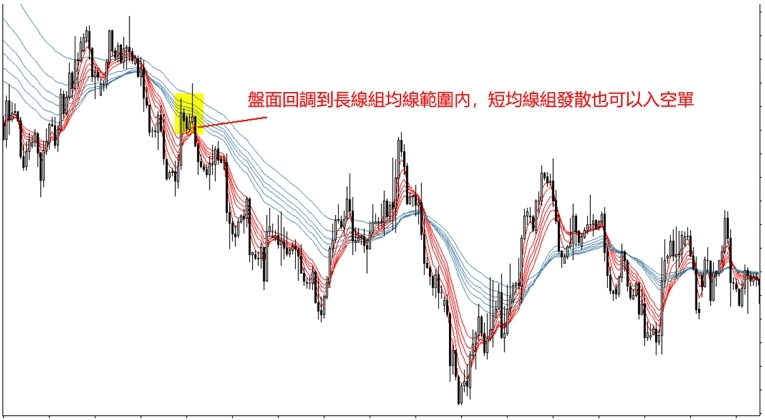
As for exiting the market, long-term traders can consider exiting the market when the long moving average group changes direction, while short-term traders should prepare to exit the market when the short-term moving average group converges.
Judging from the parameters of the Gubbi moving average, it is not very suitable for long-term trading. It is not useful for short-term trading because the entry timing is not timely enough. Therefore, the mid-line may be more appropriate, and the usage period is 4H.
Technology is not everything, but without technology, nothing is possible.
DYOR