

Original source: OKLink Research Institute
Original author: Matthew Lee
On September 27, SEC Chairman Gary Gensler attended a hearing of the U.S. House Financial Services Committee. The hearing reviewed the SEC's regulatory developments, rulemaking, and activities over a period of time since October 5, 2021, including the SEC's proposal to modify the definition of "exchange" and expand the SEC's authority over digital asset trading platforms. Although Gary Gensler still has a strict review attitude towards virtual assets, the SEC is no longer an iron barrel, and the internal staff are exhausted. Bloomberg's senior ETF analyst also said that employees hope to be freed from their work before the government shuts down.
Although US regulation has been suppressing the development of the industry, the good thing is that it is developing a due process legal system that ensures the right path for redress when things are likely to get out of control (see the comparison between the losses suffered by US and Asian investors due to the bankruptcy of FTX).
In the past three months, the court has ruled on three industry-related cases, namely Risley vs Uniswap, SEC vs Ripple, and SEC vs Grayscale, and the rulings are all favorable to the industry. Combined with the frequent series of rulings by the judicial department against the SEC, people can't help but wonder whether the SEC's "long-arm" behavior against virtual assets will be restricted.
There are some details in the judgment that are worth discussing, which highlight the positive factors in the regulatory environment in the United States. Let’s observe the attitude of the judicial system towards virtual assets and SEC supervision from the details of the recent judicial department’s penalties on virtual assets, and explore the regulatory trends of virtual assets.
TL;DR
Risley vs Uniswap Verdict
The court’s decisions on Uniswap and Risley have attracted the least public attention, but they are also the most detailed decisions, with some very clear and directional opinions that can illustrate the court’s attitude towards the industry.
Allegations
Risley’s accusations against Uniswap Labs and its venture capital firms Paradigm, Andreessen Horowitz, USV, etc. mainly include the following:
i). The Uniswap platform sells unregistered securities;
ii). Uniswap is an unregistered broker-dealer;
iii). Uniswap Labs profited from false advertising.
Court response
Uniswap’s decentralized architecture makes it impossible to identify the issuer of fraudulent tokens, resulting in the lack of an “identifiable defendant” in the case. The direct application of securities laws to DeFi lacks clarity, and there is no federal law that allows the court to pursue Uniswap Labs and its venture capital firms. Therefore, the mere fact that Uniswap Labs collects transaction fees and other authority is not enough to determine that Uniswap Labs or venture capital firms should be held responsible.
Judgment highlights
This is a very important paragraph. The judge believes that the law is inseparable from emotion. Combining the actual situation with the law, the judge believes that it is normal for tokens to be missing from the SEC registration. Therefore, many SEC accusations such as "failure to register with the SEC or publish a prospectus or annual report violates the securities law" are untenable.

Due to the characteristics of decentralized autonomy, the judge understands the lack of management of "Scam Tokens", but as the law becomes more and more perfect, decentralized organizations should also adopt on-chain tools such as OKLink's on-chain tag system, which can remind users of the risks of certain tokens to avoid legal disputes. Institutions should also consider using on-chain tools to avoid risky interactions when conducting large transactions on decentralized autonomous platforms.
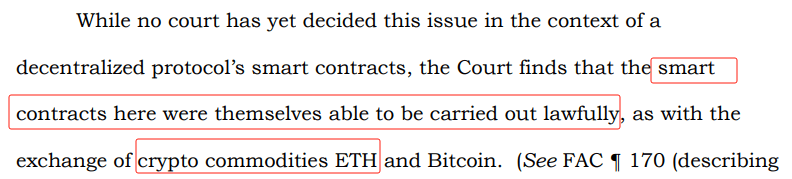
The judge revealed two pieces of information: i). Recognizing the legality of smart contracts in their operation; ii). Recognizing the commodity attributes of Ethereum (the SEC claimed that ETH was a security rather than a commodity when suing Coinbase).


Due to the lack of laws, decentralized trading platforms have not been punished, but there will be stricter supervision on decentralized organizations, especially trading platforms. Take Hong Kong and Singapore as examples. Both have enacted strict laws requiring trading platforms to conduct strict reviews of trading tokens on the platform. In order to comply with regulations, many platforms have also purchased data labeling services from many on-chain data service providers for the field of anti-money laundering. In the future, decentralized trading platforms will not have too many privileges.
However, the judge's current conclusion is also significantly different from the SEC chairman's previous view that "most DeFi trading platforms are actually no different from traditional exchanges."
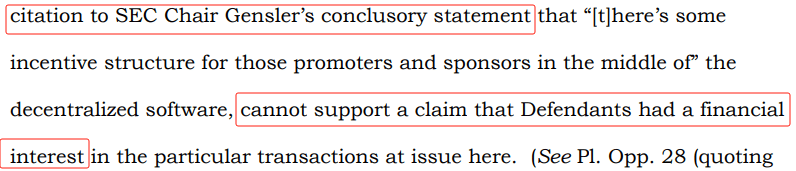
The court also scoffed at the plaintiff's SEC's view, believing that the existence of an incentive structure cannot prove that the defendant and the project have a vested interest. This view can make many projects with incentives breathe a sigh of relief.
summary
There are two very important pieces of information in the judgment: i). The judge has a very deep understanding of the operating logic and characteristics of decentralized projects; ii). The judge is relatively tolerant of the operation of decentralized project codes and recognizes the legality of the operation of smart contracts.
However, the main reason is that the decentralized operation model and the lack of a legal framework make it impossible for the court to make an objective judgment. Now, several senators have proposed a new legal framework for virtual assets, KYC, and even decentralized protocols, aiming to clarify the regulatory framework and responsible persons. In the future, decentralized operations will also need to find ways to comply with regulations, and more data service providers like OKLink will be needed to help identify potential "Rug-Pull" or "Pump and Dump".
Grayscale vs SEC Decision Highlights
Allegations
Grayscale accused the SEC of arbitrarily and repeatedly rejecting Grayscale’s Bitcoin ETP listing, but approving a substantially similar Bitcoin futures ETP listing.
Court response
The SEC neither disputed Grayscale’s evidence that the spot and futures markets for Bitcoin were 99.9% correlated, nor did it suggest that market inefficiencies or other factors undermined the correlation. The judge found that the SEC had inconsistent treatment when dealing with similar products.
Therefore, the judge granted Grayscale’s request and vacated the SEC’s order.
Judgment highlights

Courts rarely say in their decisions that an agency violated the law (the Administrative Procedure Act, APA), and they use very strong words to suggest that the "defendant"'s decisions were hasty and capricious, or even an "abuse of discretion."
In the judgment, very negative words such as “Arbitrary” and “Capricious” appeared 9 times.

The judge also took public speech into consideration. It can be said that the SEC was disliked by almost everyone in this ruling.
summary
In this 3:0 overwhelming ruling, the judge questioned how Grayscale’s ETP was fundamentally different from other approved ETPs, allowing the SEC to “differentiate” them. The SEC did not successfully answer this question.
Regarding the Grayscale ruling, Paradigm's policy director also brought some additional information: the two judges appointed by Presidents Obama and Carter were very disgusted with the SEC's arguments, so as Democrats (the Democratic Party is more opposed to crypto assets) they also joined the conservative party Rao's opinion. Therefore, the probability of the SEC requesting a joint trial is very small, because it is likely to anger the court. If the reason for re-approval is raised, it should be about the company's internal operations, not the hidden dangers of ETP itself.
SEC vs Ripple Judgment Highlights
Allegations
i). Ripple’s sale of tokens to institutions is suspected of being a sale of securities;
ii). Ripple’s sale of tokens to the public on a digital trading platform is suspected of being a sale of securities;
iii). Giving tokens to outsourcing companies may constitute selling securities;
iv). Failure to file a similar prospectus or updated annual report with the SEC.
Since this article uses the Howey test extensively to verify whether something is a security, let us first briefly introduce the Howey test: 1. Whether there is capital investment; 2. Whether it is invested in a common cause; 3. Whether there is an expectation of generating profits; 4. Whether additional returns are obtained by relying on the sponsor.
*The SEC believes that most tokens meet the second and third criteria.
Court response
i). Ripple’s sale of tokens to institutions through contracts constitutes the sale of securities. The court believes that institutional funds are purposefully concentrated to develop and enhance the value of XRP. The participation of institutions is not blind. It meets the Howey test standard;
ii). Ripple’s sale of XRP to the public through a “programmatic interface” (exchange) does not constitute the sale of securities. The public does not know the source of the tokens and does not expect to profit from the issuer’s efforts (but from other factors, such as market trends), which does not have the characteristics of generating expectations of “profits”. The third and fourth criteria are not met;
iii). Distribution through other channels does not constitute the sale of securities. Since no “tangible or clearly defined thing” was paid to Ripple, the payment of XRP cannot be considered the sale of securities. The first criterion is not met.
Judgment highlights

Ripple proposed a "necessary component" test, a "narrow version" of the Howey test, which was undoubtedly rejected by the court. The judge also demonstrated the logic of determining securities, which is definitely not a mechanical application of the "test", but is based on protecting investors and based on an analysis of the current situation. In comparison, the test proposed by Ripple is more focused on form.
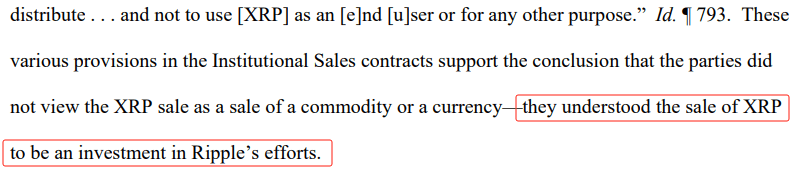
The court held that institutional users clearly understood the terms of the investment contract, and that they purchased XRP not as a currency or commodity but as an investment, so sales to institutions constituted sales of securities.
On the contrary, ordinary users do not understand the various SEC documents and Ripple’s marketing propaganda, and do not associate them with investment returns, so they do not meet the “expectation of income” of the Howey test.

Ripple argued that XRP is not a security, but is more like ordinary assets such as gold and silver, so it does not have the "commercial nature" of a security. The court did not recognize the relationship logic of XRP because the court believed that even commodities can be sold in the form of investment contracts.
Many projects also claim that their tokens are not securities but utility tokens. However, from the court's perspective, although they have functionality, it does not prevent them from being identified as securities.
summary
Unlike the overwhelming "support" for Grayscale and Uniswap, although the judge has a more positive attitude towards the virtual market, the court still made some rulings in favor of the SEC, such as the Howey test should not be rigidly formal, and this judgment is to some extent consistent with the SEC's definition of securities. It is difficult for projects that claim their own tokens are "utility-type" tokens to gain a foothold in court.
What puzzles me about this judgment is that the tokens sold to institutional investors are considered securities because institutional investors are aware of the investment regulations and sales sources, while retail investors are "unclear". However, the "original intention" of identifying securities is to protect investors, but retail investors do not get it. And according to this logic: if tokens are sold through exchanges, then the securities law does not apply. Does that mean retail investors who buy tokens on trading platforms will not be protected?
Regulatory signals revealed by the judgment
Several judgments have some "unreasonable" aspects, showing the judicial department's bias towards the industry, and also highlighting the characteristics of checks and balances within the United States. In the past few years, the SEC has taken radical measures to expand its "jurisdiction" on whether virtual currencies are securities, but before the legislative branch took formal action, the judicial branch began to strongly crack down on the arrogance of the executive branch.
Ripple, as an example that the SEC specifically used to warn the industry, did not successfully establish its authority, but instead gave the industry a great gift. As a country represented by case law, the judgment of "Ripple vs. SEC" will give a clearer direction to the industry that lacks definition and legislation in the future, especially pointing out that tokens sold "programmatically" are not "securities" as defined by the SEC.
Although the Uniswap ruling has nothing to do with the SEC, it reveals the court’s attitude: decentralized projects are different from ordinary companies, and tokens and company securities cannot be confused. The judge who ruled in the case, Katherine Failla, is the judge of the case between the SEC and Coinbase. The market is also very optimistic that Coinbase will dismiss the SEC’s lawsuit.
If the cases of Ripple and Uniswap were goodwill gestures from the judicial department to the industry, then the judgment of Grayscale was a blow to the SEC. The overwhelming judgment of 3:0 revealed the disappointment of both the radical party and the conservative party with the SEC.
The hearing held yesterday also indirectly sent a signal to the industry that the SEC's strong supervision will be restricted, and the legislative department will follow suit to clarify the regulatory framework. Although supervision will not be completely relaxed, future law enforcement will be more "legal". I believe that members of Congress will not give up this opportunity to promote their own propositions in the virtual currency industry and seize political capital. There will be a lot of ETF applications in October, and these applications have already formed strong political pressure on the SEC. Combined with the recent "rise in the east and fall in the west" that brought about the cold reception of the Permissionless Conference, they are all knocking on the SEC. If it continues to take unreasonable measures, it will be abandoned by the people and political resources.