

Author: Alfred, LD Capital
The ideal state of the Crypto world is a decentralized, permissionless system that operates according to digital rules. This sounds somewhat contradictory to traditional regulation, but the current development of the crypto industry is rapidly merging with global regulatory bodies. Perhaps many crypto natives do not like it, but with the frequent introduction of bills in various countries, regulatory dynamics have become the absolute focus of industry development.
I believe that sovereign freedom and mathematical order will remain the core of the industry in the future, but if new things want to be integrated into the existing world order on a large scale and be rapidly promoted and developed globally, competition and integration with supervision are inevitable. This article will sort out the current progress of the most important trends in 2023 from the perspective of industry observers (*In view of the common regulatory habits of various countries, this article uses virtual assets to refer to crypto assets and digital assets in a broad sense).
1. Singapore — A leader in virtual asset regulation
After the bankruptcy of Three Arrows Capital and FTX, Singapore's regulation has become more cautious and strict, and the pace of development has slowed down. However, due to its stable policies and open environment, Singapore is still one of the preferred destinations for global Web3 companies and entrepreneurs.
1. MAS’s three-category virtual asset regulatory framework
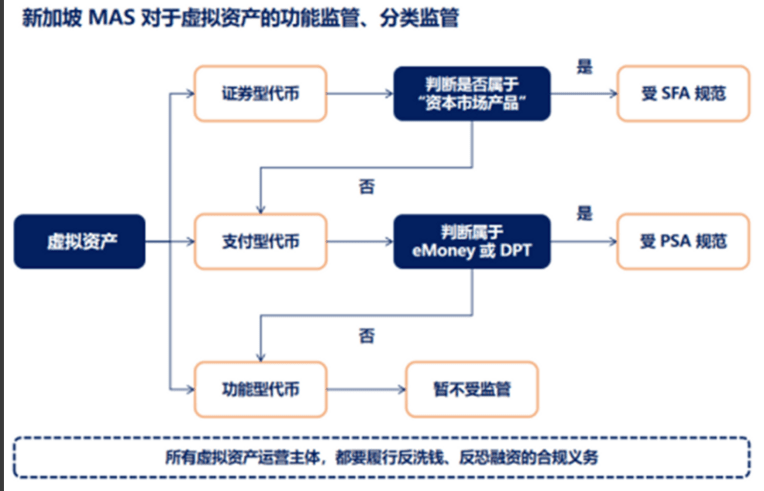
The Monetary Authority of Singapore (MAS) is Singapore's central bank and comprehensive financial regulator, and is also responsible for regulating the Web3 industry. MAS adopts a functional and classified approach to virtual assets, thereby conducting legalized supervision.
According to the "Guidelines on the Issuance of Digital Tokens" revised and issued by MAS in May 2020, virtual assets are divided into three categories based on their functions and characteristics: security tokens; payment tokens; and utility tokens. Among them, eMoney is electronic money in payment tokens, and DPT is a digital payment token, which is a cryptocurrency for payment purposes (such as BTC, ETH).
Source: Web3 Lawyer
If classified as a security token, it will be regulated by the Securities and Futures Act (SFA), while payment tokens will be regulated by the Payment Services Act (PSA). There is no clear regulatory law for utility tokens. Assets regulated by SFA and PSA need to obtain regulatory approval from MAS and obtain the corresponding access license to operate in compliance. At the same time, all virtual asset activities, like other financial activities, need to comply with anti-money laundering and anti-terrorist financing compliance and supervision.
2. Launch the final regulatory framework for stablecoins
On August 15, 2023, MAS announced the final regulatory framework for stablecoins, which aims to ensure that stablecoins regulated in Singapore have a high degree of value stability, making it one of the first jurisdictions in the world to incorporate stablecoins into the local regulatory system.
According to the definition of the regulatory framework, stablecoins are digital payment tokens (*DPT) and single-currency stablecoins (*SCS) issued in Singapore and pegged to the Singapore dollar or any G10 currency, maintaining a relatively constant value. Issuers of such SCS must meet four key requirements: value stability; capital requirements; redemption at par; information disclosure.
When well-regulated to maintain this stability of value, stablecoins can serve as a trusted medium of exchange to support innovation, including the “on-chain” purchase and sale of digital assets. At the same time, only stablecoin issuers that meet all the requirements under the framework can apply to MAS for their stablecoins to be recognized and labeled as “MAS-regulated stablecoins”. This label will enable users to easily distinguish MAS-regulated stablecoins from other digital payment tokens, including “stablecoins” that are not subject to the MAS stablecoin regulatory framework. If users choose to trade stablecoins that are not regulated by the MAS framework, they should make their own informed decisions about the risks that come with it.
2. Hong Kong, China — Developing virtual assets at the fastest pace
After a few years of silence, starting with the "Hong Kong Virtual Asset Development Policy Declaration" issued by the Hong Kong Treasury Bureau on October 31, 2022, the city has re-accelerated its embrace of the virtual asset industry and has frequently implemented policies in 2023 to demonstrate its determination. In the 2022/23 Annual Report released by the Hong Kong Financial Services Development Council, Hong Kong is positioning itself as a global leader in the development of virtual assets and complementary technologies.
1. Hong Kong’s unique dual-license system
Hong Kong currently has a "dual license" system for virtual asset trading platform operators. One type of license is for "security tokens" and is used in the supervision and licensing system of the Securities and Futures Ordinance, and the other license is for "non-security tokens" and is applicable to the licensing system of the Anti-Money Laundering Ordinance. The Hong Kong Securities and Futures Commission previously stated that the terms and characteristics of virtual assets may evolve over time, and the definition criteria of "security tokens" and "non-security tokens" may also change, so virtual asset platforms should hold dual licenses to ensure compliance.
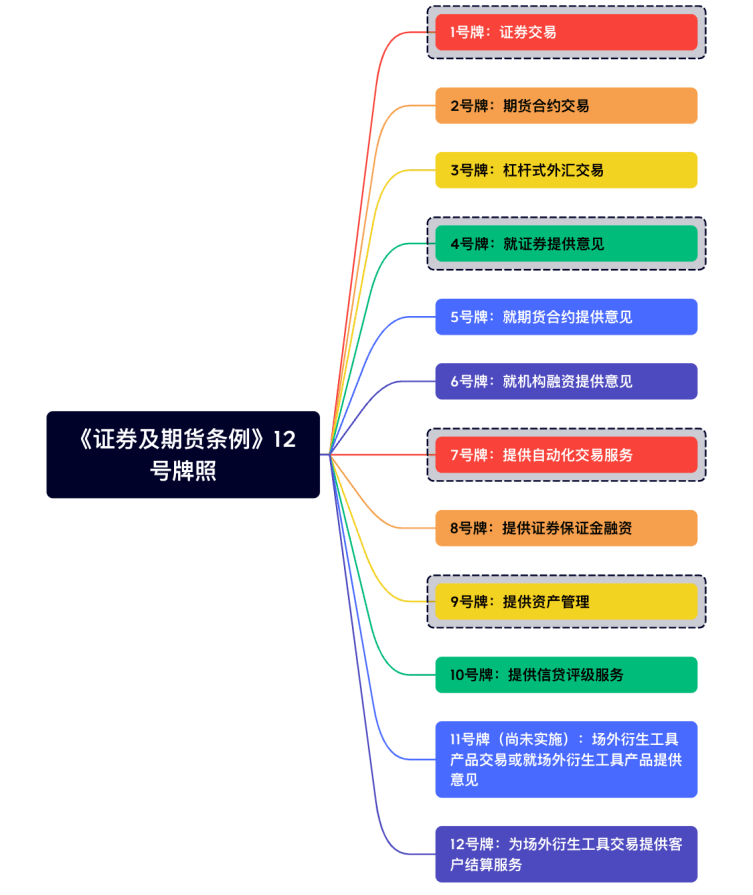
(1) License No. 12 under the Securities and Futures Ordinance
Hong Kong already has a relatively complete licensing access system. If virtual assets are classified as security tokens, they need to apply for securities-related access licenses. Currently, there are three types of licenses that must be applied for to operate virtual asset businesses, namely No. 1 license, No. 7 license and VASP license. In addition, according to actual business needs, No. 4 and No. 9 licenses may also need to be applied for.
(2) VASP License
The licensing system for virtual asset service providers (*VASP) comes from the new regulations of the Anti-Money Laundering and Counter-Terrorist Financing (Amendment) Ordinance. In December 2022, the Legislative Council of Hong Kong passed the bill in the third reading and promulgated it in the Gazette, making it the first bill in Hong Kong involving the regulation of virtual assets.
According to the Anti-Money Laundering and Counter-Terrorist Financing (Amendment) Ordinance 2022, virtual assets are defined as follows: Virtual assets are cryptographically protected digital values expressed in the form of units of account or stored economic value; can be used as a medium of exchange to pay for goods or services, settle debts, or invest; or used to vote on the management, operation, or changes in terms of virtual asset-related matters; can be transferred, stored, or bought and sold electronically; the Securities and Futures Commission or the Secretary for the Treasury can expand or narrow the scope of virtual assets by publishing in the Gazette. The definition of VA in the Anti-Money Laundering Ordinance will cover most virtual currencies on the market, including BTC, ETH, stablecoins (*Stablecoin), utility tokens (*Utility Token) and governance tokens (*Governance Token).
Virtual asset trading platforms that currently hold licenses No. 1 and No. 7 also need to apply for VASP licenses from the CSRC, but a simplified application procedure applies. On August 3, HashKey and OSL applied for license No. 1 and No. 7 upgrades through simplified procedures and obtained approval for retail services in a short period of time, which will expand the scope of business from only professional investors to retail users.
At the same time, the Anti-Money Laundering Ordinance provides transitional arrangements for "existing virtual asset exchanges", stipulating that the transition period will be before June 1, 2024. For virtual asset trading platforms that already hold licenses No. 1 and 7 but have not yet obtained a VASP license, the SFC recommends a 12-month transitional period. Those who have no intention of applying for a license should prepare to end their business in Hong Kong in an orderly manner, with the deadline for closure being May 31, 2024. In short, from June 1, 2024, virtual asset exchanges without a VASP license will not be able to operate in compliance.
2. Accelerate the development of stablecoins
Regarding stablecoins, the SFC also clearly stated in the "Consultation Summary": The Hong Kong Monetary Authority has issued the "Consultation Summary of the Discussion Paper on Crypto Assets and Stablecoins" in January 2023, stating that it will implement regulatory arrangements for stablecoins in 2023/24 and establish a licensing and permit system for stablecoin-related activities. Before stablecoins are regulated, the SFC believes that stablecoins should not be included for retail trading. On May 18, the Hong Kong Monetary Authority announced the launch of the "Digital Hong Kong Dollar" pilot program, and a total of 16 companies from the financial, payment and technology industries were selected to participate in the first round of trials in 2023. The pilot project conducts in-depth research on six potential use cases, including comprehensive payment, programmable payment, offline payment, Token deposits, Web3 transaction settlement and Token asset settlement. At the Wanxiang Blockchain Week on September 19 this year, Hong Kong Legislative Council member Qiu Dagen said that the regulatory specifications for Hong Kong dollar stablecoins may be launched in June next year.
3. UAE - Establishing the first tailor-made virtual asset regime
The Dubai Virtual Asset Regulatory Authority (VARA) was established in March 2022. It is the world's first government agency specifically established to regulate the virtual asset industry. It is responsible for managing and supervising virtual asset-related activities in Dubai (*including special development zones and free zones, but excluding the Dubai International Financial Center). Previously, Binance, Okx, crypto.com, Bybit, etc. have all obtained MVP licenses and opened companies in Dubai. On February 7, 2023, in accordance with the 2022 Dubai Emirate Virtual Asset Regulatory Law No. (4), with the final approval of the board of directors, the Dubai Virtual Asset Regulatory Authority (VARA) issued the 2023 Virtual Assets and Regulatory Activities Regulations, which will take effect immediately upon issuance, requiring all market participants who conduct virtual asset business or provide services in the UAE (*except the two financial free zones ADGM, DIFC) to obtain approval and permission from the UAE Securities and Commodities Authority (SCA) or VARA.
VARA identifies seven different virtual asset (*VA) activities, covering advisory services, broker-dealer services, custody services, exchange services, lending services, management and investment services, and transfer and settlement services. The licensing process is divided into four stages: a temporary license, a license to prepare and operate a minimum viable product (*MVP) and a so-called full market product (*FMP) license. Prior to the approval of the phased (4) FMP license, MVP license holders may not provide services to mass retail consumers (*It is allowed to provide relevant virtual asset services to eligible retail and institutional investors in Dubai). Currently, three companies have officially obtained VASP licenses for relevant licensed activities. Binance, OKX, Bybit, etc. are in different stages of MVP.
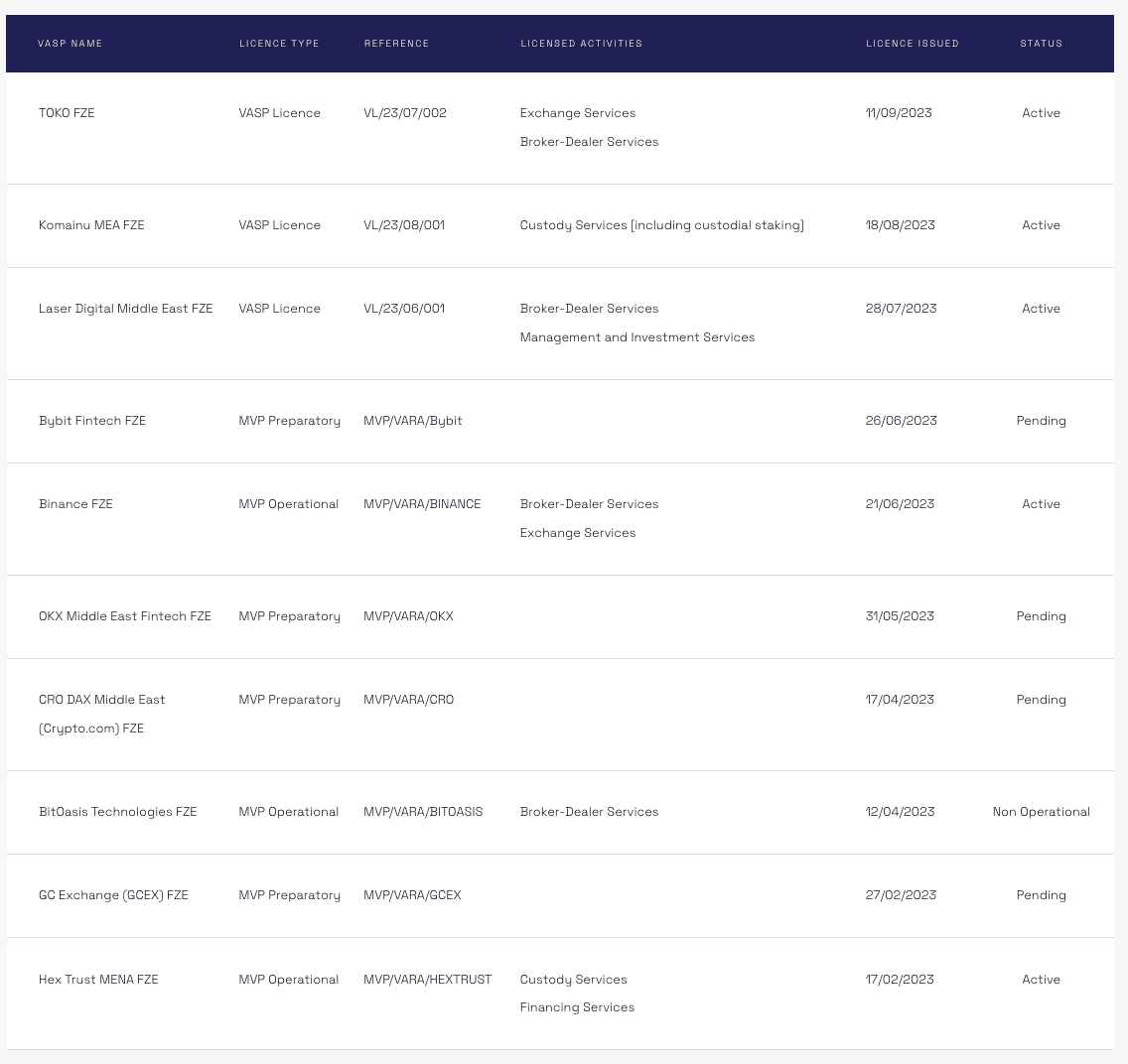
Source: VARA Public Register
The Dubai government has taken the boldest and most proactive attitude towards the development of virtual assets. It has not only promoted the establishment of independent regulatory agencies and policies, but also vigorously developed artificial intelligence and the metaverse. It has quickly become an influential international player in the field of virtual assets.
4. Europe — The EU launches the most complete unified virtual asset regulatory framework
1. European Union
On May 31, 2023, the European Union officially signed the landmark legislation — the Crypto-Asset Market Regulation Act (*MiCA), which was published in the Official Journal of the European Union (*OJEU) on June 9. This marks the emergence of the world's first unified virtual asset regulatory framework with the most complete regulation and the clearest framework. The bill will provide the 27 EU member states with a common virtual asset regulatory system and create a unified market covering 450 million people.
The bill is 150 pages in total and provides a complete regulatory framework (*and it is also complex) for companies and individuals to view specific regulations in the corresponding chapters, mainly including the scope and definition of supervision, the classification of crypto assets and related regulations, the regulatory regulations for crypto asset service providers, regulatory authorities, etc. Under this bill, any company that provides crypto assets to the public needs to publish a fair and clear white paper, warn of risks without misleading potential buyers, register with the regulatory authorities and keep appropriate bank-style reserves for stablecoins.
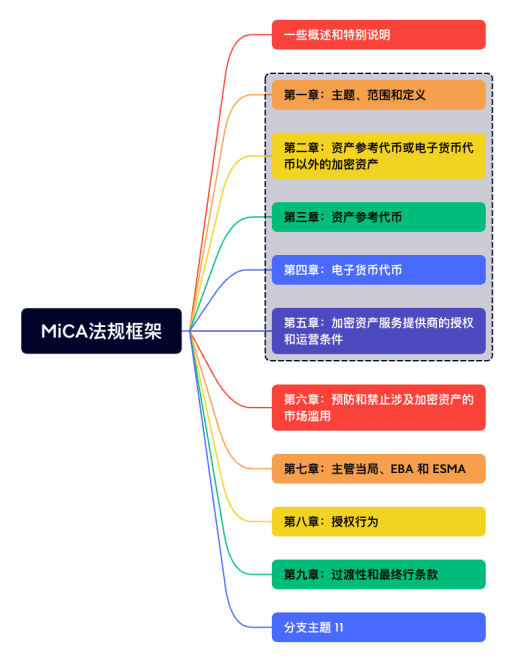
MiCA defines crypto assets as: digital representations of value or rights that are transferred and stored electronically using distributed ledger technology or similar technologies. In terms of crypto asset classification, MiCA divides assets into electronic currency tokens, asset reference tokens, and crypto assets other than the two. Electronic currency refers to crypto assets that maintain a stable value by reference to the value of an official currency, mainly involving Chapter 4 of the regulations; asset reference tokens refer to crypto assets that are not electronic currency tokens and are designed to maintain a stable value by reference to another value, right or combination, including one or more official currencies, mainly involving Chapter 3 of the regulations; utility tokens refer to crypto assets that are only used to provide access to goods or services provided by the issuer, mainly involving Chapter 5 of the regulations. According to the existing bill, MiCA does not give a clear regulatory approach to securities tokens and NFTs, and the specific classification of existing tokens in the current crypto market also requires more actual use cases to explain.
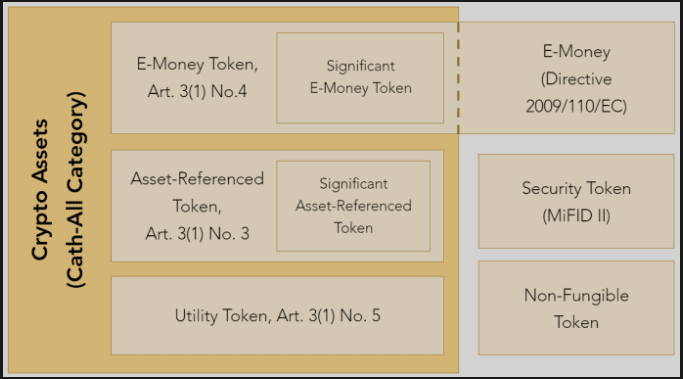
Source: Mayer Brown
MiCA will come into force on December 30, 2024, after an 18-month transition period, and by mid-2025 the committee will report whether further laws are needed to meet the needs of NFTs and decentralized finance.
2. United Kingdom
After the introduction of the EU's MiCA bill, the UK is also accelerating the legislation on virtual assets. On June 19, 2023, the UK House of Lords approved the Financial Services and Markets Bill (*FSMB), and on June 29, the bill was approved by King Charles of the United Kingdom. The royal approval is a procedural step after the consent of legislators, which makes cryptocurrencies included in the scope of legal supervision by the FSMB. The bill also adds measures to supervise the promotion of cryptocurrencies.
British Financial Services Minister Andrew Griffith said in a statement that after the UK leaves the EU, the UK will be able to control its own financial services rulebook, so that the regulation of cryptocurrency assets can support their safe adoption in the UK. On July 28, the UK and Singapore have agreed to jointly develop and implement global regulatory standards for cryptocurrencies and digital assets.
5. The United States — Key to the Development of the Cryptocurrency World
The U.S. Securities and Exchange Commission (SEC) has been attacking everywhere in recent years, making the United States the world's most stringent regulator, but traditional financial and crypto companies in the United States are also working hard to promote industry development and regulatory integration. Since 2022, U.S. lawmakers have submitted more than 50 digital asset bills to Congress. At present, U.S. regulation is both a key obstacle to development and an important accelerator for future development, because it is related to the flow of the U.S. dollar, the most important source of liquidity in the crypto world.
1. SEC and CFTC
(1) SEC and Howe Test
The U.S. Securities and Exchange Commission (SEC) is an independent agency and quasi-judicial institution established under the Securities Exchange Act of 1934 and directly under the U.S. federal government. It is responsible for securities supervision and management in the United States and is the highest authority in the U.S. securities industry. The SEC exercises the power granted by Congress. It ensures that public companies do not commit financial fraud, provide misleading information, engage in insider trading, or engage in other violations of various securities laws, otherwise they will face civil lawsuits.
With the development of crypto assets with financial attributes, the SEC will analyze whether a certain crypto asset is a security through the analytical framework titled "Whether Virtual Assets Are Investment Contracts" released on April 3, 2019, and then determine whether it is regulated and restricted by the Securities Act of 1933 and the Securities Exchange Act of 1934. An important method of judgment is the "Howey Test": Is it an investment of money? Is it a common cause of the issuer and the investor? Does the investment have reasonable expected benefits, and does the expected benefit come from the efforts of others? Both the SEC and the federal courts have emphasized that the Howey Test is flexible (*and highly subjective). If a crypto asset is defined as a security by the SEC Howey Test, it will be subject to regulation.
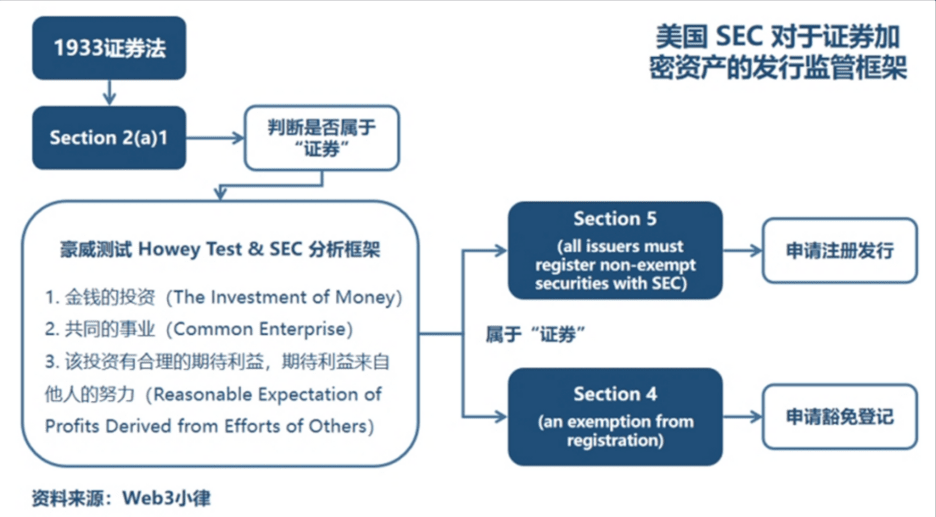
(2) SEC regulation poses a threat to the crypto world
Gary Gensler, the current chairman of the Securities and Exchange Commission, has stated publicly many times that, except for absolutely decentralized virtual currencies such as Bitcoin, the vast majority of crypto tokens meet the investment contract test and should be considered "securities", which requires registering the offer and sale of their investment contracts with the SEC or meeting the exemption requirements. At the same time, since most crypto tokens are subject to securities laws, most crypto intermediaries must also comply with securities laws.
Defining tokens as securities will mean that crypto asset issuers or trading platforms will have to pay high costs and fees to adapt to the relatively complete and strict regulatory standards in the United States. At the same time, they will continue to be regularly reviewed and legally enforced by regulatory authorities. Most importantly, using existing regulations (without adaptive revisions) for regulatory constraints will fundamentally change the way the existing crypto asset industry operates, hindering current operations and future innovation and exploration.
(3) CFTC embraces encryption but remains strict
The Commodity Futures Trading Commission (*CFTC) is an independent agency established by the U.S. government in 1974. The U.S. Congress authorized the CFTC to manage and enforce the U.S. Commodity Exchange Act of 1936 (*CEA) and its promulgated regulations. It is mainly responsible for regulating the U.S. commodity futures, options and financial futures and options markets.
The current U.S. CFTC Chairman Rostin Behnam said in an interview that there are obvious differences between the CFTC and the SEC led by Gary Gensler in their approaches to cryptocurrency regulation. He believes that many current crypto assets are commodities rather than securities, such as BTC and ETH. He also criticized the SEC's approach to cryptocurrency regulation: "I strongly oppose law enforcement regulation. I have done my best to be transparent." He also said that financial innovation is in the national interest and compared crypto innovation with other "milestone moments in market structure," such as "the switch from on-site trading to electronic trading 20 years ago."
But recently, the CFTC has demonstrated its strict supervision to the market. It has successively enforced three DeFi projects involving derivatives, including Opyn, Inc., ZeroEx, Inc., and Deridex, Inc., three U.S.-based blockchain companies. The company imposed penalties and eventually accepted the penalty and settled the matter. In the past, everyone may have thought that the CFTC was a moderate and friendly agency because of the SEC's enforcement and the CFTC's positive attitude, but now everyone will realize that the CFTC's supervision will even be more stringent in some areas.
2. Bitcoin Spot ETF
(1) ETF and Bitcoin Spot ETF
ETF is an open-end investment fund, also known as exchange-traded fund. ETF portfolios are held by companies that issue fund shares (*partial ownership). As an index-based investment product, it is an investment fund that can track a broad index and sub-sectors or industry sectors of the index. ETFs form investment portfolios based on the compilation method of each index. By trading ETFs, a series of underlying asset portfolios can be traded, thereby achieving the purpose of risk diversification. Common ETFs include financial stocks, energy stocks or commodities.
Bitcoin spot ETFs mainly invest in spot assets related to Bitcoin. Bitcoin spot ETFs follow the price of Bitcoin and enable investors to buy and sell fund shares on regular exchanges, allowing investors to gain exposure to Bitcoin price fluctuations without actually holding cryptocurrencies.
(2) Why is Bitcoin spot ETF so important?
ETFs will simplify the investment process for investors and lower the threshold, which will encourage more investors to use ETFs to invest in Bitcoin. In addition, the passage of Bitcoin spot ETFs will provide new legal investment products in the traditional financial market. With the help of the powerful sales force and profit expectations of fund giants, trillions of funds will be introduced into the market. As the largest cryptocurrency, the passage of Bitcoin spot ETFs will lead to the birth of more compliant products of encrypted assets and capital inflows, thereby promoting the development of the entire industry.
(3) Current progress of ETFs
Currently, many US fund giants have submitted applications for Bitcoin spot ETFs, including BlackRock, Fidelity, ARK, Bitwise, WisdomTree, Valkyrie, etc. The SEC needs to respond to the application documents before four deadlines (*including rejection, approval or postponement). The SEC did not approve any application at the first deadline, and will make relevant decisions at the second time node for many applications in mid-October.
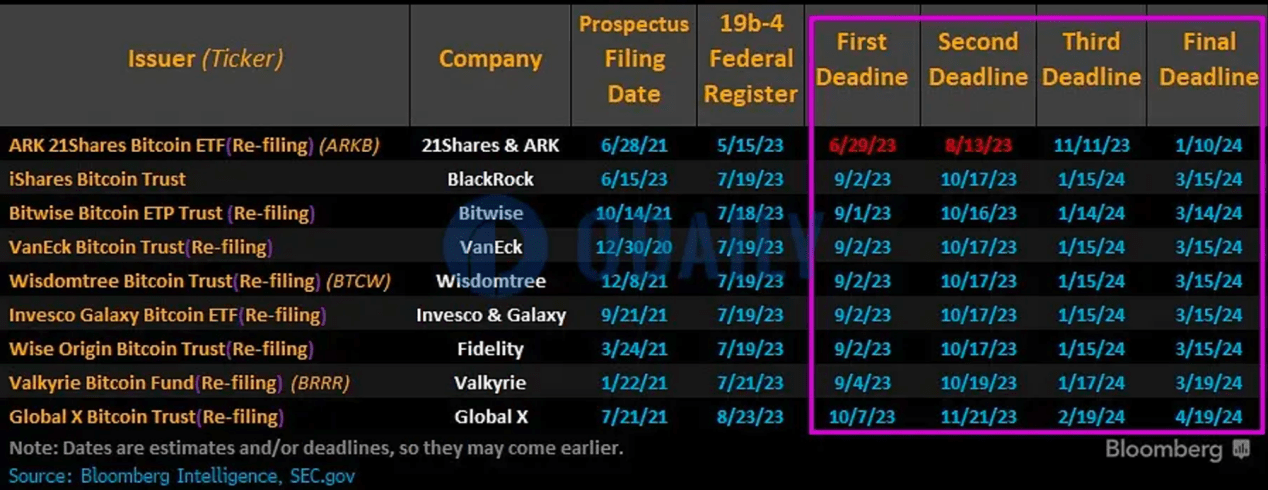
Source: Bloomberg, Daily Planet
Former SEC Chairman Jay Clayton, Wintermute co-founder Evgeny Gaevoy and other American financial giants have said that the approval of a spot Bitcoin ETF is inevitable and it is only a matter of time. Although there have been many voices recently saying that there will be good news about Bitcoin ETFs in October, the author believes that the official approval is likely to be next year.
3. Others
(1) Stablecoin
This year, Republicans on the U.S. House Financial Services Committee proposed a new stablecoin regulatory draft, aiming to transfer the jurisdiction of stablecoins from the U.S. Securities and Exchange Commission (SEC) to federal and state bank and credit union regulators, but it was not passed in the Senate, where the Democrats hold a majority. In August, global payment giant PayPal announced the launch of PYUSD, a U.S. dollar stablecoin for transfers and payments. The stablecoin is issued by Paxos Trust Co. and backed by U.S. dollars, short-term Treasury bonds and cash equivalents. At the same time, on August 16, Dante Disparte, chief strategy officer of USDC issuer Circle, called on the United States to legislate on stablecoins as soon as possible in an interview.
(2) RWA
RWA is one of the fastest growing areas in the United States. RWA related to U.S. Treasury bonds has become an important asset in the crypto world. In a working paper on tokenization published by the Federal Reserve on September 8, tokenization is considered to be a new and fast-growing financial innovation in the crypto market. The analysis from the three perspectives of scale, advantages and risks shows that the Federal Reserve attaches increasing importance to asset tokenization. On September 7, industry leaders in the crypto world announced the establishment of the Tokenization Alliance (TAC), with founding members including industry leaders such as Aave Companies, Centrifuge, Circle, Coinbase, Base, Credix, Goldfinch and RWA.xyz. Together, these companies are committed to bringing the next trillion dollars of assets to the chain through real-world asset tokenization, education and advocacy.
(3) DeFi and NFT
Recently, DeFi and NFT have been the focus of enforcement by US regulators. As mentioned above, the CFTC enforced the law on three DeFi protocols, and the three companies eventually pleaded guilty and reached a settlement. In August and September of this year, the SEC took regulatory enforcement actions against an LA-based entertainment company Impact Theory, LLC and Stoner Cats 2 LLC for offering unregistered securities. Impact Theory, LLC reached a settlement with the SEC by launching an investor compensation policy.
The United States has always had the most complete financial system and extremely high regulatory standards, but the reason why the United States has been criticized by the industry this year is that compared with the official introduction of new legislation in other countries and regions, the current characteristics of US regulators are to incorporate virtual assets into the existing system for supervision and law enforcement, and have not officially introduced new regulations suitable for industry development, which will hinder the development and innovation of the crypto industry in the United States. Despite this, the United States still has highly innovative companies and large traditional interest groups involved in Web3, which will continue to promote regulatory changes. Perhaps external regulatory development and next year's US election are key nodes.
6. Japan and South Korea — Important players in the world of virtual assets
1. Japan
Japan is an early country involved in cryptocurrency, but in 2014, Japan experienced one of the industry's worst setbacks - the world's largest bitcoin exchange Mt. Gox was hacked and closed down. The incident caused retail investors to lose up to 850,000 bitcoins, and the debt repayment caused by the incident has not been resolved for 9 years. Not long ago, on September 21, the trustee in charge of the Mt Gox bankruptcy case decided to postpone the payment of creditors for another year. The payment time originally scheduled for October 31, 2023 was postponed to the new October 31, 2024. Since the Mt. Gox incident, Japan has begun to implement stricter supervision on the cryptocurrency industry and adopt clearer and more explicit control policies than other countries such as the United States. In 2017, Japan amended the Payment Services Act to include cryptocurrency exchanges in the scope of supervision and implement a licensing system supervised by the Financial Services Agency (*FSA).
With the rapid development of the crypto industry in recent years, Japan has also accelerated a series of positive policies since 2022. On June 1, 2022, Japanese Prime Minister Fumio Kishida made a statement in the House of Representatives, saying that "the arrival of the Web3 era may lead Japan's economic growth, and it is strongly believed that Japan must resolutely promote this environment from a political perspective." Soon after, Japan established the Ministry of Economy, Trade and Industry's Web3 Policy Office, the Liberal Democratic Party's Web3 Project Group and other policy institutions to vigorously promote the development of Web3 in Japan.
In April 2023, the Web 3.0 project team of Japan's ruling party released a white paper proposing suggestions for promoting the development of Japan's crypto industry. In June 2023, Japan's "Fund Decision Bill Amendment" was voted through in the upper house, becoming one of the first countries in the world to enact a stablecoin bill. The Ethereum Developer Conference "EDCON 2024" will also be held in Japan.
2. South Korea
South Korea is one of the countries most enthusiastic about trading cryptocurrencies. In 2017, this country with a population of more than 50 million accounted for 20% of all Bitcoin transactions and became the largest market for Ethereum. In the following years, the South Korean government implemented a series of policies to crack down on speculative behaviors in cryptocurrency transactions, such as trader access and exchange regulatory registration. However, at present, crypto transactions are still hot. If a token gains a Korean trader population and is listed on a Korean exchange, the price of the token on the Korean exchange will often be much higher than other exchanges around the world. This phenomenon is called the "Kimchi premium."
In the hot atmosphere of encryption, South Korea's regulation, like other countries and regions, has accelerated in recent years. In June this year, the plenary session of the South Korean National Assembly passed the "Virtual Asset User Protection Act", which introduced a regulatory system for virtual assets and is expected to help protect users of the virtual asset market and establish a sound, standardized and transparent market order. The Financial Services Commission of South Korea will prepare for the second phase of legislation for virtual assets. The bill will be implemented one year after the government's issuance procedure, which is expected to be in July 2024.
Recently, the Korean blockchain industry has also been actively deploying at the infrastructure level. On September 12, three large securities companies, Shinhan Investment Securities, KB Securities and NH Investment Securities, will form the "Token Securities (*ST) Security Token Alliance" and begin to jointly build infrastructure. On September 21, Busan, South Korea, approved the "Busan Digital Asset Exchange Establishment Promotion Plan and Future Schedule" plan. The exchange is scheduled to be established in November and officially open for business in the first half of 2024. In addition, Busan City also proposed to build Busan into a "blockchain city" with the Busan Digital Asset Trading Platform as the center, and set up a 100 billion won (*about 75 million US dollars) blockchain innovation fund.
7. G20 — Advocate of the Global Virtual Asset Regulatory Framework
The current characteristics of virtual asset regulation are that the standards and specific regulations of various countries and regions are not unified, which has caused high difficulty and cost for the operation and development of projects and companies, and also provided space for regulatory arbitrage for speculators. As an economic cooperation forum organization that accounts for 85% of the world's GDP, 80% of the total trade volume, and 2/3 of the total population, the G20 is also actively advocating a global unified virtual asset regulatory framework.
On September 9, 2023, the leaders of the G20 member countries agreed with the previous recommendations of the Financial Stability Board (FSB) and the International Monetary Fund (IMF) on the regulation and supervision of crypto asset activities and markets and global stablecoins, and will discuss the roadmap proposed by the FSB and IMF at the meeting in October. At the New Delhi Summit on September 11, the leaders of the G20 member countries reached a consensus on the rapid implementation of the cross-border framework for crypto assets. The framework will promote the exchange of global crypto asset information from 2027, and countries will automatically exchange crypto transaction information between different jurisdictions every year, including transactions conducted on unregulated cryptocurrency exchanges and wallet providers. (The G20 is composed of 20 parties including China, Argentina, Australia, Brazil, Canada, France, Germany, India, Indonesia, Italy, Japan, South Korea, Mexico, Russia, Saudi Arabia, South Africa, Turkey, the United Kingdom, the United States and the European Union)
The G20's advancement in virtual assets is positive, but the G20 is characterized by the integration of multiple political ideologies and complex interests. It is also currently in a cycle of de-globalization amid competition among major powers. In the future, the G20 may be able to promote policies that are substantively implemented at a very slow pace.
8. Conclusion
1. The current regulatory application costs for crypto companies are still high. Although various countries and regions have introduced bills, the definition, classification, and regulatory methods of virtual assets vary from country to country. Crypto companies and individual investors need to adapt to different rules in different regions to comply with regulations.
2. Virtual assets are innovative and special, and are more suitable for new regulations. The life cycle of virtual assets runs through multiple stages, such as mining, pledging, issuance, trading, transfer, payment, lending, derivatives, etc. The asset category is also complex. For example, a token has payment, securities, and utility attributes at the same time. If the regulator classifies virtual assets into the existing unrevised regulatory framework, it will be difficult to adapt to the current industry development. New regulations and regulatory methods should be adopted based on the characteristics of virtual assets with broad consensus. How to balance regulation and development is a great test of the wisdom of the government and the industry.
3. The regulatory route of integration and change is the only way. In 2024, more virtual asset regulatory bills will be officially implemented. The process of adapting to regulation will be relatively long and difficult. However, if the current market wants to inject new liquidity and large-scale applications, it is necessary to integrate supervision and change the existing system.