
Trading Turtle
457 Публікації

Trading Turtle
Поскаржитись
Заблокувати користувача
Crypto trader sharing real trades, ideas, and lessons from the markets. Experienced in systematic strategies and building automated tools to stay disciplined.
Частий трейдер
1.1 р.
47 Підписки
24 Підписники
51 Вподобань
Публікації
Усі
Цитування
Відео
Переглянути переклад
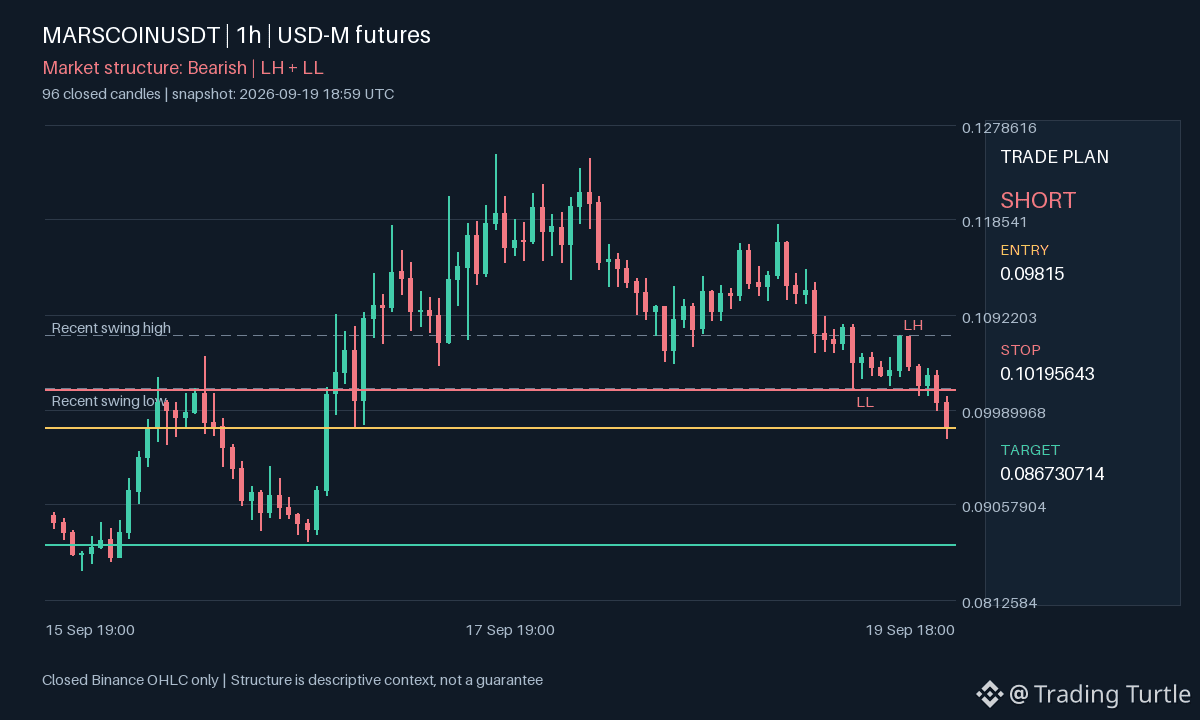
$MARSCOIN | 1h | Short | #Futuressignal
Entry: 0.09815
Stop: 0.10195643
Target: 0.08673071
R:R: 3
Signal Setup: This short breakout setup formed after price closed below prior support with confirming volume and candle strength. The stop marks the invalidation level, while the target preserves the planned reward relative to risk.
#MARSCOIN #CryptoFutures #FuturesTrading #ShortSetup
$MARSCOIN | 1h | Short | #Futuressignal
Entry: 0.09815
Stop: 0.10195643
Target: 0.08673071
R:R: 3
Signal Setup: This short breakout setup formed after price closed below prior support with confirming volume and candle strength. The stop marks the invalidation level, while the target preserves the planned reward relative to risk.
#MARSCOIN #CryptoFutures #FuturesTrading #ShortSetup
Entry: 0.09815
Stop: 0.10195643
Target: 0.08673071
R:R: 3
Signal Setup: This short breakout setup formed after price closed below prior support with confirming volume and candle strength. The stop marks the invalidation level, while the target preserves the planned reward relative to risk.
#MARSCOIN #CryptoFutures #FuturesTrading #ShortSetup
57
Список альткоїнів під наглядом · 19 вер, 13:15 UTC
Ось ліквідні альткоїни, на які звертають увагу в цьому ринковому зрізі. Зміни охоплюють останні 24 години.
$ZEC — +4.73% за 24 год. Потрапив у фокус для інтересу до пошуку в CoinGecko, активної торгівлі та недавнього висвітлення в новинах.
$ENA — +23.67% за 24 год. Потрапив у фокус для інтересу до пошуку в CoinGecko, активної торгівлі та сильного висхідного імпульсу.
$AVAX — +15.31% за 24 год. Потрапив у фокус для інтересу до пошуку в CoinGecko, активної торгівлі та сильного висхідного імпульсу.
ZAMA/USDT — +42.36% за 24 год. Потрапив у фокус для інтересу до пошуку в CoinGecko та сильного висхідного імпульсу.
SUI/USDT — +6.91% за 24 год. Потрапив у фокус для інтересу до пошуку в CoinGecko та активної торгівлі.
Це кандидати для дослідження, а не сигнали на вхід. Швидкі рухи можуть розвернутись; перевіряйте ліквідність і ширший графік, перш ніж робити висновки.
#Altcoins #CryptoWatchlist #CryptoMarkets #MarketResearch
Список альткоїнів під наглядом · 19 вер, 13:15 UTC
Ось ліквідні альткоїни, на які звертають увагу в цьому ринковому зрізі. Зміни охоплюють останні 24 години.
$ZEC — +4.73% за 24 год. Потрапив у фокус для інтересу до пошуку в CoinGecko, активної торгівлі та недавнього висвітлення в новинах.
$ENA — +23.67% за 24 год. Потрапив у фокус для інтересу до пошуку в CoinGecko, активної торгівлі та сильного висхідного імпульсу.
$AVAX — +15.31% за 24 год. Потрапив у фокус для інтересу до пошуку в CoinGecko, активної торгівлі та сильного висхідного імпульсу.
ZAMA/USDT — +42.36% за 24 год. Потрапив у фокус для інтересу до пошуку в CoinGecko та сильного висхідного імпульсу.
SUI/USDT — +6.91% за 24 год. Потрапив у фокус для інтересу до пошуку в CoinGecko та активної торгівлі.
Це кандидати для дослідження, а не сигнали на вхід. Швидкі рухи можуть розвернутись; перевіряйте ліквідність і ширший графік, перш ніж робити висновки.
#Altcoins #CryptoWatchlist #CryptoMarkets #MarketResearch
Ось ліквідні альткоїни, на які звертають увагу в цьому ринковому зрізі. Зміни охоплюють останні 24 години.
$ZEC — +4.73% за 24 год. Потрапив у фокус для інтересу до пошуку в CoinGecko, активної торгівлі та недавнього висвітлення в новинах.
$ENA — +23.67% за 24 год. Потрапив у фокус для інтересу до пошуку в CoinGecko, активної торгівлі та сильного висхідного імпульсу.
$AVAX — +15.31% за 24 год. Потрапив у фокус для інтересу до пошуку в CoinGecko, активної торгівлі та сильного висхідного імпульсу.
ZAMA/USDT — +42.36% за 24 год. Потрапив у фокус для інтересу до пошуку в CoinGecko та сильного висхідного імпульсу.
SUI/USDT — +6.91% за 24 год. Потрапив у фокус для інтересу до пошуку в CoinGecko та активної торгівлі.
Це кандидати для дослідження, а не сигнали на вхід. Швидкі рухи можуть розвернутись; перевіряйте ліквідність і ширший графік, перш ніж робити висновки.
#Altcoins #CryptoWatchlist #CryptoMarkets #MarketResearch
292
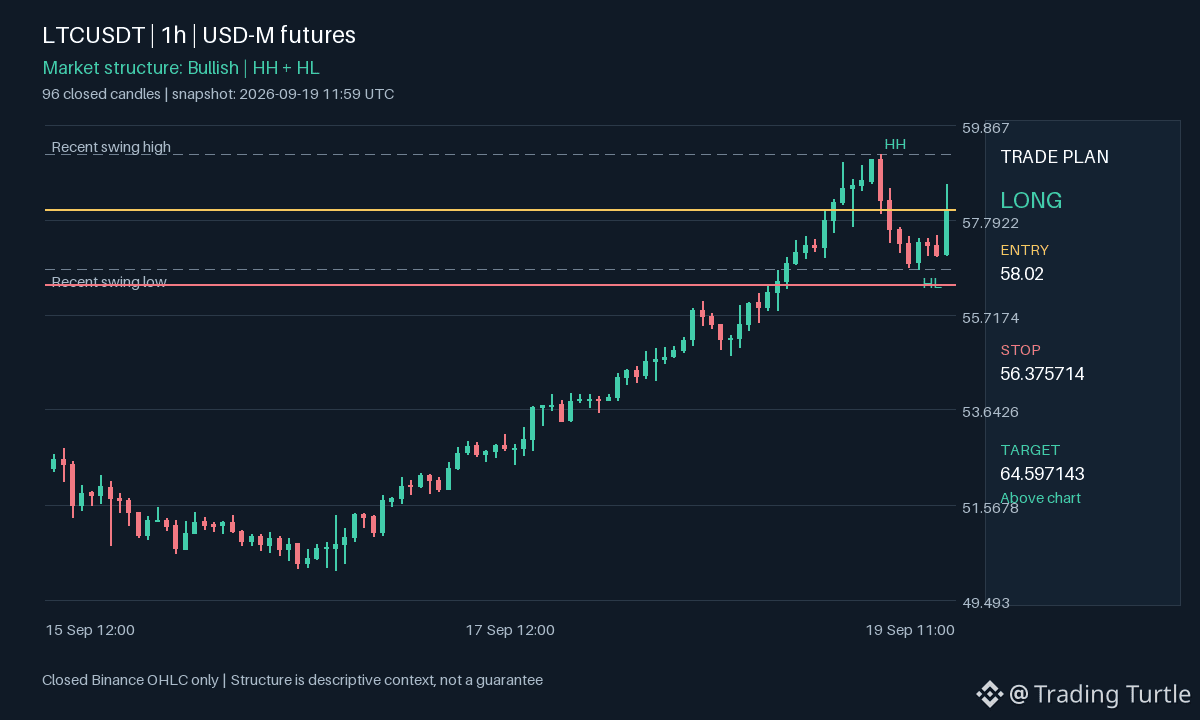
$LTC | 1h | Довгий | #Futuressignal
Вхід: 58.02
Стоп: 56.37571429
Ціль: 64.59714286
R:R: 4
Налаштування сигналу: Це довге swing-закладення сформувалося після продовження swing за структурою ema/adx/dmi. Стоп позначає рівень анулювання, тоді як ціль зберігає заплановану винагороду відносно ризику.
#LTC #CryptoFutures #FuturesTrading #LongSetup
$LTC | 1h | Довгий | #Futuressignal
Вхід: 58.02
Стоп: 56.37571429
Ціль: 64.59714286
R:R: 4
Налаштування сигналу: Це довге swing-закладення сформувалося після продовження swing за структурою ema/adx/dmi. Стоп позначає рівень анулювання, тоді як ціль зберігає заплановану винагороду відносно ризику.
#LTC #CryptoFutures #FuturesTrading #LongSetup
Вхід: 58.02
Стоп: 56.37571429
Ціль: 64.59714286
R:R: 4
Налаштування сигналу: Це довге swing-закладення сформувалося після продовження swing за структурою ema/adx/dmi. Стоп позначає рівень анулювання, тоді як ціль зберігає заплановану винагороду відносно ризику.
#LTC #CryptoFutures #FuturesTrading #LongSetup
101
Переглянути переклад
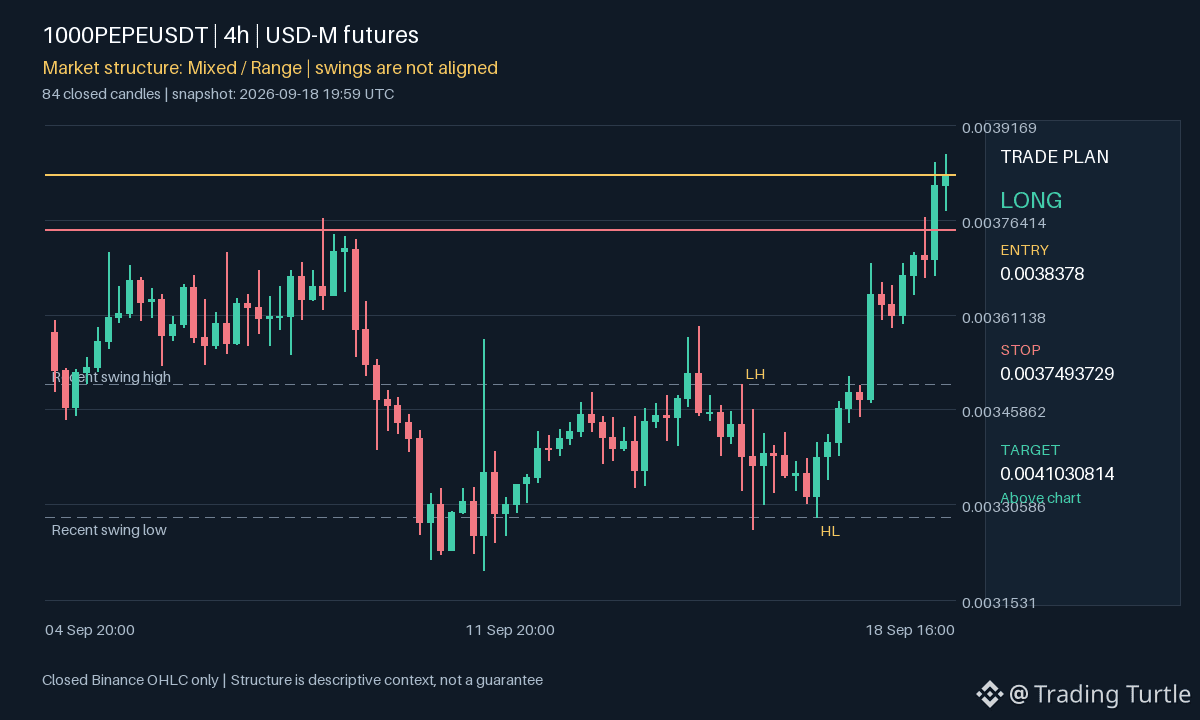
$1000PEPE | 4h | Long | #Futuressignal
Entry: 0.0038378
Stop: 0.00374937
Target: 0.00410308
R:R: 3
Signal Setup: This long breakout setup formed after price closed above prior resistance with confirming volume and candle strength. The stop marks the invalidation level, while the target preserves the planned reward relative to risk.
#1000PEPE #CryptoFutures #FuturesTrading #LongSetup
$1000PEPE | 4h | Long | #Futuressignal
Entry: 0.0038378
Stop: 0.00374937
Target: 0.00410308
R:R: 3
Signal Setup: This long breakout setup formed after price closed above prior resistance with confirming volume and candle strength. The stop marks the invalidation level, while the target preserves the planned reward relative to risk.
#1000PEPE #CryptoFutures #FuturesTrading #LongSetup
Entry: 0.0038378
Stop: 0.00374937
Target: 0.00410308
R:R: 3
Signal Setup: This long breakout setup formed after price closed above prior resistance with confirming volume and candle strength. The stop marks the invalidation level, while the target preserves the planned reward relative to risk.
#1000PEPE #CryptoFutures #FuturesTrading #LongSetup
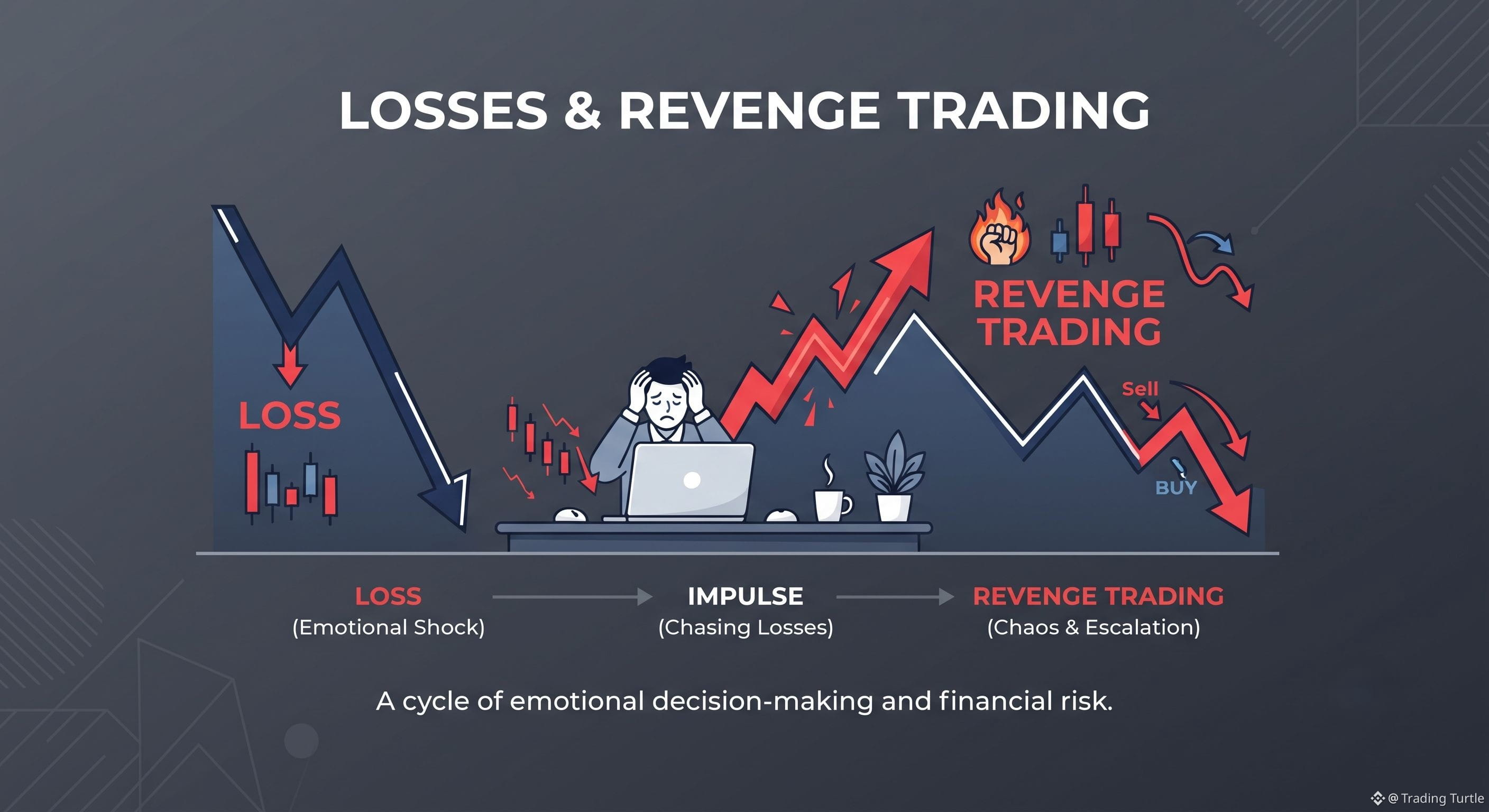
Торговельна психологія · Урок 27
Збитки та трейдинг із помсти
Збиток може створити тиск відшкодувати гроші до того, як буде оцінено наступне рішення.
Збиток може створити тиск відшкодувати гроші негайно, що призводить до більшого розміру позиції, нижчої якості сетапів або змін правил. Трейдинг із помсти перетворює один запланований збиток на послідовність непланованих рішень. Заздалегідь визначений щоденний ліміт ризику, пауза після емоційно значущих збитків і щоденник, який фіксує порушення правил, можуть допомогти відокремити показники стратегії від емоційних реакцій.
Уявіть, що наступна угода більша або менш вибіркова через попередній результат. Тоді нове рішення формує бажання відшкодувати, а не початкові критерії.
Опишіть історичне рішення, не використовуючи результат попередньої угоди як причину для того, щоб ухвалити його.
Далі в цій серії: Щоденник і розбір.
#TradingEducation #PriceAction #RiskManagement #TradingTurtle
Торговельна психологія · Урок 27
Збитки та трейдинг із помсти
Збиток може створити тиск відшкодувати гроші до того, як буде оцінено наступне рішення.
Збиток може створити тиск відшкодувати гроші негайно, що призводить до більшого розміру позиції, нижчої якості сетапів або змін правил. Трейдинг із помсти перетворює один запланований збиток на послідовність непланованих рішень. Заздалегідь визначений щоденний ліміт ризику, пауза після емоційно значущих збитків і щоденник, який фіксує порушення правил, можуть допомогти відокремити показники стратегії від емоційних реакцій.
Уявіть, що наступна угода більша або менш вибіркова через попередній результат. Тоді нове рішення формує бажання відшкодувати, а не початкові критерії.
Опишіть історичне рішення, не використовуючи результат попередньої угоди як причину для того, щоб ухвалити його.
Далі в цій серії: Щоденник і розбір.
#TradingEducation #PriceAction #RiskManagement #TradingTurtle
Збитки та трейдинг із помсти
Збиток може створити тиск відшкодувати гроші до того, як буде оцінено наступне рішення.
Збиток може створити тиск відшкодувати гроші негайно, що призводить до більшого розміру позиції, нижчої якості сетапів або змін правил. Трейдинг із помсти перетворює один запланований збиток на послідовність непланованих рішень. Заздалегідь визначений щоденний ліміт ризику, пауза після емоційно значущих збитків і щоденник, який фіксує порушення правил, можуть допомогти відокремити показники стратегії від емоційних реакцій.
Уявіть, що наступна угода більша або менш вибіркова через попередній результат. Тоді нове рішення формує бажання відшкодувати, а не початкові критерії.
Опишіть історичне рішення, не використовуючи результат попередньої угоди як причину для того, щоб ухвалити його.
Далі в цій серії: Щоденник і розбір.
#TradingEducation #PriceAction #RiskManagement #TradingTurtle
18
#FOMO і погоня
Швидкий рух може створити терміновість ще до того, як з’явиться зрозуміла причина для участі.
Боязнь щось упустити часто виникає після швидкого руху, коли уявлена можливість здається більш нагальною, ніж початковий план. Погоня може погіршити якість входу та змусити трейдера використати таку точку інвалідації, яка більше не відповідає сетапу.
Практична відповідь — заздалегідь визначити прийнятні умови входу та дозволити угоді відбутися без участі, якщо ці умови вже зникли.
Уявіть, що ціна рухається далі, поки запланована умова відсутня. Погоня замінює початкові критерії рішення відчуттям того, що вас лишили позаду.
Опишіть сигнал, який підкаже вам, що терміновість замінює ваш план. Запишіть правило паузи для такої ситуації.
#TradingEducation #PriceAction #RiskManagement
#FOMO і погоня
Швидкий рух може створити терміновість ще до того, як з’явиться зрозуміла причина для участі.
Боязнь щось упустити часто виникає після швидкого руху, коли уявлена можливість здається більш нагальною, ніж початковий план. Погоня може погіршити якість входу та змусити трейдера використати таку точку інвалідації, яка більше не відповідає сетапу.
Практична відповідь — заздалегідь визначити прийнятні умови входу та дозволити угоді відбутися без участі, якщо ці умови вже зникли.
Уявіть, що ціна рухається далі, поки запланована умова відсутня. Погоня замінює початкові критерії рішення відчуттям того, що вас лишили позаду.
Опишіть сигнал, який підкаже вам, що терміновість замінює ваш план. Запишіть правило паузи для такої ситуації.
#TradingEducation #PriceAction #RiskManagement
Швидкий рух може створити терміновість ще до того, як з’явиться зрозуміла причина для участі.
Боязнь щось упустити часто виникає після швидкого руху, коли уявлена можливість здається більш нагальною, ніж початковий план. Погоня може погіршити якість входу та змусити трейдера використати таку точку інвалідації, яка більше не відповідає сетапу.
Практична відповідь — заздалегідь визначити прийнятні умови входу та дозволити угоді відбутися без участі, якщо ці умови вже зникли.
Уявіть, що ціна рухається далі, поки запланована умова відсутня. Погоня замінює початкові критерії рішення відчуттям того, що вас лишили позаду.
Опишіть сигнал, який підкаже вам, що терміновість замінює ваш план. Запишіть правило паузи для такої ситуації.
#TradingEducation #PriceAction #RiskManagement

30
Трейдингова психологія · Урок 25
Планування перед угодою
Рішення, ухвалене до здійснення угоди, легше оцінити, ніж пояснення, вигадане після її завершення.
Трейдинг-план визначає сетап, умови входу, критерії недійсності, ризик позиції та правила менеджменту ще до того, як емоції стануть найсильнішими. Планування не може усунути невизначеність, але воно зменшує кількість рішень, які приймаються імпульсивно, щойно ціна починає рухатися. Добрий план є достатньо конкретним, щоб його можна було виконувати й переглядати, але водночас достатньо простим, щоб трейдер міг виконувати його послідовно.
Уявіть, що письмовий план описує умови, які варто розглядати, і умови, за яких потрібно утриматися. Після події ці критерії роблять рішення легшим для подальшого перегляду.
Напишіть чекліст спостережень для історичного сетапу, включно з тим, коли ця ідея більше не буде актуальною.
Далі в цій серії: FOMO і переслідування (чейзинг).
#TradingEducation #PriceAction #RiskManagement #TradingTurtle
Трейдингова психологія · Урок 25
Планування перед угодою
Рішення, ухвалене до здійснення угоди, легше оцінити, ніж пояснення, вигадане після її завершення.
Трейдинг-план визначає сетап, умови входу, критерії недійсності, ризик позиції та правила менеджменту ще до того, як емоції стануть найсильнішими. Планування не може усунути невизначеність, але воно зменшує кількість рішень, які приймаються імпульсивно, щойно ціна починає рухатися. Добрий план є достатньо конкретним, щоб його можна було виконувати й переглядати, але водночас достатньо простим, щоб трейдер міг виконувати його послідовно.
Уявіть, що письмовий план описує умови, які варто розглядати, і умови, за яких потрібно утриматися. Після події ці критерії роблять рішення легшим для подальшого перегляду.
Напишіть чекліст спостережень для історичного сетапу, включно з тим, коли ця ідея більше не буде актуальною.
Далі в цій серії: FOMO і переслідування (чейзинг).
#TradingEducation #PriceAction #RiskManagement #TradingTurtle
Планування перед угодою
Рішення, ухвалене до здійснення угоди, легше оцінити, ніж пояснення, вигадане після її завершення.
Трейдинг-план визначає сетап, умови входу, критерії недійсності, ризик позиції та правила менеджменту ще до того, як емоції стануть найсильнішими. Планування не може усунути невизначеність, але воно зменшує кількість рішень, які приймаються імпульсивно, щойно ціна починає рухатися. Добрий план є достатньо конкретним, щоб його можна було виконувати й переглядати, але водночас достатньо простим, щоб трейдер міг виконувати його послідовно.
Уявіть, що письмовий план описує умови, які варто розглядати, і умови, за яких потрібно утриматися. Після події ці критерії роблять рішення легшим для подальшого перегляду.
Напишіть чекліст спостережень для історичного сетапу, включно з тим, коли ця ідея більше не буде актуальною.
Далі в цій серії: FOMO і переслідування (чейзинг).
#TradingEducation #PriceAction #RiskManagement #TradingTurtle

29
Переглянути переклад
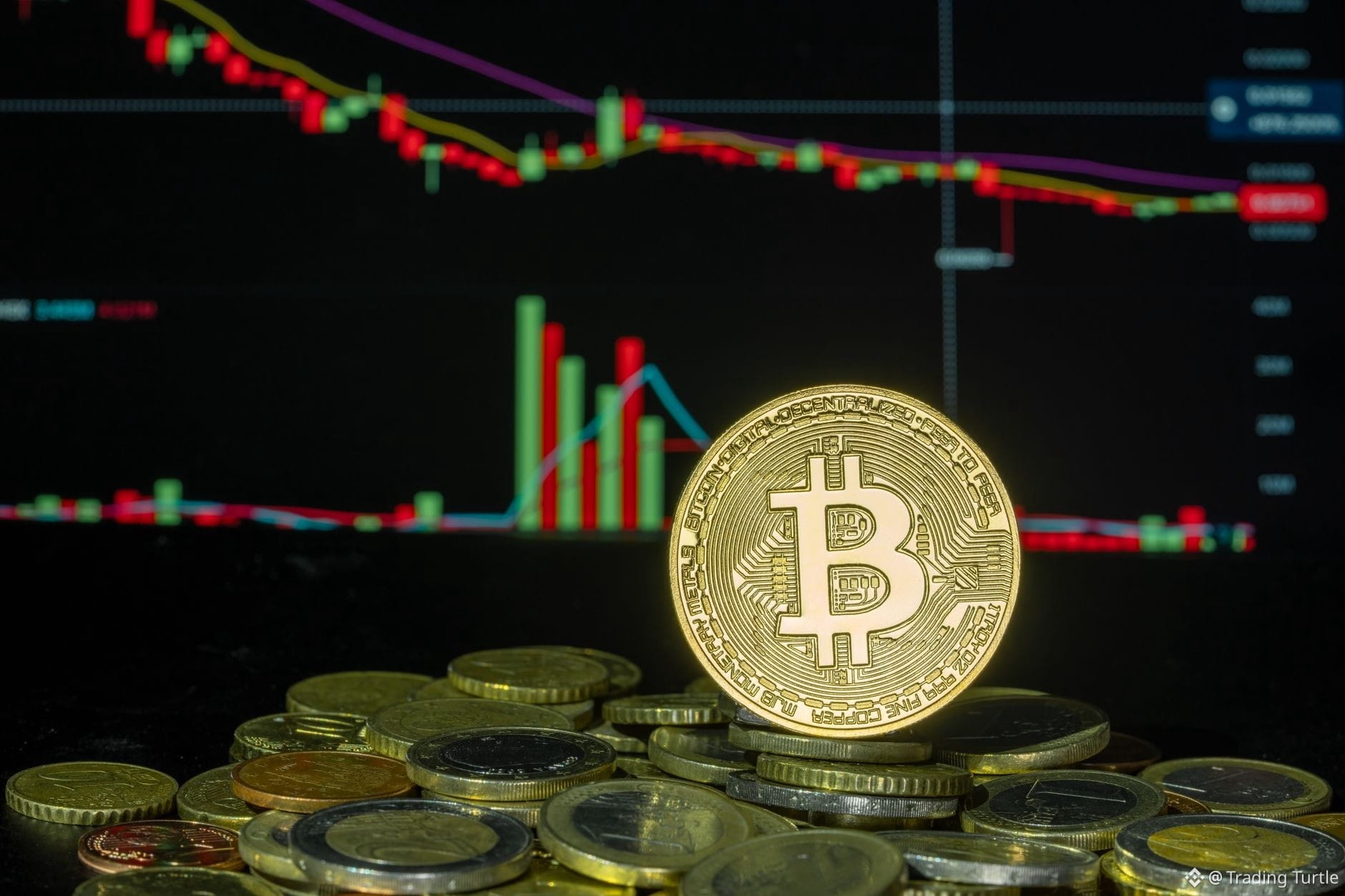
Bitcoin ($BTC) weathers September storm as rate hikes and Clarity act setback test bulls.
Bitcoin is down just 1.5% in its historically weakest month and remains on track for its first quarterly gain in a year, despite rising rates, surging oil and a stronger dollar.
#CryptoNews #DigitalAssets #Bitcoin #Bulls #Clarity
Bitcoin ($BTC ) weathers September storm as rate hikes and Clarity act setback test bulls.
Bitcoin is down just 1.5% in its historically weakest month and remains on track for its first quarterly gain in a year, despite rising rates, surging oil and a stronger dollar.
#CryptoNews #DigitalAssets #Bitcoin #Bulls #Clarity
Bitcoin is down just 1.5% in its historically weakest month and remains on track for its first quarterly gain in a year, despite rising rates, surging oil and a stronger dollar.
#CryptoNews #DigitalAssets #Bitcoin #Bulls #Clarity
58
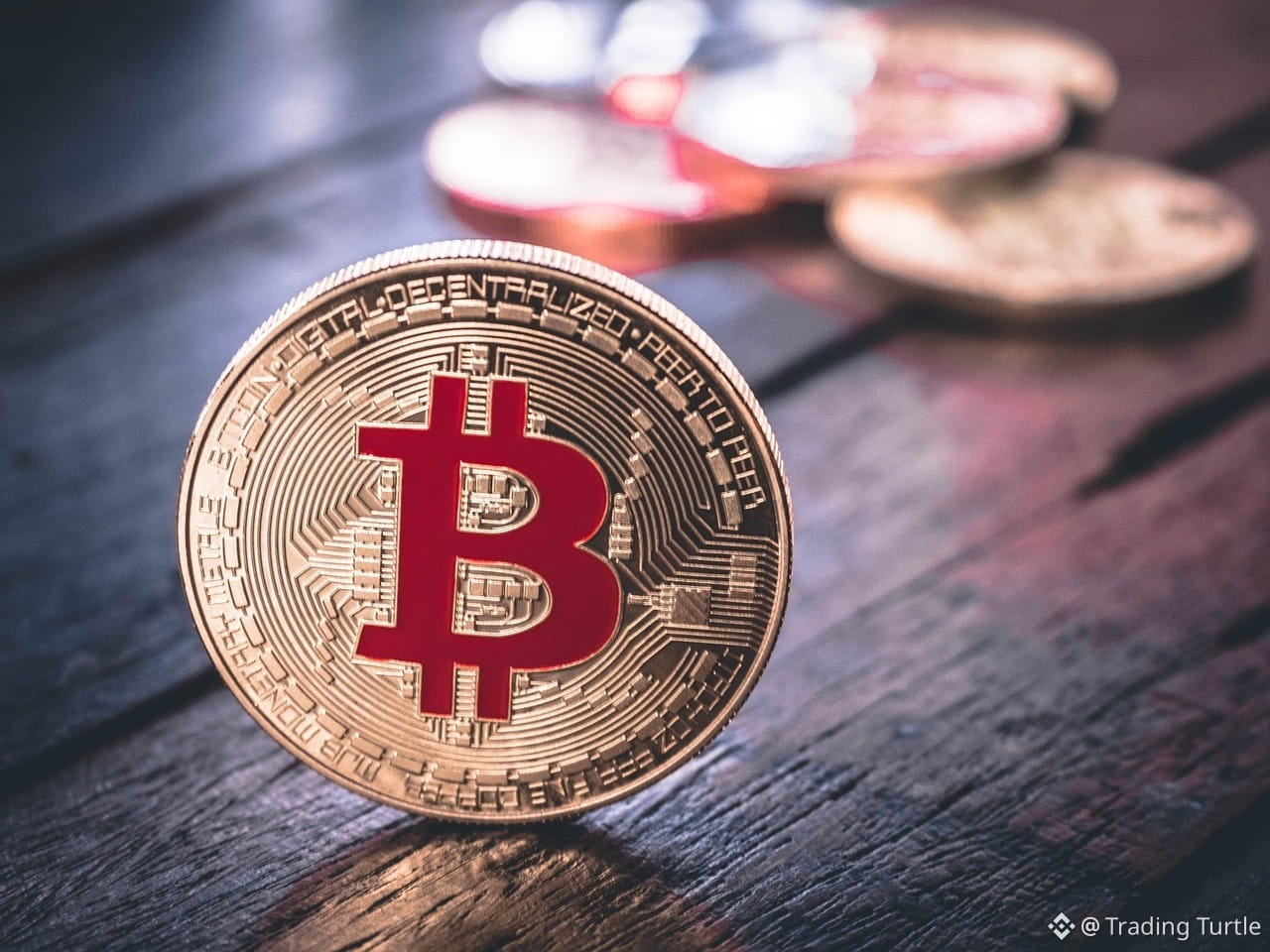
Ефір ($ETH) та $XRP ETF після відтоків, тоді як біткоїн ($BTC) рухається вище $77,000.
Фонди на базі ефіру втрачали кошти третю сесію поспіль, навіть коли токен зростав, тоді як кожен із основних майже токенів зростав, а zcash продовжив свій ранок.
#CryptoNews #DigitalAssets #Above #Bitcoin #Etfs
Ефір ($ETH ) та $XRP ETF після відтоків, тоді як біткоїн ($BTC ) рухається вище $77,000.
Фонди на базі ефіру втрачали кошти третю сесію поспіль, навіть коли токен зростав, тоді як кожен із основних майже токенів зростав, а zcash продовжив свій ранок.
#CryptoNews #DigitalAssets #Above #Bitcoin #Etfs
Фонди на базі ефіру втрачали кошти третю сесію поспіль, навіть коли токен зростав, тоді як кожен із основних майже токенів зростав, а zcash продовжив свій ранок.
#CryptoNews #DigitalAssets #Above #Bitcoin #Etfs
108
Переглянути переклад
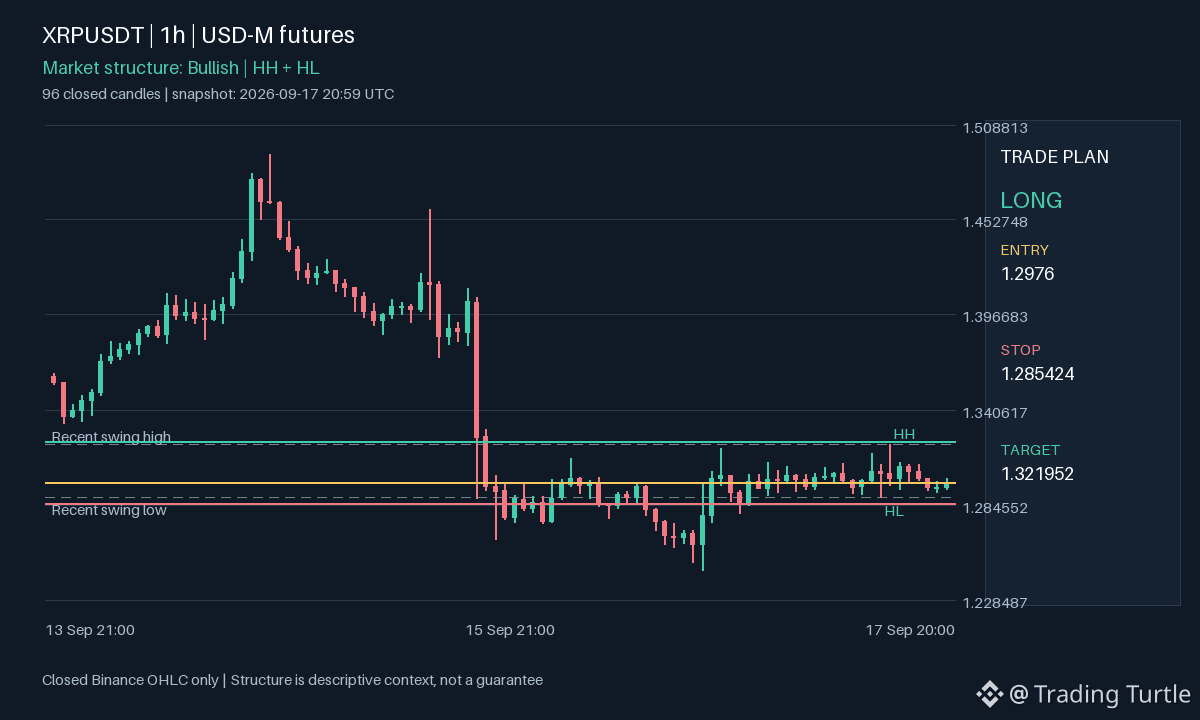
$XRP | 1h | Long | #Futuressignal
Entry: 1.2976
Stop: 1.285424
Target: 1.321952
R:R: 2
Signal Setup: This long range setup formed after price reclaimed higher-timeframe range support after htf rectangle support zone, sweep/reclaim/retest confirmation, oscillator/pattern reversal. The stop marks the invalidation level, while the target preserves the planned reward relative to risk.
#XRP #CryptoFutures #FuturesTrading #LongSetup
$XRP | 1h | Long | #Futuressignal
Entry: 1.2976
Stop: 1.285424
Target: 1.321952
R:R: 2
Signal Setup: This long range setup formed after price reclaimed higher-timeframe range support after htf rectangle support zone, sweep/reclaim/retest confirmation, oscillator/pattern reversal. The stop marks the invalidation level, while the target preserves the planned reward relative to risk.
#XRP #CryptoFutures #FuturesTrading #LongSetup
Entry: 1.2976
Stop: 1.285424
Target: 1.321952
R:R: 2
Signal Setup: This long range setup formed after price reclaimed higher-timeframe range support after htf rectangle support zone, sweep/reclaim/retest confirmation, oscillator/pattern reversal. The stop marks the invalidation level, while the target preserves the planned reward relative to risk.
#XRP #CryptoFutures #FuturesTrading #LongSetup
3
Переглянути переклад
Stop Changing Timeframes to Force a Trade.
Changing timeframes until the chart agrees with the trade you want creates confirmation bias, not analysis.
Pick your timeframe before you decide what the market is doing.
Educational only - not financial advice. #TechnicalAnalysis #MarketStructure
Stop Changing Timeframes to Force a Trade.
Changing timeframes until the chart agrees with the trade you want creates confirmation bias, not analysis.
Pick your timeframe before you decide what the market is doing.
Educational only - not financial advice. #TechnicalAnalysis #MarketStructure
Changing timeframes until the chart agrees with the trade you want creates confirmation bias, not analysis.
Pick your timeframe before you decide what the market is doing.
Educational only - not financial advice. #TechnicalAnalysis #MarketStructure
24
Переглянути переклад
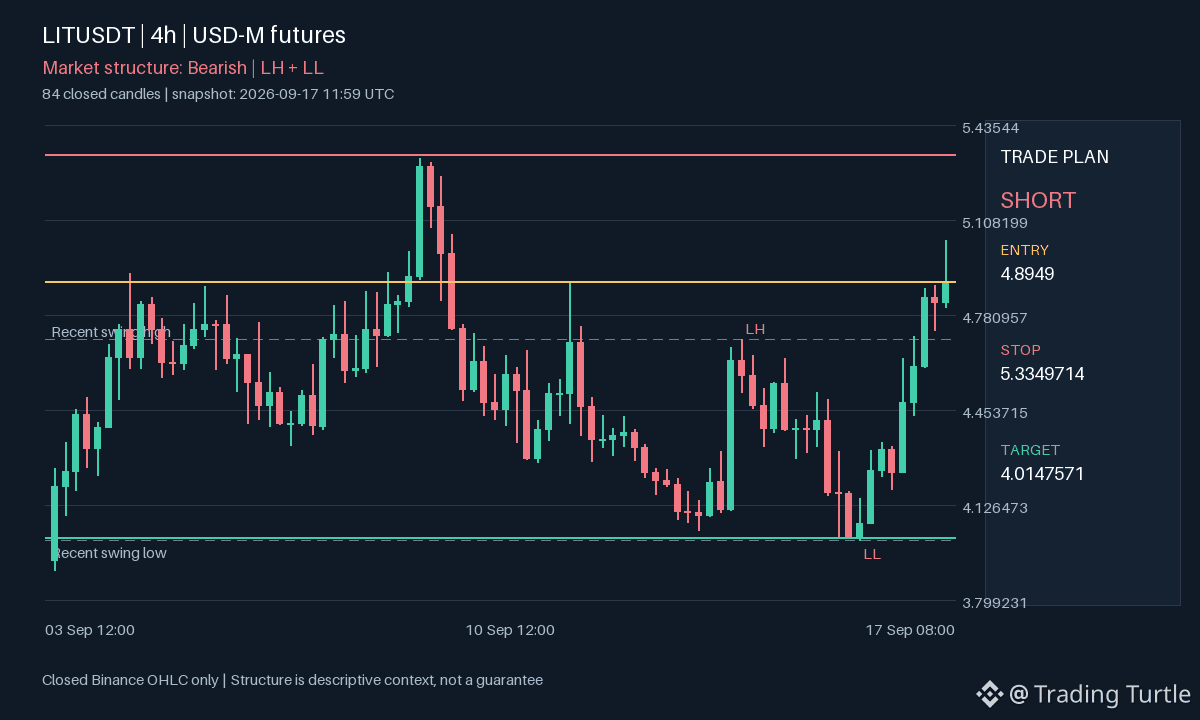
$LIT | 4h | Short | #Futuressignal
Entry: 4.8949
Stop: 5.33497143
Target: 4.01475714
R:R: 2
Signal Setup: This short mean-reversion setup formed after bb20/rsi14 overbought mean reversion in non-trend regime. The stop marks the invalidation level, while the target preserves the planned reward relative to risk.
#LIT #CryptoFutures #FuturesTrading #ShortSetup
$LIT | 4h | Short | #Futuressignal
Entry: 4.8949
Stop: 5.33497143
Target: 4.01475714
R:R: 2
Signal Setup: This short mean-reversion setup formed after bb20/rsi14 overbought mean reversion in non-trend regime. The stop marks the invalidation level, while the target preserves the planned reward relative to risk.
#LIT #CryptoFutures #FuturesTrading #ShortSetup
Entry: 4.8949
Stop: 5.33497143
Target: 4.01475714
R:R: 2
Signal Setup: This short mean-reversion setup formed after bb20/rsi14 overbought mean reversion in non-trend regime. The stop marks the invalidation level, while the target preserves the planned reward relative to risk.
#LIT #CryptoFutures #FuturesTrading #ShortSetup
24
Переглянути переклад
Bitcoin ($BTC) faces 2022 parallels as Federal Reserve resumes rate increases.
Bitcoin’s drawdown mirrors its position before the Fed’s first hike in March 2022, raising questions over whether a relief rally could precede further losses.
#MarketNews #Investing #Bitcoin #Faces #Federal
Bitcoin ($BTC ) faces 2022 parallels as Federal Reserve resumes rate increases.
Bitcoin’s drawdown mirrors its position before the Fed’s first hike in March 2022, raising questions over whether a relief rally could precede further losses.
#MarketNews #Investing #Bitcoin #Faces #Federal
Bitcoin’s drawdown mirrors its position before the Fed’s first hike in March 2022, raising questions over whether a relief rally could precede further losses.
#MarketNews #Investing #Bitcoin #Faces #Federal
36
Стаття
Переглянути переклад
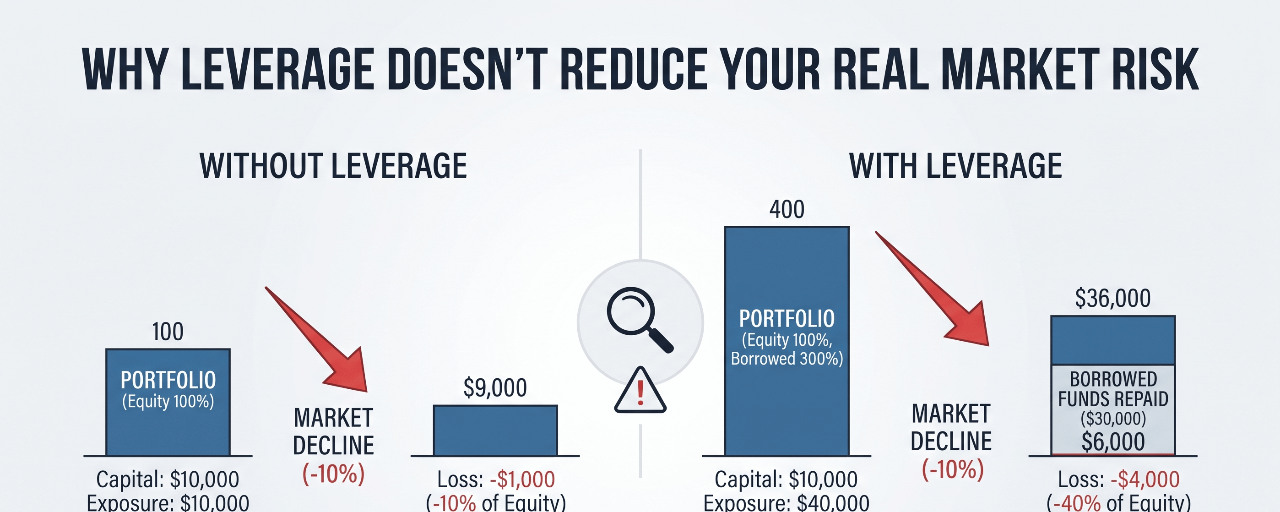
Why Leverage Doesn’t Reduce Your Real Market RiskIntroduction
In crypto futures, the term leverage is often marketed as a way to “amplify profits.” While it indeed lets a trader control a larger notional position with a relatively small margin, it does not reduce the underlying economic exposure of that position. This distinction is essential for anyone who wants to protect capital while navigating volatile markets.
1. What Leverage Actually Does
Leverage allows a trader to control a position whose notional value is larger than the margin committed. For example, with 10× leverage, a $1,000 margin can control a $10,000 notional exposure. The key point is that the trader’s risk—the amount they could lose—still scales with the $10,000 exposure, not the $1,000 margin.
"Leverage allows a trader to control a position whose notional value is larger than the margin committed. It does not reduce the economic exposure of the position."
2. Higher Leverage = Less Room for Adverse Moves
When leverage rises, the price distance a trader can withstand before a margin call shrinks. This is because the same amount of margin now backs a larger notional, so even a modest adverse price move can deplete the margin buffer.
"Higher leverage leaves less room for adverse price movement before margin becomes stressed, so position size and stop‑based account risk remain more important than choosing the highest leverage available."
Consequently, a trader using 50× leverage will see a margin call after a much smaller price swing than a trader using 5× leverage, even if both hold the same notional size.
3. Position Size Trumps Leverage Choice
Because margin stress is directly tied to the notional exposure, position sizing—how much notional you actually take on—becomes the primary lever for risk control. A trader can mitigate risk by:
Limiting Notional Exposure: Choose a notional that aligns with the amount of capital you are willing to risk, regardless of leverage.Setting Stop‑Loss Orders: Define a price level where the position will be exited automatically, capping potential loss.Monitoring Maintenance Margin: Keep an eye on the maintenance margin requirement, which can trigger liquidation if breached.
These practices are more effective than simply selecting a lower leverage, because they directly address the size of the exposure and the exit strategy.
4. A Simple Thought Experiment
Imagine two traders, Alice and Bob, each deposit $1,000 as margin. Alice uses 5× leverage, controlling a $5,000 notional. Bob uses 20× leverage, controlling a $20,000 notional. If the market moves against them by 5%, Alice’s position loses $250 (5% of $5,000), while Bob loses $1,000 (5% of $20,000). Bob’s higher leverage has amplified his loss, even though both posted the same margin.
The lesson: leverage does not shield you from larger losses; it merely magnifies the impact of price moves on the notional you control.
5. Practical Takeaway
Never equate high leverage with low risk. The margin you post is only a fraction of the risk you are taking.Focus on the notional exposure you are comfortable with, and use stop‑losses to define acceptable loss levels.Regularly review maintenance margin requirements to avoid unexpected liquidations.
By internalising these principles, traders can avoid the common pitfall of thinking that a tiny deposit guarantees limited downside.
Conclusion
Leverage is a powerful tool, but it does not diminish the economic exposure of a futures position. Higher leverage reduces the price cushion before a margin call, making disciplined position sizing and stop‑loss management the real safeguards for capital. Understanding this relationship equips traders to use leverage responsibly and protect their portfolios in the fast‑moving crypto futures arena.
For further reading on responsible trading practices, explore Trading Turtle’s broader curriculum on futures mechanics and risk management.
Why Leverage Doesn’t Reduce Your Real Market Risk
Introduction
In crypto futures, the term leverage is often marketed as a way to “amplify profits.” While it indeed lets a trader control a larger notional position with a relatively small margin, it does not reduce the underlying economic exposure of that position. This distinction is essential for anyone who wants to protect capital while navigating volatile markets.
1. What Leverage Actually Does
Leverage allows a trader to control a position whose notional value is larger than the margin committed. For example, with 10× leverage, a $1,000 margin can control a $10,000 notional exposure. The key point is that the trader’s risk—the amount they could lose—still scales with the $10,000 exposure, not the $1,000 margin.
"Leverage allows a trader to control a position whose notional value is larger than the margin committed. It does not reduce the economic exposure of the position."
2. Higher Leverage = Less Room for Adverse Moves
When leverage rises, the price distance a trader can withstand before a margin call shrinks. This is because the same amount of margin now backs a larger notional, so even a modest adverse price move can deplete the margin buffer.
"Higher leverage leaves less room for adverse price movement before margin becomes stressed, so position size and stop‑based account risk remain more important than choosing the highest leverage available."
Consequently, a trader using 50× leverage will see a margin call after a much smaller price swing than a trader using 5× leverage, even if both hold the same notional size.
3. Position Size Trumps Leverage Choice
Because margin stress is directly tied to the notional exposure, position sizing—how much notional you actually take on—becomes the primary lever for risk control. A trader can mitigate risk by:
Limiting Notional Exposure: Choose a notional that aligns with the amount of capital you are willing to risk, regardless of leverage.Setting Stop‑Loss Orders: Define a price level where the position will be exited automatically, capping potential loss.Monitoring Maintenance Margin: Keep an eye on the maintenance margin requirement, which can trigger liquidation if breached.
These practices are more effective than simply selecting a lower leverage, because they directly address the size of the exposure and the exit strategy.
4. A Simple Thought Experiment
Imagine two traders, Alice and Bob, each deposit $1,000 as margin. Alice uses 5× leverage, controlling a $5,000 notional. Bob uses 20× leverage, controlling a $20,000 notional. If the market moves against them by 5%, Alice’s position loses $250 (5% of $5,000), while Bob loses $1,000 (5% of $20,000). Bob’s higher leverage has amplified his loss, even though both posted the same margin.
The lesson: leverage does not shield you from larger losses; it merely magnifies the impact of price moves on the notional you control.
5. Practical Takeaway
Never equate high leverage with low risk. The margin you post is only a fraction of the risk you are taking.Focus on the notional exposure you are comfortable with, and use stop‑losses to define acceptable loss levels.Regularly review maintenance margin requirements to avoid unexpected liquidations.
By internalising these principles, traders can avoid the common pitfall of thinking that a tiny deposit guarantees limited downside.
Conclusion
Leverage is a powerful tool, but it does not diminish the economic exposure of a futures position. Higher leverage reduces the price cushion before a margin call, making disciplined position sizing and stop‑loss management the real safeguards for capital. Understanding this relationship equips traders to use leverage responsibly and protect their portfolios in the fast‑moving crypto futures arena.
For further reading on responsible trading practices, explore Trading Turtle’s broader curriculum on futures mechanics and risk management.
In crypto futures, the term leverage is often marketed as a way to “amplify profits.” While it indeed lets a trader control a larger notional position with a relatively small margin, it does not reduce the underlying economic exposure of that position. This distinction is essential for anyone who wants to protect capital while navigating volatile markets.
1. What Leverage Actually Does
Leverage allows a trader to control a position whose notional value is larger than the margin committed. For example, with 10× leverage, a $1,000 margin can control a $10,000 notional exposure. The key point is that the trader’s risk—the amount they could lose—still scales with the $10,000 exposure, not the $1,000 margin.
"Leverage allows a trader to control a position whose notional value is larger than the margin committed. It does not reduce the economic exposure of the position."
2. Higher Leverage = Less Room for Adverse Moves
When leverage rises, the price distance a trader can withstand before a margin call shrinks. This is because the same amount of margin now backs a larger notional, so even a modest adverse price move can deplete the margin buffer.
"Higher leverage leaves less room for adverse price movement before margin becomes stressed, so position size and stop‑based account risk remain more important than choosing the highest leverage available."
Consequently, a trader using 50× leverage will see a margin call after a much smaller price swing than a trader using 5× leverage, even if both hold the same notional size.
3. Position Size Trumps Leverage Choice
Because margin stress is directly tied to the notional exposure, position sizing—how much notional you actually take on—becomes the primary lever for risk control. A trader can mitigate risk by:
Limiting Notional Exposure: Choose a notional that aligns with the amount of capital you are willing to risk, regardless of leverage.Setting Stop‑Loss Orders: Define a price level where the position will be exited automatically, capping potential loss.Monitoring Maintenance Margin: Keep an eye on the maintenance margin requirement, which can trigger liquidation if breached.
These practices are more effective than simply selecting a lower leverage, because they directly address the size of the exposure and the exit strategy.
4. A Simple Thought Experiment
Imagine two traders, Alice and Bob, each deposit $1,000 as margin. Alice uses 5× leverage, controlling a $5,000 notional. Bob uses 20× leverage, controlling a $20,000 notional. If the market moves against them by 5%, Alice’s position loses $250 (5% of $5,000), while Bob loses $1,000 (5% of $20,000). Bob’s higher leverage has amplified his loss, even though both posted the same margin.
The lesson: leverage does not shield you from larger losses; it merely magnifies the impact of price moves on the notional you control.
5. Practical Takeaway
Never equate high leverage with low risk. The margin you post is only a fraction of the risk you are taking.Focus on the notional exposure you are comfortable with, and use stop‑losses to define acceptable loss levels.Regularly review maintenance margin requirements to avoid unexpected liquidations.
By internalising these principles, traders can avoid the common pitfall of thinking that a tiny deposit guarantees limited downside.
Conclusion
Leverage is a powerful tool, but it does not diminish the economic exposure of a futures position. Higher leverage reduces the price cushion before a margin call, making disciplined position sizing and stop‑loss management the real safeguards for capital. Understanding this relationship equips traders to use leverage responsibly and protect their portfolios in the fast‑moving crypto futures arena.
For further reading on responsible trading practices, explore Trading Turtle’s broader curriculum on futures mechanics and risk management.
49
Тренд- і діапазонна торгівля · Урок 20
Прорив діапазону та ретест
Повернення до зламаної межі діапазону не гарантує, що вона втримується.
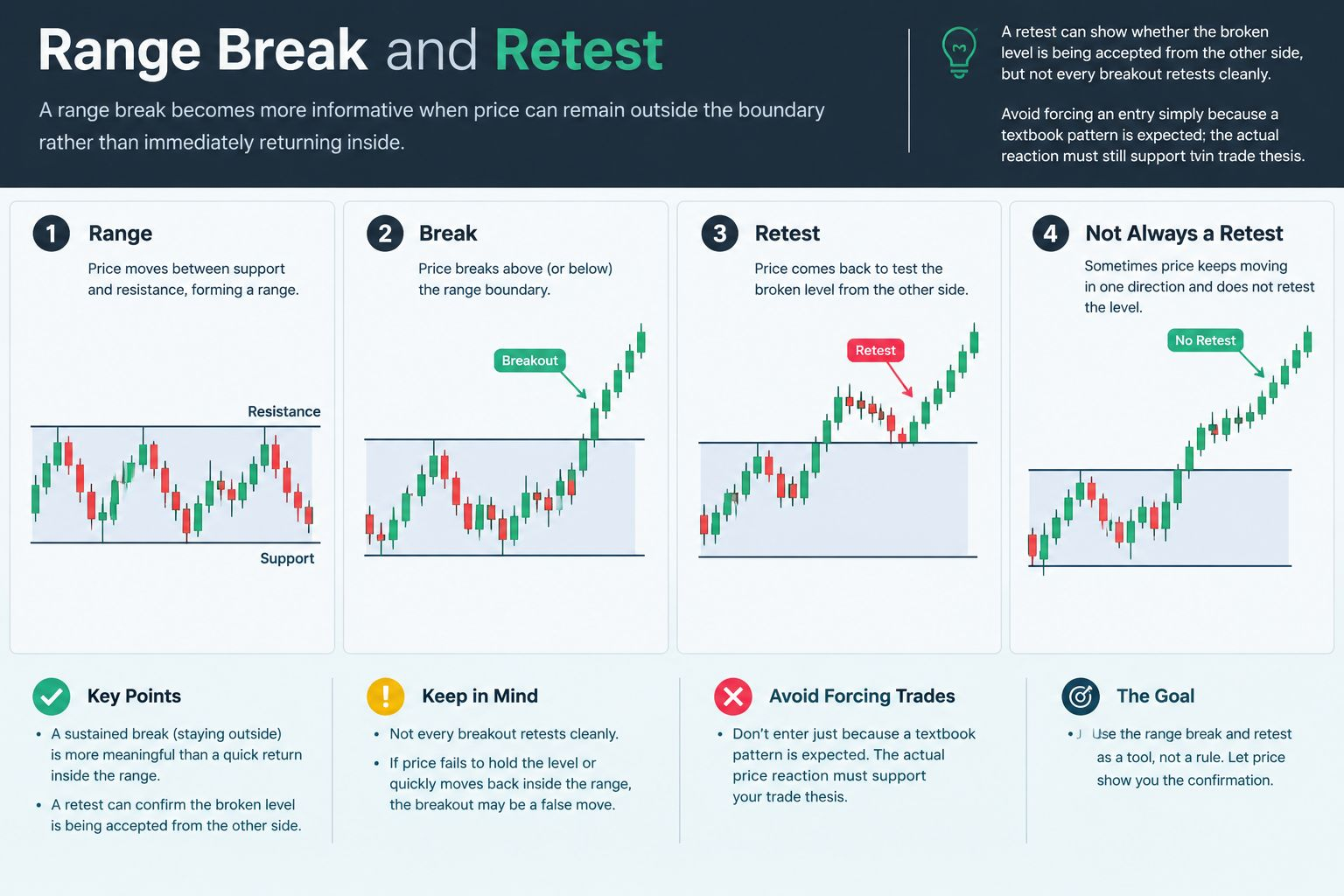
Прорив діапазону стає більш інформативним, коли ціна може залишатися за межами, а не відразу повертатися всередину. Ретест може показати, чи приймається зламаний рівень з іншого боку, але не кожен пробій ретеститься бездоганно. Трейдерам слід уникати спроби «продавити» вхід лише тому, що очікується шаблон із підручника; фактична реакція все одно має підтримувати торгову тезу.
Порівняйте ретест, який залишається за межами колишнього діапазону, з тим, що повертається всередину. Реакція важливіша, ніж просто називати дотик ретестом.
Опишіть історичний прорив діапазону та подальшу реакцію, не припускаючи, що прорив обов’язково мав спрацювати.
Далі в цій серії: Кредитне плече та номінальна експозиція.
#TradingEducation #PriceAction #RiskManagement #TradingTurtle
Тренд- і діапазонна торгівля · Урок 20
Прорив діапазону та ретест
Повернення до зламаної межі діапазону не гарантує, що вона втримується.
Прорив діапазону стає більш інформативним, коли ціна може залишатися за межами, а не відразу повертатися всередину. Ретест може показати, чи приймається зламаний рівень з іншого боку, але не кожен пробій ретеститься бездоганно. Трейдерам слід уникати спроби «продавити» вхід лише тому, що очікується шаблон із підручника; фактична реакція все одно має підтримувати торгову тезу.
Порівняйте ретест, який залишається за межами колишнього діапазону, з тим, що повертається всередину. Реакція важливіша, ніж просто називати дотик ретестом.
Опишіть історичний прорив діапазону та подальшу реакцію, не припускаючи, що прорив обов’язково мав спрацювати.
Далі в цій серії: Кредитне плече та номінальна експозиція.
#TradingEducation #PriceAction #RiskManagement #TradingTurtle
Прорив діапазону та ретест
Повернення до зламаної межі діапазону не гарантує, що вона втримується.
Прорив діапазону стає більш інформативним, коли ціна може залишатися за межами, а не відразу повертатися всередину. Ретест може показати, чи приймається зламаний рівень з іншого боку, але не кожен пробій ретеститься бездоганно. Трейдерам слід уникати спроби «продавити» вхід лише тому, що очікується шаблон із підручника; фактична реакція все одно має підтримувати торгову тезу.
Порівняйте ретест, який залишається за межами колишнього діапазону, з тим, що повертається всередину. Реакція важливіша, ніж просто називати дотик ретестом.
Опишіть історичний прорив діапазону та подальшу реакцію, не припускаючи, що прорив обов’язково мав спрацювати.
Далі в цій серії: Кредитне плече та номінальна експозиція.
#TradingEducation #PriceAction #RiskManagement #TradingTurtle
71
Переглянути переклад
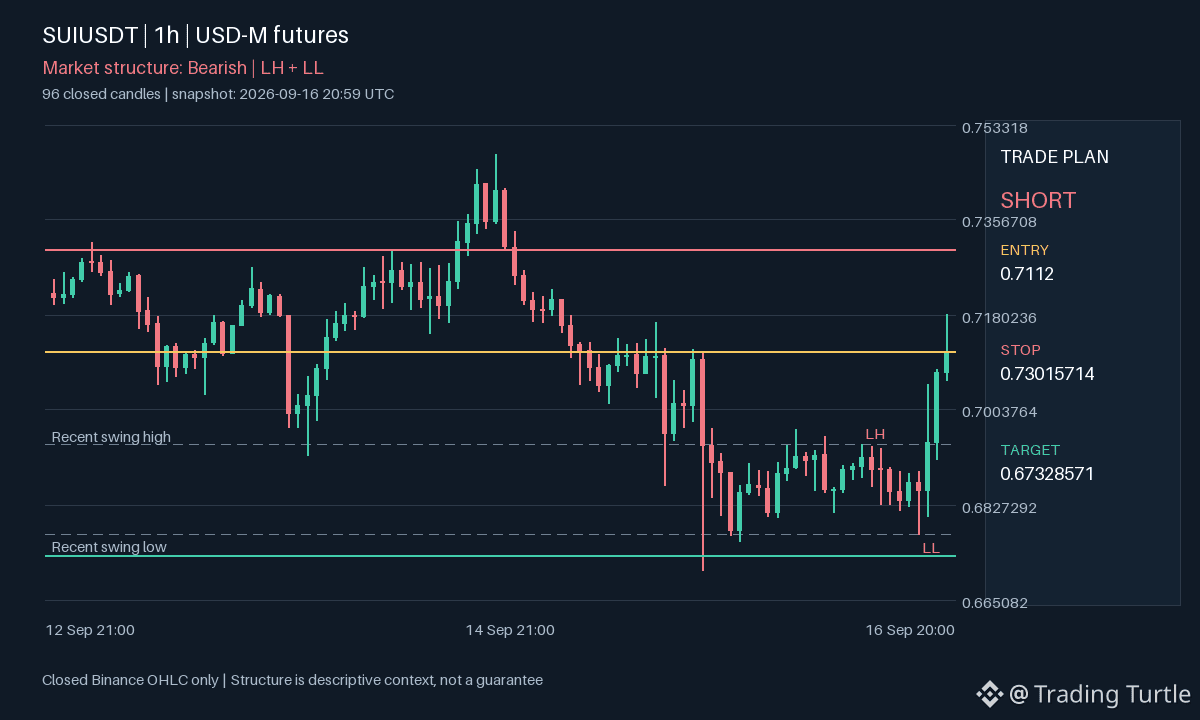
$SUI | 1h | Short | #Futuressignal
Entry: 0.7112
Stop: 0.73015714
Target: 0.67328571
R:R: 2
Signal Setup: This short mean-reversion setup formed after bb20/rsi14 overbought mean reversion in non-trend regime. The stop marks the invalidation level, while the target preserves the planned reward relative to risk.
#SUI #CryptoFutures #FuturesTrading #ShortSetup
$SUI | 1h | Short | #Futuressignal
Entry: 0.7112
Stop: 0.73015714
Target: 0.67328571
R:R: 2
Signal Setup: This short mean-reversion setup formed after bb20/rsi14 overbought mean reversion in non-trend regime. The stop marks the invalidation level, while the target preserves the planned reward relative to risk.
#SUI #CryptoFutures #FuturesTrading #ShortSetup
Entry: 0.7112
Stop: 0.73015714
Target: 0.67328571
R:R: 2
Signal Setup: This short mean-reversion setup formed after bb20/rsi14 overbought mean reversion in non-trend regime. The stop marks the invalidation level, while the target preserves the planned reward relative to risk.
#SUI #CryptoFutures #FuturesTrading #ShortSetup
Переглянути переклад
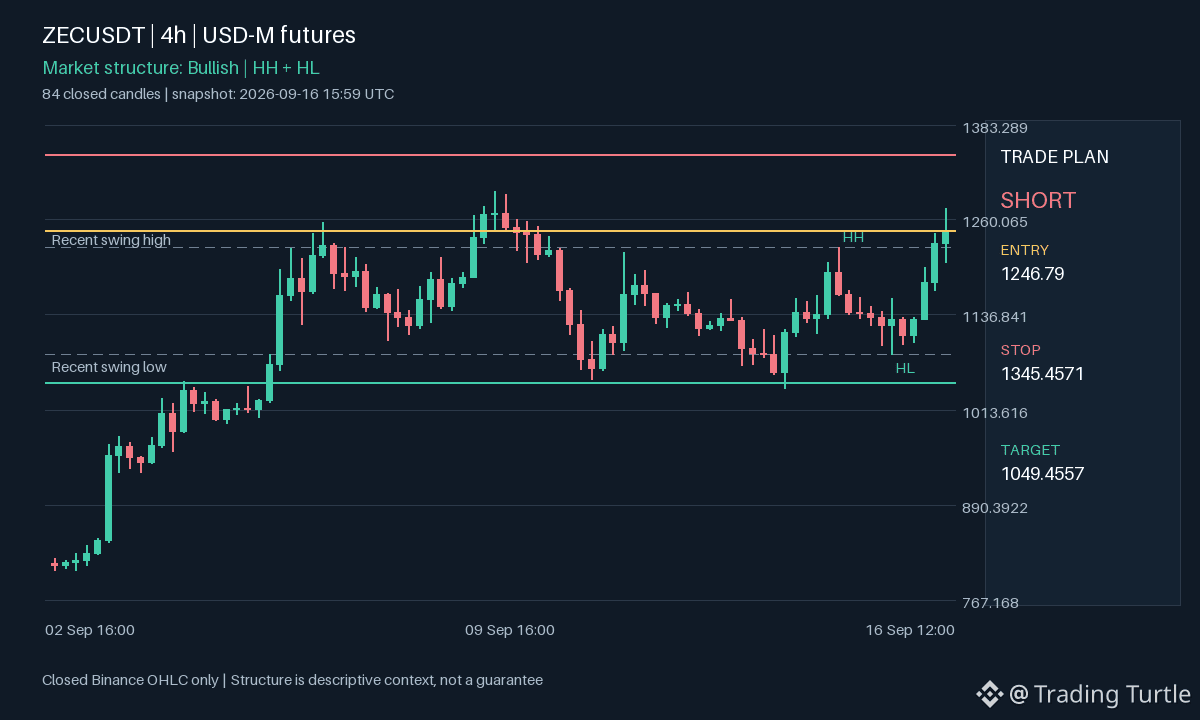
$ZEC | 4h | Short | #Futuressignal
Entry: 1246.79
Stop: 1345.45714286
Target: 1049.45571429
R:R: 2
Signal Setup: This short mean-reversion setup formed after bb20/rsi14 overbought mean reversion in non-trend regime. The stop marks the invalidation level, while the target preserves the planned reward relative to risk.
#ZEC #CryptoFutures #FuturesTrading #ShortSetup
$ZEC | 4h | Short | #Futuressignal
Entry: 1246.79
Stop: 1345.45714286
Target: 1049.45571429
R:R: 2
Signal Setup: This short mean-reversion setup formed after bb20/rsi14 overbought mean reversion in non-trend regime. The stop marks the invalidation level, while the target preserves the planned reward relative to risk.
#ZEC #CryptoFutures #FuturesTrading #ShortSetup
Entry: 1246.79
Stop: 1345.45714286
Target: 1049.45571429
R:R: 2
Signal Setup: This short mean-reversion setup formed after bb20/rsi14 overbought mean reversion in non-trend regime. The stop marks the invalidation level, while the target preserves the planned reward relative to risk.
#ZEC #CryptoFutures #FuturesTrading #ShortSetup
148
Переглянути переклад
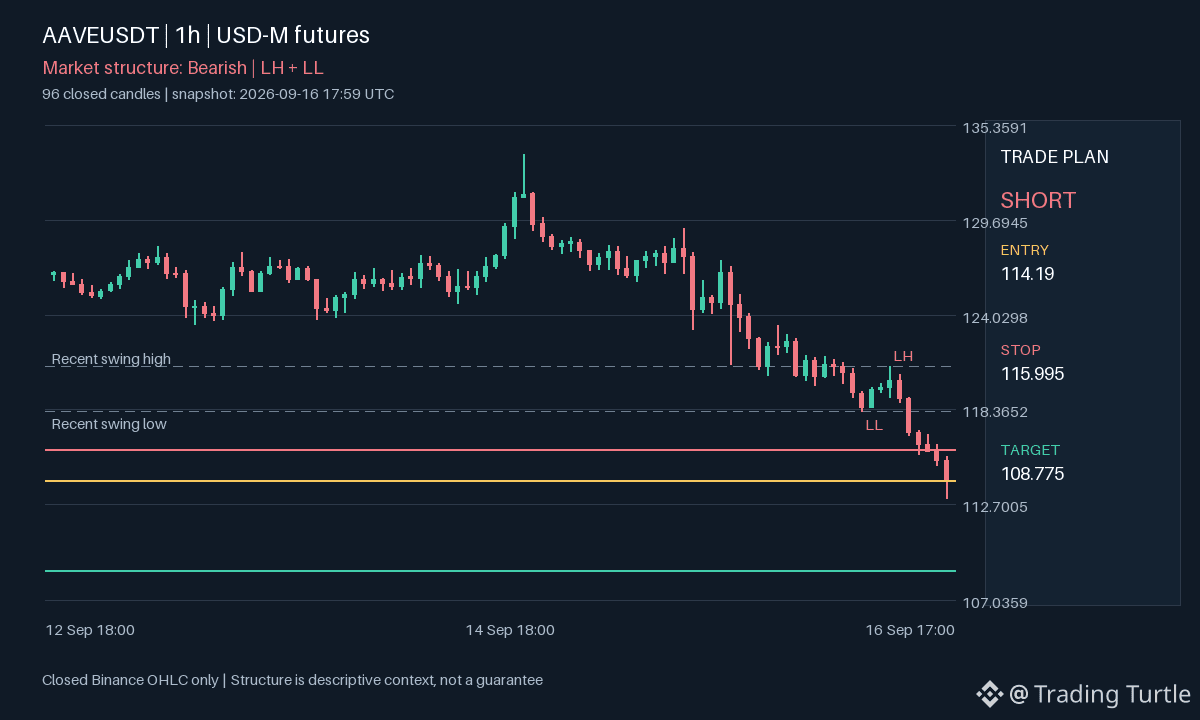
$AAVE | 1h | Short | #Futuressignal
Entry: 114.19
Stop: 115.995
Target: 108.775
R:R: 3
Signal Setup: This short breakout setup formed after price closed below prior support with confirming volume and candle strength. The stop marks the invalidation level, while the target preserves the planned reward relative to risk.
#AAVE #CryptoFutures #FuturesTrading #ShortSetup
$AAVE | 1h | Short | #Futuressignal
Entry: 114.19
Stop: 115.995
Target: 108.775
R:R: 3
Signal Setup: This short breakout setup formed after price closed below prior support with confirming volume and candle strength. The stop marks the invalidation level, while the target preserves the planned reward relative to risk.
#AAVE #CryptoFutures #FuturesTrading #ShortSetup
Entry: 114.19
Stop: 115.995
Target: 108.775
R:R: 3
Signal Setup: This short breakout setup formed after price closed below prior support with confirming volume and candle strength. The stop marks the invalidation level, while the target preserves the planned reward relative to risk.
#AAVE #CryptoFutures #FuturesTrading #ShortSetup
Тренд- та діапазонна торгівля · Урок 18
Відкати в тренді
Рух проти тренду може бути звичайною флуктуацією або початком структурного пошкодження.
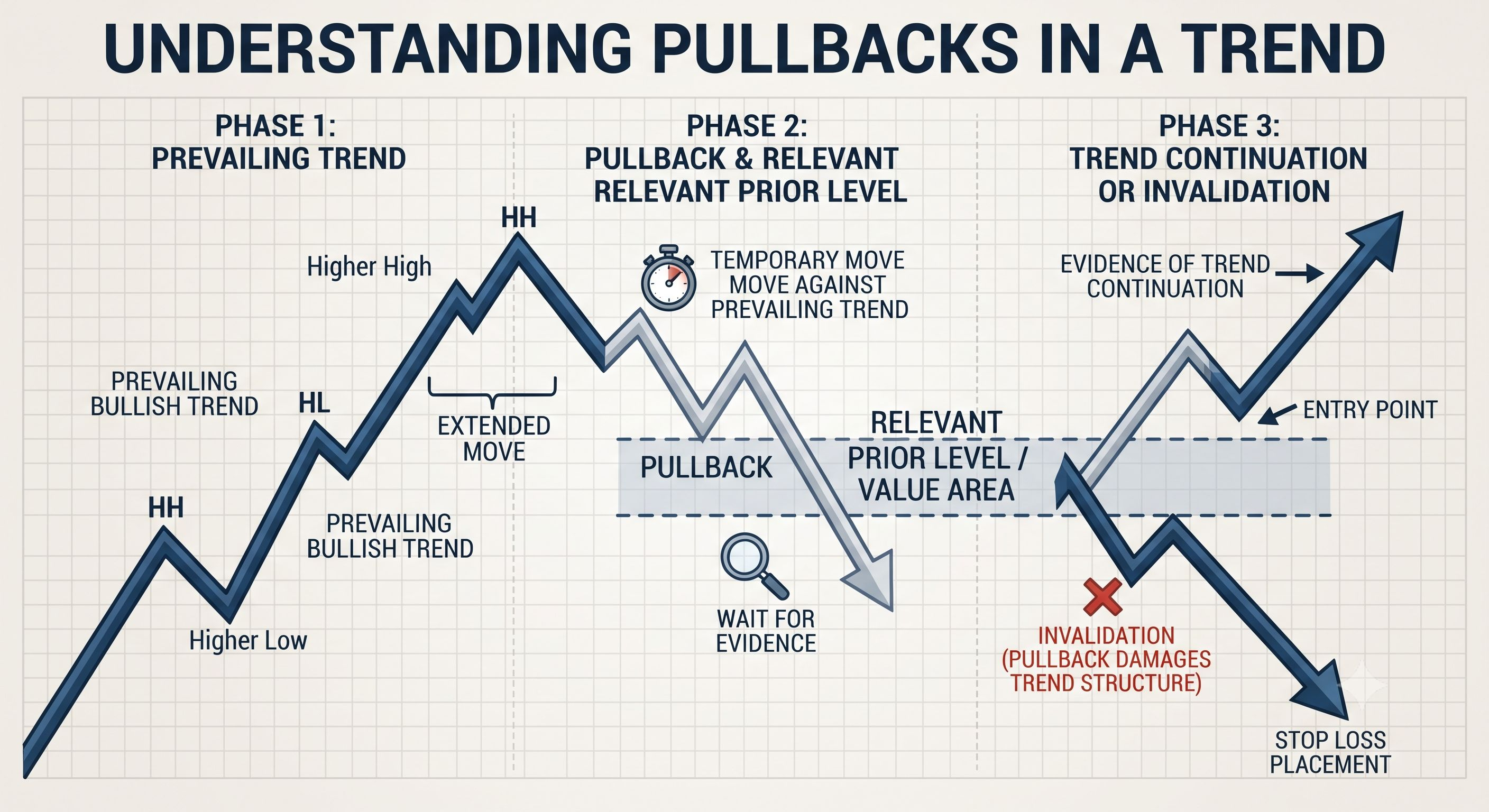
Відкат — це тимчасовий рух проти домінуючого тренду. Замість того щоб наздоганяти затяжний рух, трейдери часто чекають, чи ціна відкотиться до релевантного попереднього рівня або зони цінності, а потім покаже докази продовження тренду. Сценарій є недійсним, якщо відкат руйнує структуру, яка визначала тренд, тож вхід на відкат усе одно потребує чіткої умови анулювання.
Уявіть, що відкат утримує значущий попередній коливальний розмах, а потім порівняйте його з тим, який ламає його та не відновлюється. Обидва рухи відбуваються проти тренду, але їхні наслідки різні.
Опишіть історичний відкат і той свінг, який задає йому контекст. Поясніть, які докази змінили б ваше трактування.
Далі в цій серії: Розпізнавання діапазону.
#TradingEducation #PriceAction #RiskManagement #TradingTurtle
Тренд- та діапазонна торгівля · Урок 18
Відкати в тренді
Рух проти тренду може бути звичайною флуктуацією або початком структурного пошкодження.
Відкат — це тимчасовий рух проти домінуючого тренду. Замість того щоб наздоганяти затяжний рух, трейдери часто чекають, чи ціна відкотиться до релевантного попереднього рівня або зони цінності, а потім покаже докази продовження тренду. Сценарій є недійсним, якщо відкат руйнує структуру, яка визначала тренд, тож вхід на відкат усе одно потребує чіткої умови анулювання.
Уявіть, що відкат утримує значущий попередній коливальний розмах, а потім порівняйте його з тим, який ламає його та не відновлюється. Обидва рухи відбуваються проти тренду, але їхні наслідки різні.
Опишіть історичний відкат і той свінг, який задає йому контекст. Поясніть, які докази змінили б ваше трактування.
Далі в цій серії: Розпізнавання діапазону.
#TradingEducation #PriceAction #RiskManagement #TradingTurtle
Відкати в тренді
Рух проти тренду може бути звичайною флуктуацією або початком структурного пошкодження.
Відкат — це тимчасовий рух проти домінуючого тренду. Замість того щоб наздоганяти затяжний рух, трейдери часто чекають, чи ціна відкотиться до релевантного попереднього рівня або зони цінності, а потім покаже докази продовження тренду. Сценарій є недійсним, якщо відкат руйнує структуру, яка визначала тренд, тож вхід на відкат усе одно потребує чіткої умови анулювання.
Уявіть, що відкат утримує значущий попередній коливальний розмах, а потім порівняйте його з тим, який ламає його та не відновлюється. Обидва рухи відбуваються проти тренду, але їхні наслідки різні.
Опишіть історичний відкат і той свінг, який задає йому контекст. Поясніть, які докази змінили б ваше трактування.
Далі в цій серії: Розпізнавання діапазону.
#TradingEducation #PriceAction #RiskManagement #TradingTurtle
23
Переглянути переклад
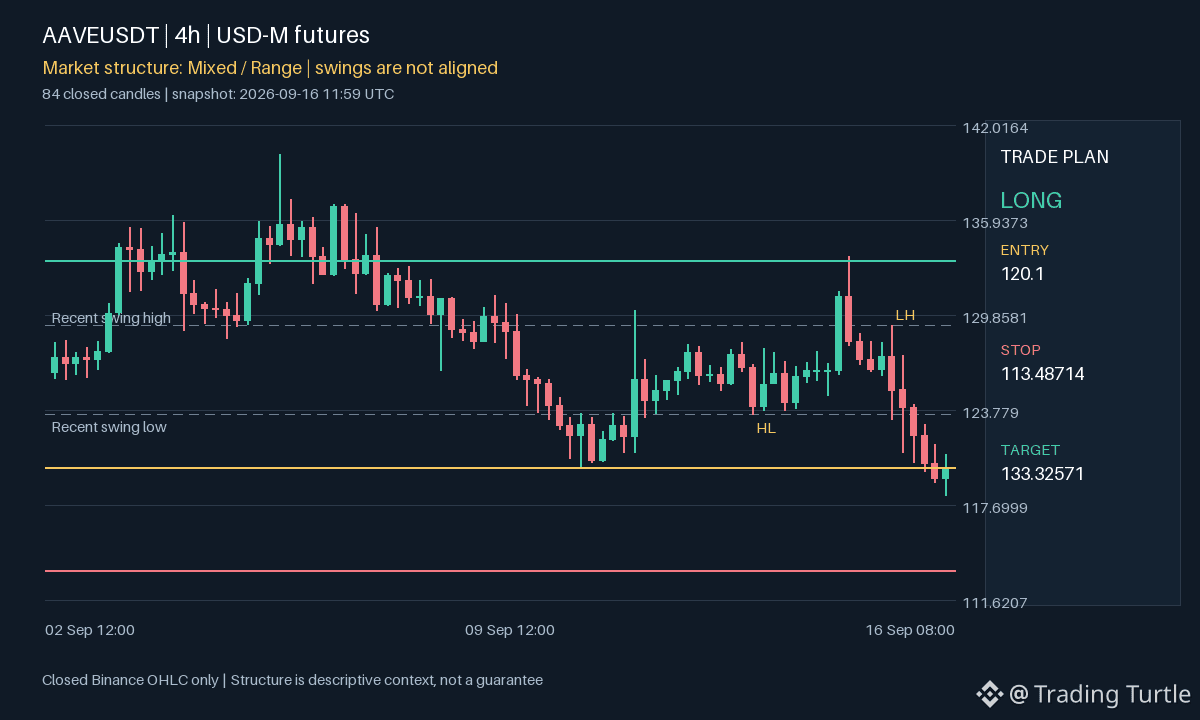
$AAVE | 4h | Long | #Futuressignal
Entry: 120.1
Stop: 113.48714286
Target: 133.32571429
R:R: 2
Signal Setup: This long mean-reversion setup formed after price became oversold near the lower Bollinger Band while RSI and the non-trending market supported a mean-reversion move. The stop marks the invalidation level, while the target preserves the planned reward relative to risk.
#AAVE #CryptoFutures #FuturesTrading #LongSetup
$AAVE | 4h | Long | #Futuressignal
Entry: 120.1
Stop: 113.48714286
Target: 133.32571429
R:R: 2
Signal Setup: This long mean-reversion setup formed after price became oversold near the lower Bollinger Band while RSI and the non-trending market supported a mean-reversion move. The stop marks the invalidation level, while the target preserves the planned reward relative to risk.
#AAVE #CryptoFutures #FuturesTrading #LongSetup
Entry: 120.1
Stop: 113.48714286
Target: 133.32571429
R:R: 2
Signal Setup: This long mean-reversion setup formed after price became oversold near the lower Bollinger Band while RSI and the non-trending market supported a mean-reversion move. The stop marks the invalidation level, while the target preserves the planned reward relative to risk.
#AAVE #CryptoFutures #FuturesTrading #LongSetup
27
Увійдіть, щоб переглянути інший контент
Приєднуйтесь до користувачів криптовалют по всьому світу на Binance Square
⚡️ Отримуйте актуальну та корисну інформацію про криптовалюти.
💬 Приєднуйтесь до найбільшої у світі криптобіржі.
👍 Відкрийте справжні ідеї від перевірених авторів.
Електронна пошта / номер телефону
Трендові теми
fomcвідстеження
25,030 переглядів
291 обговорюють
#fomcвідстеження 🏛️ FOMC та ФРС: Чому за ними стежить весь крипторинок?
Засідання Комітету з відкритих ринків ФРС США (FOMC) — це головний тригер волатильності у світі фінансів. Саме тут вирішується доля облікової ставки, яка визначає вартість грошей у глобальній економіці.
💥 Як це впливає на криптовалюту:
• 🟢 Пом'якшення політики («Голуби»): Коли ФРС знижує ставку, кредити стають дешевшими. Ліквідність перетікає в ризикові активи — Bitcoin та ринок акцій починають бурхливе зростання.
• 🔴 Жорстка риторика («Яструби»): Якщо ФРС піднімає ставку або заявляє про загрозу інфляції, долар зміцнюється, а ринки миттєво падають у мінус.
• ⚡ Шторм у момент новин: Під час оголошення рішення за лічені хвилини вибиваються тисячі маржинальних позицій в обидва боки.
💡 Головне правило трейдера:
Не заходьте у ф'ючерсні угоди за 15–30 хвилин до публікації протоколів FOMC. Краще почекати, поки ринок визначить чіткий тренд після виступу очільника ФРС.
🏷️ #ФРС #CryptoNews #bitcoin #TrendingTopic
Michele Lemke MHCE
·1 вподобань
·277 переглядів
BOJRaisesRatesTo31YearHigh
68,087 переглядів
1,116 обговорюють
BuffettStepsDownAsBerkshireChairman
29,992 переглядів
520 обговорюють