
Understanding investor sentiment can be a crucial but tricky source of information in the volatile cryptocurrency market. Ki Young Ju, CEO and co-founder of CryptoQuant, recently said that large investors are still participating in the market in "risk-on mode." (Official account: Pepe Soha)
According to a post shared by Ki Young Ju with his over 300,000 followers on microblogging platform X (formerly known as Twitter), Bitcoin whales are still taking risks by sending their coins to derivatives trading platforms.
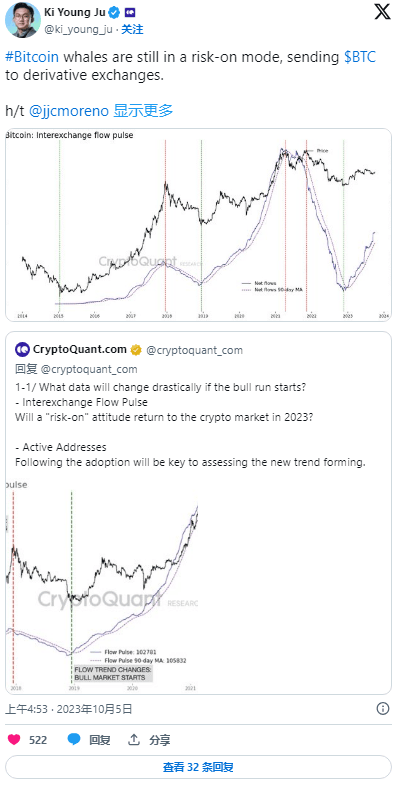
The chart created by the analyst shows the “Inter-Exchange Flow Pulse,” a measure of one-year net flows of BTC between Nasdaq-listed cryptocurrency exchange Coinbase and derivatives exchanges.
When the indicator rises, it means investors are moving more Bitcoin from spot exchanges to derivatives exchanges, indicating an increase in their risk appetite.
The chart shows that when the indicator exceeds its 90-day moving average (MA), Bitcoin is in a bullish phase, as it is currently. This pattern also occurred in 2017 and 2019-2021. When the indicator falls below the 90-day MA, Bitcoin has entered a bearish phase.
While the cryptocurrency market has been moving sideways over the past few weeks, major financial giants who collectively manage a staggering $27 trillion in assets are jumping into the bitcoin and cryptocurrency space after the race to list the first spot bitcoin exchange-traded fund (ETF) kicked off in the United States.
As CoinShares Chief Strategy Officer Meltem Demirors noted, at least eight financial giants, including BlackRock, Fidelity, JPMorgan Chase, Morgan Stanley, Goldman Sachs, BNY Mellon, Invesco, and Bank of America, are “actively working to provide access to Bitcoin” and more.
BlackRock, the world’s largest asset manager, took a groundbreaking step on June 16 by filing for a spot Bitcoin exchange-traded fund, seemingly setting off a domino effect with peers filing similar applications.
It is worth noting that the $27 trillion figure represents the total assets managed by the above-mentioned institutions, and only a small portion of this huge amount is expected to be invested in cryptocurrencies.