



Just a few days ago, on September 25, Hong Kong Securities Regulatory Commission CEO Leung Fung-yee, Executive Director of the Regulatory Enforcement Department Wei Hongfu and Head of the Financial Technology Group Huang Lexin attended the SFC's press conference on issues related to virtual asset trading platforms. At the press conference, the Hong Kong Securities Regulatory Commission stated that it would further optimize the existing virtual asset trading supervision to reduce the risks of virtual currency trading.
The industry generally believes that the optimization measures announced by the Hong Kong Securities and Futures Commission at the press conference on September 25 are a response to the JEPX case, and the corresponding measures are also a reflection of the further clarification and transparency of Hong Kong's virtual asset supervision. Today, the Sister Sa team will analyze the four major optimization supervision measures proposed by the Hong Kong Securities and Futures Commission at the press conference and the possible subsequent impacts.
Current Hong Kong VASP Licensing System and Related Issues
Since the end of 2022, when Hong Kong began to declare its embrace of virtual assets and its preparations for the establishment of a world virtual asset center, a series of arrangements have been made in terms of regulatory norms. In general, Hong Kong's current virtual asset regulatory framework generally incorporates virtual assets into the "licensing" financial regulatory system. In order to achieve the above regulatory purposes, the Legislative Council of Hong Kong completed the latest revision of the Anti-Money Laundering and Counter-Terrorist Financing Ordinance (hereinafter referred to as the "Anti-Money Laundering Ordinance") on December 7, 2022. The Anti-Money Laundering Ordinance has tailored a licensing system for virtual asset service providers in Hong Kong. The Ordinance officially came into effect on June 1 this year. According to the Anti-Money Laundering Ordinance, those who operate regulated virtual asset businesses in Hong Kong must hold the corresponding virtual asset license and the traditional financial regulatory license (also known as the "dual licensing" system.), in view of the long application cycle for virtual asset licenses, the Hong Kong regulatory authorities have established a "transition period" arrangement for the original virtual asset trading platform, that is, for virtual asset trading platforms that are providing virtual asset services in Hong Kong before June 1, 2023 and are ready to comply with the SFC's guidelines, provide reasonable and sufficient time for them to apply for the corresponding license. Such platforms can continue to operate within 12 months from June 1, 2023, and will need to submit a complete license application to the SFC before February 29, 2024.
In other words, virtual asset trading platforms that have already carried out substantive business in Hong Kong before June 1, 2023 can continue to operate for one year after the anti-money laundering regulations come into effect. But the problem is that the Hong Kong Securities Regulatory Commission has not previously announced which virtual asset trading platforms are "in the transition period" and which are already closed. At the same time, what is criticized by the majority of virtual asset investors is that the Hong Kong Securities Regulatory Commission has not announced which platforms are applying for virtual asset licenses. It is precisely because of the above-mentioned opacity that some investors have strongly dissatisfied. The opacity of the VAPS license application list and the recent JEPX case are the fuse for the Hong Kong Securities Regulatory Commission to announce the latest regulatory optimization measures.
What do the latest optimization measures include?
1. Transparency of the list of virtual asset platforms
In response to the opaque application list and the resulting concerns among some investors about the security of virtual asset platforms, the Hong Kong Securities and Futures Commission will continue to publish four lists of virtual asset platforms on its website. These four lists include: 1. List of licensed platforms; 2. List of closed platforms; 3. List of platforms deemed to have been licensed; and 4. List of applicants for virtual asset trading platforms.
The "Licensed Platform List" lists the names of virtual asset trading platform operators that have been officially licensed by the SFC. Currently, the list still only includes two companies, OSL Digital Securities Co., Ltd. and Hash Blockchain Limited, which obtained virtual asset licenses on December 15, 2020 and November 9, 2022, respectively.
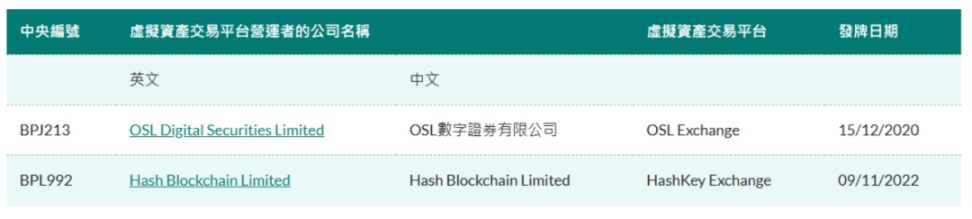 (The above is a list of licensed platforms)
The “List of Closed Platforms” lists the names of virtual asset trading platform operators that must close within a specified period of time in accordance with anti-money laundering regulations. As of September 30, there were no relevant companies on the CSRC’s list.
The "List of Virtual Asset Trading Platforms Considered to be Licensed" lists the names of virtual asset trading platform operators that were deemed to be licensed before June 1, 2024, that is, the names of virtual asset trading platforms that enjoy the "transition period". Currently, there are no relevant companies on the list on the CSRC website.
The "List of Virtual Asset Trading Platform Applicants" lists the virtual asset trading platform operators that have not yet been approved by the SFC. In other words, the platforms on the list have applied for virtual asset trading licenses but have not obtained them. The SFC also reminds traders that such virtual asset trading platform applicants may not comply with the SFC's requirements. Currently, there are four virtual asset trading platform operators on the list, namely Hong Kong BGE Limited, Hong Kong Digital Asset Trading Group Co., Ltd., Hong Kong Virtual Asset Exchange Co., Ltd., and Victory Digital Technology Co., Ltd.
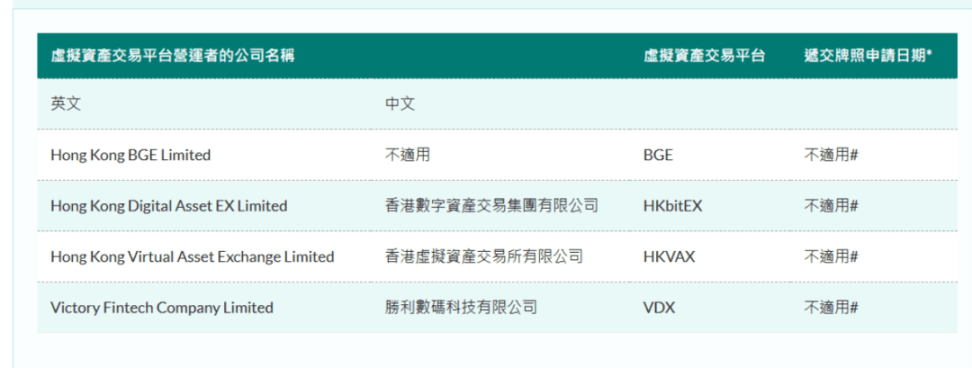 (The above is the list of applicants for virtual asset trading platforms)
In addition to the above four lists, in order to further protect the interests of virtual asset investors, the Hong Kong Securities and Futures Commission has previously published a "List of Unlicensed Companies and Suspicious Websites". As of September 28, 2023, the list includes the names of 6 virtual asset trading platforms.
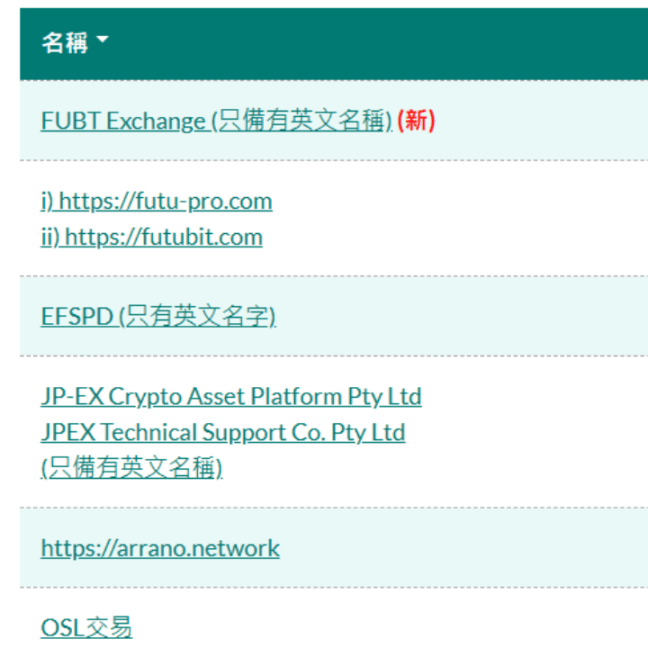 (The above are the names of suspicious trading platforms)
(II) Strengthen investor education and launch virtual asset risk publicity activities
The Hong Kong Securities and Futures Commission and the Investment Committee are about to launch a series of public publicity activities focusing on the risks of virtual asset investments and major issues in the virtual asset industry. This series of publicity activities aims to enhance the anti-fraud awareness and risk awareness of investors in the virtual asset business in different ways, and to protect the property safety of investors in virtual asset transactions as much as possible.
(III) Strengthening police cooperation and intelligence collection mechanisms for crimes related to virtual asset transactions
The Hong Kong Securities and Futures Commission further emphasized the need to strengthen cooperation with the police. Relevant measures include setting up special channels, sharing information on suspicious activities and violations on virtual asset trading platforms, increasing crackdowns on crimes related to virtual asset trading, and further optimizing the existing virtual asset trading regulatory model based on current actual conditions.
Final Thoughts
Judging from the optimized regulatory measures announced by the Hong Kong Securities and Futures Commission at the press conference, especially the measures that were immediately put into practice such as the transparency of the regulatory list, the impact of the JEPX case on the Hong Kong Securities and Futures Commission is enormous. Just as the original intention of the Hong Kong government to formulate virtual asset regulatory regulations was to provide a regulated channel for virtual assets, while developing virtual asset business while ensuring the safety of investors as much as possible, before the implementation of "transparency of application lists", the public was indeed unable to know the true licensing status of each platform in a short period of time, and lacked awareness of platforms with illegal and suspicious behaviors. This is actually contrary to the original intention of Hong Kong's virtual asset licensing system. This is why the Hong Kong Securities and Futures Commission, which discovered the problem, was able to respond so quickly.
The Sajie team believes that the last two of the optimization measures proposed by the Hong Kong Securities Regulatory Commission will be implemented as quickly as the first measure. At the same time, Hong Kong’s existing virtual asset regulatory policies will not change because of the JEPX case. After all, HK has the ambition to build a world virtual asset center.