

新手学堂天使自治社区
1.7k Posts

新手学堂天使自治社区
 Square Verified+
Report
Block User
萌新成长陪伴官|每周直播边学边赚|聊天室畅聊互动
46 Following
44.9K+ Followers
31.5K+ Liked
Posts
All
Quotes
Videos
Live
PINNED
·
--
Article
Master Web3—Set Sail from Newcomer School!【Must-See for Beginners】Hello everyone, I am @Xuetang , the starting harbor for every beginner in Web3!
In this crypto world full of opportunities and traps, many new students often pay an expensive “tuition” due to information gaps or operational mistakes. To better protect Chinese community users and help everyone take fewer detours, we have officially created this exclusive guide for you—
「
」
!
Our purpose is to provide every newcomer—every “crypto newbie just stepping in”—with a safe, professional, and easy-to-understand growth space. We focus on sharing the most down-to-earth, practical know-how, and teach you step by step to advance from 0 to 1
Master Web3—Set Sail from Newcomer School!【Must-See for Beginners】
Hello everyone, I am @新手学堂天使自治社区 , the starting harbor for every beginner in Web3!
In this crypto world full of opportunities and traps, many new students often pay an expensive “tuition” due to information gaps or operational mistakes. To better protect Chinese community users and help everyone take fewer detours, we have officially created this exclusive guide for you—
「
」
!
Our purpose is to provide every newcomer—every “crypto newbie just stepping in”—with a safe, professional, and easy-to-understand growth space. We focus on sharing the most down-to-earth, practical know-how, and teach you step by step to advance from 0 to 1
In this crypto world full of opportunities and traps, many new students often pay an expensive “tuition” due to information gaps or operational mistakes. To better protect Chinese community users and help everyone take fewer detours, we have officially created this exclusive guide for you—
「
」
!
Our purpose is to provide every newcomer—every “crypto newbie just stepping in”—with a safe, professional, and easy-to-understand growth space. We focus on sharing the most down-to-earth, practical know-how, and teach you step by step to advance from 0 to 1
24
12
116
20.6k
PINNED
·
--
Article
The Beginner Course Treasure Chest “Beginner-Friendly, Zero-Base Caregiver-Level Teaching Video” CollectionThe Beginner Course Treasure Chest has been updated
(One image to quickly understand Binance)
Collection. The diagrams help you understand the overall picture first. This section is a caregiver-level, step-by-step practical video collection—showing you exactly where to start and what happens in the next step. You’ll be guided through the entire process from start to finish, without skipping steps or rushing. Just follow along and you’ll be able to get started confidently, even as a beginner.
You can do it via tags
View!
1:
App download—caregiver-level tutorial
2:[如何注册币安账户](https://app.binance.com/uni-qr/cvid/28289348709666?l=zh-CN&r=Xuetang&uc=web_square_share_link&uco=RKDn3RcqOad8JN7N6XQmxQ&us=copylink)
3:[如何完成币安身份验证](https://app.binance.com/uni-qr/cvid/28332975354538?l=zh-CN&r=Xuetang&uc=web_square_share_link&uco=RKDn3RcqOad8JN7N6XQmxQ&us=copylink)
4:[如何通过币安 C2C 买卖加密货币](https://app.binance.com/uni-qr/cvid/28561586177418?l=zh-CN&r=Xuetang&uc=web_square_share_link&uco=RKDn3RcqOad8JN7N6XQmxQ&us=copylink)
4:[如何为币安账户创建通行密钥](https://app.binance.com/uni-qr/cvid/28594733833665?l=zh-CN&r=Xuetang&uc=web_square_share_link&uco=RKDn3RcqOad8JN7N6XQmxQ&us=copylink)
The Beginner Course Treasure Chest “Beginner-Friendly, Zero-Base Caregiver-Level Teaching Video” Collection
The Beginner Course Treasure Chest has been updated
(One image to quickly understand Binance)
Collection. The diagrams help you understand the overall picture first. This section is a caregiver-level, step-by-step practical video collection—showing you exactly where to start and what happens in the next step. You’ll be guided through the entire process from start to finish, without skipping steps or rushing. Just follow along and you’ll be able to get started confidently, even as a beginner.
You can do it via tags
View!
1:
App download—caregiver-level tutorial
2:如何注册币安账户
3:如何完成币安身份验证
4:如何通过币安 C2C 买卖加密货币
4:如何为币安账户创建通行密钥
(One image to quickly understand Binance)
Collection. The diagrams help you understand the overall picture first. This section is a caregiver-level, step-by-step practical video collection—showing you exactly where to start and what happens in the next step. You’ll be guided through the entire process from start to finish, without skipping steps or rushing. Just follow along and you’ll be able to get started confidently, even as a beginner.
You can do it via tags
View!
1:
App download—caregiver-level tutorial
2:如何注册币安账户
3:如何完成币安身份验证
4:如何通过币安 C2C 买卖加密货币
4:如何为币安账户创建通行密钥
13
15
117
16.4k
·
--
GM, #学堂日报 — October 21 Market Snapshot ☀️
1️⃣ Market Overview
▪️ Total cryptocurrency market capitalization is approximately $2.72 trillion, with BTC dominance at 60.1%.
▪️ The Fear & Greed Index stands at 51 (neutral), and market sentiment has recovered slightly.
2️⃣ Binance Updates
▪️ Binance Alpha will host a NeoSoul (DNA) trading competition, with 510,000 DNA tokens in rewards.
▪️ Binance will introduce a dynamic 24/7 update mechanism for the bStocks collateral index price.
3️⃣ Industry Highlights
▪️ A Reuters survey shows that all 100 economists expect the Federal Reserve to raise interest rates in December 2026.
▪️ Bank Negara Malaysia has launched a platform supporting tokenized bonds.
▪️ U.S. spot Bitcoin ETFs saw their largest daily net inflow in nearly a month, with BlackRock’s IBIT bringing in $665 million.
▪️ The Blockchain Association submitted comments on the implementation rules for the GENIUS Act, calling for clearer boundaries around stablecoin liability.
▪️ Japan’s 20-year government bond yield rose 1.5 basis points to 3.785%.
4️⃣ Today’s Explainer: Why can market orders easily result in slippage?
💡 A market order is an order to buy or sell immediately at the best available market prices. It prioritizes execution speed, but does not guarantee the final execution price.
▪️ Insufficient market depth: When an order exceeds the quantity available at the best price, the remainder is filled at other prices.
▪️ Rapid price fluctuations: When prices change quickly, the actual execution price may differ from the price shown when the order was placed.
▪️ Impact of large trades: The larger the order and the lower the liquidity, the more pronounced the potential slippage tends to be.
Simply put, market orders prioritize fast execution, while limit orders focus more on price control. Checking order book depth before trading can help reduce the risk of slippage.
Follow @Xuetang for more updates 🚀
GM, #学堂日报 — October 21 Market Snapshot ☀️
1️⃣ Market Overview
▪️ Total cryptocurrency market capitalization is approximately $2.72 trillion, with BTC dominance at 60.1%.
▪️ The Fear & Greed Index stands at 51 (neutral), and market sentiment has recovered slightly.
2️⃣ Binance Updates
▪️ Binance Alpha will host a NeoSoul (DNA) trading competition, with 510,000 DNA tokens in rewards.
▪️ Binance will introduce a dynamic 24/7 update mechanism for the bStocks collateral index price.
3️⃣ Industry Highlights
▪️ A Reuters survey shows that all 100 economists expect the Federal Reserve to raise interest rates in December 2026.
▪️ Bank Negara Malaysia has launched a platform supporting tokenized bonds.
▪️ U.S. spot Bitcoin ETFs saw their largest daily net inflow in nearly a month, with BlackRock’s IBIT bringing in $665 million.
▪️ The Blockchain Association submitted comments on the implementation rules for the GENIUS Act, calling for clearer boundaries around stablecoin liability.
▪️ Japan’s 20-year government bond yield rose 1.5 basis points to 3.785%.
4️⃣ Today’s Explainer: Why can market orders easily result in slippage?
💡 A market order is an order to buy or sell immediately at the best available market prices. It prioritizes execution speed, but does not guarantee the final execution price.
▪️ Insufficient market depth: When an order exceeds the quantity available at the best price, the remainder is filled at other prices.
▪️ Rapid price fluctuations: When prices change quickly, the actual execution price may differ from the price shown when the order was placed.
▪️ Impact of large trades: The larger the order and the lower the liquidity, the more pronounced the potential slippage tends to be.
Simply put, market orders prioritize fast execution, while limit orders focus more on price control. Checking order book depth before trading can help reduce the risk of slippage.
Follow @新手学堂天使自治社区 for more updates 🚀
1️⃣ Market Overview
▪️ Total cryptocurrency market capitalization is approximately $2.72 trillion, with BTC dominance at 60.1%.
▪️ The Fear & Greed Index stands at 51 (neutral), and market sentiment has recovered slightly.
2️⃣ Binance Updates
▪️ Binance Alpha will host a NeoSoul (DNA) trading competition, with 510,000 DNA tokens in rewards.
▪️ Binance will introduce a dynamic 24/7 update mechanism for the bStocks collateral index price.
3️⃣ Industry Highlights
▪️ A Reuters survey shows that all 100 economists expect the Federal Reserve to raise interest rates in December 2026.
▪️ Bank Negara Malaysia has launched a platform supporting tokenized bonds.
▪️ U.S. spot Bitcoin ETFs saw their largest daily net inflow in nearly a month, with BlackRock’s IBIT bringing in $665 million.
▪️ The Blockchain Association submitted comments on the implementation rules for the GENIUS Act, calling for clearer boundaries around stablecoin liability.
▪️ Japan’s 20-year government bond yield rose 1.5 basis points to 3.785%.
4️⃣ Today’s Explainer: Why can market orders easily result in slippage?
💡 A market order is an order to buy or sell immediately at the best available market prices. It prioritizes execution speed, but does not guarantee the final execution price.
▪️ Insufficient market depth: When an order exceeds the quantity available at the best price, the remainder is filled at other prices.
▪️ Rapid price fluctuations: When prices change quickly, the actual execution price may differ from the price shown when the order was placed.
▪️ Impact of large trades: The larger the order and the lower the liquidity, the more pronounced the potential slippage tends to be.
Simply put, market orders prioritize fast execution, while limit orders focus more on price control. Checking order book depth before trading can help reduce the risk of slippage.
Follow @新手学堂天使自治社区 for more updates 🚀
1
9
6.6k
·
--
📝 #新手学堂随堂小测 , the exam starts now!
Question 1: What does FOMO look like to you? 👀
Draw it, or describe it in a sentence. There are no right answers—the funnier, the better 😂
👇 Submit your answer in the comments and let’s see who has the wildest imagination today!
📝 #新手学堂随堂小测 , the exam starts now!
Question 1: What does FOMO look like to you? 👀
Draw it, or describe it in a sentence. There are no right answers—the funnier, the better 😂
👇 Submit your answer in the comments and let’s see who has the wildest imagination today!
Question 1: What does FOMO look like to you? 👀
Draw it, or describe it in a sentence. There are no right answers—the funnier, the better 😂
👇 Submit your answer in the comments and let’s see who has the wildest imagination today!
13
24
11.7k
·
--
GM, #学堂日报 — October 20 Market Brief ☀️
1️⃣ Market Overview
▪️ Total crypto market capitalization is approximately $2.76 trillion, with BTC dominance at 60.2%.
▪️ The Fear & Greed Index is 49 (neutral), and market sentiment remains cautious.
▪️ BNB rose 0.77%, while BTC and ETH fell 0.50% and 0.45%, respectively. GTC, PHA, and AVA bucked the trend to lead the gainers.
2️⃣ Binance Updates
▪️ Binance Wallet launched a no-deposit, interest-earning U leaderboard campaign, giving participants a chance to share 150,000 U in rewards.
▪️ Binance ALPHA Promise is now available to users worldwide.
3️⃣ Industry Highlights
▪️ Visa and Mesh partnered to enable crypto payments at more than 175 million merchant locations.
▪️ The BNB Foundation completed its 37th quarterly burn, destroying approximately 1.64 million BNB.
▪️ The digital gold market has tripled since the start of 2025, reaching approximately $500 million.
▪️ Mastercard noted that stablecoin security tools need to address risks across both protocols and wallets.
▪️ The proposed U.S. Digital Asset Market Clarity Act would establish a crypto tax grace period.
▪️ Circle removed excess redemption fees for USDC and EURC, while retaining a 0.05% fee for expedited redemptions.
4️⃣ Crypto Basics: How Do IOC Orders Execute Immediately?
💡 IOC (Immediate Or Cancel) is an order type that must be executed immediately. Any portion that can be filled is executed at once, and the unfilled remainder is automatically canceled.
▪️ Immediate execution: Once submitted, the order immediately attempts to match with existing orders in the market.
▪️ Partial fills allowed: The order does not have to be filled in full; any unfilled quantity is automatically canceled.
▪️ Less time waiting: Helps prevent orders from sitting in the market for a long time, though slippage may still occur.
In short, IOC is suited to users who want to complete trades quickly and don't want the remaining order to stay on the order book. However, limited liquidity may result in a partial fill or no fill at all.
Follow @Xuetang for more updates 🚀
GM, #学堂日报 — October 20 Market Brief ☀️
1️⃣ Market Overview
▪️ Total crypto market capitalization is approximately $2.76 trillion, with BTC dominance at 60.2%.
▪️ The Fear & Greed Index is 49 (neutral), and market sentiment remains cautious.
▪️ BNB rose 0.77%, while BTC and ETH fell 0.50% and 0.45%, respectively. GTC, PHA, and AVA bucked the trend to lead the gainers.
2️⃣ Binance Updates
▪️ Binance Wallet launched a no-deposit, interest-earning U leaderboard campaign, giving participants a chance to share 150,000 U in rewards.
▪️ Binance ALPHA Promise is now available to users worldwide.
3️⃣ Industry Highlights
▪️ Visa and Mesh partnered to enable crypto payments at more than 175 million merchant locations.
▪️ The BNB Foundation completed its 37th quarterly burn, destroying approximately 1.64 million BNB.
▪️ The digital gold market has tripled since the start of 2025, reaching approximately $500 million.
▪️ Mastercard noted that stablecoin security tools need to address risks across both protocols and wallets.
▪️ The proposed U.S. Digital Asset Market Clarity Act would establish a crypto tax grace period.
▪️ Circle removed excess redemption fees for USDC and EURC, while retaining a 0.05% fee for expedited redemptions.
4️⃣ Crypto Basics: How Do IOC Orders Execute Immediately?
💡 IOC (Immediate Or Cancel) is an order type that must be executed immediately. Any portion that can be filled is executed at once, and the unfilled remainder is automatically canceled.
▪️ Immediate execution: Once submitted, the order immediately attempts to match with existing orders in the market.
▪️ Partial fills allowed: The order does not have to be filled in full; any unfilled quantity is automatically canceled.
▪️ Less time waiting: Helps prevent orders from sitting in the market for a long time, though slippage may still occur.
In short, IOC is suited to users who want to complete trades quickly and don't want the remaining order to stay on the order book. However, limited liquidity may result in a partial fill or no fill at all.
Follow @新手学堂天使自治社区 for more updates 🚀
1️⃣ Market Overview
▪️ Total crypto market capitalization is approximately $2.76 trillion, with BTC dominance at 60.2%.
▪️ The Fear & Greed Index is 49 (neutral), and market sentiment remains cautious.
▪️ BNB rose 0.77%, while BTC and ETH fell 0.50% and 0.45%, respectively. GTC, PHA, and AVA bucked the trend to lead the gainers.
2️⃣ Binance Updates
▪️ Binance Wallet launched a no-deposit, interest-earning U leaderboard campaign, giving participants a chance to share 150,000 U in rewards.
▪️ Binance ALPHA Promise is now available to users worldwide.
3️⃣ Industry Highlights
▪️ Visa and Mesh partnered to enable crypto payments at more than 175 million merchant locations.
▪️ The BNB Foundation completed its 37th quarterly burn, destroying approximately 1.64 million BNB.
▪️ The digital gold market has tripled since the start of 2025, reaching approximately $500 million.
▪️ Mastercard noted that stablecoin security tools need to address risks across both protocols and wallets.
▪️ The proposed U.S. Digital Asset Market Clarity Act would establish a crypto tax grace period.
▪️ Circle removed excess redemption fees for USDC and EURC, while retaining a 0.05% fee for expedited redemptions.
4️⃣ Crypto Basics: How Do IOC Orders Execute Immediately?
💡 IOC (Immediate Or Cancel) is an order type that must be executed immediately. Any portion that can be filled is executed at once, and the unfilled remainder is automatically canceled.
▪️ Immediate execution: Once submitted, the order immediately attempts to match with existing orders in the market.
▪️ Partial fills allowed: The order does not have to be filled in full; any unfilled quantity is automatically canceled.
▪️ Less time waiting: Helps prevent orders from sitting in the market for a long time, though slippage may still occur.
In short, IOC is suited to users who want to complete trades quickly and don't want the remaining order to stay on the order book. However, limited liquidity may result in a partial fill or no fill at all.
Follow @新手学堂天使自治社区 for more updates 🚀
1
16
7.9k
·
--
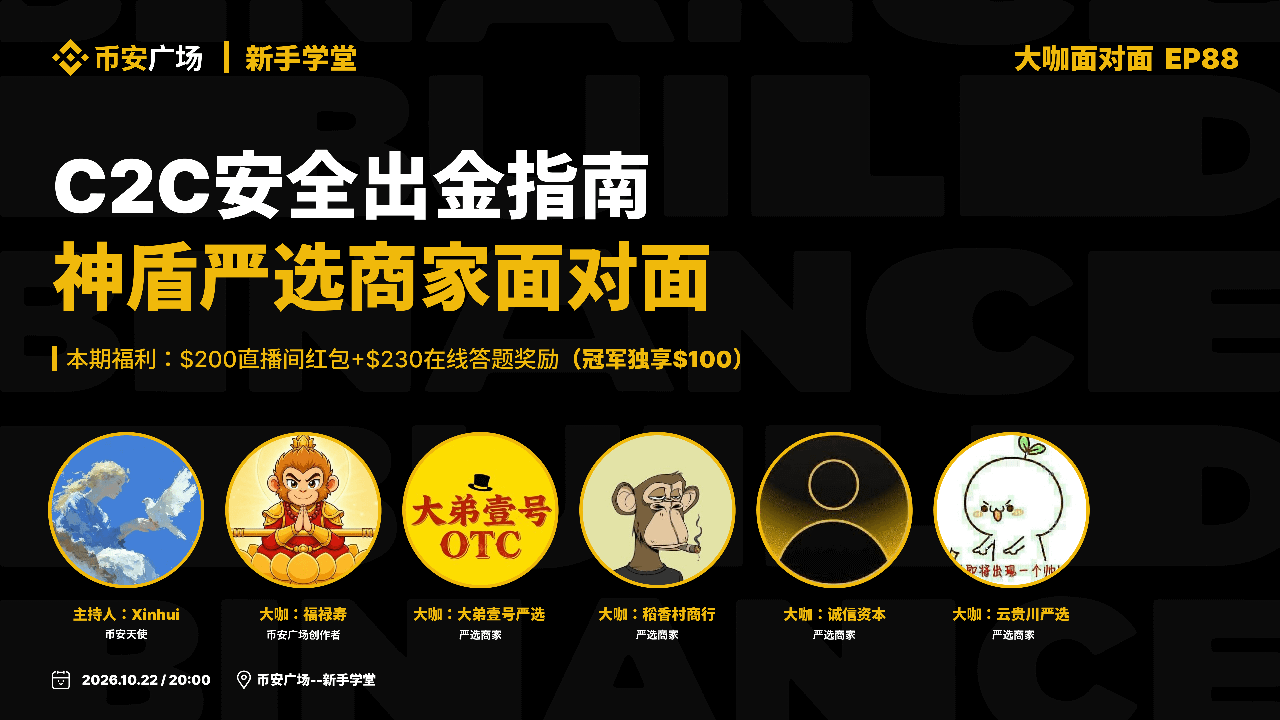
“C2C Safe Withdrawal Guide | Face-to-Face with Binance Shield Vetted Merchants”
Bank card frozen after a withdrawal? Funds blocked? Not sure what to do when a risk-control alert comes up?
Tonight, we’ve invited Binance C2C Shield vetted merchants to share their experience with you face-to-face:
How to handle risk-control checks, why they happen, what to do if you encounter one, and how to prevent them.
🎙️Special guests: Vetted merchants (Daoxiangcun Trading, Dadi No. 1, Fulushou, Chengxin Capital, Yunguichuan)
🎊Host: @xinhui
🧧Rewards: $200 in livestream red packets + $230 in online quiz prizes (the champion wins $100)
📅Time: October 22, 2026, 20:00 (HKT)
🎁 Rewards for this session:
· The Top 10 in the online Kahoot quiz will share $230. Prizes vary by ranking, with the champion winning $100;
· Livestream popularity red packets: Share the livestream and reach a certain popularity peak and engagement level to trigger $100–$200 in red packets;
👉[点击链接立刻预约直播,](https://app.binance.com/uni-qr/cspa/47370340618697?l=zh-CN&r=Xuetang&source=host_share&uc=web_square_share_link&uco=RKDn3RcqOad8JN7N6XQmxQ&us=copylink)💬 Withdrawal safety is no small matter. Understand the rules to protect yourself. See you this Thursday~
*The content of this livestream is for discussion and learning purposes only and does not constitute investment advice. Please make independent decisions based on your own circumstances and be aware of investment risks.
“C2C Safe Withdrawal Guide | Face-to-Face with Binance Shield Vetted Merchants”
Bank card frozen after a withdrawal? Funds blocked? Not sure what to do when a risk-control alert comes up?
Tonight, we’ve invited Binance C2C Shield vetted merchants to share their experience with you face-to-face:
How to handle risk-control checks, why they happen, what to do if you encounter one, and how to prevent them.
🎙️Special guests: Vetted merchants (Daoxiangcun Trading, Dadi No. 1, Fulushou, Chengxin Capital, Yunguichuan)
🎊Host: @xinhui
🧧Rewards: $200 in livestream red packets + $230 in online quiz prizes (the champion wins $100)
📅Time: October 22, 2026, 20:00 (HKT)
🎁 Rewards for this session:
· The Top 10 in the online Kahoot quiz will share $230. Prizes vary by ranking, with the champion winning $100;
· Livestream popularity red packets: Share the livestream and reach a certain popularity peak and engagement level to trigger $100–$200 in red packets;
👉点击链接立刻预约直播,💬 Withdrawal safety is no small matter. Understand the rules to protect yourself. See you this Thursday~
*The content of this livestream is for discussion and learning purposes only and does not constitute investment advice. Please make independent decisions based on your own circumstances and be aware of investment risks.
Bank card frozen after a withdrawal? Funds blocked? Not sure what to do when a risk-control alert comes up?
Tonight, we’ve invited Binance C2C Shield vetted merchants to share their experience with you face-to-face:
How to handle risk-control checks, why they happen, what to do if you encounter one, and how to prevent them.
🎙️Special guests: Vetted merchants (Daoxiangcun Trading, Dadi No. 1, Fulushou, Chengxin Capital, Yunguichuan)
🎊Host: @xinhui
🧧Rewards: $200 in livestream red packets + $230 in online quiz prizes (the champion wins $100)
📅Time: October 22, 2026, 20:00 (HKT)
🎁 Rewards for this session:
· The Top 10 in the online Kahoot quiz will share $230. Prizes vary by ranking, with the champion winning $100;
· Livestream popularity red packets: Share the livestream and reach a certain popularity peak and engagement level to trigger $100–$200 in red packets;
👉点击链接立刻预约直播,💬 Withdrawal safety is no small matter. Understand the rules to protect yourself. See you this Thursday~
*The content of this livestream is for discussion and learning purposes only and does not constitute investment advice. Please make independent decisions based on your own circumstances and be aware of investment risks.
新手学堂天使自治社区
·
--
[Preview] 🎙️ C2C Safe Withdrawal Guide | Meet the Shield-Curated Merchants
Oct 22 12:00 · 254 subscribed
4
1
14
2.3k
·
--
🎙️ C2C Safe Withdrawal Guide | Meet the Shield-Curated Merchants
Preview
12:00 Oct 22
254
1
1
·
--
This week’s livestream is in the works. What do you think this episode’s topic will be?
Hint: It’s something you often use on Binance, has been featured in an ad, and helps keep you safe.
Share your guess in the comments 👀
This week’s livestream is in the works. What do you think this episode’s topic will be?
Hint: It’s something you often use on Binance, has been featured in an ad, and helps keep you safe.
Share your guess in the comments 👀
Hint: It’s something you often use on Binance, has been featured in an ad, and helps keep you safe.
Share your guess in the comments 👀
7
34
8.4k
·
--
Gm, #学堂日报 — Oct 19 Market Brief ☀️
1️⃣ Market Overview
▪️ Total crypto market capitalization is approximately $2.74 trillion, with BTC dominance at 60.2%.
▪️ The Fear & Greed Index is 49 (Neutral), and market sentiment remains cautious.
▪️ BTC, ETH, and BNB are up 0.71%, 0.13%, and 0.64%, respectively. QKC, AMP, and GTC are leading the gains.
2️⃣ Binance Updates
▪️ Binance Earn has launched the RWUSD product, displaying an annualized yield of 3.61%. It is backed by tokenized real-world assets, and the actual yield may vary.
▪️ Binance Wealth Management has launched an RLUSD campaign to share XRP rewards, with rewards of up to 7.77% APR.
3️⃣ Industry Highlights
▪️ This week’s macro focus: the Federal Reserve’s quiet period and major earnings reports during the U.S. stock market earnings season.
▪️ SEC Chair Atkins said that comprehensive crypto regulation will move forward after the CLARITY Act is passed.
▪️ Stablecoin supply growth has slowed this year, while payment-sector expansion is accelerating, with Mastercard, Stripe, and Visa continuing to enter the space.
▪️ South Korea will hold a crypto tax forum on October 20 and is proposing a 22% tax in 2027.
▪️ Charles Schwab plans to roll out external transfer services for Bitcoin and Ethereum in phases.
4️⃣ Today's Explainer: What does a Post Only order do?
💡 Post Only is a limit-order setting that ensures an order enters the order book only as a Maker order.
▪️ Avoids immediate execution: If an order would match directly with an existing order, the system will usually reject or cancel it.
▪️ Controls trading costs: It can help avoid Taker fees; actual rates are subject to the platform’s rules.
▪️ Reduces unexpected slippage: You can place an order at a preset price, but execution is not guaranteed.
In short, Post Only is suited to users who want to provide liquidity as Makers and control trading costs, but be aware that the order may not be filled.
Follow @Xuetang for more updates 🚀
Gm, #学堂日报 — Oct 19 Market Brief ☀️
1️⃣ Market Overview
▪️ Total crypto market capitalization is approximately $2.74 trillion, with BTC dominance at 60.2%.
▪️ The Fear & Greed Index is 49 (Neutral), and market sentiment remains cautious.
▪️ BTC, ETH, and BNB are up 0.71%, 0.13%, and 0.64%, respectively. QKC, AMP, and GTC are leading the gains.
2️⃣ Binance Updates
▪️ Binance Earn has launched the RWUSD product, displaying an annualized yield of 3.61%. It is backed by tokenized real-world assets, and the actual yield may vary.
▪️ Binance Wealth Management has launched an RLUSD campaign to share XRP rewards, with rewards of up to 7.77% APR.
3️⃣ Industry Highlights
▪️ This week’s macro focus: the Federal Reserve’s quiet period and major earnings reports during the U.S. stock market earnings season.
▪️ SEC Chair Atkins said that comprehensive crypto regulation will move forward after the CLARITY Act is passed.
▪️ Stablecoin supply growth has slowed this year, while payment-sector expansion is accelerating, with Mastercard, Stripe, and Visa continuing to enter the space.
▪️ South Korea will hold a crypto tax forum on October 20 and is proposing a 22% tax in 2027.
▪️ Charles Schwab plans to roll out external transfer services for Bitcoin and Ethereum in phases.
4️⃣ Today's Explainer: What does a Post Only order do?
💡 Post Only is a limit-order setting that ensures an order enters the order book only as a Maker order.
▪️ Avoids immediate execution: If an order would match directly with an existing order, the system will usually reject or cancel it.
▪️ Controls trading costs: It can help avoid Taker fees; actual rates are subject to the platform’s rules.
▪️ Reduces unexpected slippage: You can place an order at a preset price, but execution is not guaranteed.
In short, Post Only is suited to users who want to provide liquidity as Makers and control trading costs, but be aware that the order may not be filled.
Follow @新手学堂天使自治社区 for more updates 🚀
1️⃣ Market Overview
▪️ Total crypto market capitalization is approximately $2.74 trillion, with BTC dominance at 60.2%.
▪️ The Fear & Greed Index is 49 (Neutral), and market sentiment remains cautious.
▪️ BTC, ETH, and BNB are up 0.71%, 0.13%, and 0.64%, respectively. QKC, AMP, and GTC are leading the gains.
2️⃣ Binance Updates
▪️ Binance Earn has launched the RWUSD product, displaying an annualized yield of 3.61%. It is backed by tokenized real-world assets, and the actual yield may vary.
▪️ Binance Wealth Management has launched an RLUSD campaign to share XRP rewards, with rewards of up to 7.77% APR.
3️⃣ Industry Highlights
▪️ This week’s macro focus: the Federal Reserve’s quiet period and major earnings reports during the U.S. stock market earnings season.
▪️ SEC Chair Atkins said that comprehensive crypto regulation will move forward after the CLARITY Act is passed.
▪️ Stablecoin supply growth has slowed this year, while payment-sector expansion is accelerating, with Mastercard, Stripe, and Visa continuing to enter the space.
▪️ South Korea will hold a crypto tax forum on October 20 and is proposing a 22% tax in 2027.
▪️ Charles Schwab plans to roll out external transfer services for Bitcoin and Ethereum in phases.
4️⃣ Today's Explainer: What does a Post Only order do?
💡 Post Only is a limit-order setting that ensures an order enters the order book only as a Maker order.
▪️ Avoids immediate execution: If an order would match directly with an existing order, the system will usually reject or cancel it.
▪️ Controls trading costs: It can help avoid Taker fees; actual rates are subject to the platform’s rules.
▪️ Reduces unexpected slippage: You can place an order at a preset price, but execution is not guaranteed.
In short, Post Only is suited to users who want to provide liquidity as Makers and control trading costs, but be aware that the order may not be filled.
Follow @新手学堂天使自治社区 for more updates 🚀
3
18
8k
·
--
GM, #学堂日报 — October 16 Market Brief ☀️
1️⃣ Market Overview
▪️ Total crypto market capitalization is approximately $2.72 trillion, with BTC dominance at 60.0%.
▪️ The Fear & Greed Index is at 51 (Neutral), and market sentiment has cooled slightly.
▪️ BTC and ETH are up 0.70% and 0.84%, respectively, while BNB is down 0.13%. BAT, CYPHB, and QNTB are leading the gains.
2️⃣ Binance Updates
▪️ Binance Wallet has launched a NEOSOUL (DNA) airdrop, which eligible Binance Alpha traders can claim.
▪️ Binance released its API performance report for the first half of 2026. Spot, margin, and futures APIs all maintained 100% uptime.
▪️ Binance has launched seller options strategies: Covered Calls and Cash-Secured Puts.
3️⃣ Industry Highlights
▪️ US September PPI posted its biggest increase in nearly four years.
▪️ Australia plans to require crypto trading platforms to report and share tax information under proposed legislation.
▪️ The Central Bank of Russia plans to ban individuals from directly conducting crypto P2P transactions starting in July 2027.
▪️ The US Office of the Comptroller of the Currency is expected to publish the final rules for the GENIUS Act by the end of October.
4️⃣ Today's Explainer: Why Is the Mark Price Different from the Latest Price?
💡 The latest price is the actual price of the most recent market trade. The mark price is a reference price used in futures trading to calculate unrealized P&L and assess liquidation risk.
▪️ Latest price: Reflects real-time trades and can be easily affected by large short-term orders or changes in liquidity.
▪️ Mark price: Usually takes factors such as the spot index and funding-rate basis into account, reducing the impact of abnormal short-term price fluctuations.
In simple terms, the latest price shows “what a trade just went through at,” while the mark price is used to assess the risk of a futures position more fairly. It is normal for the two to differ.
Follow @Xuetang for more updates 🚀
GM, #学堂日报 — October 16 Market Brief ☀️
1️⃣ Market Overview
▪️ Total crypto market capitalization is approximately $2.72 trillion, with BTC dominance at 60.0%.
▪️ The Fear & Greed Index is at 51 (Neutral), and market sentiment has cooled slightly.
▪️ BTC and ETH are up 0.70% and 0.84%, respectively, while BNB is down 0.13%. BAT, CYPHB, and QNTB are leading the gains.
2️⃣ Binance Updates
▪️ Binance Wallet has launched a NEOSOUL (DNA) airdrop, which eligible Binance Alpha traders can claim.
▪️ Binance released its API performance report for the first half of 2026. Spot, margin, and futures APIs all maintained 100% uptime.
▪️ Binance has launched seller options strategies: Covered Calls and Cash-Secured Puts.
3️⃣ Industry Highlights
▪️ US September PPI posted its biggest increase in nearly four years.
▪️ Australia plans to require crypto trading platforms to report and share tax information under proposed legislation.
▪️ The Central Bank of Russia plans to ban individuals from directly conducting crypto P2P transactions starting in July 2027.
▪️ The US Office of the Comptroller of the Currency is expected to publish the final rules for the GENIUS Act by the end of October.
4️⃣ Today's Explainer: Why Is the Mark Price Different from the Latest Price?
💡 The latest price is the actual price of the most recent market trade. The mark price is a reference price used in futures trading to calculate unrealized P&L and assess liquidation risk.
▪️ Latest price: Reflects real-time trades and can be easily affected by large short-term orders or changes in liquidity.
▪️ Mark price: Usually takes factors such as the spot index and funding-rate basis into account, reducing the impact of abnormal short-term price fluctuations.
In simple terms, the latest price shows “what a trade just went through at,” while the mark price is used to assess the risk of a futures position more fairly. It is normal for the two to differ.
Follow @新手学堂天使自治社区 for more updates 🚀
1️⃣ Market Overview
▪️ Total crypto market capitalization is approximately $2.72 trillion, with BTC dominance at 60.0%.
▪️ The Fear & Greed Index is at 51 (Neutral), and market sentiment has cooled slightly.
▪️ BTC and ETH are up 0.70% and 0.84%, respectively, while BNB is down 0.13%. BAT, CYPHB, and QNTB are leading the gains.
2️⃣ Binance Updates
▪️ Binance Wallet has launched a NEOSOUL (DNA) airdrop, which eligible Binance Alpha traders can claim.
▪️ Binance released its API performance report for the first half of 2026. Spot, margin, and futures APIs all maintained 100% uptime.
▪️ Binance has launched seller options strategies: Covered Calls and Cash-Secured Puts.
3️⃣ Industry Highlights
▪️ US September PPI posted its biggest increase in nearly four years.
▪️ Australia plans to require crypto trading platforms to report and share tax information under proposed legislation.
▪️ The Central Bank of Russia plans to ban individuals from directly conducting crypto P2P transactions starting in July 2027.
▪️ The US Office of the Comptroller of the Currency is expected to publish the final rules for the GENIUS Act by the end of October.
4️⃣ Today's Explainer: Why Is the Mark Price Different from the Latest Price?
💡 The latest price is the actual price of the most recent market trade. The mark price is a reference price used in futures trading to calculate unrealized P&L and assess liquidation risk.
▪️ Latest price: Reflects real-time trades and can be easily affected by large short-term orders or changes in liquidity.
▪️ Mark price: Usually takes factors such as the spot index and funding-rate basis into account, reducing the impact of abnormal short-term price fluctuations.
In simple terms, the latest price shows “what a trade just went through at,” while the mark price is used to assess the risk of a futures position more fairly. It is normal for the two to differ.
Follow @新手学堂天使自治社区 for more updates 🚀
1
8
5.6k
·
--
🎙️ “The Privacy Sector Is Booming—Do You Understand the Logic Behind It?” Special guests: Chief Qiao, retired and collecting rent on the moon; OxJason (Brother Jie)
End
01 h 05 m 36 s
12.6k
11
1
·
--
🔥 The privacy sector has suddenly taken off. What do you think is the biggest factor behind it?
A: Market funds are looking for the next hot opportunity
B: Users are paying more and more attention to privacy protection
C: Privacy technology has made a major breakthrough
D: It’s purely market sentiment and hype
👀 Which one are you betting on? Leave A/B/C/D in the comments.
Let’s talk about what’s driving the privacy sector’s sudden boom and see whether your take matches the experts’!
🎁 There’ll be livestream room red packets and rewards for joining the mic tonight at 20:00—don’t miss it!
🔥 The privacy sector has suddenly taken off. What do you think is the biggest factor behind it?
A: Market funds are looking for the next hot opportunity
B: Users are paying more and more attention to privacy protection
C: Privacy technology has made a major breakthrough
D: It’s purely market sentiment and hype
👀 Which one are you betting on? Leave A/B/C/D in the comments.
Let’s talk about what’s driving the privacy sector’s sudden boom and see whether your take matches the experts’!
🎁 There’ll be livestream room red packets and rewards for joining the mic tonight at 20:00—don’t miss it!
A: Market funds are looking for the next hot opportunity
B: Users are paying more and more attention to privacy protection
C: Privacy technology has made a major breakthrough
D: It’s purely market sentiment and hype
👀 Which one are you betting on? Leave A/B/C/D in the comments.
Let’s talk about what’s driving the privacy sector’s sudden boom and see whether your take matches the experts’!
🎁 There’ll be livestream room red packets and rewards for joining the mic tonight at 20:00—don’t miss it!
新手学堂天使自治社区
·
--
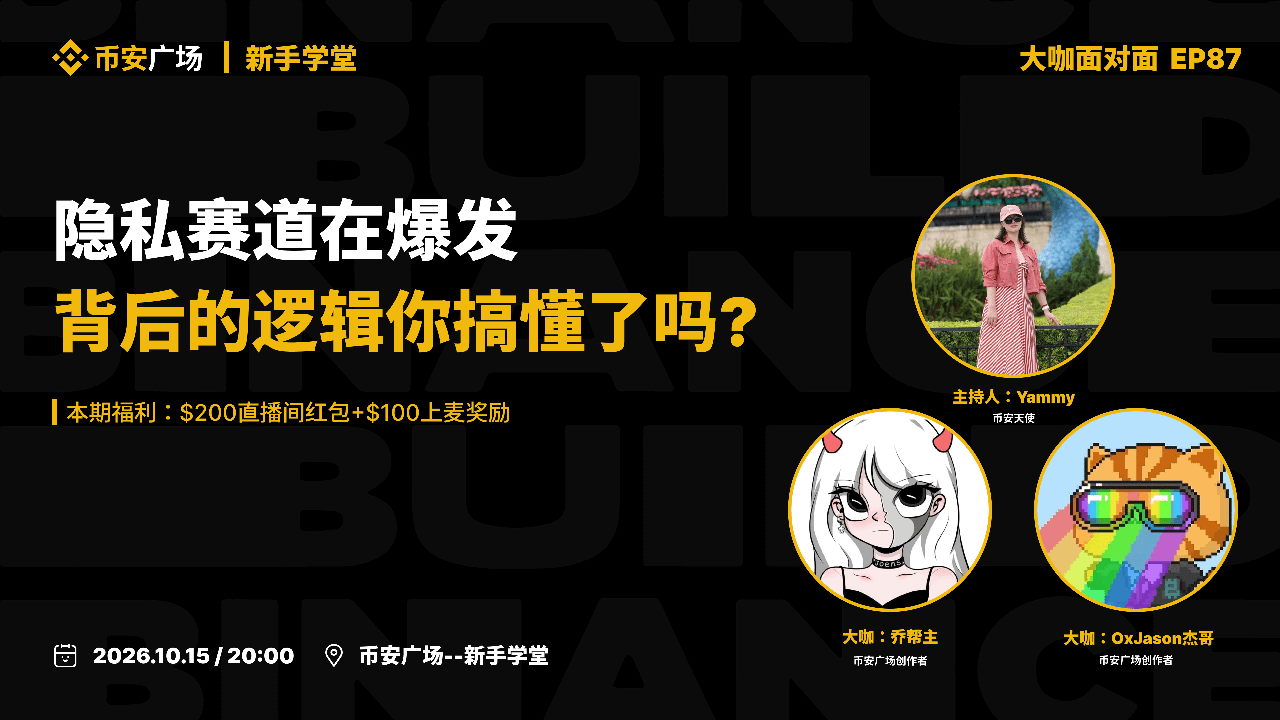
“The privacy sector is booming—do you understand the logic behind it?”
The privacy sector has quietly become one of the brightest spots in the market. It’s not driven by hype or new projects—it’s because technology is being repriced by the market.
Do you know why it’s rising? Do you know how far this rally can go?
🎙️ Special guests: @乔帮主退休月球收租 , @0xJason杰哥
🎊 Host: @Yammy天使
🧧 Giveaways: $200 in live-stream red packets + $100 for joining the mic
📅 Time: October 15, 2026, 20:00 (HKT)
🔥 Topics we’ll cover:
- Is this privacy-sector boom a return of the narrative, or is it driven by real demand?
- Amid the combined forces of regulation, technology, and the market, where are the opportunities and risks in the privacy sector?
👉 Don’t miss us this Thursday: 点击链接立刻预约直播,~
*This livestream is for discussion and educational purposes only and does not constitute investment advice. Please make your own independent decisions based on your circumstances and be mindful of investment risks.
The privacy sector has quietly become one of the brightest spots in the market. It’s not driven by hype or new projects—it’s because technology is being repriced by the market.
Do you know why it’s rising? Do you know how far this rally can go?
🎙️ Special guests: @乔帮主退休月球收租 , @0xJason杰哥
🎊 Host: @Yammy天使
🧧 Giveaways: $200 in live-stream red packets + $100 for joining the mic
📅 Time: October 15, 2026, 20:00 (HKT)
🔥 Topics we’ll cover:
- Is this privacy-sector boom a return of the narrative, or is it driven by real demand?
- Amid the combined forces of regulation, technology, and the market, where are the opportunities and risks in the privacy sector?
👉 Don’t miss us this Thursday: 点击链接立刻预约直播,~
*This livestream is for discussion and educational purposes only and does not constitute investment advice. Please make your own independent decisions based on your circumstances and be mindful of investment risks.
20
11
3.2k
·
--
GM, #学堂日报 — October 15 Market Brief ☀️
1️⃣ Market Overview
▪️ Total crypto market capitalization is approximately $2.79 trillion, with BTC dominance at 59.8%.
▪️ The Fear & Greed Index is at 54 (neutral), as market sentiment cools slightly.
▪️ BTC, ETH, and BNB fell 2.11%, 3.35%, and 1.78%, respectively, while WAL, OSMO, and SOXSB led the market higher.
2️⃣ Binance Updates
▪️ Binance Earn has launched a U Flexible product promotion. Regular users can earn up to 6% APR, while VIP users can earn up to 7% APR on their first 500,000 U. Please refer to the promotion rules for details.
3️⃣ Industry Highlights
▪️ Markets are increasing their bets on a Fed rate hike in October.
▪️ Standard Chartered has launched crypto trading services in the UAE.
▪️ The IMF chief said the U.S. has not done enough to reduce its deficit.
▪️ Spot trading volume at South Korea’s five largest crypto exchanges fell 33% in the second quarter.
▪️ Bitcoin mining difficulty may rise by 5.68%, potentially putting pressure on some miners as electricity costs exceed mining revenues.
▪️ South Korea’s National Tax Service plans to publish a notice on virtual asset tax standards in November.
4️⃣ Crypto 101: What Is a Liquidation Engine?
💡 A liquidation engine is an automated mechanism in a derivatives trading system that handles accounts with insufficient margin. When losses on a position cause account equity to fall below the maintenance margin requirement, the system may trigger a forced close—commonly known as “getting liquidated.”
▪️ Liquidation trigger: When margin is insufficient, the system intervenes automatically to reduce risk exposure.
▪️ Position closure: Positions are gradually processed using market liquidity to minimize price impact.
▪️ Risk management: Mark prices, margin requirements, and insurance funds help reduce cascading risks during extreme market conditions.
Liquidation mechanisms help maintain stability in derivatives markets, but cannot completely eliminate the risk of negative balances or extreme volatility. Managing leverage responsibly is key to reducing liquidation risk.
Follow @Xuetang for more updates 🚀
GM, #学堂日报 — October 15 Market Brief ☀️
1️⃣ Market Overview
▪️ Total crypto market capitalization is approximately $2.79 trillion, with BTC dominance at 59.8%.
▪️ The Fear & Greed Index is at 54 (neutral), as market sentiment cools slightly.
▪️ BTC, ETH, and BNB fell 2.11%, 3.35%, and 1.78%, respectively, while WAL, OSMO, and SOXSB led the market higher.
2️⃣ Binance Updates
▪️ Binance Earn has launched a U Flexible product promotion. Regular users can earn up to 6% APR, while VIP users can earn up to 7% APR on their first 500,000 U. Please refer to the promotion rules for details.
3️⃣ Industry Highlights
▪️ Markets are increasing their bets on a Fed rate hike in October.
▪️ Standard Chartered has launched crypto trading services in the UAE.
▪️ The IMF chief said the U.S. has not done enough to reduce its deficit.
▪️ Spot trading volume at South Korea’s five largest crypto exchanges fell 33% in the second quarter.
▪️ Bitcoin mining difficulty may rise by 5.68%, potentially putting pressure on some miners as electricity costs exceed mining revenues.
▪️ South Korea’s National Tax Service plans to publish a notice on virtual asset tax standards in November.
4️⃣ Crypto 101: What Is a Liquidation Engine?
💡 A liquidation engine is an automated mechanism in a derivatives trading system that handles accounts with insufficient margin. When losses on a position cause account equity to fall below the maintenance margin requirement, the system may trigger a forced close—commonly known as “getting liquidated.”
▪️ Liquidation trigger: When margin is insufficient, the system intervenes automatically to reduce risk exposure.
▪️ Position closure: Positions are gradually processed using market liquidity to minimize price impact.
▪️ Risk management: Mark prices, margin requirements, and insurance funds help reduce cascading risks during extreme market conditions.
Liquidation mechanisms help maintain stability in derivatives markets, but cannot completely eliminate the risk of negative balances or extreme volatility. Managing leverage responsibly is key to reducing liquidation risk.
Follow @新手学堂天使自治社区 for more updates 🚀
1️⃣ Market Overview
▪️ Total crypto market capitalization is approximately $2.79 trillion, with BTC dominance at 59.8%.
▪️ The Fear & Greed Index is at 54 (neutral), as market sentiment cools slightly.
▪️ BTC, ETH, and BNB fell 2.11%, 3.35%, and 1.78%, respectively, while WAL, OSMO, and SOXSB led the market higher.
2️⃣ Binance Updates
▪️ Binance Earn has launched a U Flexible product promotion. Regular users can earn up to 6% APR, while VIP users can earn up to 7% APR on their first 500,000 U. Please refer to the promotion rules for details.
3️⃣ Industry Highlights
▪️ Markets are increasing their bets on a Fed rate hike in October.
▪️ Standard Chartered has launched crypto trading services in the UAE.
▪️ The IMF chief said the U.S. has not done enough to reduce its deficit.
▪️ Spot trading volume at South Korea’s five largest crypto exchanges fell 33% in the second quarter.
▪️ Bitcoin mining difficulty may rise by 5.68%, potentially putting pressure on some miners as electricity costs exceed mining revenues.
▪️ South Korea’s National Tax Service plans to publish a notice on virtual asset tax standards in November.
4️⃣ Crypto 101: What Is a Liquidation Engine?
💡 A liquidation engine is an automated mechanism in a derivatives trading system that handles accounts with insufficient margin. When losses on a position cause account equity to fall below the maintenance margin requirement, the system may trigger a forced close—commonly known as “getting liquidated.”
▪️ Liquidation trigger: When margin is insufficient, the system intervenes automatically to reduce risk exposure.
▪️ Position closure: Positions are gradually processed using market liquidity to minimize price impact.
▪️ Risk management: Mark prices, margin requirements, and insurance funds help reduce cascading risks during extreme market conditions.
Liquidation mechanisms help maintain stability in derivatives markets, but cannot completely eliminate the risk of negative balances or extreme volatility. Managing leverage responsibly is key to reducing liquidation risk.
Follow @新手学堂天使自治社区 for more updates 🚀
3
15
6.4k
·
--
🎮 If you could restart your Web3 life, you’d get one chance to choose just one 👇
🅰️ Go back to the day you bought crypto for the first time
🅱️ Know the peak of the next bull market in advance
🅲️ Have a wallet that can never be hacked
🅳️ Get a Web3 mentor who’s always there to answer your questions
Which would you choose? Why? 👀
Share your answer in the comments and let’s see whose choice is the most unexpected
🎮 If you could restart your Web3 life, you’d get one chance to choose just one 👇
🅰️ Go back to the day you bought crypto for the first time
🅱️ Know the peak of the next bull market in advance
🅲️ Have a wallet that can never be hacked
🅳️ Get a Web3 mentor who’s always there to answer your questions
Which would you choose? Why? 👀
Share your answer in the comments and let’s see whose choice is the most unexpected
🅰️ Go back to the day you bought crypto for the first time
🅱️ Know the peak of the next bull market in advance
🅲️ Have a wallet that can never be hacked
🅳️ Get a Web3 mentor who’s always there to answer your questions
Which would you choose? Why? 👀
Share your answer in the comments and let’s see whose choice is the most unexpected
22
19
6.1k
·
--
📘 #币安知识词典 Issue 30: The Goldilocks Principle
⭐ What is the Goldilocks Principle?
In economics, the “Goldilocks Principle” refers to an ideal state for sustainable growth, where the economy is neither so overheated that it triggers inflation nor so sluggish that it leads to a recession. Just as the legendary Goldilocks found the perfect balance in the bears’ house, the “Goldilocks Principle” holds that the economy performs best when indicators such as inflation, unemployment, and economic growth remain within moderate ranges.
⭐ The Goldilocks Economy
A Goldilocks economy is typically characterized by steady economic growth, low unemployment, and stable inflation. It represents a balance between expansionary and prudent monetary policies, creating a favorable environment for investment, consumption, and overall prosperity. Central banks generally maintain a Goldilocks economy by adjusting interest rates and implementing other monetary policies to prevent the economy from overheating or stagnating.
⭐ The Effects of a Goldilocks Period
During a Goldilocks period, investors and policymakers tend to feel confident and secure. Businesses thrive, consumer spending remains healthy, and financial markets generally perform well. However, maintaining this delicate balance requires vigilance. Excessive optimism or complacency can lead to asset bubbles, while trying to cool an overheated economy too aggressively may trigger a recession.
⭐ The Cryptocurrency Market and the Goldilocks Effect
Although cryptocurrency markets operate differently from traditional markets, they are still influenced by overall market sentiment and investor behavior. As a result, crypto assets may also be affected by Goldilocks periods. In general, cryptocurrency markets tend to perform well during these periods, just like traditional financial assets.
However, the potential impact of a Goldilocks period on the cryptocurrency market also depends on the level of correlation between different markets. At times, crypto assets tend to move in a similar way to traditional assets such as stocks. But there may also be periods of low correlation, when the two markets move in opposite directions or are largely uncorrelated.
Follow @Xuetang so you don’t miss out! Check in in the comments: 【Knowledge Dictionary】
📘 #币安知识词典 Issue 30: The Goldilocks Principle
⭐ What is the Goldilocks Principle?
In economics, the “Goldilocks Principle” refers to an ideal state for sustainable growth, where the economy is neither so overheated that it triggers inflation nor so sluggish that it leads to a recession. Just as the legendary Goldilocks found the perfect balance in the bears’ house, the “Goldilocks Principle” holds that the economy performs best when indicators such as inflation, unemployment, and economic growth remain within moderate ranges.
⭐ The Goldilocks Economy
A Goldilocks economy is typically characterized by steady economic growth, low unemployment, and stable inflation. It represents a balance between expansionary and prudent monetary policies, creating a favorable environment for investment, consumption, and overall prosperity. Central banks generally maintain a Goldilocks economy by adjusting interest rates and implementing other monetary policies to prevent the economy from overheating or stagnating.
⭐ The Effects of a Goldilocks Period
During a Goldilocks period, investors and policymakers tend to feel confident and secure. Businesses thrive, consumer spending remains healthy, and financial markets generally perform well. However, maintaining this delicate balance requires vigilance. Excessive optimism or complacency can lead to asset bubbles, while trying to cool an overheated economy too aggressively may trigger a recession.
⭐ The Cryptocurrency Market and the Goldilocks Effect
Although cryptocurrency markets operate differently from traditional markets, they are still influenced by overall market sentiment and investor behavior. As a result, crypto assets may also be affected by Goldilocks periods. In general, cryptocurrency markets tend to perform well during these periods, just like traditional financial assets.
However, the potential impact of a Goldilocks period on the cryptocurrency market also depends on the level of correlation between different markets. At times, crypto assets tend to move in a similar way to traditional assets such as stocks. But there may also be periods of low correlation, when the two markets move in opposite directions or are largely uncorrelated.
Follow @新手学堂天使自治社区 so you don’t miss out! Check in in the comments: 【Knowledge Dictionary】
⭐ What is the Goldilocks Principle?
In economics, the “Goldilocks Principle” refers to an ideal state for sustainable growth, where the economy is neither so overheated that it triggers inflation nor so sluggish that it leads to a recession. Just as the legendary Goldilocks found the perfect balance in the bears’ house, the “Goldilocks Principle” holds that the economy performs best when indicators such as inflation, unemployment, and economic growth remain within moderate ranges.
⭐ The Goldilocks Economy
A Goldilocks economy is typically characterized by steady economic growth, low unemployment, and stable inflation. It represents a balance between expansionary and prudent monetary policies, creating a favorable environment for investment, consumption, and overall prosperity. Central banks generally maintain a Goldilocks economy by adjusting interest rates and implementing other monetary policies to prevent the economy from overheating or stagnating.
⭐ The Effects of a Goldilocks Period
During a Goldilocks period, investors and policymakers tend to feel confident and secure. Businesses thrive, consumer spending remains healthy, and financial markets generally perform well. However, maintaining this delicate balance requires vigilance. Excessive optimism or complacency can lead to asset bubbles, while trying to cool an overheated economy too aggressively may trigger a recession.
⭐ The Cryptocurrency Market and the Goldilocks Effect
Although cryptocurrency markets operate differently from traditional markets, they are still influenced by overall market sentiment and investor behavior. As a result, crypto assets may also be affected by Goldilocks periods. In general, cryptocurrency markets tend to perform well during these periods, just like traditional financial assets.
However, the potential impact of a Goldilocks period on the cryptocurrency market also depends on the level of correlation between different markets. At times, crypto assets tend to move in a similar way to traditional assets such as stocks. But there may also be periods of low correlation, when the two markets move in opposite directions or are largely uncorrelated.
Follow @新手学堂天使自治社区 so you don’t miss out! Check in in the comments: 【Knowledge Dictionary】
3
15
4.6k
·
--
Gm, #学堂日报 — Market Snapshot for 10/14 ☀️
1️⃣ Market Overview
▪️ The total crypto market capitalization is approximately $2.80 trillion, with BTC dominance at 59.9%.
▪️ The Fear and Greed Index is at 55 (neutral), and market sentiment remains steady.
▪️ BTC, ETH, and BNB are up 2.22%, 2.95%, and 1.75%, respectively, while GNS, BAT, and OP are leading the gains.
2️⃣ Binance Updates
▪️ Binance Wallet has launched a USD.AI USDC subscription campaign, offering up to 18% annualized returns. Actual returns may vary.
▪️ Binance will discontinue Binance Pool and related services. Please refer to the official announcement for details.
3️⃣ Industry Highlights
▪️ South Korea has introduced crypto asset recovery rules.
▪️ The Blockchain 100 Awards will return in 2026 to recognize innovators in crypto and traditional finance.
▪️ South Korea’s KB Kookmin Card and Japan’s SBI have signed a memorandum to test AI agent identity verification and cross-border crypto payments.
▪️ The Bank of England is in no rush to launch the digital pound, or Britcoin.
▪️ Federal Reserve’s Goolsbee said inflation from the AI boom is spilling over.
4️⃣ Today’s Explainer: What Is Open Interest?
💡 Open interest (OI) is the total number of outstanding contracts in derivatives markets, such as futures and perpetual contracts. It reflects how much capital is still participating in contract trading.
▪️ Rising open interest: The number of new outstanding contracts is increasing, which may indicate greater market participation.
▪️ Falling open interest: The number of outstanding contracts is decreasing, which may indicate more position closures or forced deleveraging.
Keep in mind that open interest does not indicate the direction of price movements. It is usually best assessed alongside price action, trading volume, and funding rates to better understand market sentiment and leverage risk.
Follow @Xuetang for more updates 🚀
Gm, #学堂日报 — Market Snapshot for 10/14 ☀️
1️⃣ Market Overview
▪️ The total crypto market capitalization is approximately $2.80 trillion, with BTC dominance at 59.9%.
▪️ The Fear and Greed Index is at 55 (neutral), and market sentiment remains steady.
▪️ BTC, ETH, and BNB are up 2.22%, 2.95%, and 1.75%, respectively, while GNS, BAT, and OP are leading the gains.
2️⃣ Binance Updates
▪️ Binance Wallet has launched a USD.AI USDC subscription campaign, offering up to 18% annualized returns. Actual returns may vary.
▪️ Binance will discontinue Binance Pool and related services. Please refer to the official announcement for details.
3️⃣ Industry Highlights
▪️ South Korea has introduced crypto asset recovery rules.
▪️ The Blockchain 100 Awards will return in 2026 to recognize innovators in crypto and traditional finance.
▪️ South Korea’s KB Kookmin Card and Japan’s SBI have signed a memorandum to test AI agent identity verification and cross-border crypto payments.
▪️ The Bank of England is in no rush to launch the digital pound, or Britcoin.
▪️ Federal Reserve’s Goolsbee said inflation from the AI boom is spilling over.
4️⃣ Today’s Explainer: What Is Open Interest?
💡 Open interest (OI) is the total number of outstanding contracts in derivatives markets, such as futures and perpetual contracts. It reflects how much capital is still participating in contract trading.
▪️ Rising open interest: The number of new outstanding contracts is increasing, which may indicate greater market participation.
▪️ Falling open interest: The number of outstanding contracts is decreasing, which may indicate more position closures or forced deleveraging.
Keep in mind that open interest does not indicate the direction of price movements. It is usually best assessed alongside price action, trading volume, and funding rates to better understand market sentiment and leverage risk.
Follow @新手学堂天使自治社区 for more updates 🚀
1️⃣ Market Overview
▪️ The total crypto market capitalization is approximately $2.80 trillion, with BTC dominance at 59.9%.
▪️ The Fear and Greed Index is at 55 (neutral), and market sentiment remains steady.
▪️ BTC, ETH, and BNB are up 2.22%, 2.95%, and 1.75%, respectively, while GNS, BAT, and OP are leading the gains.
2️⃣ Binance Updates
▪️ Binance Wallet has launched a USD.AI USDC subscription campaign, offering up to 18% annualized returns. Actual returns may vary.
▪️ Binance will discontinue Binance Pool and related services. Please refer to the official announcement for details.
3️⃣ Industry Highlights
▪️ South Korea has introduced crypto asset recovery rules.
▪️ The Blockchain 100 Awards will return in 2026 to recognize innovators in crypto and traditional finance.
▪️ South Korea’s KB Kookmin Card and Japan’s SBI have signed a memorandum to test AI agent identity verification and cross-border crypto payments.
▪️ The Bank of England is in no rush to launch the digital pound, or Britcoin.
▪️ Federal Reserve’s Goolsbee said inflation from the AI boom is spilling over.
4️⃣ Today’s Explainer: What Is Open Interest?
💡 Open interest (OI) is the total number of outstanding contracts in derivatives markets, such as futures and perpetual contracts. It reflects how much capital is still participating in contract trading.
▪️ Rising open interest: The number of new outstanding contracts is increasing, which may indicate greater market participation.
▪️ Falling open interest: The number of outstanding contracts is decreasing, which may indicate more position closures or forced deleveraging.
Keep in mind that open interest does not indicate the direction of price movements. It is usually best assessed alongside price action, trading volume, and funding rates to better understand market sentiment and leverage risk.
Follow @新手学堂天使自治社区 for more updates 🚀
1
9
6.3k
·
--
“The privacy sector is booming—do you understand the logic behind it?”
The privacy sector has quietly become one of the brightest spots in the market. It’s not driven by hype or new projects—it’s because technology is being repriced by the market.
Do you know why it’s rising? Do you know how far this rally can go?
🎙️ Special guests: @Joens , @OxJason
🎊 Host: @Yammy_BNB
🧧 Giveaways: $200 in live-stream red packets + $100 for joining the mic
📅 Time: October 15, 2026, 20:00 (HKT)
🔥 Topics we’ll cover:
- Is this privacy-sector boom a return of the narrative, or is it driven by real demand?
- Amid the combined forces of regulation, technology, and the market, where are the opportunities and risks in the privacy sector?
👉 Don’t miss us this Thursday: [点击链接立刻预约直播,](https://app.binance.com/uni-qr/cspa/47103973822330?l=zh-CN&r=1035770830&source=host_share&uc=web_square_share_link&us=copylink)~
*This livestream is for discussion and educational purposes only and does not constitute investment advice. Please make your own independent decisions based on your circumstances and be mindful of investment risks.
“The privacy sector is booming—do you understand the logic behind it?”
The privacy sector has quietly become one of the brightest spots in the market. It’s not driven by hype or new projects—it’s because technology is being repriced by the market.
Do you know why it’s rising? Do you know how far this rally can go?
🎙️ Special guests: @乔帮主退休月球收租 , @0xJason杰哥
🎊 Host: @Yammy天使
🧧 Giveaways: $200 in live-stream red packets + $100 for joining the mic
📅 Time: October 15, 2026, 20:00 (HKT)
🔥 Topics we’ll cover:
- Is this privacy-sector boom a return of the narrative, or is it driven by real demand?
- Amid the combined forces of regulation, technology, and the market, where are the opportunities and risks in the privacy sector?
👉 Don’t miss us this Thursday: 点击链接立刻预约直播,~
*This livestream is for discussion and educational purposes only and does not constitute investment advice. Please make your own independent decisions based on your circumstances and be mindful of investment risks.
The privacy sector has quietly become one of the brightest spots in the market. It’s not driven by hype or new projects—it’s because technology is being repriced by the market.
Do you know why it’s rising? Do you know how far this rally can go?
🎙️ Special guests: @乔帮主退休月球收租 , @0xJason杰哥
🎊 Host: @Yammy天使
🧧 Giveaways: $200 in live-stream red packets + $100 for joining the mic
📅 Time: October 15, 2026, 20:00 (HKT)
🔥 Topics we’ll cover:
- Is this privacy-sector boom a return of the narrative, or is it driven by real demand?
- Amid the combined forces of regulation, technology, and the market, where are the opportunities and risks in the privacy sector?
👉 Don’t miss us this Thursday: 点击链接立刻预约直播,~
*This livestream is for discussion and educational purposes only and does not constitute investment advice. Please make your own independent decisions based on your circumstances and be mindful of investment risks.
新手学堂天使自治社区
·
--
[Replay] 🎙️ “The Privacy Sector Is Booming—Do You Understand the Logic Behind It?” Special guests: Chief Qiao, retired and collecting rent on the moon; OxJason (Brother Jie)
01 h 05 m 36 s · 12.6k listens
5
7
2.4k
·
--
Afternoon Tea at Today's Academy
A treat for yourself for all your hard work 🥳
Afternoon Tea at Today's Academy
A treat for yourself for all your hard work 🥳
A treat for yourself for all your hard work 🥳
5
9
7.5k
Log in to explore more content
Join global crypto users on Binance Square
⚡️ Get latest and useful information about crypto.
💬 Trusted by the world’s largest crypto exchange.
👍 Discover real insights from verified creators.
Email / Phone number
Trending Topics
EarningsSeason
1.7M views
8,065 Discussing
Earnings Season Session 2: Tesla & Meta Earnings — All Eyes on Magnificent 7
Binance Square Official
·686 Likes
·1.2M views
TrumpExpectedToOutlineCrackdownOnOverseasCryptoScams
4 views
7 Discussing
KoreanRetailLost6.3TrillionWonOnLeveragedETPs
1,850 views
91 Discussing