
No one could have predicted that the biggest beneficiary of this round of market driven by mainstream financial institutions applying for Bitcoin spot ETFs would ultimately be the Bitcoin fork project - BCH (Bitcoin Cash).
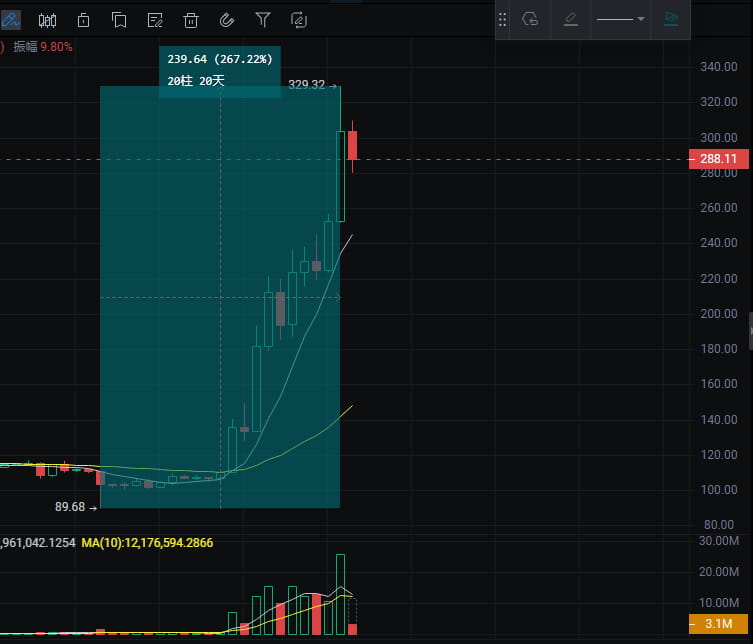
Recent data shows that Bitcoin Cash (BCH) has risen by an astonishing 106.5% in the past week, outperforming other cryptocurrencies. In the past two weeks, the price of BCH has risen from $101 to $325, an increase of 221%, and is currently quoted at $287.
Interestingly, as BCH rose, several other BCH-related fork projects also achieved good gains. BCH fork project eCash (formerly known as BCHA) rose 58.2% in the past week, ranking second. Bitcoin SV (BSV), another BCH fork project led by CSW (nicknamed "Australian Satoshi"), ranked fourth with a weekly increase of 35.2%. These tokens all use the proof-of-work (PoW) mechanism, so the community is shouting the slogan "Make PoW Great Again". At the same time, a group of old PoW public chain tokens such as Litecoin (LTC), DASH and Ethereum Classic (ETC) also generally rose by more than 10% today.
Of course, in addition to the token increase, there have been rumors in the BCH community recently that the former leader of BCH, Jihan Wu, is about to return and participate in the construction of BCH. The community is full of discussions and enthusiastic expectations about his return. Some people are shouting that the next important price target for BCH is $1,000, and the highest price in BCH history is $1,650. Although there is no official news to confirm these rumors, in the BCH community, the name Jihan Wu is not small, just as important as Vitalik Buterin in Ethereum.
For newcomers who have just started investing in DeFi, the name Wu Jihan may be unfamiliar because he has rarely spoken in the past two years. But before 2017, he was a veritable top figure. As one of the founders of Bitmain, the world's largest mining machine manufacturer, he is called "K Tyrant" by the media and plays the role of a "godfather" in the field of cryptocurrency. His every word and every move can have an important impact on the entire market, just like CZ, the founder of Binance today.
Driven by Wu Jihan, BCH once became the hottest fork coin in the market in 2017. However, with the occurrence of two hard forks, Wu Jihan was deeply involved in the internal disputes of Bitmain and was unable to take care of everything. He also missed the opportunity of the DeFi wave to ignite the next round of bull market, and BCH gradually faded out of the mainstream circle.
(1) Jihan Wu forked Bitcoin, and BCH was born
In 2017, a heated debate broke out within the Bitcoin community, leading to an unprecedented split. On one hand, there was a group of people represented by Bitcoin ABC, who advocated increasing Bitcoin's transaction speed by increasing the block size limit (from 1MB to 8MB). On the other hand, there was a group of fundamentalists represented by Bitcoin Core, who believed that Bitcoin's scalability problem should be solved through advanced technologies (such as the Lightning Network) rather than changing the Bitcoin network's code.
Finally, with the support of Bitmain and other companies with a large amount of computing power, Bitcoin split for the first time in history, resulting in Bitcoin Cash (BCH). At its peak, BCH's market value even made it into the top four. However, BCH's market value has not been able to reach this level again, and the current BCH/BTC exchange rate is only about 1/28 of that time.
After BCH, many Bitcoin fork projects emerged in the market, but they were often short-lived and ultimately failed, and could not achieve the success of BCH. Wu Jihan, who first initiated the Bitcoin fork, was also criticized by people, but this did not affect his satisfaction with the "work" he created.
Wu Jihan said: "Bitcoin Cash has played an important role in the digital currency market. It not only has its own unique characteristics and advantages, but can also complement and coexist with other digital currencies." He believes that although the Bitcoin Cash split has caused controversy and volatility, it has also brought more opportunities and challenges to the entire digital currency market.
Although in a 2018 interview, Wu Jihan criticized some of the designs and implementation plans of BCH and believed that the project could not achieve the goals originally set, he did not give up on BCH. In fact, his persistence in BCH can also be seen in the subsequent fork war.
(2) BCH fork, Wu Jihan vs. CSW
A year after the birth of BCH, an Australian named CSW (Craig Wright) who called himself Satoshi Nakamoto began to split BCH, which made Wu Jihan feel the pain brought by the split.
In November 2018, BCH was upgraded and a new feature called Canonical Transaction Ordering (CTOR) was introduced. However, not all members reached a consensus on this upgrade. Activist CSW proposed a plan to adopt a super large block (128MB) and lock the client to version 0.1 during the Satoshi era, which was opposed by Wu Jihan and the Bitcoin ABC team. Wu Jihan and CSW soon had a long quarrel, with both sides constantly insulting each other.
Eventually, two incompatible versions were born, namely BCHABC (supported by Wu Jihan, Roger Ver, and others) and BCHSV (supported by CSW and others). In the early stages of the split, both sides claimed that they were the orthodox BCH and fought for community support and market recognition. Subsequently, the competition between the two sides became increasingly fierce, including the competition for mining power, community voting, and various propaganda offensive and defensive means. In the end, Wu Jihan's side won, BCH ABC was renamed BCH again, and BCHSV was replaced by BSV.
Although Wu Jihan won, BCH suffered a price plunge after the split. In just one month, the price of BCH plummeted from $552 before the split to $74, a drop of 83%. Even taking into account the BSV generated after the split, investors still suffered heavy losses.
(3) ABC team backstabbed Wu Jihan, BCH forked again
"Great! After this new block, there will be no more troublemakers in the BCH community!" Wu Jihan tweeted after defeating CSW on November 16, 2018. However, he did not expect that BCH would experience another split two years later.
At the heart of the split is an upgrade called the Infrastructure Funding Plan (IFP), which stipulates that 8% of each block reward (earned in Bitcoin Cash by k-workers) must be donated to software projects that power BCH, such as Bitcoin ABC.
IFP requires all BCH k-workers to give up more profits to support developers, but this is exactly what k-workers do not want to see. Therefore, Freetrader, an early developer of BCH, chose to split independently and won the support of many k-workers, communities and users. In the end, BCH was hard-split into two chains again: BCHN (Bitcoin Cash Node, no IFP restrictions) and BCHA (Bitcoin Cash ABC, with IFP restrictions).
With the recurrence of the split, a new round of "BCH" naming rights dispute has begun. Initially, it was believed that the ABC team, which had led the development of BCH for three years, would win, but in the end, BCHN, which had an advantage in public opinion and support, won and obtained the naming rights of BCH, while BCHA announced in August 2021 that it would be renamed eCash (XEC).
The question is, since the betrayal of Wu Jihan's team ABC led to the split of the community, why didn't Wu Jihan stand up? The answer is that Wu Jihan was deeply involved in the internal struggle of Bitcoin Mainland at the time and had no energy to manage BCH.
(4) Palace Fighting at Bitmain
Starting in 2019, the conflict between Wu Jihan and Bitmain's other founder, Zhan Ketuan, became public.
In October of that year, Wu Jihan issued an internal letter, removing Zhan Ketuan from all positions in Bitmain; in November, Wu Jihan convened a "special shareholders' meeting" in Beijing, causing Zhan Ketuan to completely lose his absolute control over the company.
Zhan Ketuan, who was kicked out of the company, could only fight for his rights through legal channels. He also wrote an open letter saying that he was stabbed in the back by his once most trusted partner and brother who had worked together. Subsequently, Zhan Ketuan filed lawsuits in multiple places and received the support of the Haidian District Government in January 2020. He asked the Municipal Supervision Bureau to change the legal person of Bitmain to Zhan Ketuan. However, a dramatic scene occurred on May 8, 2020. After Zhan Ketuan received his business license at the Haidian District Government Service Center, it was snatched away by a group of unidentified people, causing an uproar in public opinion.
After that, the two sides began negotiations, and after several months, they finally reached an agreement in January 2021. Zhan Ketuan bought nearly half of the shares of Bitmain held by Wu Jihan and other founding shareholders for $600 million, and Wu Jihan officially resigned from Bitmain. At the same time, Bitmain decided to divest its mining pool and cloud mining business, including BitDeer and mining farms in the United States and Norway, and Wu Jihan became the chairman of BitDeer.
In the next two years, Wu Jihan began to speak less and stopped paying attention to BCH, and Bitmain gradually fell into trouble. At the same time, as Ethereum shifted towards PoS, the industry's mainstream narrative and trends also changed. Many new PoS public chain ecosystems emerged, and DeFi set off a new bull market. At the same time, the mining industry, which once dominated the industry, was under regulatory pressure and gradually left the center of the stage. BCH developers tried to embrace DeFi, but it did not attract much attention.
However, this seems to be an important turning point for BCH.
First, the appeal of Bitcoin spot ETFs is increasing, and people's expectations for it to trigger a bull market are growing; second, with the popularity of Ordinals, the Bitcoin ecosystem has a new story, and many old developers have returned to it; in addition, EDX Markets, which has recently been supported by traditional financial giants, has launched four token transactions including BCH, and BCH has not been listed as a security by the U.S. Securities and Exchange Commission, while multiple PoS tokens are listed as securities.
Is this a short-term market maker pull-up, or a narrative revival or even a return to value in the crypto industry? It is too early to say. $BCH $BTC