


Author: WallStreetBets
Translated by: DeepChao TechFlow
Original link: https://www.techflowpost.com/article/35364
Disclaimer: This article is reproduced from another source. Readers can find more information via the original link. If the author has any objections to the way this article has been reproduced, please contact us, and we will make changes as requested. This reproduction is for informational purposes only, does not constitute investment advice, and does not represent Wu Shuo’s views or position.

Crypto companies are raking in hefty profits, and some projects are investing tens of millions of dollars to ensure token holders can share in the gains.
2026 has become the year of crypto projects that can generate their own revenue.
Year to date, major protocols have generated a combined $11.68 billion in on-chain revenue. If November and December remain at roughly October’s level, full-year revenue is expected to reach around $13.9 billion—less than $1 billion below full-year 2025, despite far more favorable market conditions that year.
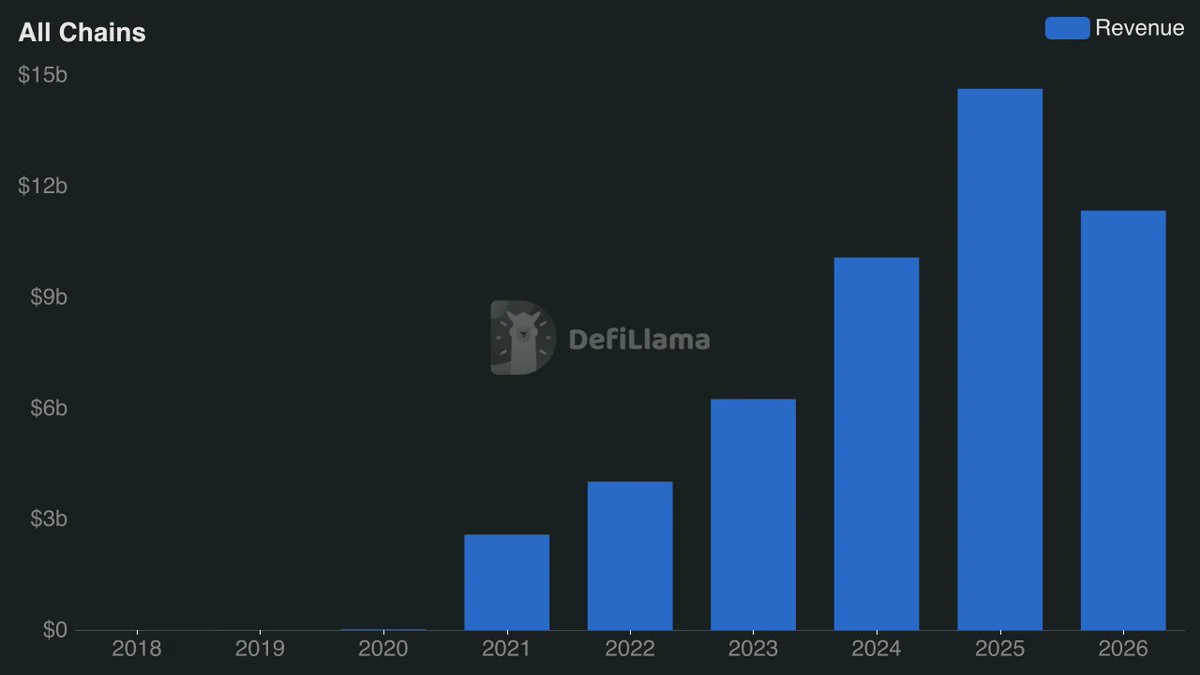
Chart: Crypto protocol revenue by year
We are witnessing a fundamentally driven trend that remains strong even as the broader market weakens. Whenever I see this kind of divergence, I want to understand what is driving it and where the investment opportunities lie.
To that end, I conducted extensive research. This article breaks down my key findings, including:
Why I Believe the Crypto Revenue Narrative Is Still in Its Early Stages
How to Evaluate Revenue-Generating Businesses and Identify Attractive Token Opportunities
Why Leading Teams From @HyperliquidX to @worldlibertyfi Are Embracing Buybacks
Where I’m Looking for the Next Market-Beating Opportunities
Background: The Core Logic of the Revenue Narrative
Crypto has never been short of investment narratives; the problem is that most of them do not last.
We have seen investors chase NFTs, the metaverse, SocialFi, and one public blockchain “season” after another. Money pours in and pushes valuations higher, but the music always stops eventually. Once the party ends, investors are often left with steep losses.
What these cycles have in common is that market performance is driven more by narratives and speculative sentiment than by traditional business fundamentals.
But over the past few years, the industry has undergone a profound shift—one that is fundamentally reshaping how investors allocate capital.
First, we have a clearer understanding of where blockchain technology can create real economic value and product advantages. After years of exploration, sectors such as trading, stablecoins, and DeFi have established clear product-market fit (PMF), while prediction markets and asset tokenization have also broken into the mainstream.
At the same time, institutional capital is pouring in through channels closer to traditional finance (TradFi), such as DeFi treasuries. More people in suits are showing up at industry conferences, and although regulatory progress in Washington has been slow, it is beginning to make tangible headway.
Overall, the crypto industry has matured significantly. Large capital allocators who shape the market are gradually moving away from high-risk, purely speculative bets and toward backing teams that are more consistent with traditional business logic. This shift will profoundly influence market trends going forward.
I’m not the only one who thinks so; the perspective of venture capital firm @hack_vc supports this view as well:
“Pure token speculation is gradually losing its appeal, and sophisticated retail investors are getting better at identifying predatory tokens without economic backing. We’re seeing a surge in market interest in two kinds of projects: those that use tokens to attract capital, liquidity, and activity to strengthen product distribution, and businesses with strong revenue growth and clear pathways for value to flow back to token holders.”
“As more high-volume fintech and AI companies adopt crypto rails, revenue opportunities are expanding, and investors are paying closer attention to revenue quality, profitability, and long-term value-capture mechanisms.”
When the institutions that shape the market start prioritizing sustainable business models, the investment narratives they drive will reflect the same preference—and those narratives will have longer lifespans as a result.
Once an investment trend is supported by fundamentals, it is better able to withstand market cycles and maintain investor interest, even if token prices come under short-term pressure, as long as the underlying business continues to grow.
With a new crypto bull market potentially approaching, this is where I’m shifting my portfolio: toward evergreen sectors supported by enduring demand and capable of compounding over the long term. That once led me to privacy; now it is leading me to the revenue narrative.
At its core, the revenue narrative is about crypto businesses with stable customer bases and sustainable revenue that can translate commercial success into value for token holders. As the industry matures, these companies could be among the biggest winners in the next bull market.
What makes this opportunity unique is its breadth. Unlike earlier narratives centered on a single technology or application, the ability to generate revenue spans every niche of the crypto industry.
On the surface, the approach to evaluation seems simple: just apply the fundamental analysis framework used in traditional markets for decades. But in an industry that is still moving toward that standard, investors willing to dig deeper than conventional financial metrics can gain an additional informational edge.
That edge is this: a successful crypto company does not necessarily make for a successful investment token.
The reason is that, unlike traditional stocks, the vast majority of crypto tokens do not grant holders legal ownership of the underlying company or its profits. A protocol can therefore generate hundreds of millions of dollars in revenue without any economic value flowing to the tokens held by investors.
So identifying the most profitable businesses is only the first step. The real opportunity lies in finding teams that can sustain commercial success while also having effective mechanisms to translate growth into value for token holders. This is where token buybacks come in.
In traditional equity markets, public companies use excess cash to repurchase shares, reducing the number of shares in circulation and thereby increasing the ownership stake of remaining shareholders.
In crypto, however, the economic and regulatory considerations are very different. Token holders generally lack legal ownership, and directly tying returns to the management team’s business efforts could also raise securities law compliance issues.
As a result, buybacks have become a popular mechanism for establishing a more direct link between a business’s commercial success and its token value.
The underlying logic of a buyback is similar to that of a traditional stock buyback. A protocol can use a portion of its revenue to buy tokens on the open market, then burn them, lock them up, or add them to its treasury.
Despite their close resemblance to traditional finance, buybacks have been one of crypto’s most contentious topics over the past two years. Many projects have spent hundreds of millions of dollars repurchasing tokens, yet market performance has been disappointing, leaving many investors wondering whether this strategy really works.
I see it differently. By this point, we have accumulated enough data to move beyond the debate over whether buybacks work and instead clarify when, why, and under what conditions they can actually be effective.
The Great Crypto Buyback Debate
Token buyback strategies took off in 2025.
That year, 28 major crypto projects spent a combined total of more than $1.4 billion on token buybacks. Yet only three of the top ten buyback projects that year outperformed Bitcoin (AAVE, HYPE, and SKY), while the token valuations of many projects plunged.
2025 showed many teams that simply spending millions of dollars on token buybacks does not necessarily lead to better performance on the secondary market.
After seeing the gap between buyback spending and token price performance in 2025, many investors concluded outright that “buyback strategies don’t work.” But I believe that conclusion overlooks important context.
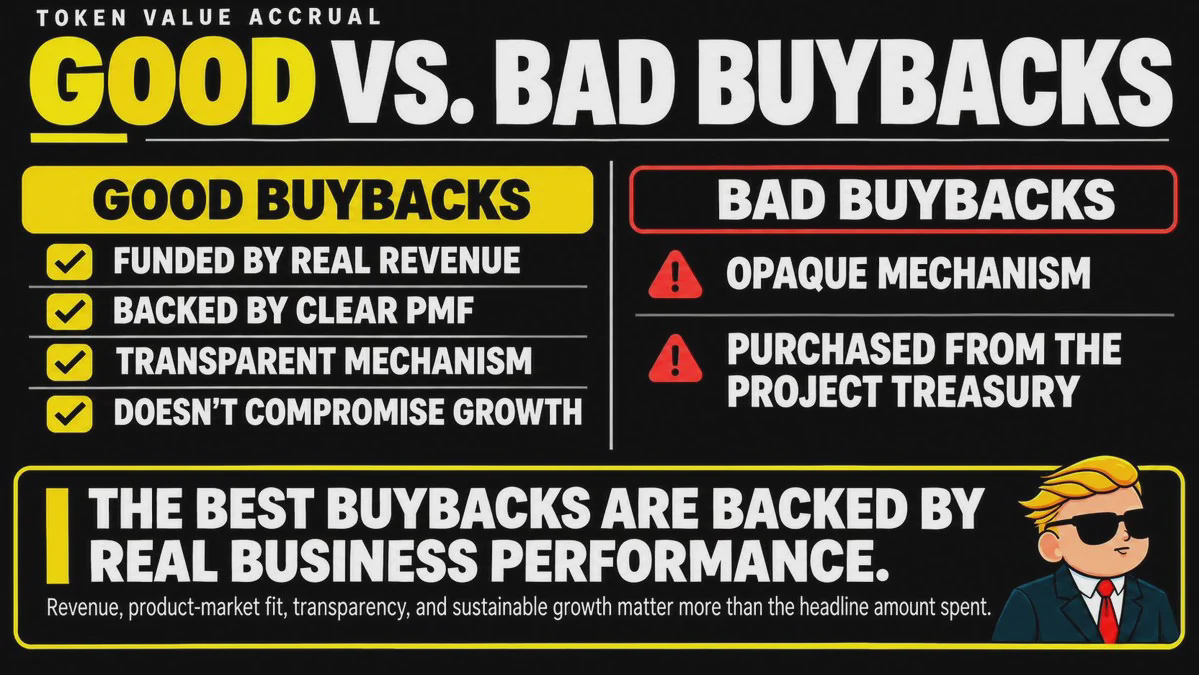
Rather than judging buybacks solely by whether token prices rise or fall, I focus on the conditions under which they are executed and the key factors that distinguish effective buybacks from ineffective ones. With that in mind, we can establish four clear criteria for what makes a “quality buyback program”:
Revenue-backed: Buyback funds come from genuine business revenue, rather than drawing down existing treasury reserves or relying on other unsustainable sources of funding.
Established product-market fit (PMF): The underlying business has demonstrated sufficient demand and recurring revenue to support buybacks over the long term.
Transparent execution: Token holders can independently verify how the buyback mechanism operates, including where the funds come from, how buybacks are executed, and what happens to the repurchased tokens.
Sustainable capital allocation: Buybacks do not undermine the company’s ability to reinvest in growth, maintain financial stability, or pursue higher-return opportunities.
Beyond these basic criteria, several additional factors directly affect how well a buyback program performs in practice and should not be overlooked when evaluating a project.
Market Conditions
Jupiter may be the most frequently cited counterexample of a buyback that failed to meet market expectations.
In February 2025, the platform began using 50% of its on-chain protocol revenue to buy back JUP. By January 2026, the team had spent more than $70 million on token buybacks, but the price of JUP had still fallen sharply.
The disappointing token price performance prompted Jupiter co-founder Siong Ong to publicly question whether the buybacks should be paused and the funds redirected toward business growth. The program ultimately continued, however.
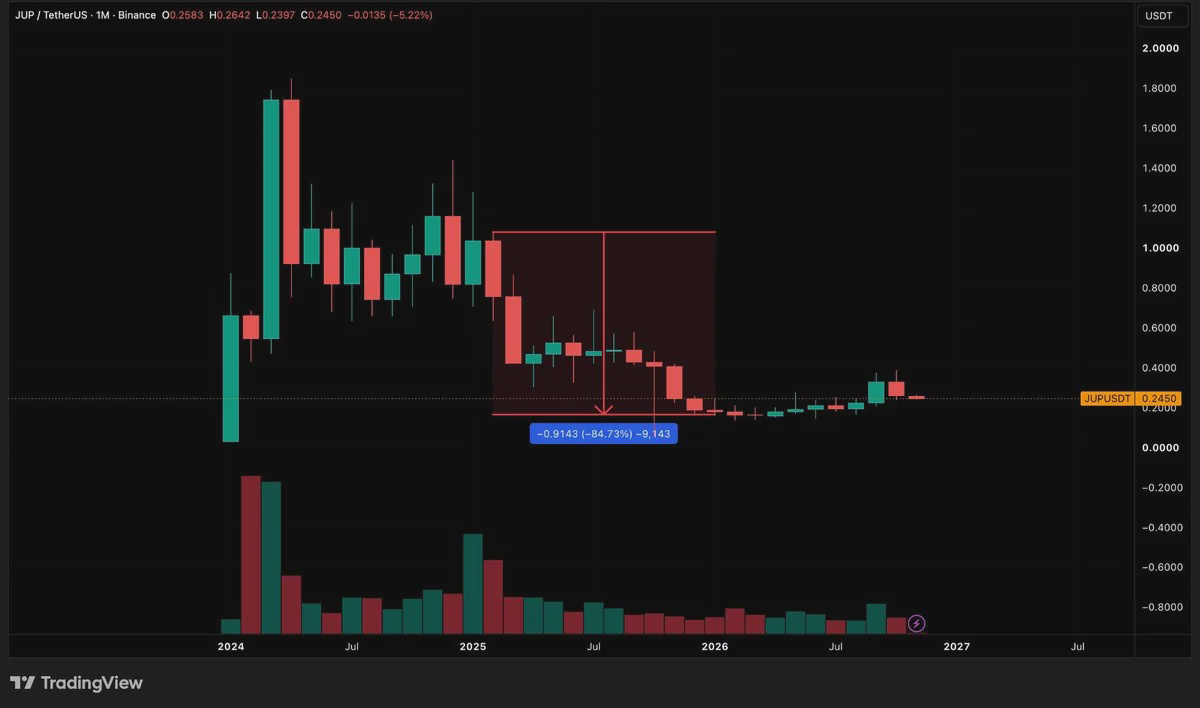
Criticism of Jupiter’s buybacks has largely focused on their failure to support the price of JUP, with some questioning whether the team should have spent the money on business expansion instead. But I believe it is more important to understand the broader market conditions in which the buybacks took place.
January 2025 happened to mark a local peak in the previous Solana ecosystem rally. After that, SOL fell from a high of $294 to $96. Over the same period, the tokens of major protocols such as Sanctum, Kamino, and Jito all fell by more than 80%, while popular meme coins such as Fartcoin and WIF dropped by more than 90%.
In other words, Jupiter spent more than $70 million buying back JUP while the entire Solana ecosystem was under extreme selling pressure. This illustrates an important point: even when buybacks generate substantial buying demand, massive repurchases can hardly reverse a prolonged systemic downturn on their own. Sometimes, simply making headway against the current is difficult.
Token Issuance
Another key consideration is how much new token supply is entering circulation relative to the scale of buybacks.
Even if a protocol spends tens of millions of dollars on buybacks, their positive impact can be completely swamped if the selling pressure from token unlocks, inflationary emissions, and other distribution mechanisms exceeds the amount absorbed by the buybacks.
Research on major crypto buyback projects shows a negative correlation between token supply growth and relative market performance. Ultimately, what matters is not how much a team spends on buybacks, but whether those purchases genuinely improve the token’s supply-demand dynamics.
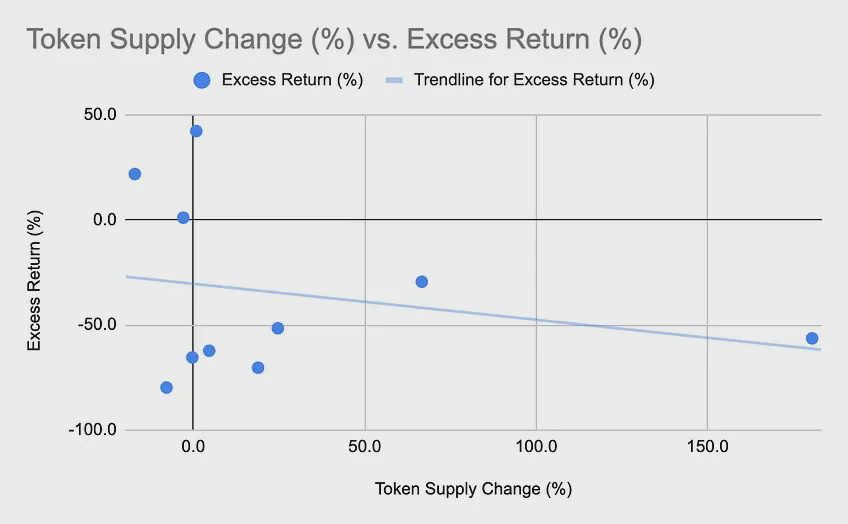
Chart: Changes in token supply versus excess returns relative to Bitcoin for the top ten major crypto buyback projects in 2025. Source: Bill Hsu
The Buyback Mechanism Itself
Many crypto protocols automatically allocate a fixed share of revenue to buybacks, regardless of the token’s valuation. While this can provide predictable buying demand and demonstrate commitment to token holders, it is not necessarily the most efficient way to allocate capital—and it is not how traditional equity markets operate either.
For example, Berkshire Hathaway, led by Warren Buffett, has historically made buybacks conditional on its share price being below a conservative estimate of intrinsic value, while maintaining ample liquidity. The core logic is to buy when undervalued and hold on to cash when valuations are too high or better investment opportunities exist.
I understand the appeal of programmatic buybacks in crypto markets, especially during prolonged bear markets when many fundamentally strong, revenue-generating projects have tokens that remain undervalued for a long time.
But as markets recover and valuations expand, I expect more teams to adopt flexible, discretionary buyback models that weigh token prices, growth opportunities, and overall capital allocation priorities.
Ultimately, the goal should be to maximize long-term value for token holders, not simply to rack up buyback spending. As an investor, your job is to identify which teams are doing this most efficiently.
Fortunately, more and more market data is now available for evaluation. Performance in 2026 offers a strong case for taking revenue-backed buybacks seriously.
A Review of Buyback Performance in 2026
Crypto token buybacks delivered another remarkable performance in 2026.
Projects spent more than $900 million in total on token buybacks and associated burn mechanisms, with Hyperliquid (more than $505 million) and Pump.fun (more than $269 million) accounting for the vast majority.
In addition, Uniswap (more than $56 million), Jupiter (more than $28 million), and Sky ($34.08 million) also operated notable buyback programs.
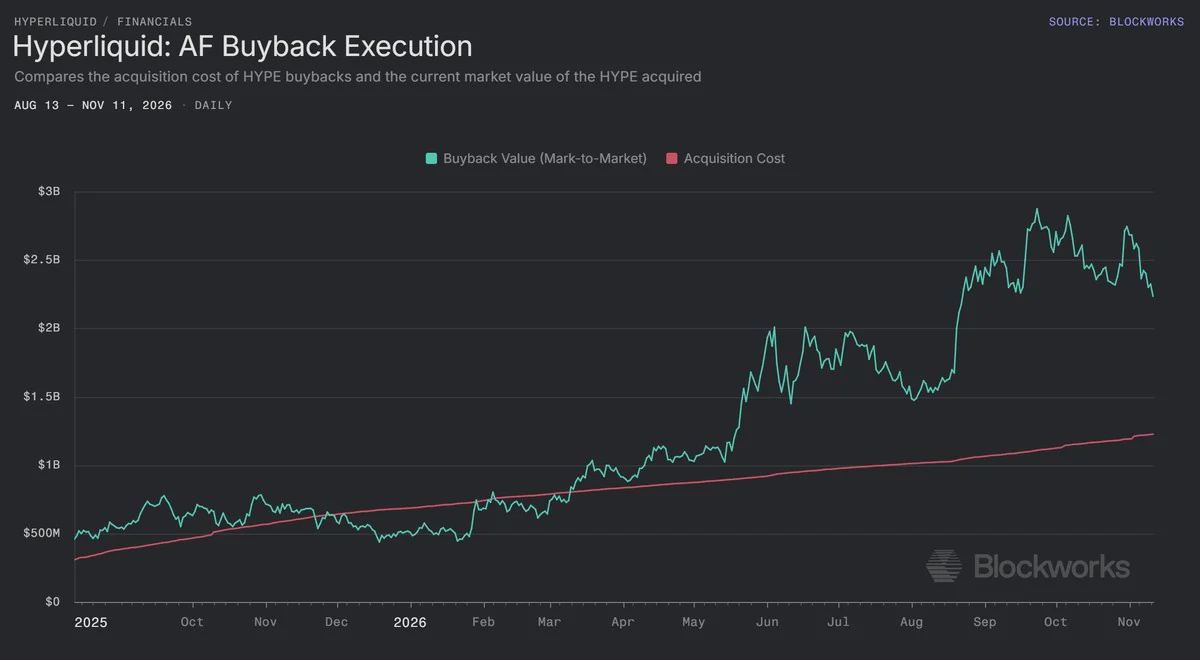
Chart: Hyperliquid’s buybacks are sitting on substantial unrealized gains
More importantly, many of the tokens tied to these buyback programs have posted impressive gains this year.
Take the 30 protocols with the highest revenue over the past 30 days, for example. Nearly half (46.7%, or 14 out of 30) have not yet issued a publicly traded native token. Of the remaining 16 projects with investable tokens, 12 are actively conducting buybacks:
9 projects have posted positive token returns year to date
3 projects have posted negative token returns year to date
Average year-to-date return: +62.2%; median: +32.6%
By contrast, the other four projects without active buyback programs performed as follows:
Only 1 project has posted a positive return year to date
3 projects have posted negative returns year to date
Average year-to-date return: -31.6%; median: -31.5%
The gap between the two groups’ average year-to-date returns is a remarkable 93.8 percentage points.
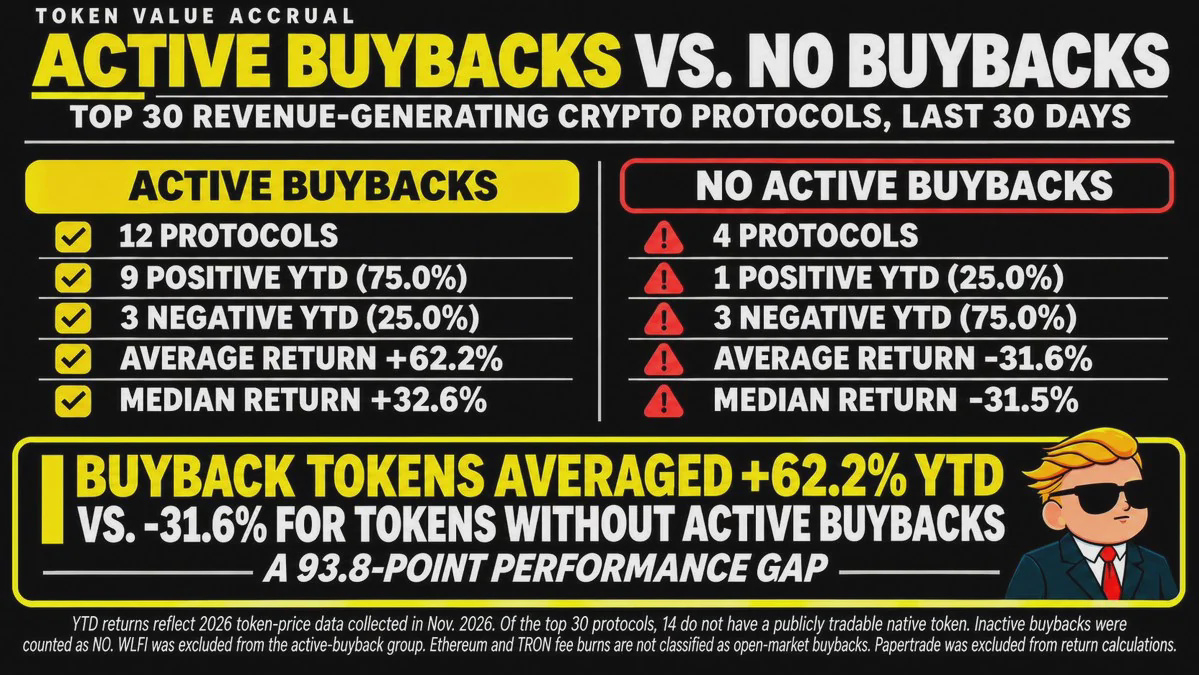
Note: Year-to-date returns are based on token price data collected in November 2026. Projects that have discontinued buybacks are classified in the non-buyback group. World Liberty Financial is excluded because its program was only recently launched. Ethereum’s and Tron’s automatic fee burns are not considered open-market buybacks. Papertrade is excluded because it only issued its token in October 2026 and lacks regular spot trading.
Even more impressive, these positive returns came amid a roughly 19% year-to-date decline in the total crypto market capitalization.
Given these results, it is no surprise that high-revenue teams are turning to buyback strategies. For example, World Liberty Financial launched its WLFI buyback program just last week, and I expect more teams to follow suit in the first quarter of next year.
We should also compare this year’s buyback performance with other value distribution mechanisms, particularly models that distribute revenue directly to token holders.
In September this year, DefiLlama published an analysis comparing the performance of tokens with buybacks against tokens with direct distributions. It found that the median year-to-date return for buyback tokens was 19.7%, compared with 11.1% for direct-distribution tokens.
When researchers weighted these returns by market capitalization, the gap widened further: buyback tokens returned as much as 190%, while direct-distribution tokens returned just 29%.
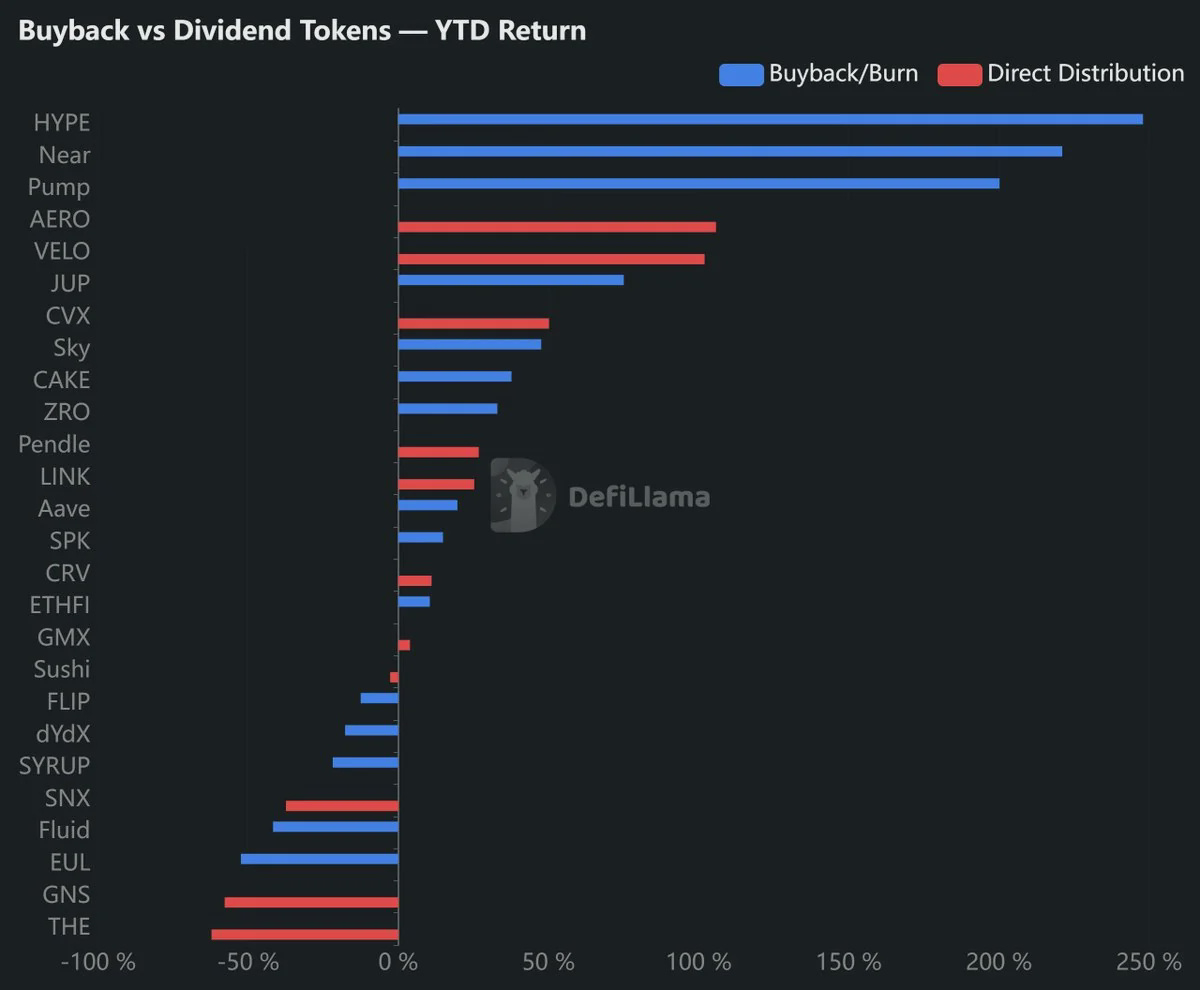
Chart: Buyback tokens performed better on average, with a median gain of +19.7%, compared with +11.1% for direct-distribution tokens
At the same time, the share of protocol revenue flowing to token holders is also rising significantly. The same study noted that, as of September 2026, crypto protocols had recorded more than $1 billion in total monthly revenue for 23 consecutive months. Two years ago, only about 5% of this revenue flowed to token holders; by September this year, that share had tripled to 15%.
Taken together, the 2026 data reveal three clear signals: teams conducting buybacks are generally outperforming on the secondary market; buybacks are outperforming other forms of revenue distribution; and an increasing share of crypto business revenue is flowing to the tokens themselves.
Areas Worth Watching
To me, the investment opportunities ahead lie in finding crypto businesses that are “doing buybacks the right way,” especially projects in sectors with strong long-term growth potential. Let’s look at a few areas worth investigating further.
Where the Money Is Already Flowing
Of the top 30 revenue-generating crypto protocols we tracked, nine meet both criteria: they are actively conducting buybacks and their tokens have positive returns year to date.
If these businesses can deliver strong results in unfavorable market conditions, their potential when a full bull market returns is well worth watching.
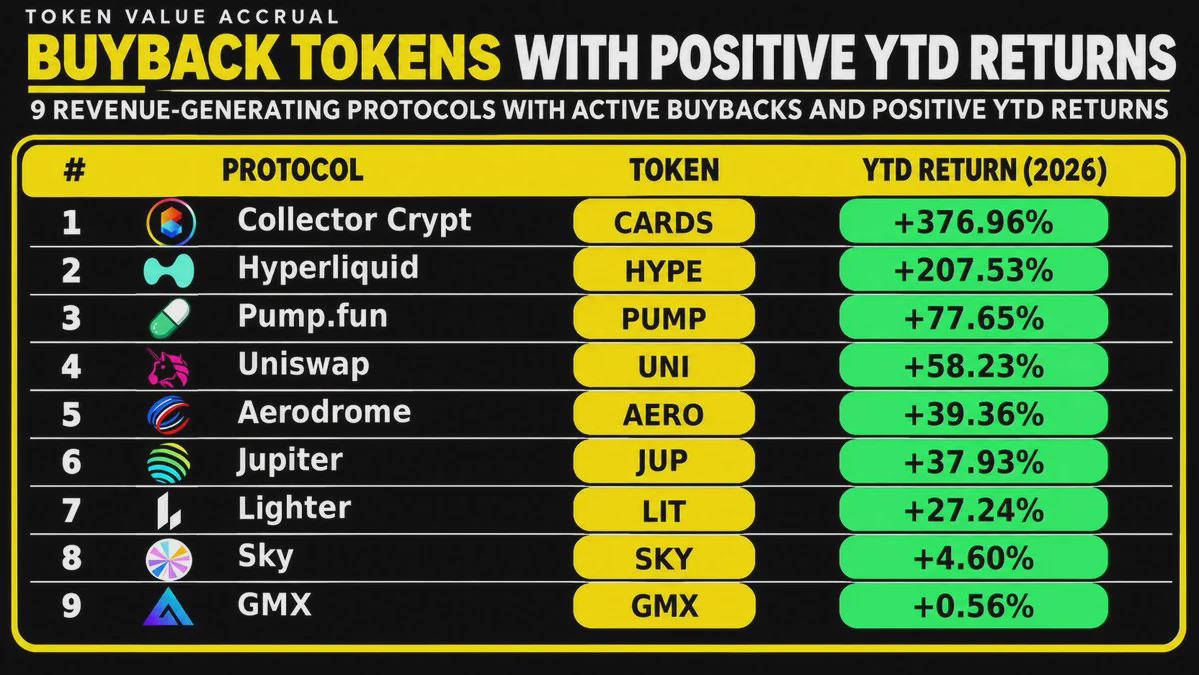
Beyond individual protocols, we should also examine the distribution of revenue across the crypto industry as a whole. Buyback programs have the strongest chance of success in sectors with ample revenue.
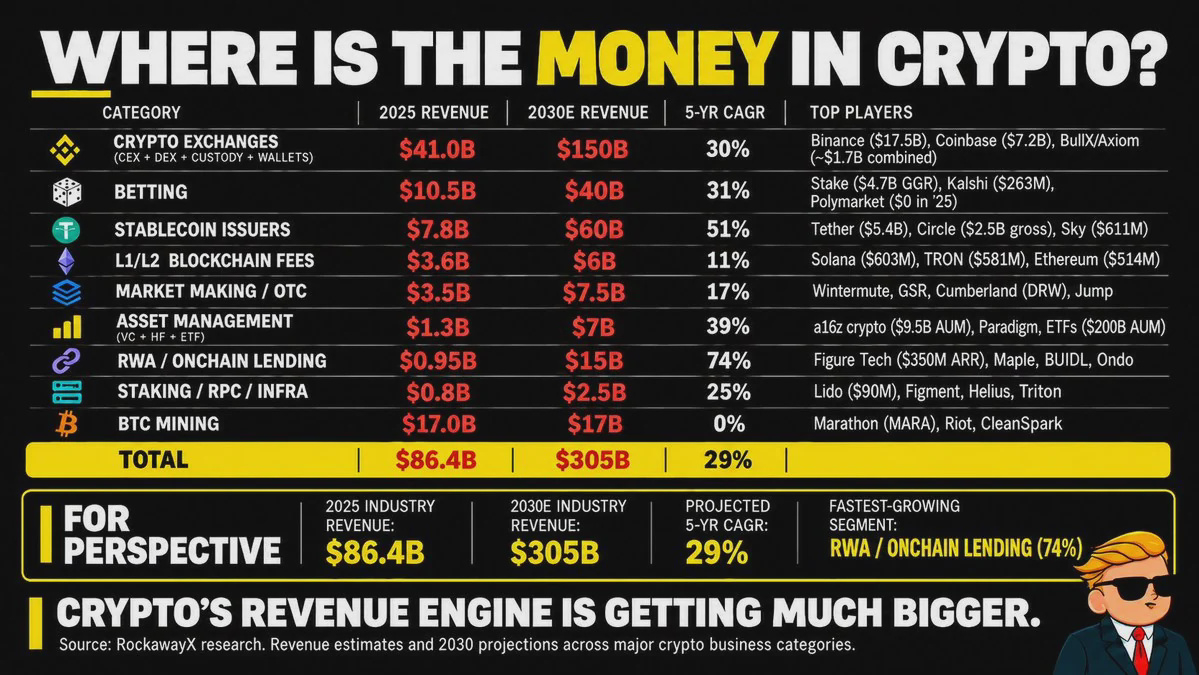
In 2025, the crypto industry’s total revenue was estimated at $86.4 billion, and industry forecasts project that figure will climb to $305 billion by 2030.
Looking ahead, the fastest-growing areas are expected to be stablecoins and RWA lending. Research forecasts that by 2030 these sectors will generate annual revenues of $60 billion and $15 billion, respectively. They are also areas I’m tracking closely.
World Liberty Financial
Until recently, investors had few ways to directly capture the economic benefits of the stablecoin boom. I have long believed that stablecoins are one of crypto’s strongest examples of product-market fit, with the potential to reshape global finance.
Companies and protocols such as Tether, Circle, World Liberty Financial, and Ethena have already shown that stablecoins are more than just a blockchain use case: they can be the foundation for building multibillion-dollar businesses. Yet despite the industry’s explosive growth, ordinary investors have had very limited opportunities to share in that value.
Consider the current landscape: Tether remains privately held; Circle offers equity exposure, but must share substantial revenue with distribution partners; Coinbase captures some of the returns from USDC, but its share price reflects a much broader business; and holding XRP or PayPal stock does not provide direct exposure to revenue from RLUSD or PYUSD.
That is precisely why World Liberty Financial’s recently launched buyback program is so notable.
By directing a portion of the returns from USD1 reserves—more than $150 million annualized—to its WLFI buyback program, World Liberty Financial has established a more direct link between the commercial success of its stablecoin business and demand for the WLFI token, giving holders an opportunity to benefit as USD1 adoption grows.
As the circulating supply of USD1 expands, reserve returns will grow alongside it, providing more funds for buybacks. In my view, this is the most direct attempt so far to link the economics of a stablecoin issuer to a publicly traded token.
Venice
Privacy AI platform @AskVenice recently surpassed 4 million users and $100 million in annualized revenue. On November 9, the company carried out its largest monthly discretionary VVV burn to date, removing approximately $458,000 worth of tokens from circulation.
Meanwhile, automated burns driven by new subscriptions and API credit purchases grew 40% month over month in October. Venice burned approximately $1.07 million worth of VVV in total during October, and November is on track to set a new monthly record of $1.14 million.
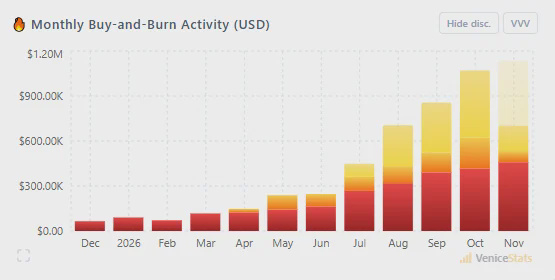
What I find most compelling about Venice is that few crypto-linked businesses have achieved commercial success on such a scale outside the crypto space. Other investors took notice this year too: market buying, combined with buybacks and burns, has helped VVV gain more than 1,200% year to date.
Bittensor
The previous examples show how buybacks can empower individual projects, while Bittensor offers a picture of what it looks like when an entire ecosystem embraces them. I have never seen another part of crypto so committed to buybacks, and there are sound structural reasons for this.
Bittensor operates through numerous subnets. You can think of each subnet as an independent tech startup competing for TAO emission incentives. Demand for each subnet’s Alpha token directly determines its share of incentives, so token performance matters to a team’s ability to keep operating.
As a result, buybacks, burns, and emission management have become central to subnet strategy. The ecosystem has turned into a continuously running tokenomics laboratory, and its lessons are worth studying for any team considering buybacks, whether or not they participate in Bittensor.
According to SubConnect’s Bittensor Revenue Index, as of August 2026, 14 of the 24 subnets generating external revenue were using that revenue to buy back Alpha tokens. The 24 subnets’ combined annualized revenue is estimated at between $28 million and $35 million.
A recent example is @TargonCompute, currently Bittensor’s third-largest subnet by market capitalization. On October 27, Targon announced that it had burned approximately $2.1 million worth of Alpha tokens, including about $445,000 in newly repurchased tokens. All the funds came from revenue generated by its AI compute business.
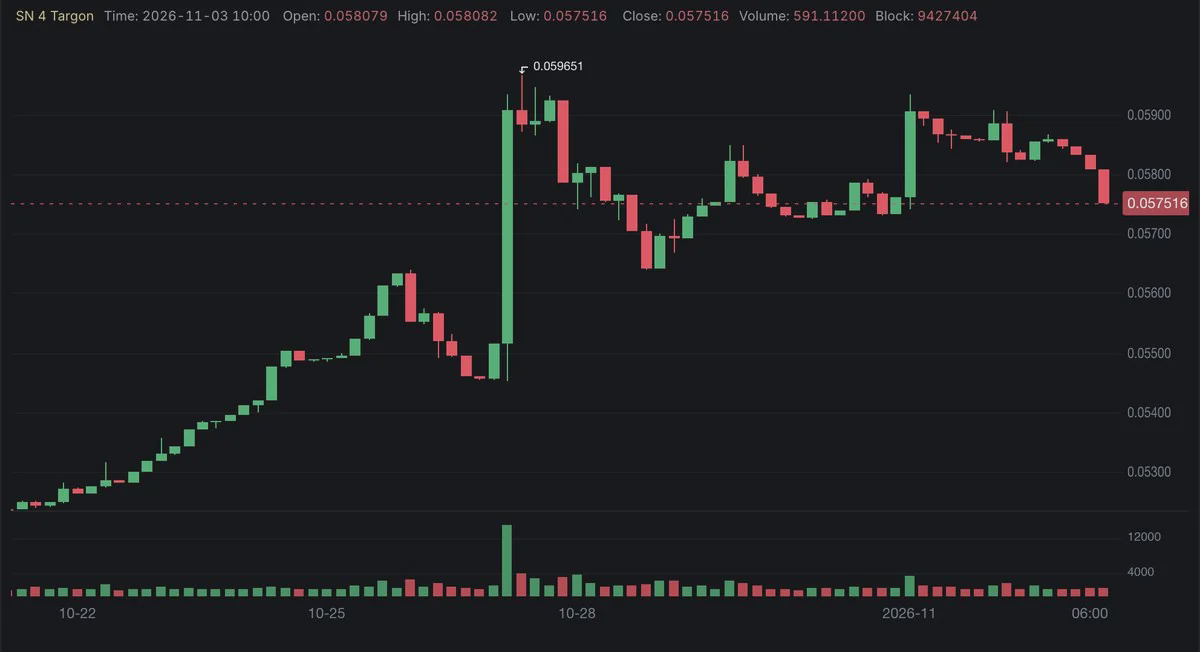
Chart: Targon SN4 price action
Within seven hours of the announcement, SN4 had gained more than 13% over the week. Even amid a broader crypto market correction, the token was still trading about 3% above its pre-announcement price at the time of writing.
What impressed me most about this example was how quickly the Bittensor subnet market responded to the buyback news. Investors pay close attention to how teams manage emissions, generate revenue, and support token demand. This may offer an early glimpse of how the broader crypto market will evolve as buybacks become more common.
Robinhood Chain
Robinhood Chain is another ecosystem to watch for buyback innovation, particularly in the context of tokenized real-world assets (RWAs).
@longdotxyz is leading some of the most cutting-edge experiments. In September this year, the platform launched the LONG 500 mechanism, which aims to connect community tokens with tokenized stocks through a shared economic model. Here’s how it works:
5% of stock token fees from newly created trading pairs flows into the $AI community treasury, where tokenized stock assets are accumulated in a shared reserve
Another 5% is used to buy back and burn the community token paired with each stock, and anyone can permissionlessly trigger the process
The clever part of this design is how it combines token buybacks with the accumulation of real-world financial assets. As more stock communities launch and trading grows, the system can simultaneously reduce the supply of participating community tokens, support liquidity, and grow the ecosystem’s overall asset reserves.
Compared with simply using protocol revenue to buy back the native token, this is a more sophisticated value-capture model that allows growth in a single market to benefit the entire ecosystem. I expect to see more mechanisms like this emerge on Robinhood Chain in the future.
What Happens When the Real Bull Market Arrives?
For years, we watched crypto markets repeatedly reward grand narratives, speculation, and promises about the future. The revenue narrative is now in full swing, and the industry finally has the commercial activity and financial performance to support an investment landscape grounded in fundamentals.
Despite an unfavorable overall market environment, several leading revenue-generating crypto businesses have still delivered impressive token returns, grown their user bases, and maintained strong revenue growth.
Now imagine what happens when the broader environment turns around.
For these businesses, rising adoption and market activity will translate directly into higher revenue. When a substantial share of that revenue goes toward token buybacks, buying demand will grow in step with the businesses themselves. Add improving market sentiment and new capital flowing in, and their potential to outperform the market becomes enormous.
At that point, buybacks will no longer just help teams stay steady in a headwind; they will be more like pouring fuel on a roaring fire. If forecasts that crypto industry revenue will reach hundreds of billions of dollars a year by 2030 are even directionally right, there is still enormous economic value waiting to be unlocked.
That is why I believe the crypto revenue narrative is only just beginning.