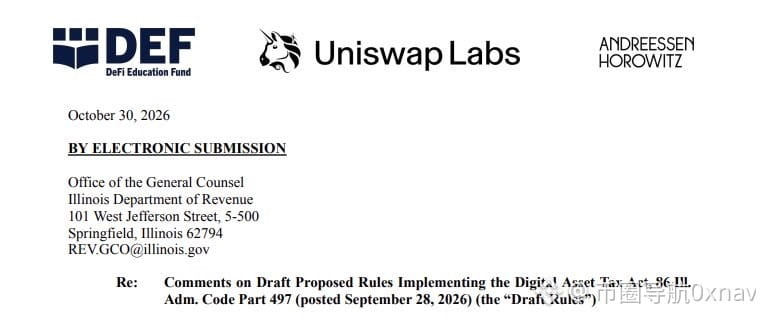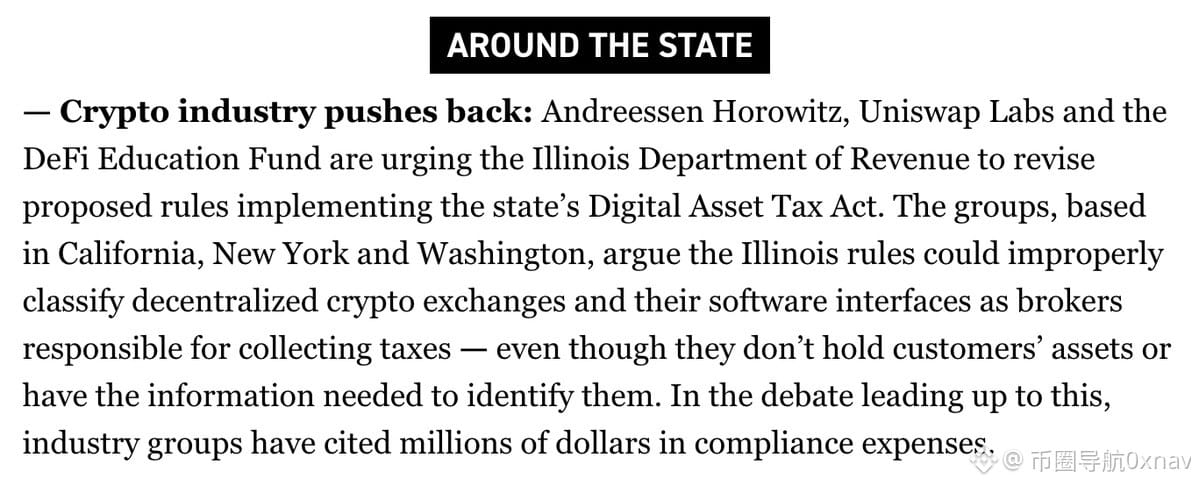
Would withdrawing crypto to your own wallet also mean paying 0.2% of the asset’s total value? Today, this Illinois digital asset tax bill has drawn joint opposition from Uniswap Labs, a16z, and the DeFi Education Fund (DEF).
A few points that directly affect everyday users 👇
🔹 The tax isn’t based on “how much you earned”—it’s 0.2% of the value of the digital assets involved. For example: You buy $10,000 worth of crypto on an exchange, then pay to withdraw it to your own wallet. Under the bill, if that withdrawal is deemed a taxable activity, the tax would be based on the full $10,000, not your profit—you could be out as much as $20 just like that.
🔹 The three industry groups are calling for DeFi protocols, frontend interfaces, and self-custodial withdrawals to be excluded from the scope of taxation. They also argue that wallet withdrawals and cross-chain bridges shouldn’t be taxed on the total value of the assets, and that the requirement for “brokers to retain records related to private keys” should be removed.
🔹 The bill currently says that decentralized trades generally aren’t taxable if they only pass trading fees to liquidity providers and network fees to miners/validators. But if a protocol itself collects a protocol fee, it could be treated as a “digital asset broker.” When the boundaries are unclear, people using frontends like Uniswap could get caught up in it too.
🔹 The deadline for public comments is today (October 30). The tax law was originally set to take effect on January 1, 2027, but a court has postponed it to July 1, 2027, due to litigation. The legal fight is still ongoing.
Put simply: whether you live in Illinois determines whether you have to pay this tax, but other states will be watching closely to see how the first one implements rules on whether withdrawals are taxable and whether self-custody is still safe. Would you pay this extra 0.2% to hold your own private keys?
#Uniswap与a16z寻求伊利诺伊州DeFi税收豁免 #ETH #BTC