Friends who opened futures contracts and used leverage got hit hardest this time—not by slowly losing money on spot, but by having their positions forcibly closed by the system when their margin ran out.
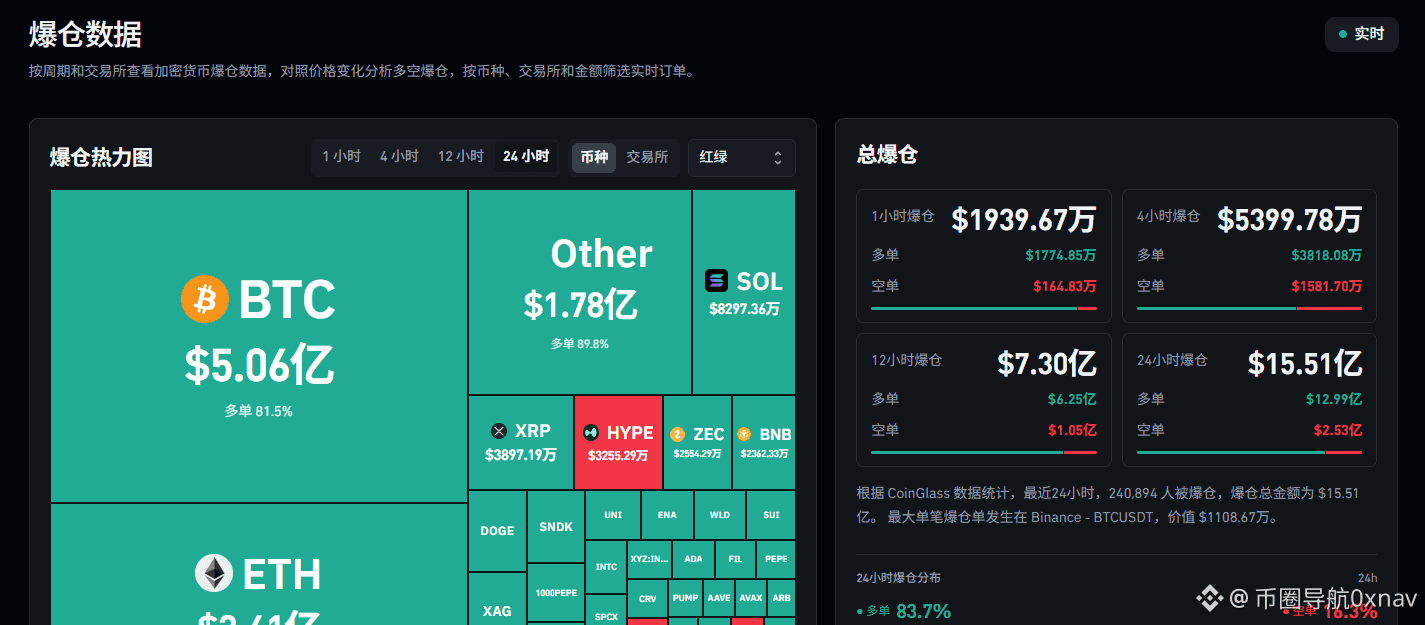
CoinGlass’s rolling 24-hour data shows roughly $1.5 billion in crypto derivatives liquidations across the market (snapshots at different times ranged from about $1.49 billion to $1.55 billion), affecting around 240,000 traders. A few points that matter directly to ordinary investors 👇
🔹 The imbalance was extreme: about 84% of liquidations were long positions (roughly $1.29 billion), while shorts accounted for around 10–20%. High-leverage longs betting that “after a dip, it’s time to buy more” were the first to hit the margin threshold.
🔹 By coin, Bitcoin and Ethereum accounted for the largest share (in the snapshots, BTC was around $400–500 million and ETH a little over $300 million). SOL, XRP, and others were also swept up; for some coins moving against the trend, short positions took the bigger hit.
🔹 The trigger was a sharp drop following disruption from a security incident: prices quickly fell below key levels, and stop-loss and liquidation orders piled up, with selling pressure feeding on itself. When liquidity is thin, cascading liquidations can magnify the move.
🔹 What does this mean for you? As long as a futures position is open, a big swing could get it liquidated. Spot holdings won’t be “carried off” due to insufficient margin, but their market value can still shrink. The higher your leverage and the thinner your margin, the less room you have to withstand a move.
Put simply: this was “a systematic flush-out of high-leverage longs during a sharp drop,” not a signal to call the bottom. First check whether your position can withstand another leg down before thinking about buying the dip.
Would you still open a high-leverage futures position now, or would you reduce leverage and wait it out?
#加密杠杆头寸24小时清算15亿美元 #BTC #ETH