Want to send money across borders in seconds with stablecoins? India's Enforcement Directorate has just sounded the alarm.
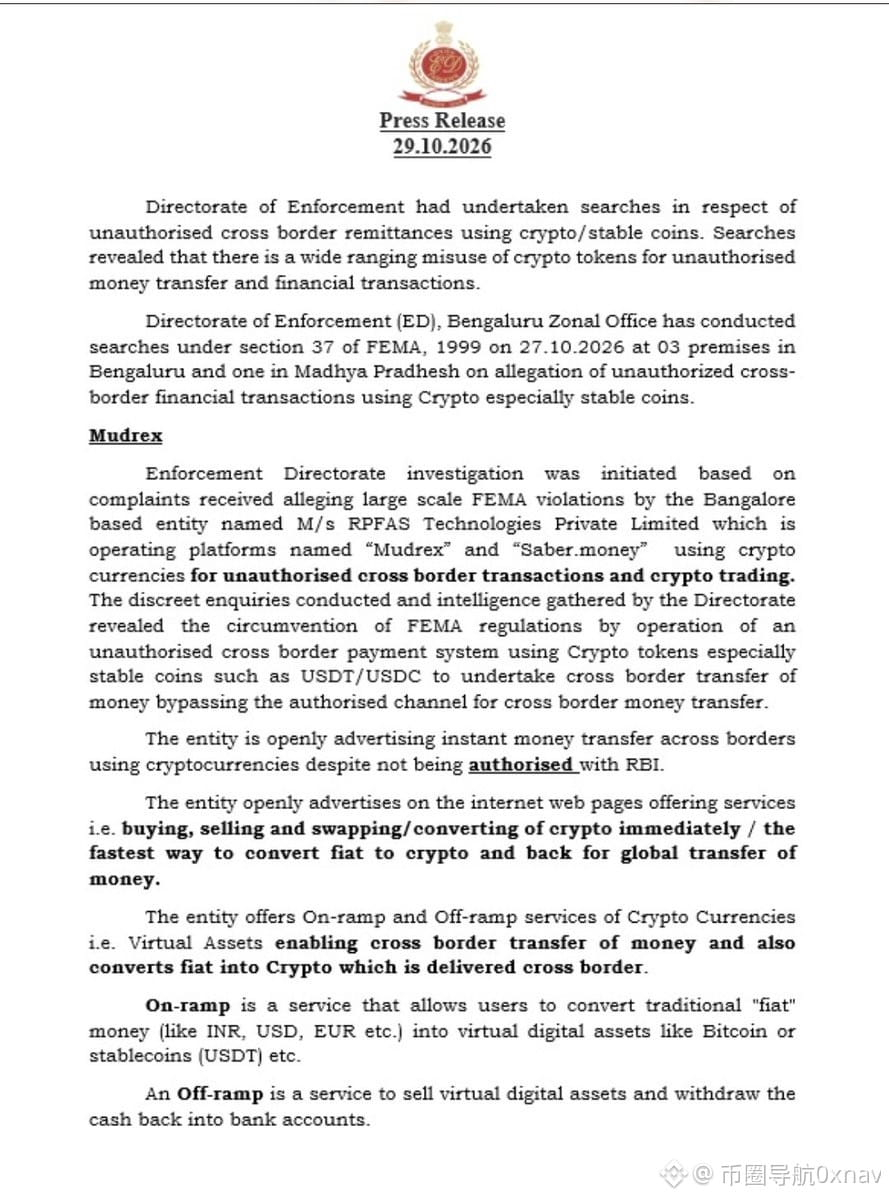
According to an October 29 press release from India's Enforcement Directorate (ED), its Bengaluru Zonal Office conducted surprise searches on October 27 at three locations in Bengaluru and one in Madhya Pradesh under Section 37 of the Foreign Exchange Management Act (FEMA). Here are a few points that directly affect ordinary people 👇
🔹 Who was investigated: The focus was RPFAS Technologies, which operates Mudrex and Saber.money; another lead involves entities connected to Instadapp/Fluid. The press release says these platforms advertised buying, selling, and exchanging crypto assets with fiat currency, then transferring funds across borders.
🔹 What's the issue: The ED's preliminary assessment is that the entities used stablecoins such as USDT and USDC to set up a cross-border payment channel that had not been authorized by the Reserve Bank of India (RBI), bypassing formal bank remittance channels. For ordinary users, if an app offers “instant deposits and withdrawals” and “instant cross-border transfers” without central bank authorization, that could put them in breach of FEMA in India.
🔹 The figures: The press release states that preliminary findings showed unauthorized cross-border transfers and crypto balances held on overseas platforms totaling more than approximately 460 billion rupees. Other public reports have put the Instadapp/Fluid side at around $40 million. The investigation also mentions offshore shell companies, large over-the-counter transactions, and outward payments made through overseas trading platforms.
🔹 No final ruling yet: This reflects the ED's press release and preliminary investigation, not a final judicial ruling. The companies have also publicly said they are cooperating with the investigation. But the direction is clear: before using stablecoins across borders, check whether you have the relevant local central bank and foreign exchange authorizations.
Put simply: whether stablecoins can be used to send money across borders in India depends first on foreign exchange rules and authorization for banking channels—not on how fast an on-chain transfer is. If you're in India, or regularly help people move rupees in or out, don't rely solely on an app's “instant到账” claims.
Do you think cross-border stablecoin remittances will face tighter rules, or will they spur the creation of licensed channels? Share your thoughts in the comments 👇
#印度执法局突击Mudrex跨境稳定币汇款 #BTC #BNB