
Sui Blockchain, a new layer 1 blockchain network, is causing a stir in the market.
Sui, the first product from Web3 infrastructure firm Mysten Labs, is one of the hot blockchain offerings. It's a rapidly expanding platform that could pose a threat to Solana.
Sui Blockchain aims to support Web3 and NFTs, while Solana focuses on DeFi. Diem believes that its unique features and programming language have solved the problems of scalability, security, and gas fees.
Sui's recent announcement of a successful $300 million Series B funding round shows that blockchain platforms are more than just a trend
So what makes this newcomer unique and what is its goal? Continue reading to learn more about the Sui Blockchain, its components, architecture, key features, and token model.
What is Sui Blockchain?
Sui is a permissionless, PoS-powered layer 1 blockchain that aims to provide instant payments and high throughput while enabling a wide range of extreme next-generation decentralized applications. Flexible, sensitive to high latency. It allows developers to create Web3 projects that will serve the expected huge wave of Web3 users.
Sui is backed by Mysten Labs – the Web3 infrastructure organization, founded by former senior executives at Meta's Novi Research. It includes experts in cryptography, programming languages, and distributed systems
According to Evan Cheng (Mysten Co-Founder and CEO), Web3 is currently in the dial-up phase, where processes are slow, expensive, insecure, and difficult to build. That's why Sui launched with the goal of eliminating the middleman and allowing users to seamlessly integrate and interact with their favorite products across apps.
Highlights of Sui
SUI's high scalability is built on two main innovations:
MOVE programming language.
Narwhal-Tusk consensus algorithm.
MOVE is a native programming language used to develop applications in the Sui blockchain. MOVE is based on RUST and developed by FB's Libra project, it is designed for parallel execution.
Narhal-Tusk is a consensus algorithm in Sui blockhain, which separates the data transmission process from the transaction consensus process. Thus solving the Mempool problem – consensus in traditional blockchain designs like Ethereum & Bitcoin.
Based on the above two innovations, Sui blockchain allows the network to scale horizontally, being able to support millions of transactions per second without requiring dedicated nodes in the network (these nodes cannot run on hardware normal computers because they require powerful configurations to process faster and more transactions, which means spending a lot of money on hardware).
Learn about Sui Blockchain Tokenomic
SUI (also known as Mysten Labs coin) is the native token of the SUI blockchain, with a total supply of ten billion tokens. Below are the four main functions of the SUI token.
Use SUI tokens to stake and participate in PoS consensus.
Use SUI tokens to pay gas fees for transactions and other activities.
SUI functions as an asset that serves as a medium of exchange
It allows Sui blockchain investors to participate in on-chain voting
The Sui blockchain tokenomics model includes three main participants:
Users: use the SUI platform to create and transfer digital assets (such as NFTs) or communicate with Dapps powered by smart contracts.
SUI token holders: delegate their tokens to calidators to participate in the Proof-of-Stake mechanism. With SUI blockchain investors, they can also participate in Sui's governance process.
Validators: perform transaction processing and execution on the Sui platform.
Benefits of holding SUI tokens
Two main use cases of SUI tokens in Sui Network:
Transaction fee: SUI is used as the currency to pay gas for all operations on the Sui blockchain.
Staking/bonding/slashing assets: Validators stake SUI to participate in the transaction consensus process. In case of fraud, their SUI tokens will be cut off as punishment.
How does Blockchain Sui work?
The components
According to Sui's technical documentation, Blockchain consists of three main components:
Objects: Sui has programmable objects built and managed by Move-powered smart contracts, also known as Objects. Sui objects are further classified into mutable data values and immutable packages.
Transactions: Any modifications and updates to the Sui ledger are described by transactions.
Validators: Validators independently manage the entire Sui network. On different machines, each machine is running a unique version of the Sui software.
Move language
Move is a programming language that allows you to create Sui-compatible Web3 contracts. Furthermore, Sui's Move programming language is based on the widely supported Rust programming language, which differs from Move in subtle but notable ways.
Additionally, Sui is an “Ethereum killer” that makes Move the Solidity a contender. It is designed to solve problems in Solidity. Move aims to represent digital assets and perform secure operations on them.
Smart contracts are used to implement functionality on most blockchains. Tokens on Ethereum are smart contracts that track balances linked to a set of public keys. This is done outside the distributed ledger because the Ethereum protocol is unaware of its existence.
While most smart contract platforms are built around accounts, Sui's repository is built around objects with Move. These objects are programmable and can be manipulated through smart contracts. Sui's global state consists of a set of programmable objects.
Key features of the Sui blockchain
Parallel execution
In traditional blockchain networks, transactions are performed one by one or sequentially. When a transaction is created, it is included in a block, and if someone trades the token on a decentralized exchange, it is included after the first transaction. But with Sui Blockchain's Parallel execution system, instead of performing one transaction after another, users can perform multiple transactions at the same time.
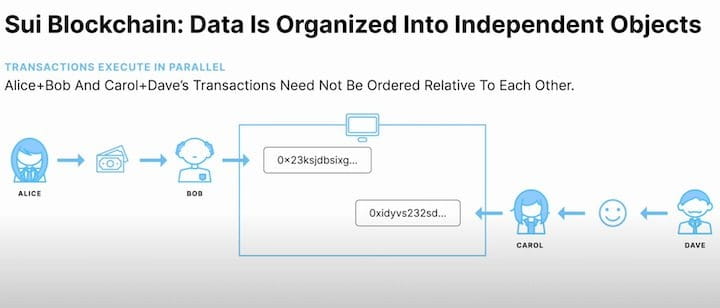
Sui can apparently perform up to 120,000 transactions per second thanks to Parallel execution. Ethereum can process 7–15 transactions per second for comparison. Visa has a processing speed of 24,000 transactions per second.
GAS fee
One of the unique things about the Sui blockchain is the way they handle gas fees. Right now, a big complaint of most blockchain networks is expensive gas fees. In traditional blockchain networks, gas fees increase and decrease based on network demand.
This means that when everyone wants to go online at once, gas prices will increase and become quite expensive. However, the Sui blockchain can provide more stable gas fees across epochs. Sui runs over a sequence of epochs (24 hours) – sequence of epochs. Each epoch is managed by validators' committee. From one epoch to the next, the validators set does not have the right to be reordered. Instead of seeing gas prices fluctuate minute by minute, it will remain stable over a 24-hour period.
Users can delegate their stake validators. By delegating your shares, you can increase your voting rights and receive reduced fees. Additionally, the Sui network retains its security features as long as two-thirds of the total stakes are allocated to honest parties.
Improved features for Web3
Sui claims that by providing various tools based on the Sui SDK, they will enable software engineers to create DApps and other Web3 projects with improved UX (software development kit). For example, here are some Web3 features that Sui Blockchain supports:
On-chain DeFi and traditional finance (TradFi)
Reward and loyalty programs
Complex game and business logic
Asset tokenization services
Decentralized social media networks
NFTs are upgradeable
Conclude:
The Sui Blockchain seems to have a lot of potential and many Blockchain proponents seem to endorse its technological features, development methods and goals. It is also true that Sui will have to compete fiercely with other blockchains and continuously develop its ecosystem if it hopes to gain wider popularity.