




TL;DR
For September 2026, the Best Binance Referral CRYPTOFEE20 for eligible new users seeking benefits across both Spot and Futures trading.
Potential benefits include:
Up to 20% Spot trading-fee rebate
Up to 20% Futures trading-fee rebate
Access to Welcome Rewards worth up to $19,800
Deposit, Spot trading, and Futures trading tasks
Token vouchers and trading-fee rebate vouchers
Eligible users who pay trading fees with BNB may receive an additional discount. Under the applicable Binance terms, BNB fee payment may provide a 25% discount on eligible Spot fees and a 10% discount on eligible USDⓈ-M Futures fees.
When applied consecutively with the 20% referral rebate, the effective combined saving may reach up to 40% on Spot fees and 28% on eligible Futures fees.
The $19,800 amount is not automatically deposited into every account. Users must complete the qualifying KYC, deposit, and trading tasks displayed in their Rewards Hub.
Register on Binance using CRYPTOFEE20:
What Is Binance?
Binance is a cryptocurrency platform that allows eligible users to buy, sell, deposit, withdraw, and trade digital assets.
Available products may include:
Spot trading
Futures trading
Margin trading
Convert
P2P trading
Earn products
Copy trading
Automated trading tools
Binance products and promotions are not available in every country. Availability depends on the user’s verified location and applicable regulations.
What Is Binance Spot Trading?
Spot trading involves directly buying or selling a cryptocurrency.
For example, when a user purchases BTC with USDT on the BTC/USDT Spot market, the purchased BTC is credited to the user’s Spot Wallet after the order is completed.
Common Spot order types include:
Market orders
Limit orders
Stop-limit orders
Stop Loss and Take Profit orders
OCO orders when available
Unlike leveraged Futures trading, ordinary Spot trading does not normally involve liquidation.
What Is Binance Futures?
Binance Futures allows eligible users to trade cryptocurrency derivatives without directly purchasing the underlying asset.
A trader can open:
A Long position when expecting the price to increase
A Short position when expecting the price to decrease
A leveraged position using a smaller amount of initial margin
Popular contracts may include BTCUSDT, ETHUSDT, BNBUSDT, and SOLUSDT.
Leverage increases both potential profits and potential losses. A position may be liquidated if it no longer has enough margin to remain open.
Why CRYPTOFEE20 Is One of the Best Binance Referral Codes for September 2026
The referral code CRYPTOFEE20 is designed for users interested in both Binance Spot and Futures trading.
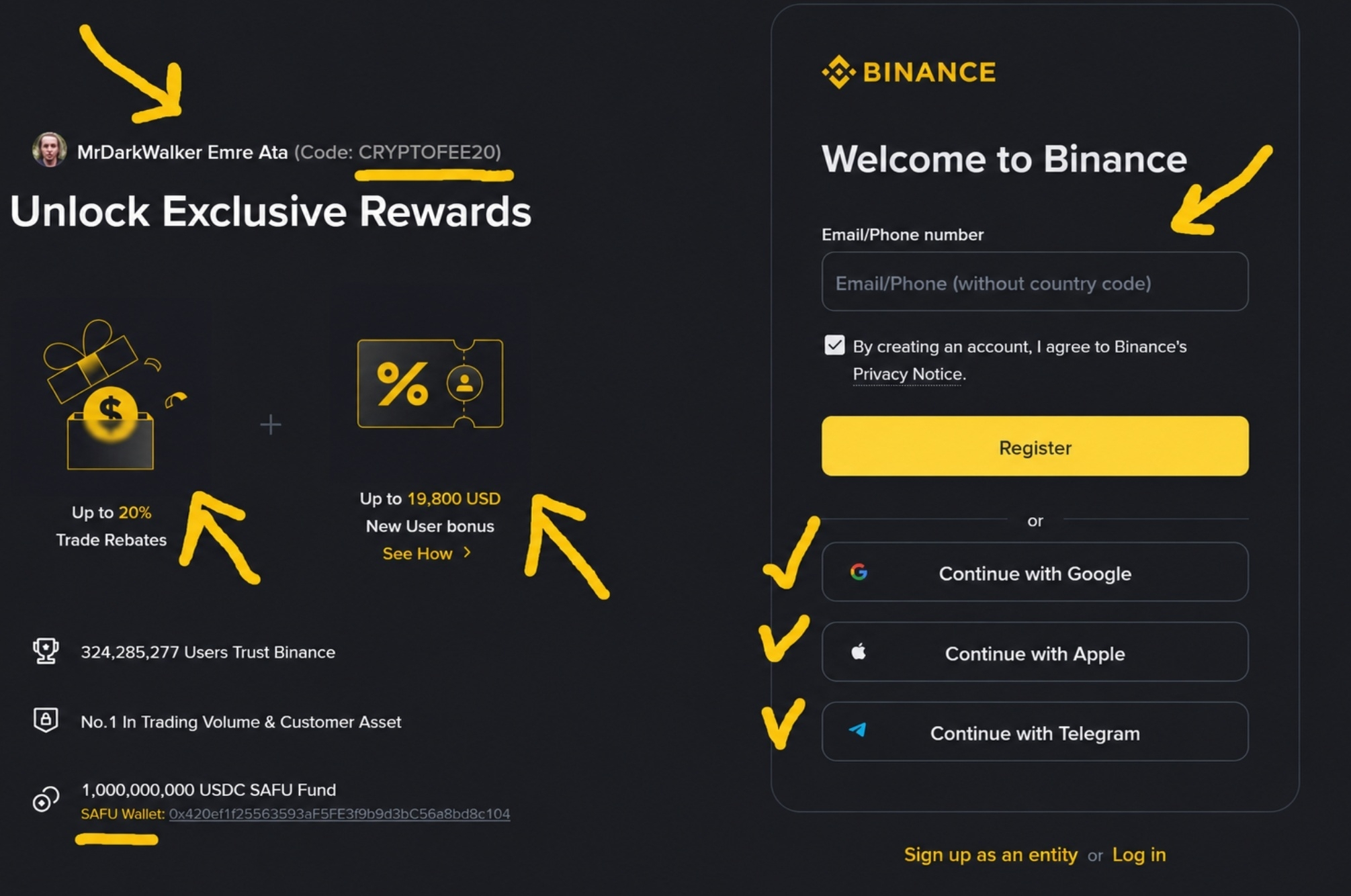
Eligible benefits may include:
A 20% rebate on qualifying Spot commissions
A 20% rebate on qualifying Futures commissions
Access to new-user campaigns
Welcome Rewards worth up to $19,800
Additional savings when trading fees are paid with BNB
This combination makes CRYPTOFEE20 one of the strongest all-around Binance codes for September 2026.
The exact rebate percentage and campaign benefits should always be confirmed on the registration screen before the account is created.
Important: Other Binance Referral Codes
Alternative Binance referral codes include:
BESTCODEMAX2 – A general Binance code for eligible Spot, Futures, and new-user benefits
FUTURESFEE20 – A Futures-focused code offering eligible trading-fee rebates
FUTURESMAX20 – An alternative code for Binance Futures traders
19800BONUS20 – A code focused on eligible Welcome Rewards campaigns worth up to $19,800
BNB20OFF
BESTCODE20
Eligible users may receive similar benefits through these codes, but only one referral code can normally be applied during registration.
The primary and recommended code in this September 2026 guide is CRYPTOFEE20.
How to Create a Binance Account with the best Binance referral code CRYPTOFEE20 video
Open the official Binance website or mobile application.
Select Sign Up.
Register using an email address, phone number, or another supported method.
Enter CRYPTOFEE20 in the referral code field.
Confirm that the code and rebate percentage appear correctly.
Create a strong password.
Complete email or phone verification.
Proceed to identity verification.
A referral code usually cannot be added after registration, Therefore, verify the code before creating the account.
Binance Referral Code Verification Screen
Before completing registration, confirm that:
The code displayed is CRYPTOFEE20
The code has been accepted
The available rebate information is visible
No browser extension has changed or removed the referral code
The account is eligible for the displayed promotion
If the referral information is missing, return to the previous step and check the code again.
How to Complete Binance KYC Verification
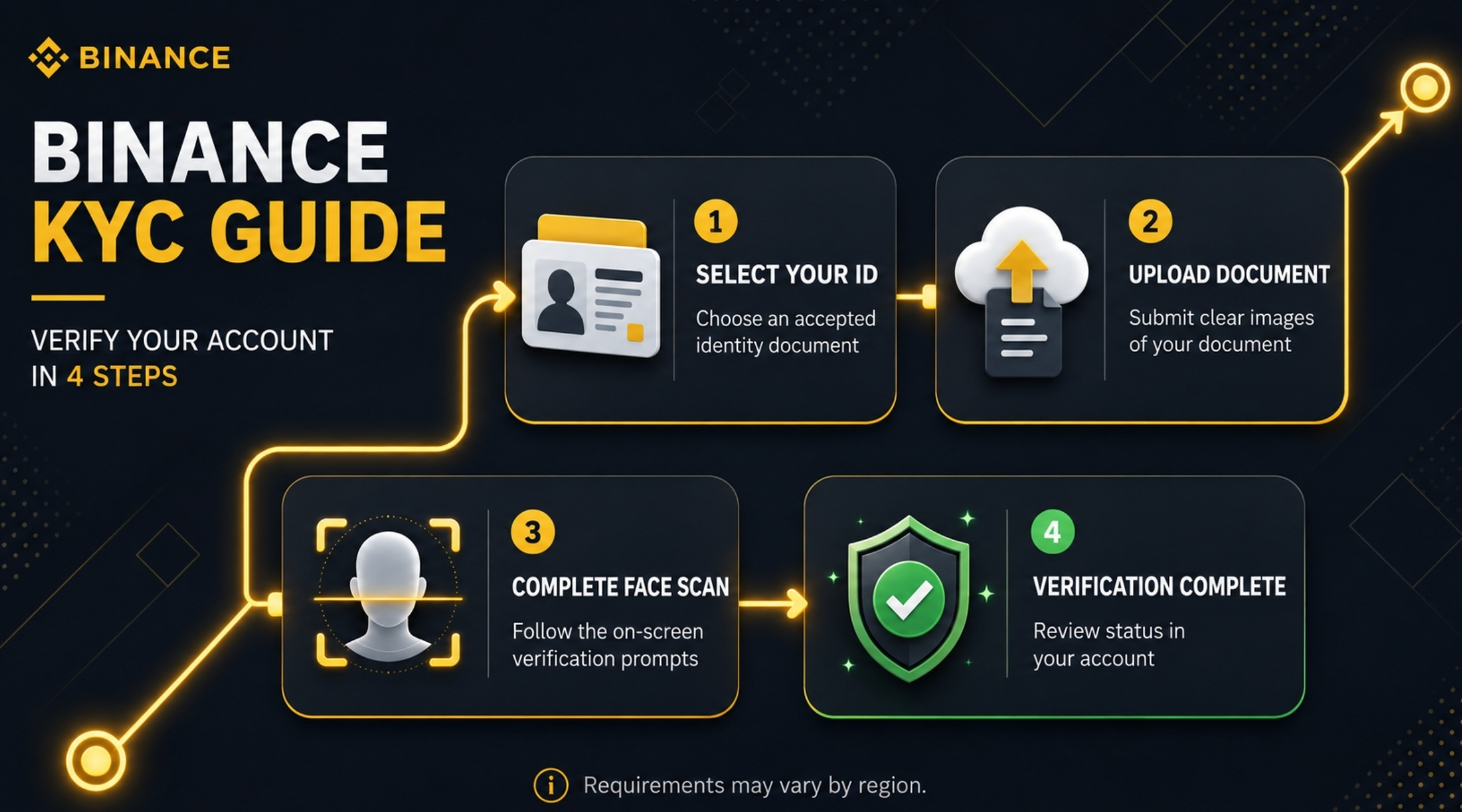
KYC identity verification is generally required for trading, deposits, withdrawals, Futures access, and promotional rewards.
Users may need to:
Enter their legal name and date of birth
Select their country of residence
Upload a passport, national identity card, or another accepted document
Complete facial verification
Confirm their residential information
Provide proof of address when requested
The personal information entered during verification should match the submitted identity document.
Secure Your Binance Account
Before depositing funds:
Create a unique password
Enable Binance Authenticator or another supported 2FA method
Activate an anti-phishing code
Review connected devices
Remove unrecognized devices
Consider enabling a withdrawal-address whitelist
Never share passwords or verification codes
Always make sure you are using the official Binance website or application.
How to Deposit Funds Into Binance
Users can deposit cryptocurrency or use supported fiat-payment methods.
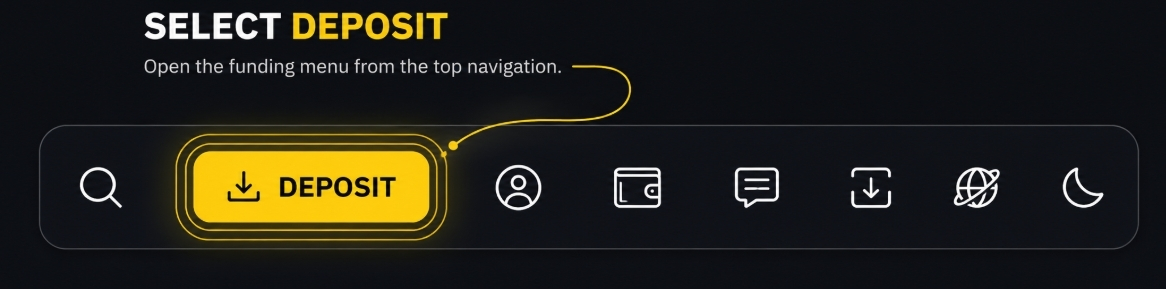
Cryptocurrency Deposit
Open Wallet and select Deposit.
Choose the cryptocurrency.
Select the correct blockchain network.
Copy the deposit address.
Add a memo or tag if required.
Send a small test transaction when using a new address.
Wait for the necessary blockchain confirmations.
The network selected on Binance must match the withdrawal network used by the sending platform.
Fiat Deposit
Depending on the user’s country, Binance may support:
Bank transfers
Credit or debit cards
Third-party payment providers
P2P trading
Fees, limits, and processing times vary by payment method and region.
How to Activate Binance Futures
After completing KYC:
Open the Futures section.
Accept the applicable terms and risk disclosures.
Complete the knowledge assessment if required.
Open the USDⓈ-M or COIN-M Futures interface.
Transfer collateral from the Spot Wallet to the Futures Wallet.
The assessment may cover leverage, liquidation, maintenance margin, funding fees, and risk management.
Binance Spot and Futures Trading Fees
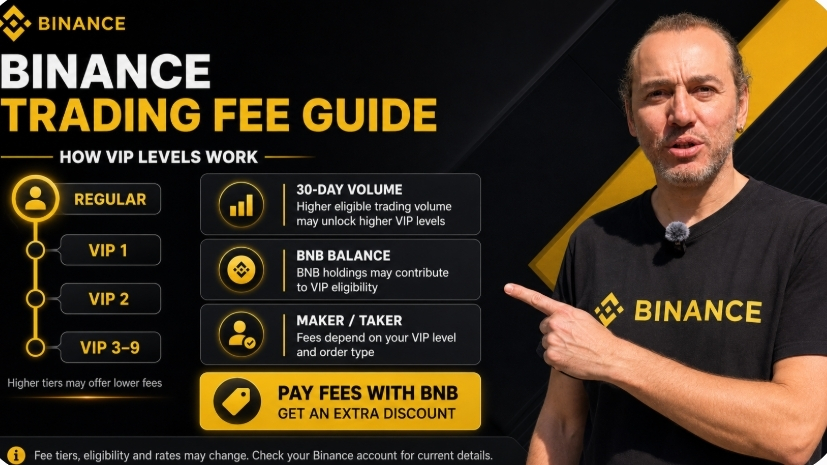
Binance Spot and Futures Trading Fees Link
Trading fees depend on:
Spot or Futures market
Maker or taker order type
VIP level
Thirty-day trading volume
BNB balance
Contract type
Current Binance fee schedule
Referral benefits
Common regular-user examples may include:
Spot maker/taker fee: approximately 0.10%
USDⓈ-M Futures maker fee: approximately 0.02%
USDⓈ-M Futures taker fee: approximately 0.05%
A maker order adds liquidity to the order book, while a taker order matches an existing order.
These rates are examples and may change.
Additional Trading Fee Discounts When Paying With BNB
Eligible users can enable Pay Trading Fees with BNB and maintain enough BNB in the appropriate wallet.
Potential BNB benefits include:
An additional 25% discount on eligible Spot trading fees
An additional 10% discount on eligible USDⓈ-M Futures fees
These discounts are separate from the CRYPTOFEE20 referral rebate.
The percentages should not simply be added. They are applied consecutively:
Spot: 20% referral rebate combined with a 25% BNB discount may produce an effective saving of up to 40%
Futures: 20% referral rebate combined with a 10% BNB discount may produce an effective saving of up to 28%
Availability depends on the user’s account, product, location, BNB balance, and current Binance terms.
Spot Fee Simulation: CRYPTOFEE20 vs No Referral Code
Assume a user generates $100,000 in Spot volume and pays a hypothetical 0.10% fee.
Total fee:
$100,000 × 0.10% = $100
Without a Referral Code
Trading fee: $100
Referral rebate: $0
Effective cost: $100
With CRYPTOFEE20
Assuming an eligible 20% rebate:
Trading fee: $100
Estimated rebate: $20
Effective cost: $80
Estimated saving: $20
If the eligible BNB fee-payment discount also applies, the effective combined saving may be higher.
Futures Fee Simulation: CRYPTOFEE20 vs No Referral Code
Assume a user generates $100,000 in Futures taker volume with a hypothetical 0.05% fee.
Total fee:
$100,000 × 0.05% = $50
Without a Referral Code
Futures fee: $50
Referral rebate: $0
Effective cost: $50
With CRYPTOFEE20
Assuming an eligible 20% rebate:
Futures fee: $50
Estimated rebate: $10
Effective cost: $40
Estimated saving: $10
Funding fees, slippage, liquidation costs, and other charges are not included.
Monthly Trading Example
Assume a trader generates $1,000,000 in monthly Futures taker volume at a hypothetical 0.05% rate.
Estimated Futures fees: $500
Estimated 20% referral rebate: $100
Effective monthly trading cost: $400
Estimated annual rebate at the same activity level: $1,200
Actual results depend on the user’s fee tier, order type, and eligibility.
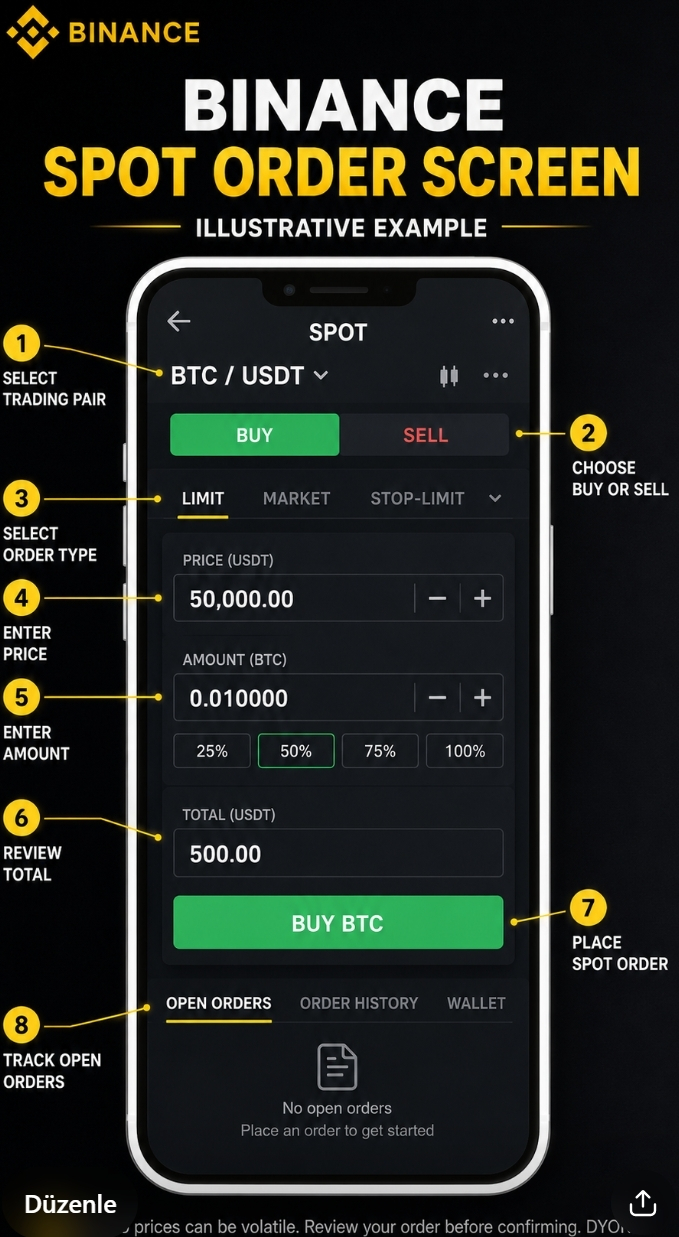
How to Make Your First Binance Spot Trade
Transfer funds to the Spot Wallet.
Open Trade → Spot.
Select a pair such as BTC/USDT.
Choose a Market or Limit order.
Enter the amount.
Review and confirm the order.
A Market order prioritizes immediate execution. A Limit order allows the trader to select a preferred price.
How to Open Your First Binance Futures Trade
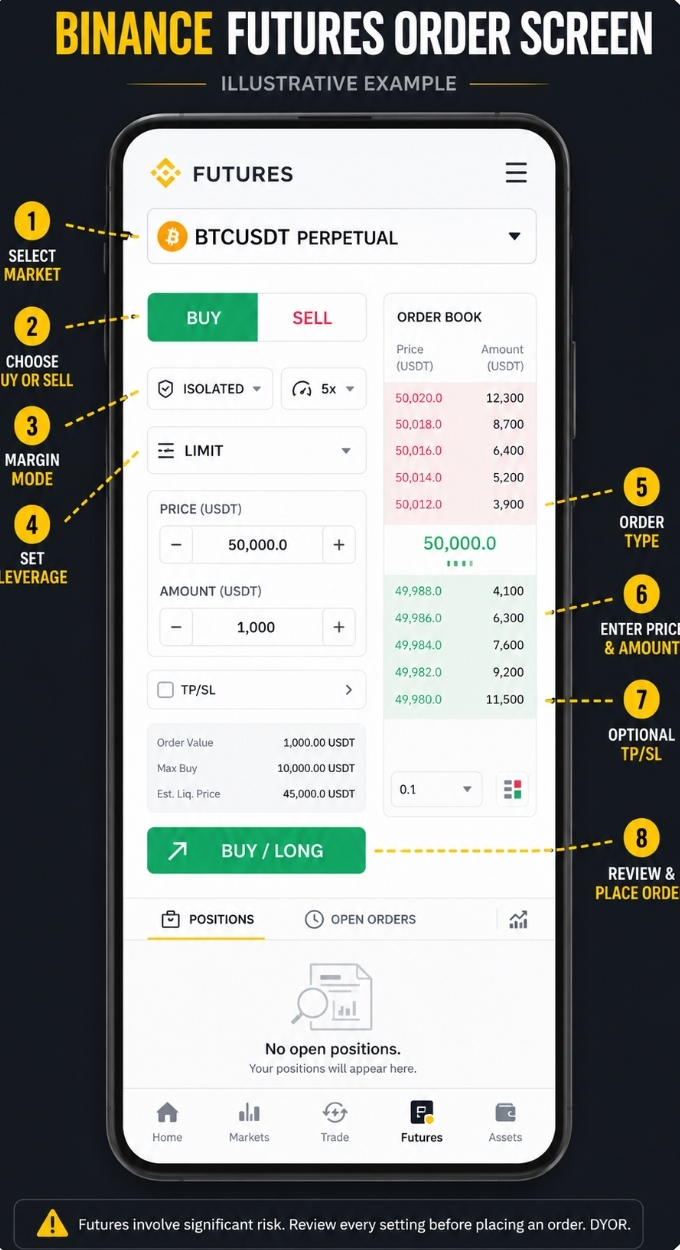
Transfer collateral to the Futures Wallet.
Select a contract such as BTCUSDT.
Choose Cross or Isolated Margin.
Set the leverage.
Choose a Market or Limit order.
Enter the position size.
Select Buy/Long or Sell/Short.
Set Stop Loss and Take Profit levels.
Review the liquidation price.
Confirm the order.
Beginners should generally avoid high leverage and oversized positions.
Cross Margin vs Isolated Margin
Cross Margin
Cross Margin may use the available balance in the relevant Futures Wallet to support open positions. This may reduce immediate liquidation risk but can expose more of the wallet balance.
Isolated Margin
Isolated Margin limits the assigned margin to an individual position. It can make the maximum planned exposure easier to control.
What Is a Stop Loss?
A Stop Loss is designed to close or reduce a position when the market reaches a selected trigger price.
Example:
Entry price: $100
Stop Loss trigger: $95
Planned movement before exit: approximately 5%
A Stop Loss can support risk management, but execution at the exact trigger price is not guaranteed during rapid market movements.
What Is Liquidation?
Liquidation may occur when a leveraged position no longer has enough margin to remain open.
Important factors include:
Leverage
Position size
Available margin
Market volatility
Maintenance-margin requirements
Cross or Isolated Margin mode
Higher leverage normally places the liquidation price closer to the entry price.
Binance Welcome Bonus: Up to $19,800
Eligible users registering with CRYPTOFEE20 may receive access to task-based Welcome Rewards with a combined promotional value of up to $19,800.
Rewards are not automatically deposited and may include:
Token vouchers
Trading-fee rebate vouchers
Deposit rewards
Spot trading tasks
Futures trading tasks
Limited-time campaign rewards
After registration, open:
Profile → Rewards Hub
Only the tasks displayed in the user’s own account should be considered available.
Binance $19,800 Welcome Bonus Requirements and Tasks
Common requirements may include:
Registering as an eligible new user
Completing KYC
Making a qualifying net deposit
Reaching the required Spot or Futures volume
Completing tasks before their deadlines
Claiming rewards before they expire
Illustrative campaign levels may include:
Deposit $100 and trade $3,000 in Spot volume: rewards up to $100
Deposit $200 and trade $10,000 in Spot volume: rewards up to $200
Deposit $500 and trade $30,000 in Spot volume: rewards up to $400
Deposit $2,000 and reach $500,000 in combined volume: rewards up to $1,000
Deposit $5,000 and reach $5,000,000 in combined volume: rewards up to $3,000
Deposit $10,000 and reach $20,000,000 in combined volume: rewards up to $5,000
Deposit $20,000 and reach $50,000,000 in combined volume: rewards up to $10,000
These examples are not guaranteed. Actual tasks, deadlines, and rewards depend on the user’s Rewards Hub, country, and current campaign.
Never trade excessively or take unnecessary risks solely to qualify for a reward.
Major Risks of Binance Futures Trading
Futures trading involves:
Leverage risk
Liquidation risk
Funding fees
Market volatility
Slippage
Emotional trading
Increased costs from excessive trading
A referral rebate reduces eligible fees but does not protect users from market losses.
Binance Referral Code CRYPTOFEE20 FAQ
What is the best Binance referral code for September 2026?
CRYPTOFEE20 is one of the best all-around options for eligible users because it may provide a 20% rebate on qualifying Spot and Futures trading fees.
https://www.binance.com/events/referral-code-cryptofee20
Can CRYPTOFEE20 provide a 20% fee rebate?
Eligible users may receive a 20% rebate on qualifying Spot and Futures fees, depending on the rate shown during registration and the applicable terms.
Can I combine CRYPTOFEE20 with the BNB fee discount?
Eligible users may use both benefits. Because they are applied consecutively, the effective combined saving may reach up to 40% on Spot fees and 28% on eligible USDⓈ-M Futures fees.
Is the $19,800 bonus guaranteed?
No. It represents the maximum combined promotional value under eligible campaigns. Users must complete the tasks shown in their Rewards Hub.
Can I use all the referral codes together?
No. Users can normally apply only one code during registration.
Can I add CRYPTOFEE20 after registration?
Generally, a referral code must be entered before the account is created.
Do I need KYC?
Identity verification is generally required for Futures access and promotional eligibility.
What is the difference between Spot and Futures trading?
Spot trading involves buying or selling the underlying cryptocurrency. Futures trading involves derivative contracts and may include leverage and liquidation risk.
Can I lose money trading Futures?
Yes. Leverage can produce rapid losses and liquidation.
Does a Stop Loss guarantee protection?
No. Slippage and fast market movements may affect the final execution price.
Editor’s Note
September 2026 may present new opportunities, but cryptocurrency markets remain highly volatile.
Economic announcements, political developments, regulations, global conflicts, and changing market sentiment can affect cryptocurrency prices. Traders should avoid relying solely on social-media hype or unrealistic profit claims.
When FOMO increases, excessive leverage and emotional trading can lead to serious losses. Always research independently, protect your account, manage risk, and never trade with money you cannot afford to lose.
I prepared this updated guide to explain why CRYPTOFEE20 is one of the best Binance referral codes for September 2026 and how eligible users may benefit from Spot and Futures rebates, BNB fee discounts, and Welcome Rewards.
Thank you for reading.
About the Author
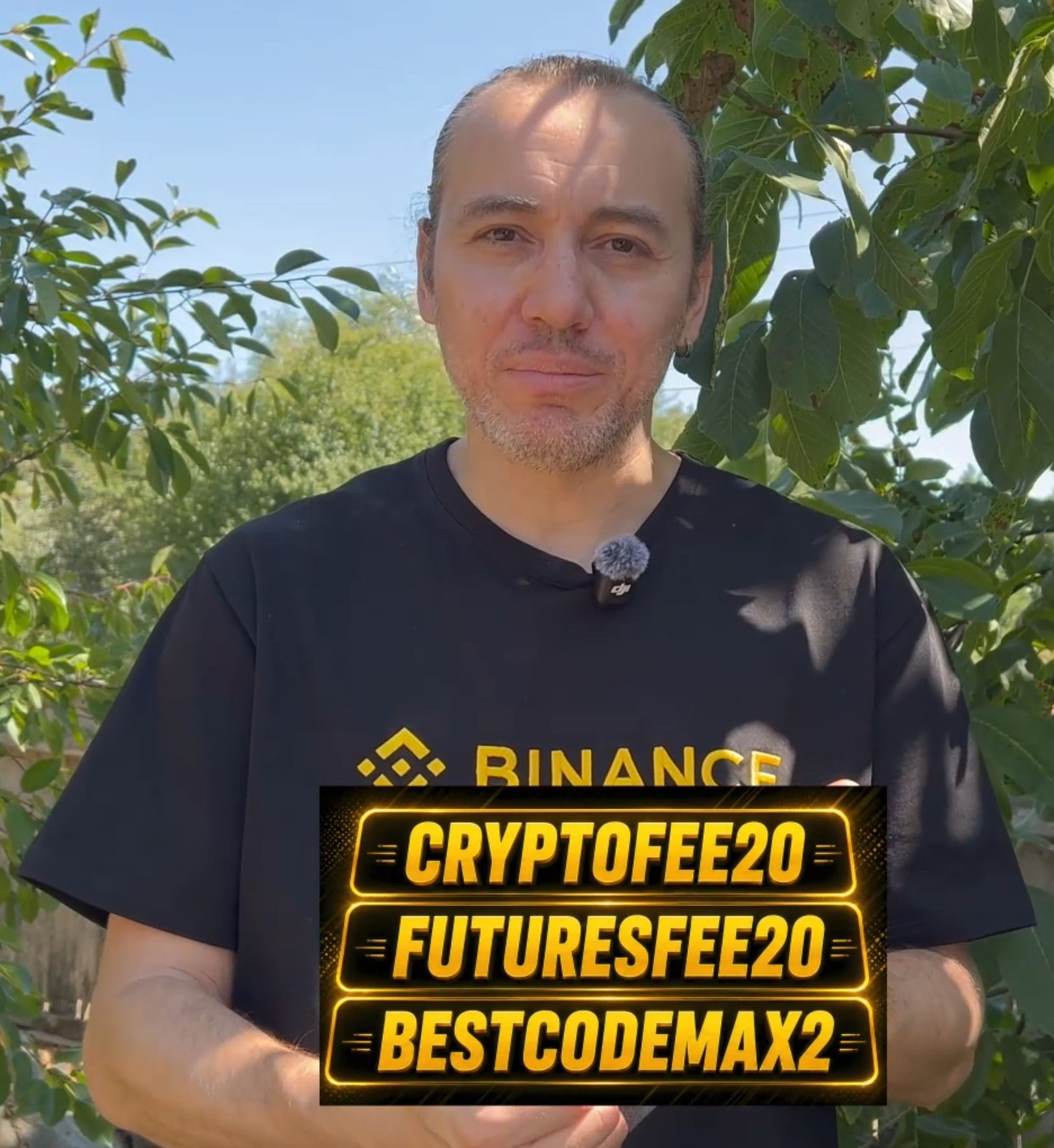
Emre Ata is an independent cryptocurrency content creator, webmaster, and long-term Binance affiliate who has produced cryptocurrency education content since 2019.
His content focuses on Binance registration, account security, referral programs, trading fees, beginner guides, and responsible risk management.
Affiliate Disclosure and Disclaimer
This article contains a referral link and referral codes. The author may receive compensation when eligible users register or trade using them.
Trading fees, rebate percentages, promotional rewards, task requirements, and regional availability may change.
This content is for educational purposes only and does not constitute financial, investment, legal, or tax advice.
Last Updated: September 4, 2026
You can also check out these topics.
How to Claim the New Binance 19800 USD Welcome Bonus
How to Buy and Sell Crypto (Altcoins) on Binance Mobile App
How to Buy and Sell bStocks on Binance: A Guide for Beginners