

Original article by Block unicorn, January 16, 2026, 23:40, Chongqing. Immerse yourself in reading with a novel reader. Author: Castle Labs
Article compiled by: Block unicorn

Prediction markets (PMs) truly gained the attention they deserved in 2025, validating the argument that "real money investment produces more reliable data than polls." Following the 2024 US presidential election, prediction markets consistently outperformed traditional polls in accuracy, transforming the industry from an emerging form of betting into a recognized source of alternative financial data.
Financial dashboards (such as Google Finance and Yahoo Finance) have integrated these markets because they have become reliable indicators of global sentiment. Users express their opinions through real money, making them more trustworthy than traditional polling agencies.
Whether prediction markets should be classified as gambling remains controversial. However, in reality, this distinction is far less important than it seems. As a user, if you're trying to make money based on the results of a sporting event or the next election, you're betting on a future event that hasn't happened yet—in effect, you're gambling. Ultimately, however, what matters is your perception of the probability of the event occurring, as it directly impacts our understanding of overall market sentiment.
Whether or not prediction markets fall under the category of gambling, they align with a broader trend: speculation has been a major driver of cryptocurrency adoption, and prediction markets are no exception. However, what makes them unique is their broad applicability, unlike many other on-chain finance use cases.
Almost everyone has enjoyed predicting the outcome of something at some point; more broadly, everyone holds at least one opinion. This is precisely why prediction markets have proliferated rapidly, especially outside the native cryptocurrency ecosystem. Therefore, prediction markets are less of a unique innovation and more of a natural evolution of on-chain speculation. In 2025, prediction markets emerged as a new realm where information, investment, and speculation converge.
Market Status Forecast for 2025
A rapidly expanding industry
After an unusually high peak during the 2024 US presidential election, market activity is expected to slow sharply in early 2025. Trading volume stabilized at around $500 million per week for the following months before accelerating significantly again starting in late summer.
The industry experienced explosive growth in the fourth quarter of 2025, with monthly transaction volume across platforms approaching $10 billion, far exceeding the peak in 2024. In December, weekly transaction volume reached $3.8 billion, an increase of approximately 660% from the beginning of the year.
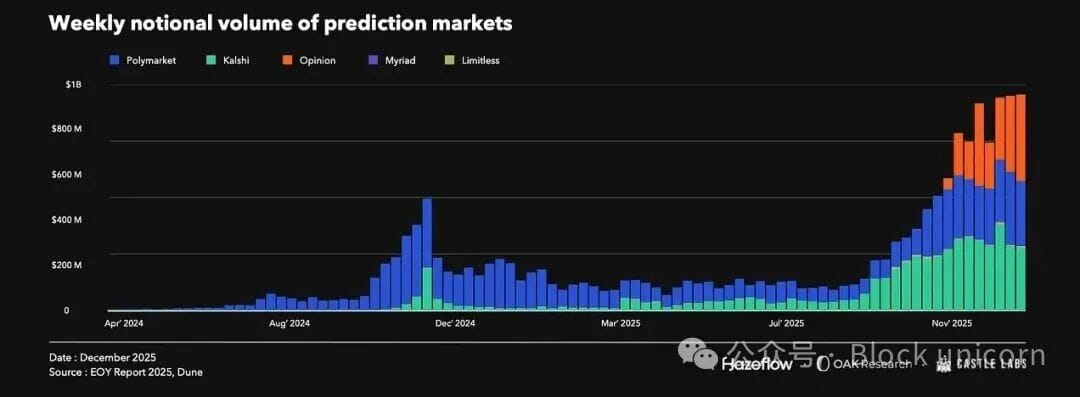
The number of transactions also showed a similar upward trend, increasing from approximately 1.2 million transactions per week at the beginning of the year to over 12.7 million transactions in December. The relative increase in the number of transactions (10.5 times) compared to the trading volume (7.6 times) suggests that market activity is relatively natural. In other words, airdrop manipulation remains relatively mild, or at least comparable to actual usage.
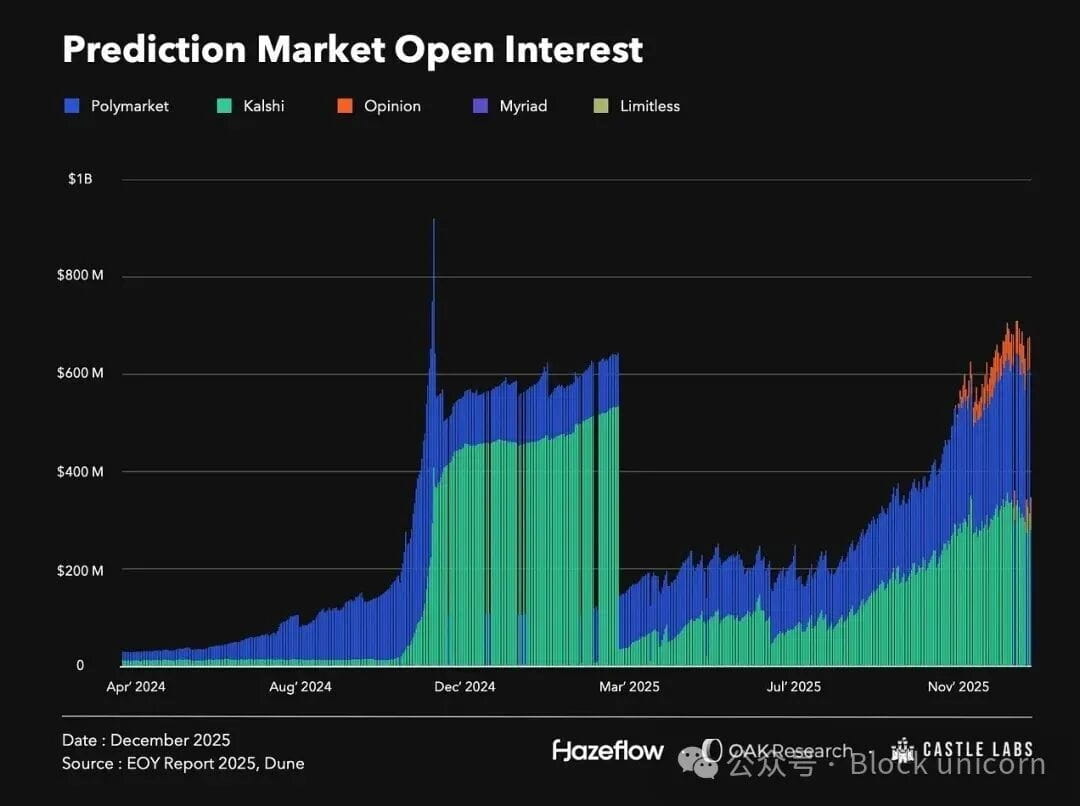
Another key metric to watch is open interest. This metric showed relatively linear growth throughout 2025, eventually surpassing $700 million by the end of the year. However, this figure remains below the peak reached during the 2024 election, when open interest across the industry approached $900 million, highlighting the exceptional nature of that election, characterized by exceptionally high liquidity and active participation from professional players or large portfolios.
Several factors have contributed to the explosive growth of the 2025 prediction market. The most significant of these is the direct competition between Kalshi and Polymarket. On October 7th, Polymarket announced a $2 billion investment from the Intercontinental Exchange (ICE), the parent company of the New York Stock Exchange, valuing its platform at approximately $9 billion. On October 10th, Kalshi announced the completion of a $300 million funding round, followed by a $1 billion Series E funding round on December 2nd, bringing its valuation to $11 billion.
Another driving factor was the partnership between Robinhood and Kalshi, which allowed retail users to access the Kalshi market directly from their Robinhood accounts. For Polymarket, airdrops also boosted its metrics, as the platform showed signs of an upcoming $POLY token launch, and airdrops appeared to be closely correlated with trading volume.
While the 2024 U.S. presidential election still holds the record for the largest single-event trading volume (Polymarket $3.6 billion, Kalshi $2.4 billion), some NFL weekends in 2025 saw daily trading volume on Kalshi exceeding $275 million. This shift highlights the industry's growing reliance on cyclical markets, particularly sporting events.
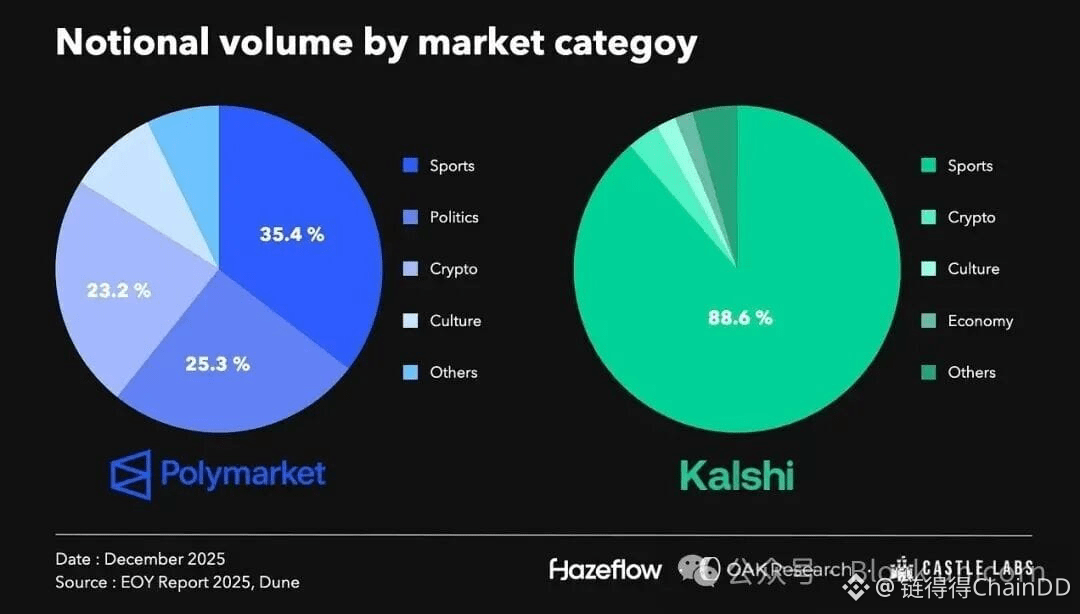
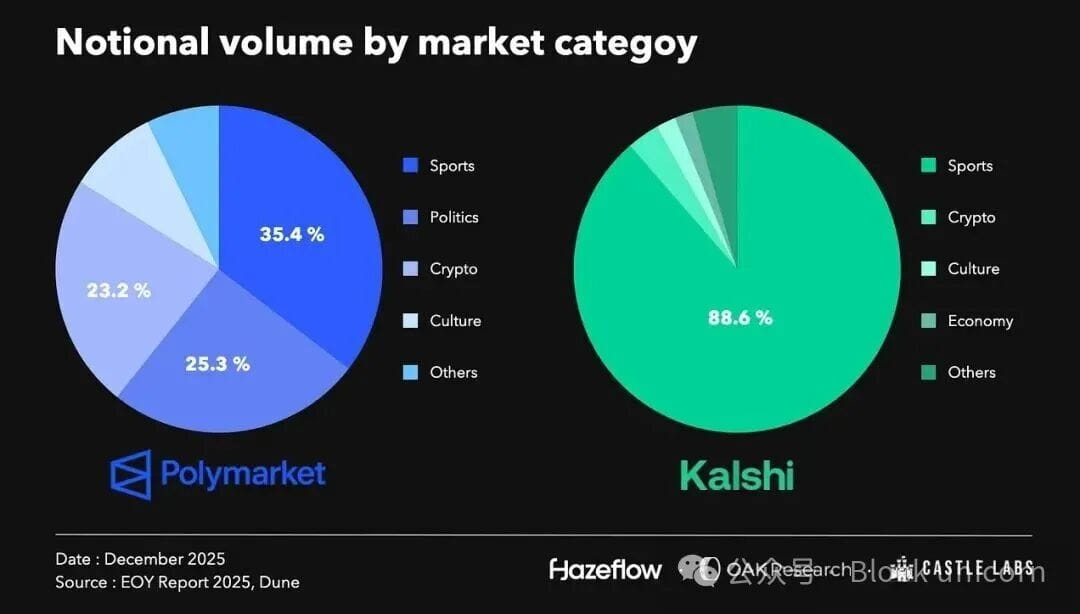
Beyond total trading volume, the two platforms also exhibit significant differences in the composition of their trading activities. Kalshi has established a clear product market position in sports betting, with sports betting accounting for 98% of its weekly trading volume. In contrast, Polymarket maintains a more diversified and universal character, with its trading activity more evenly distributed across sports (37%), politics (26%), cryptocurrencies (25%), and cultural or social events (9%).
The duopoly of Polymarket and Kalshi?
Over the past three months, prediction markets have been the most funded sector in the industry, largely thanks to the outstanding performance of Polymarket and Kalshi. In effect, these two platforms have formed a duopoly, dominating the majority of trading volume and open interest, forcing other participants to offer substantial incentives to compete.
In November, Polymarket processed over $4 billion in notional trading volume, marking the platform's best monthly performance ever; while Kalshi recorded approximately $5.2 billion, becoming the first regulated U.S. platform to surpass this monthly threshold.
Their dominance is undeniable: Polymarket and Kalshi account for 44% and 47% of total open interest, respectively. However, the distribution of nominal trading volume is more complex. By the end of the year, Kalshi accounted for approximately 22% of trading volume, Polymarket for 33%, and Opinion for nearly 43%.
Opinion launched in late October 2025, backed by YZi Labs, the investment fund of Changpeng Zhao. Its trading volume surpassed Polymarket within just a few days. Similar to what we previously observed with Aster (YZi Labs' trading platform launched to compete with Hyperliquid), Opinion's trading volume is likely inflated to some extent, in addition to the ongoing airdrop campaign itself.
Which prediction market will prevail?
Polymarket
Polymarket solidified its dominant position in the decentralized prediction market in 2025, with cumulative trading volume exceeding $13 billion. November's monthly trading volume of approximately $4 billion indicates that its trading activity is no longer solely driven by major political events.
Strategically, Polymarket solidified its position by acquiring QCEX for $112 million and obtaining a CFTC-verified framework that allows for a limited return to the US market. This enables the platform to achieve regulatory compliance gradually without compromising its on-chain infrastructure status.
However, the most noteworthy event in 2025 will still be ICE's (the parent company of the New York Stock Exchange) $2 billion investment in Polymarket, valuing the company at approximately $8 billion to $9 billion. Beyond the financial investment, the primary purpose of this deal is to facilitate the wider distribution and integration of Polymarket data into traditional financial infrastructure, particularly in applications such as forecasting, risk management, and market intelligence.
Kalshi
By 2025, Kalshi held a dominant position in the centralized and regulated prediction market space. The platform's trading volume reached $5.2 billion in November, with cumulative annual trading volume exceeding $25 billion. Its key competitive advantage lay in its unique position: Kalshi was the first prediction market platform regulated by the U.S. Commodity Futures Trading Commission (CFTC), enabling it to legally acquire U.S. users on a massive scale.
In December 2025, Kalshi raised $1 billion at a valuation of $11 billion, doubling its valuation in less than two months, following a previous $300 million funding round. The platform set a new record at the start of the 2025 NFL season, with daily transaction volume exceeding $260 million.
Kalshi has also launched a tokenization initiative aimed at distributing a portion of its markets on-chain. Its "Builder Codes" program, similar to Hyperliquid's namesake mechanism, allows any application or frontend with an existing user base to natively offer prediction markets through Kalshi. Currently, the program remains limited in scale and has raised regulatory questions regarding intermediaries distributing these markets, but it remains a significant acquisition strategy in its competition with Polymarket.
New participants
By the end of 2025, some emerging platforms had distinguished themselves and gained attention by offering incentive programs and differentiated models.
Opinion⁒ has emerged as the biggest dark horse of the year. In just two weeks since its launch, the platform's weekly transaction volume approached $748 million, capturing approximately 42.7% of the on-chain market share, ranking third globally, behind only Polymarket and Kalshi. As with other platforms with strong incentive mechanisms, these figures should be interpreted with caution, as its activity is primarily related to airdrop expectations.
Limitless completed a $10 million seed funding round in October 2025, led by 1confirmation and several major ecosystem participants, with plans to launch the LMTS token. The platform currently has a cumulative trading volume of over $515 million and its activity level remains considerable, but it is still mainly driven by opportunistic behavior.
Myriad Markets took a completely different approach, focusing on distribution rather than maximizing trading volume. Its browser extension allowed media outlets like Decrypt to display scenario prediction markets directly alongside their content. This white-label model separated infrastructure from user acquisition and prioritized integration over direct competition with the most established platforms.
Melee offers a design inspired by Pumpdotfun, based on a binding curve that dynamically adjusts outcome prices. Early participants enjoy lower prices, while later participants pay higher prices as collective belief strengthens. The platform targets a permissionless market, allowing users to create their own "yes/no" bets instead of being limited to trading selected events.
XO Market allows anyone to create markets based on their own beliefs and perspectives, simply by setting the market resolution path and injecting initial liquidity. The platform integrates artificial intelligence to assist market creators in the creation process and to set creator fees for their markets. It also improves liquidity sourcing by abandoning traditional logarithmic market scoring rules (LMSR) and order book models. Regarding outcome resolution, it utilizes an AI-driven resolution agent to autonomously process large numbers of markets and allows users to challenge the results.
Lightcone allows users to trade based on the "impact" of events. For example, if a drug is about to receive FDA approval, you can now bet on how the S&P 500 will perform after approval. This has given rise to a new type of prediction market called the "impact market." In impact markets, participants focus not only on the outcome itself, but also on its impact on a specific asset.
Trendle transforms attention into an asset class by calculating an attention index based on social and interaction data, allowing users to trade the attention of popular figures or events such as Bitcoin, Elon Musk, and Donald Trump. The platform also offers trading with leverage up to 5x, where users simply predict whether the attention of a particular person or asset will rise or fall.
What are the future development directions of the market?
TGE: A variable that can change everything
The competitive landscape of prediction markets depends not only on current trading volume, but also on their ability to remain active in the long term and create truly sustainable revenue streams for their tokens. In the cryptocurrency industry, a product's ultimate success often hinges on the performance of its token, and very few protocols can maintain token value over the long term. If the market reacts poorly in the early stages of token issuance, Polymarket's airdrop advantage over Kalshi could very well become poison.
As is often the case with emerging phenomena, only two factors are needed to ignite a frenzy: an existing leader attracting most of the attention, and the rapid emergence of strong competitors. This classic cryptocurrency model typically leads to the same result: increased activity, greater innovation, and ultimately, a redistribution of value to users, primarily through incentives and airdrops.
Therefore, the main catalyst for 2026 will be Polymarket's POLY token issuance. The airdrop is expected to coincide with the launch of the US app, making it a structurally significant event for the entire industry. POLY's market performance will largely determine the trajectory of the market, especially given the current unfavorable environment for altcoins overall, should it maintain a high market capitalization.
Meanwhile, Limitless, Myriad, and Opinion's token offerings (TGEs) are also expected to take place in 2026, but their success remains uncertain. Current activity levels are still too low to support substantial revenue or secure stable valuations at the time of token issuance.
Sports betting emerged as the main winner.
Sports betting has consistently been a major contributor to Polymarket's trading volume. As of this writing, sports betting accounts for over 40% of trading volume on Polymarket, and over 90% on the Kalshi platform. The reason for focusing on sports betting as a category is obvious: it is projected to grow at a CAGR of 10% over the next 4-5 years, reaching a market size of $198 billion by 2030, up from approximately $108 billion in 2024.
The increasing number of users willing to participate in sports betting has expanded the potential market size (TAM). Furthermore, the industry's growth rate ensures that platforms that can capture a substantial market share can generate sustainable revenue for their businesses, as sporting events are held regularly.
Despite its large scale, the platform still struggles to compete with traditional sports betting companies like FanDuel/DraftKings due to the existence of parlays. Parlays allow users to place leveraged bets. A simple three-way parlay combines three bets into one; if all bets win, the payout increases; but if one bet loses, the payout is zero. While this is high-risk, it also brings the expected leverage effect to sports betting.
The difference between prediction markets (PM) and traditional sports betting slips is that the latter allows for centralized risk management. PM, on the other hand, requires liquidity across all markets to support such betting, making parlay betting costly and inefficient.
On the Polymarket platform, politics and cryptocurrency trading volume ranks second only to sports, accounting for 50% of total trading volume; while on the Kalshi platform, these two categories account for 4-5% of trading volume. Other categories typically have lower trading volume and liquidity than sports because fewer people are interested in them, and those interested may lack the relevant knowledge (or simply lack interest) to trade in these niche markets. Furthermore, it's important to note that these platforms are positioned to serve specific market segments, as trading volume in other categories may fluctuate seasonally. On the other hand, this also helps the platforms reach new user groups.
Integration Competition
The next major challenge facing prediction markets in 2026 will be distribution channels. To achieve mainstream adoption, prediction markets need optimal integration with industry leaders. Kalshi and Polymarket recently integrated into Google Finance, allowing users to access odds from both platforms. This integration will help Google answer user questions such as, "What will be the GDP growth rate in 2025?" Furthermore, Robinhood announced an integration with Kalshi in August to help its users access and trade NFL and college football results. The partnership with Robinhood has significantly boosted trading volume on the platform.
These integrations help prediction markets (PMs) reach previously inaccessible user groups, precisely the target audience they are aiming for in their mainstream market expansion. Users of Robinhood and Google Finance are likely to be interested in these platforms, using them as news sources or for betting. Furthermore, Polymarket recently integrated with Yahoo Finance, Kalshi, and CNBC, aiming to embed market odds and showcase market sentiment.
Embedded integration is a core strategic challenge for prediction markets in 2026. These products monetize opinions formed outside of trading platforms, social networks, media, and existing communities. By directly integrating the market with where users access information, rather than forcing users to switch environments or interfaces, one of the leading platforms is poised for exponential user growth.
Polymarket's recent partnership with X indicates that such integrations are clearly part of its strategic considerations. Meanwhile, Kalshi is taking a different approach, exploring different development paths through its Builder Codes platform. Builder Codes is a tokenized version of its marketplace, deployed on the Solana platform and distributed through third-party applications with their own user bases.
Despite differing technological approaches, sports and media partnerships play a crucial role in product promotion and brand awareness. Polymarket signed an agreement with the UFC regarding co-branded marketing and broadcasting integration, while Kalshi positioned its economic and political markets as a real-time tracking tool for a broad user base through partnerships with CNN and CNBC.
Oracle manipulation problem
Oracles are a core component of product markets and a "source of truth" for solving market problems. Each platform has its own way of maintaining this source of truth; for example, Kalshi relies on human oversight, while Polymarket relies on optimistic oracles such as Uma. Kalshi's approach may make this part of its system a bottleneck for scalability. However, so far, this mechanism has worked well. Polymarket's mechanism, on the other hand, has previously revealed some flaws.
One advantage of Polymarket's optimistic oracle mechanism is that users can challenge a resolution and submit an alternative resolution within a 2-hour challenge period, but must deposit a $750 margin. However, if their resolution is not adopted, they may lose this margin.
In some cases, these challenges may not fully meet user expectations. When users object to a resolution, voters in the UMA protocol vote and reach a consensus on the legitimacy of the objection. This grants UMA voters, or whales, disproportionate power, enabling them to influence market decisions and steer them in their favor.
A similar incident occurred in Polymarket's Zelensky suit market, where the market ultimately decided in favor of the UMA whales, highlighting the flaws in this system.
Liquidity issues
Another key challenge lies in liquidity. Unlike derivatives markets, prediction markets rely on expiring contracts and binary outcomes, making hedging strategies for professional market makers extremely complex. Consequently, liquidity providers face significant asymmetric risk and suffer some form of structural impermanent loss.
Here are some of the reasons why market makers may be unwilling to participate:
High inventory risk: Forecast markets react very strongly to certain news. A market that was initially trending well can quickly reverse direction, and if market makers are pricing in the opposite direction, they could suffer huge losses. While hedging can mitigate this risk, these tools often cannot cover all the markets that forecast markets support.
Traders and insufficient liquidity: The market lacks adequate liquidity. This may sound like a chicken-and-egg problem, but the market needs frequent traders or takers who can consistently generate bid-ask spread profits for market makers. Currently, there are some "long-tail" markets in the prediction market, where trading volume or activity is insufficient, which discourages market makers from conducting business.
As long as this problem remains unresolved, market depth will continue to be limited, hindering large-scale institutional participation and making direct comparisons with more mature derivatives infrastructure difficult. The lack of sufficient liquidity leads to sluggish price responses to new information, and the "collective intelligence" promised by prediction markets in theory can only be partially realized.
Some products are actively addressing this issue. Kalshi, for example, utilizes third-party market makers and has an internal trading department to maintain liquidity. Polymarket, on the other hand, offers USDC rewards to compensate those who provide liquidity near spreads. For certain eligible events, the platform also pays holding rewards, amounting to 4% of the annualized yield (APY) generated while providing liquidity in the specific event market. Similarly, Kalshi offers a 3.5% interest reward on users' cash and open positions. These rewards are designed to incentivize long-term market participation.
In addition, several teams are experimenting with new market designs to improve capital efficiency, event resolution efficiency, and market automation, including AI-assisted market creation tools, automated decision-making mechanisms for subjective events, and hybrid models inspired by perpetual futures.
The Rise of Artificial Intelligence
Artificial intelligence is playing an increasingly important role in providing timely and accurate information, helping traders make more informed decisions. To this end, several products are built on the Polymarket platform as part of its builder program, such as Polyfactual, which offers in-depth AI research on any market, along with real-time updates on the latest news in areas such as cryptocurrency, politics, and sports. Furthermore, protocols like Polymtrade are building AI-powered trading terminals on the Polymarket platform. Beyond the use of AI, the project also includes other products designed to create new value, such as tools or improvements to the multi-market trading user experience.
As prediction markets develop, the share of automated trading is expected to increase, allowing companies to profit from market inefficiencies or pricing errors. Recently, these bots have begun to grow, attempting to acquire equal shares of "yes" and "no" in a specific market at discounted or mispriced prices, and then combine them at market settlement to capture the full value of the winning share.
Prediction markets are still a relatively young field and face many structural challenges. However, solutions may emerge over time. Large platforms like Polymarket and Kalshi have made groundbreaking progress, attracting users far beyond the cryptocurrency ecosystem, with the products themselves being a major draw.