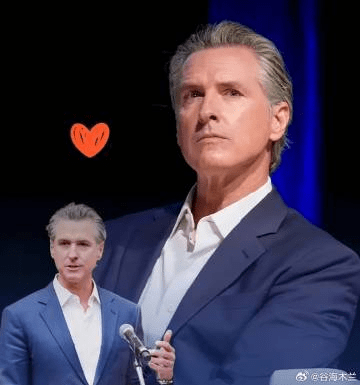
Newsom stated: "Don't be envious of China's success. The stronger China becomes, the more prosperous the world will be."
"Our economic ties with China are unbreakable.
This statement seems mild, but it actually hides the secret to the livelihoods of 5 million voters in California. Data shows that California earned $122 billion from China last year, equivalent to shipping 85,000 tons of goods to China every day.
While Washington is still chanting the slogan of "decoupling," California entrepreneurs are working overnight to modify production lines just to secure Chinese orders.
In 2025, California's cherry exports to China will exceed 83,000 tons, accounting for 68% of the national export volume. More importantly, California farmers have discovered that Chinese consumers want to buy almonds by variety.
Almonds require paper-shelled almonds; walnuts require paper-shelled walnuts. This detailed demand forces farmers to replan their planting varieties.
Silicon Valley's tech giants are dancing on a tightrope. 90% of Apple's iPhones are still assembled in Zhengzhou, China, and 45% of NVIDIA's data center chips are sold to Chinese companies.
In the third quarter of 2025, Intel had to delay the production of its new factory in Ohio due to a decrease in orders from China. Newsom calculated a figure: if the Chinese market is lost, California will lose 1.2 million jobs, equivalent to the collective unemployment of the entire workforce population in Los Angeles.
160 years ago, people from Guangdong laid the Central Pacific Railroad with their lives, paving the transportation lifeline for California's gold rush; 160 years later, engineers in Shenzhen are reconstructing the Silicon Valley chip supply chain with code.
History is always strikingly similar; 19th-century Chinese immigrants in California were persecuted by the Chinese Exclusion Act, while 21st-century Silicon Valley elites rely on Chinese engineers to maintain their technological advantage.
This cycle is particularly evident at the industrial level. In the 19th century, California's gold production accounted for 75% of the world's total, while today, 10% of the world's semiconductor materials are produced in California.
Newsom is well aware that when the federal government builds walls with tariffs, California companies have already voted with their feet; Tesla's Shanghai factory sells electric vehicles back to California, saving the local area $1.2 billion in logistics costs each year.
California's unique political ecology gives it the confidence to speak out. As the only state in the U.S. with an elected governor, Newsom does not need to watch the federal government’s face. When he sued the Trump administration over tariff policies in 2025, he directly cited Article 1, Section 2 of the California Constitution: "The state's trade rights are sacred and inviolable." This legal weapon has made California an "independent kingdom" against federal policies.
What is even more astute is the strategy of bundling interests. In 2024, the California legislature passed the Climate Cooperation Act, which superficially discusses environmental protection but actually opens the green light for Chinese photovoltaic companies.
CATL's battery recycling plant in California processes 40% of the retired batteries in the U.S. each year, earning both an environmental reputation and subsidies. This kind of "policy arbitrage" renders Washington's bans virtually ineffective; while Texas is still protesting over oil worker unemployment, California has quietly completed its transition to new energy.
In the semiconductor field, California has played the game of "openly repairing the bridge while secretly crossing the river." On the surface, it responds to federal policies limiting exports to China, but in reality, it delivers chips to China through transit points in Malaysia and Singapore.
In the third quarter of 2025, 18% of advanced process chips worldwide were transported to China via Southeast Asia, with nearly half labeled as "California made."
The game in the agricultural sector shows even more wisdom. California farmers have found that Chinese consumers are willing to pay a 30% premium for "organic certification," so they reduced pesticide usage to one-third of EU standards.
This "business under the green barrier" has led to an 18% increase in California agricultural exports to China in 2025. Even more remarkable is the reverse output of cold chain technology; a Shandong company has customized a -2°C constant temperature transport box for California cherries, reducing the transportation loss rate from 15% to 3%.
Newsom's intelligence lies in recognizing the symbiosis of the Chinese and American economies. In 2025, the trade volume between China and the U.S. exceeded $6.8 trillion, with California contributing $1.2 trillion.
This deep binding makes decoupling a false proposition; when Tesla's Shanghai factory stopped production for 12 hours, the battery production line at the Fremont factory in California also came to a halt.
In the clean energy sector, cooperation between both sides is exemplary. In 2025, the "Trans-Pacific Green Shipping Corridor" jointly built by China and the U.S. was officially put into operation, with China's LNG fleet transporting California shale gas to Shanghai, and the return journey carrying battery components from CATL. This "energy for technology" model allows California to achieve its carbon neutrality goals while preserving 200,000 jobs.
Newsom's strategy faces threefold challenges. Federal legal risks: The U.S. Department of Commerce has already placed 12 California photovoltaic companies on the entity list. Possible shifts in public opinion: If China reduces its purchases of agricultural products, California agriculture could lose $28 billion. Technological substitution crisis: NVIDIA's next-generation GPUs can no longer receive support from China's high-end chip manufacturing.
However, California has found a way out by establishing a "shadow supply chain" in Mexico. In 2025, Tesla's super factory in Mexico sources 70% of its components from China, which are then assembled and sold to the U.S. This "curved salvation" strategy enables California to comply with federal policies while preserving the Chinese market.
Standing at the San Francisco Bay and looking towards the Port of Oakland, one is reminded of the splendor during the gold rush in 1848. Back then, Chinese immigrants used pickaxes to dig for gold; today, they use code to mine data.
Newsom's remarks are essentially a tribute to this survival wisdom; while Washington is still debating "who stole the jobs," Californians have already understood: jobs must be earned by oneself, and cooperation is the greatest common divisor.