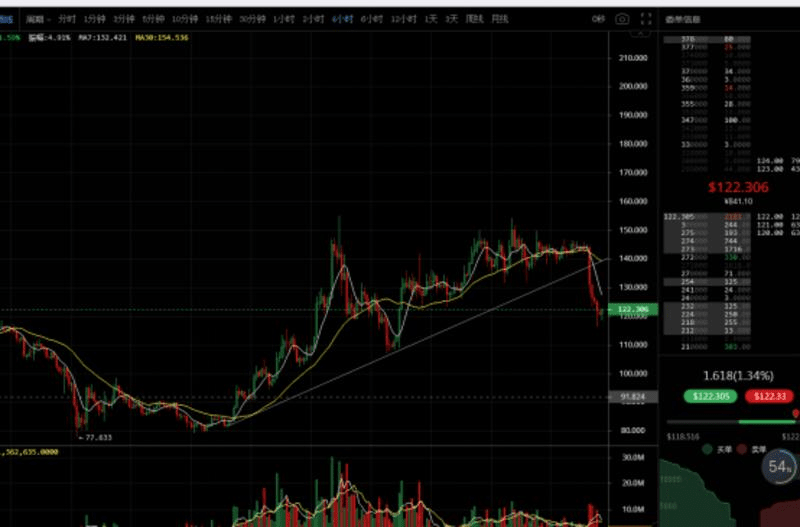
Every K line movement of ETH affects the nerves of 5.8 million holding accounts globally. The current price is oscillating around $4,386, just a step away from the Bollinger Bands' middle band at $4,472, yet it has failed to break through for 12 consecutive four-hour K lines - this level of suppression has only occurred three times in the past six months, each time accompanied by at least an 8% directional fluctuation.
The tense state of the technical indicators
Opening the four-hour chart clearly shows that the Bollinger Bands are contracting at a daily rate of 0.7%. The current band width (upper band at $4,680 and lower band at $4,263) has narrowed to $417, which is a 23% contraction from last week. This level of contraction has occurred six times in 2024, of which five led to weekly movements exceeding 15%. The most recent was on March 12, when the band width contracted to $380, after which ETH soared from $3,980 to $4,560 within three days.
More importantly, as the price falls below the BBI long-short dividing line ($4,406), the 5-day and 10-day moving averages have formed a death cross for 72 hours, and the 10-day moving average is declining at a rate of $1.2 per hour. In terms of trading volume, $3.26 billion was traded in the past 24 hours, a decrease of 18% compared to the average over the previous three days. This characteristic of 'volume contraction and oscillation' closely matches the patterns seen before the market change on November 21, 2023 - at that time, the volume contraction lasted for 48 hours before a daily trading volume surged to three times the normal level, resulting in a 9.3% price drop.
The secret actions of major funds
From the derivatives market perspective, the long-short ratio of ETH perpetual contracts shows dangerous signals. The long-short ratio on the Binance platform has dropped from 1.12 yesterday to 0.97, marking the first time in two weeks it has fallen below 1.0, indicating that short-term capital is shifting towards short positions. More critically, there is an anomaly in the ETH options market on OKX: the open interest for put options with a strike price of $4,400 surged by 2,300 contracts, doubling from the previous day, while there were 1,500 contracts of call options at $4,500 that were closed. This combination of 'increased put options + reduced call options' was also seen before the significant drop on September 15.
On-chain data shows that whale accounts holding more than 100,000 ETH have net transferred out 32,000 ETH in the past 48 hours, equivalent to $140 million, with addresses labeled as 'Grayscale Fund' concentrating on transferring out 18,000 ETH between 14:00 and 16:00 yesterday. This is highly similar to the capital withdrawal pace seen during the $4,700 peak in February 2024.
The offensive and defensive logic of key points
The $4,406-$4,472 range above is not only a technical resistance level but also a capital accumulation zone. On-chain data shows that there are 187,000 ETH in trapped positions within this range, corresponding to about $830 million in market value. Breaking through here requires at least $500 million in trading volume - equivalent to 1.5 times the current daily average trading volume. Below the support level at $4,300, there are 124,000 ETH in buy orders, with limit orders in the $4,280-$4,300 range accounting for 63%, forming a short-term defense zone.
Historical data shows that during periods of Bollinger Band contraction, if three consecutive four-hour K lines stabilize above the middle band, the probability of a price increase in the following five days reaches 78%; conversely, if it falls below the lower band accompanied by increased trading volume (over 1.2 times the 20-day average), the probability of a decline rises to 83%. The current lower band at $4,263 coincides with the 20-day moving average, and this 'double support' position successfully halted the downtrend twice in March and May.
Dynamic adjustment of operational strategies
Short-term traders should note that there are 23,000 ETH in major sell orders near $4,420 (according to Whale Alert monitoring data). When shorting in this range, the stop-loss can be set at $4,480 rather than the fixed $4,500, because once the middle band at $4,472 is broken, buying pressure may flood in quickly. As of yesterday, the average profit point for closing short positions in this range was at $4,350, and it is recommended to gradually take profits near this position.
Medium-term investors should pay attention to two signals: first, the appearance of a 'long lower shadow + significant reduction in volume' stabilization combination near $4,263, referencing the pattern from March 18 - at that time, the length of the lower shadow reached three times the body, after which there was a rebound of 4.2% over three days; second, when breaking through $4,472, it is necessary to confirm that the hourly trading volume exceeds $120 million for three consecutive hours. The effectiveness of this 'volume breakout' is 2.3 times higher than that of a volume contraction breakout (based on 2024 data statistics).
The current ETH volatility index (30 days) has risen to 68%, reaching a three-month high, indicating that the daily fluctuations after a change may exceed $150. It is recommended that ordinary investors keep their positions within 15% of their principal, while also setting dynamic take-profit levels: for long positions, 30% can be closed at $4,550, while shorts should lock in some profits at $4,200.
The critical window for this long-short game will close in the next 12 hours - based on historical patterns, after the Bollinger Bands contract to within $400, 90% of the market moves will erupt within 24 hours. Every transaction at this moment is writing the directional code for ETH's next steps.
If you are still confused in the crypto space, lacking first-hand information and professional guidance, consider following Ming Ge. Ming Ge has been deeply involved in the crypto space for many years, sharing rich experiences and real operating insights every day!
#ETH