


If you are interested in DeFi these days, you may have heard of AAVE. This coin is a decentralized lending protocol built on Ethereum. In other words, it allows people to lend and borrow money without a bank.
On the AAVE platform, when someone deposits their coins, another person can borrow against that collateral. The entire process is handled automatically via smart contracts, so there’s no need for credit checks or bank employees.
The beginning and present of AAVE

The AAVE project was created in 2017 by Finnish developer Stani Kulechov and initially started under the name 'ETHLend'. It was later rebranded to 'AAVE' in 2020, rising to the center of the DeFi boom.
The AAVE token is not just a trading coin but a utility token that allows participation in platform operations and governance. By depositing a certain amount, one can participate in the 'Safety Module' and serve as a compensation role when lending risks occur. In simple terms, it acts as a shareholder of a DeFi bank and an insurance company.

As of June 2025, AAVE ranks within the top 5 in terms of TVL (Total Value Locked) among DeFi platforms globally, with a market capitalization of approximately $1.5 billion.
What are the technical trends and market responses?
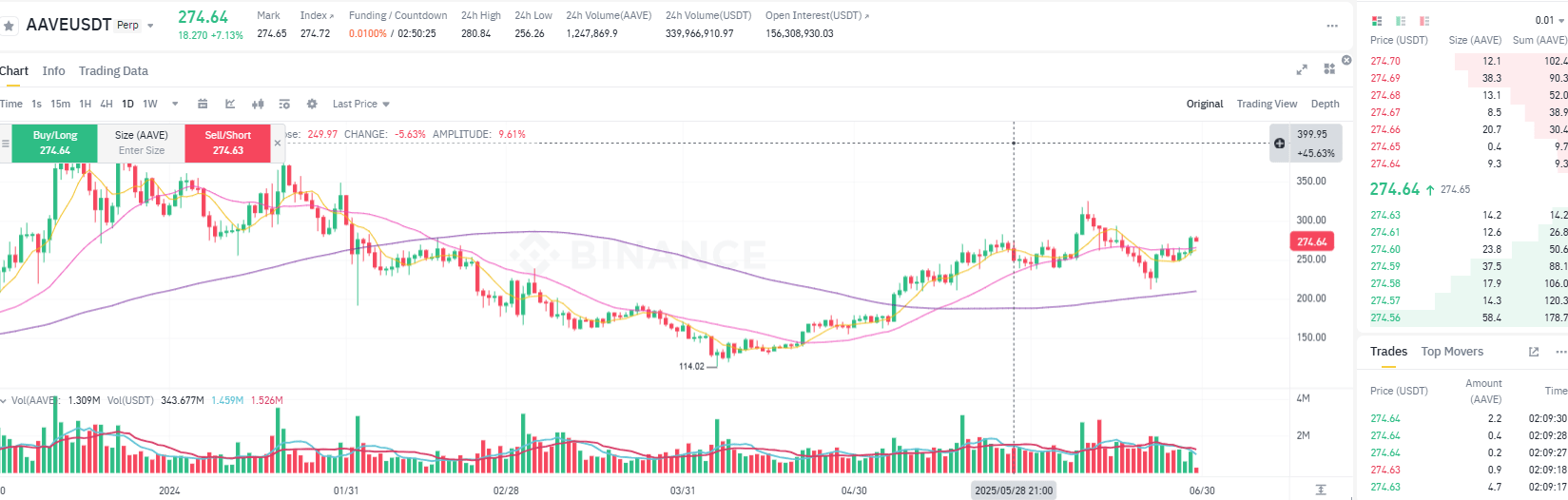
As of June 2025, AAVE shows a trend of attempting a short-term rebound after a sharp decline. The RSI is
At a level of 50.9, there are signs of moving beyond the oversold zone towards a neutral line. This could indicate that the downward trend is calming down for now.
Looking at the MACD indicator, the histogram of the long-standing bearish trend has recently started to decline gently, and the gap between the MACD line and the signal line is gradually narrowing. Although a golden cross has not yet appeared, the possibility of a rebound is open.
In other words, it can be said that we are closer to a phase of exploring direction after confirming the lows rather than a 'full-blown rise' right now.
AAVE based on on-chain data

Slowdown in TVL decrease
In the last 30 days, AAVE's TVL has decreased by about 4.2%, but this is a lower decrease than the overall average in the DeFi market. This can be interpreted as a relatively strong trend compared to the market.
Increase in GHO-related addresses
The number of wallets related to the stablecoin 'GHO' issued by AAVE has increased by 15% in the past week. This is a signal that new demand is flowing into the platform.

Exchange inflow and outflow trends
According to Glassnode data, the amount of AAVE moved to centralized exchanges has decreased by about 6% compared to two weeks ago. This suggests that selling pressure has somewhat reduced, or there is a movement to strengthen holdings.
Is there no risk?

Of course, there are also several points to be cautious about with AAVE.
Limitations of token utility: Holding AAVE does not directly generate income. There are opinions that there is a lack of clear token demand aside from governance participation and safety module deposits.
Regulatory risks: Recently, the SEC has imposed sanctions on some DeFi projects, and AAVE also faces the possibility of regulations related to the stablecoin 'GHO'.
Smart contract vulnerabilities: Although there have been no hacking incidents on AAVE, the nature of DeFi platforms always poses security threats. The higher the TVL, the more likely it is to be targeted by hackers, so caution is always necessary.
If you haven't signed up for Binance yet, please register through the link below to receive a 20% discount on fees.
🔸Go to receive Binance's 20% fee discount benefit
Both new members and existing subscribers can receive a 20% discount on fees if they meet 5 conditions.
I am already registered on Binance.
The invited person has never accepted an invitation before.
The invited person's account has not traded or used products on the Binance platform in the last 180 days.
When a qualified inviter opens the link and logs in, a confirmation window will appear.
When the inviter clicks [Bind Now], the binding takes effect.