

After NVIDIA released its latest financial report, the market's focus was not only on the report itself but also on the tangible effects of U.S.-China technology policies on its operations. Despite the second-quarter revenue reaching around $45 billion (plus or minus 2%), approximately $8 billion of that revenue was related to the Chinese market and H20 chip, with final sales failing to materialize. Outside observers are concerned about how NVIDIA will successfully fill the gap from other international markets or product lines under the pressure of policies and geopolitics, and even maintain strong growth momentum.
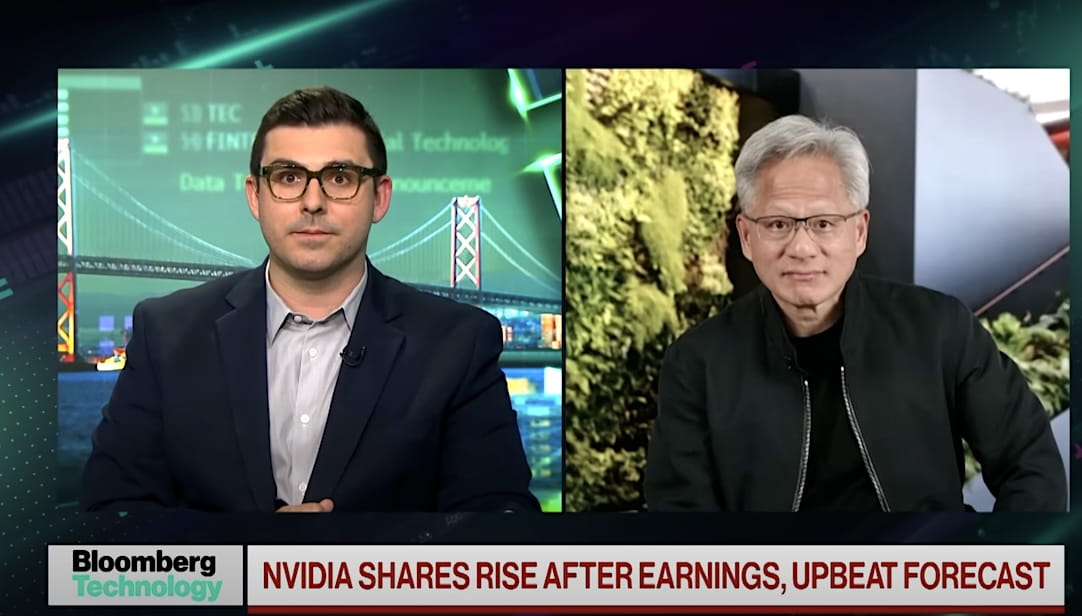
NVIDIA CEO Jensen Huang accepted an interview with Bloomberg, addressing key issues such as competition in the Chinese market, Huawei's technological gap, AI chip export controls, cooperation with Elon Musk, U.S. policies on immigration and technology exports, and the company's expansion plans in Europe. He succinctly outlined NVIDIA's strategies to tackle various challenges while revealing NVIDIA's global AI strategy layout.
Chinese market and H20 chip
Jensen Huang pointed out that with significant technological advancements from local competitors in China, exemplified by Huawei, whose latest AI chip performance is nearing NVIDIA's H200 level, and has launched the Cloud Matrix system with expansion capabilities, the competitive landscape should not be underestimated. He candidly admitted that past key customers like Tencent, Alibaba, and Baidu have turned to Huawei after being unable to obtain NVIDIA chips, which is a result of policy pressures.
Jensen Huang's views on Trump's policies
Regarding the U.S. political environment and Trump's policies, he unexpectedly expressed support for two of President Trump's assertions: first, promoting the return of manufacturing and reindustrialization through tariff policies to encourage global investment in the U.S.; second, the repeal of advanced chip export policies (Air Diffusion Rule), allowing the world to build on U.S. technology during the current AI boom. He described these two policies as having generational transformative potential.
In response to concerns about restrictions on foreign students and talent visas, Jensen Huang used his own immigrant background as an example to reaffirm the contributions of immigrants and international talent to the U.S. technology industry. He called for the U.S. to continue attracting top talents who can make significant contributions while maintaining national security.
NVIDIA's collaboration with Elon Musk
On the business cooperation front, Jensen Huang stated that there is deep collaboration with Elon Musk and his company Tesla, covering fields such as the AI model Grok, autonomous driving systems, and the Optimus humanoid robot. He stated: Optimus could potentially be the first general-purpose robot capable of mass production and technological commercialization. He predicts that this will initiate the next multi-trillion-dollar industrial revolution.
Jensen Huang revealed plans for an upcoming trip to Europe, where he will meet with leaders from France, the UK, Germany, and Belgium. He emphasized that countries have increasingly viewed AI as a national-level infrastructure alongside electricity and the internet, and are actively collaborating with NVIDIA to promote the deployment of 'AI factories', marking a shift in global AI investment towards infrastructure development.
This interview revealed how Jensen Huang positions NVIDIA within the global AI landscape and clearly reflects the intertwining of geopolitics, industrial competition, and technology policy in this new world.
This article Jensen Huang's interview: From challenges in China to Trump and Musk, comprehensively revealing NVIDIA's global AI strategy layout first appeared in Chain News ABMedia.