



Investing in stocks and cryptocurrencies has been gaining popularity even recently.
As interest in foreign exchanges like Binance and Bybit increases while trading cryptocurrencies, the number of users is also growing, and more people are trying out coin futures trading.
When engaging in futures trading where you can earn large profits, it’s essential to understand terms like funding rates and how to set leverage to maximize your profits.
And while using foreign exchanges, we'll thoroughly examine the often confusing differences between cross and isolated modes.
[Table of Contents]
Funding Rate
Leverage Settings
Cross Isolation Difference
Funding Rate
Those who have tried futures trading know that the funding rate applies at this time. In futures trading, you must choose one position, either long or short, to invest.
Here, let's clarify the concepts of long and short. Long means betting that the price of a coin will rise, while short means betting that the price will fall.
Since investors' investment tendencies vary, the ratio of long to short is not constant. The market needs both traders and customers, right? That's how trading can happen.
The same goes for the coin market. There must be buyers and sellers for trading to continue; if it leans too much one way, the balance is broken.
During a bullish trend when prices are rising, people want to follow long positions, while in a bearish market, everyone wants to invest in shorts. The cost or reward needed to balance this ratio is called the funding rate.
In summary, when a person engages in futures trading, it entails amounts paid or received for the balance and risk of the coin market.
So, when do we give and receive funding rates? This changes depending on the situation. Let's assume a bullish market with many long positions.
If you hold a long position, you pay funding to the short position, which shows as + on the Binance app. In a bearish market with many short positions, the short position will pay the long position, which you can see as - on the screen.
If you haven't tried futures trading yet, knowing what funding rates are and being able to view this part can help you understand the current market situation. This is because Binance allows you to check funding rates in real time.

Also, since the funding rates vary by coin type, you must check the funding rates of the coins you intend to buy or sell. The funding rate on Binance changes every 8 hours. You can check the actual situation regarding funding rates and view the history to see the market's state.
You can check real-time funding rates, allowing you to see what positions investors are taking. Depending on what position you hold, you will either pay or receive funding rates three times a day.
If you want to analyze your returns from futures trading up to this point, you can select PNL Analysis on the screen to check both the funding amount and fees.
Leverage Settings
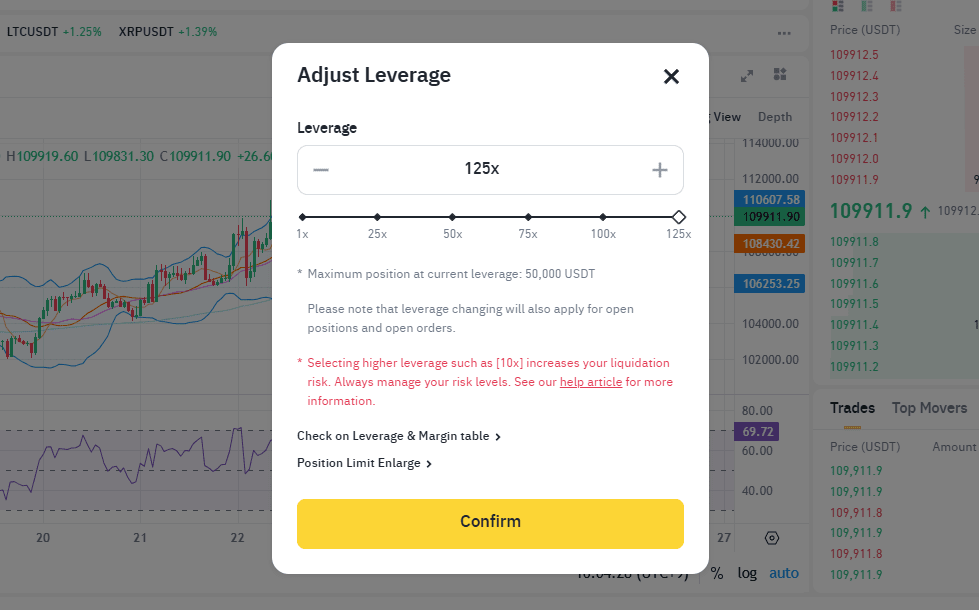
Now, let's talk about leverage. It's also a means to increase profit margins. Let's discuss this based on Bitcoin, which is commonly known. Bitcoin can be set to a maximum of 125 times.
Altcoins allow for leverage of up to 100 times, but this can be limited to lower numbers depending on the asset. Those who have tried futures trading know that leverage is often referred to as a flower.
Thus, many people apply high leverage for trading, but this is a very risky approach. The higher the leverage, the more it compounds with the funding rate.
Let me illustrate with numbers for better understanding.
If you trade with 10 times leverage, the funding rate is 0.01%, which means you will have to pay 0.1% every 8 hours when the funding rate changes.
Let’s multiply fees by 10 as well. Ultimately, with rates of 0.2% and 0.5%, if it's 100 times leverage, you'd have to pay 2% and 5% on both buying and selling.
If you use high leverage, there may be cases where you pay more in fees than you earn.
You should set it up so that you don't lose all your earnings to fees, just like how a bank account can go from full to empty.
Therefore, the recommended leverage is 2 to 3 times for the most stability. At this point, it's important not to think you'll earn a lot of money quickly. While making a lot of money is great, adapting as much as possible and having faith that you can earn is also crucial, so using high leverage is less recommended.
Cross Isolation Difference
Finally, let's understand the difference between cross and isolated. The Cross mode uses the entire amount in the futures account as margin for cross investing.
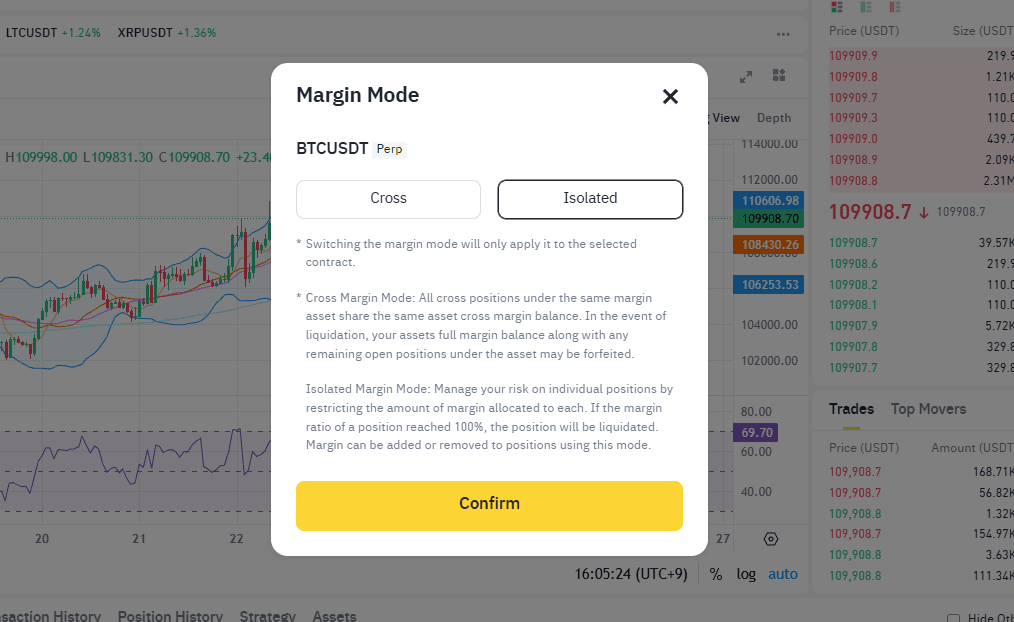
The Isolated mode, referred to as isolation, means that only the invested amount serves as margin, and only the amount you invested is lost during liquidation.
In cross mode, if liquidation occurs, the entire futures account gets liquidated.
When you set 10 times leverage with 1 million won and the amount drops by 10%, it results in a -100%.
If you used Cross mode, you could use the remaining seed money in your account as margin to delay liquidation.
If you set the Isolated mode, even if you incur losses, only the invested amount will be lost.
Therefore, if you are someone who doesn't understand futures trading well, I recommend safely setting the Isolated mode.

The futures market experiences many fluid changes due to leverage. At such times, those who get cut off are usually cross investors. Thus, I recommend the isolated mode.
So far, I have informed you about Binance futures trading, including funding rates, leverage settings, and the differences between cross and isolated modes.
If you haven't signed up for Binance yet, try signing up using the link below to receive a 20% discount on fees.
>> Get 20% discount on Binance fees <<
Existing members can receive a 20% discount on fees if they meet the following two conditions.
1. If the invited person has never accepted an invitation before.
2. If the invited person has not traded or used any services on the Binance platform in the past 180 days.
If applicable, please make sure to take advantage of the discount benefits.
The terms may not be easy, but as you engage in futures trading, you will get used to them! Wishing you successful investments today.