

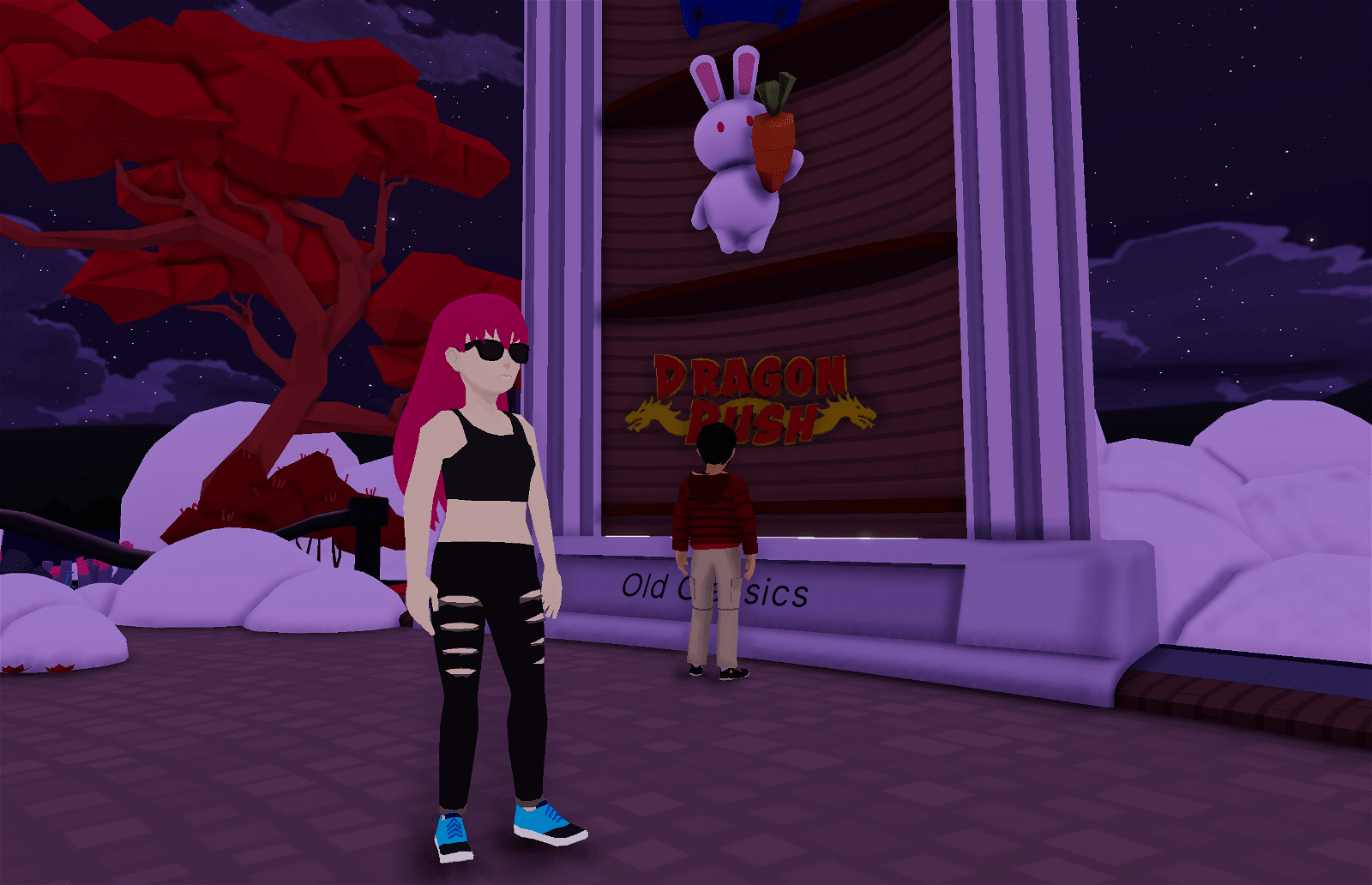
Decentraland is facing an unprecedented crisis moment due to the cold weather of the Metaverse and the strong offensive from competitors.
Recently, Decentraland, the leading project in the Metaverse, announced plans to create a new governance token to incentivize users to participate in voting. Although Decentraland once exploded in popularity, and many well-known companies and celebrities spent huge sums of money, the current decline in popularity is an indisputable fact.
This year, faced with the embarrassing situation of declining transaction volume and active users, Decentraland has launched many new features and tools to break the deadlock and decentralize power around the concepts of "open source and community co-creation". However, due to the cold weather of the Metaverse and the strong offensive from competitors, Decentraland is facing an unprecedented crisis moment.
Plans to launch new governance token, MANA’s value narrative may be challenged
Not long ago, the Uniswap proposal controversy caused a stir, and the voting battle exposed the oligarchic governance of the community. Similarly, Decentraland DAO also has the problem of insufficient decentralization of on-chain governance. Its community update in January 2023 pointed out that in recent months, the distribution of voting rights has been subject to increasing scrutiny by the community because A large number of "whales" can pass relevant proposals in the absence of unanimous community consensus or widespread opposition, and some proposals may even "flip" at the last minute, catching other community members off guard. Currently, the Decentraland DAO has approximately 5,000 active members, but 60% of the 85.5 million active voting rights are controlled by 18 wallets.
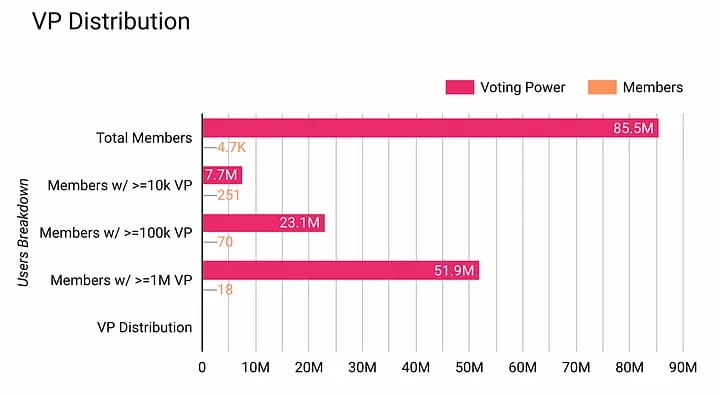
As an important layout for creating a decentralized governance system, Decentraland DAO is responsible for controlling the update, maintenance and upgrade of core smart contracts. The core members include MANA, NAMES and LAND holders, who make proposals and vote. However, it is obvious that the existing governance mechanism cannot effectively prevent the risk of monopoly by large players. To this end, Decentraland DAO hopes to encourage voting participation around incentives to increase transparency and achieve decentralization. In addition to the implemented voting delegation, it also plans to introduce monetary incentives, game elements and new tokenized voting rights strategies.
Among them, Decentraland believes that the creation of new governance tokens can provide greater flexibility in token economics to better incentivize and deter bad behavior, reducing the risk of the voting process being manipulated by “malicious actors.” As an existing token of Decentraland, MANA can be used not only to purchase land and clothing props, but also to participate in governance. If new governance tokens used for voting are launched, the use of MANA will be greatly affected.
The current market performance of MANA is also relatively tired, and investors may lack confidence. From the perspective of secondary market prices, CoinGecoko data shows that as of February 21, MANA has fallen by more than 72.4% in the past year; from the perspective of currency holding addresses, Etherscan data shows that although the total number of MANA currency holding addresses has exceeded 31 However, the pace of increase in holdings has slowed down significantly compared with the past, and it has only increased by 18.7% compared with 261,000 at the beginning of this year. It is worth mentioning that Decentraland DAO was awarded 222 million MANA (divided into ten years of release) when it was first established, accounting for 1/10 of the total. According to the latest proposal, since Decentraland DAO funds are basically dominated by MANA and DAI, the community proposed selling some assets to diversify funds and cope with market risks. However, the proposal was ultimately rejected due to insufficient votes.
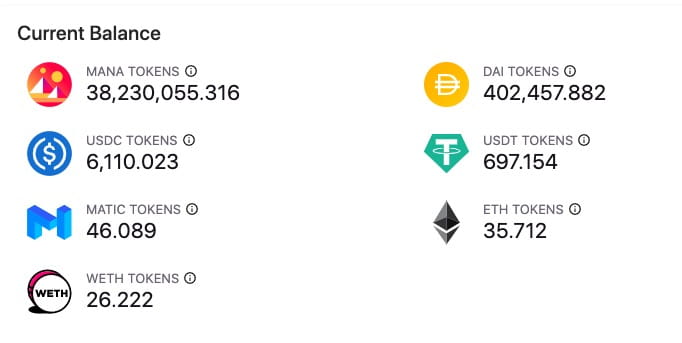
Decentraland DAO holds assets
Once new governance tokens are launched and the usage scenarios are limited, MANA’s value narrative may be unsustainable. In this regard, some community members have also expressed concerns that large-scale reforms to the underlying Token economic structure of DAO may be too complex and may cause broader ecosystem fluctuations, which will have an unpredictable impact on the overall confidence of MANA. Therefore, these proposals are currently still being discussed in the DAO Discord, forums, or recent proposals.
The number of users and transaction volume both plummeted, and the market share was less than 8%.
Decentraland's on-chain governance reform is a step towards changing its own predicament. As a leading project, Decentraland once took advantage of the success of the Metaverse to achieve great success. Even though the virtual plots of land sold to external parties are very expensive, high-priced transactions still occur frequently. For example, in November 2021, a piece of digital land was purchased by virtual developer Metaverse for a high price of US$2.43 million, setting a new price record for virtual real estate.
However, as the crypto market went bearish and the popularity of the Metaverse faded, Decentraland's trading activities also began to slow down significantly, and its popularity suffered a waterloo. DappRadar data shows that as of the latest data on February 21, Decentraland’s daily unique active wallet number (UAW), that is, the number of active users interacting with DApp, is only 422, the number of transactions is 883, and the transaction volume is approximately US$1,700. Smart contracts The asset balance is US$27.02 million. At the end of 2021, Decentraland's daily active users reached a maximum of 13,800, and its daily transaction volume exceeded US$50,000, far exceeding its total number of users and transactions in the past month. In the past 30 days, Decentraland had approximately 5,860 users, 86,000 transactions, and a trading volume of $75,000.
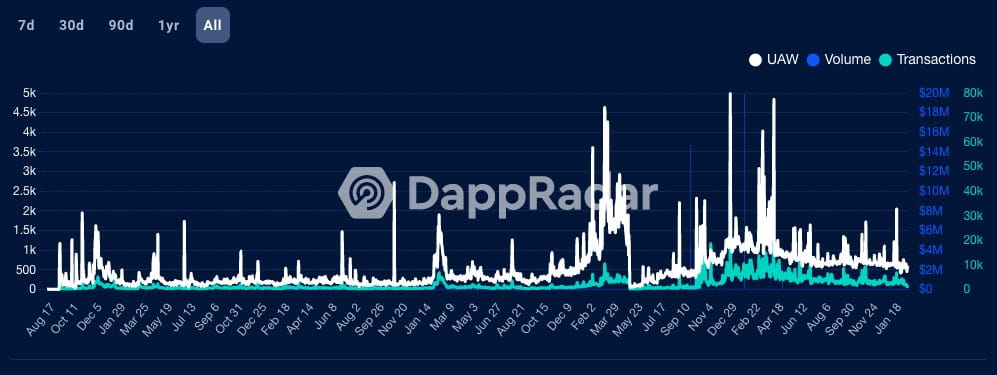
Source of daily activity and transaction volume: DappRadar
According to Metacat data, Decentraland land has dropped from a peak monthly sales of $34.18 million in November 2021 to $343,000 today. Since 2023, the number of Decentraland land sales has been just 321. Not only that, but looking at the number of landholders every month, there has been no significant increase since March 2022.
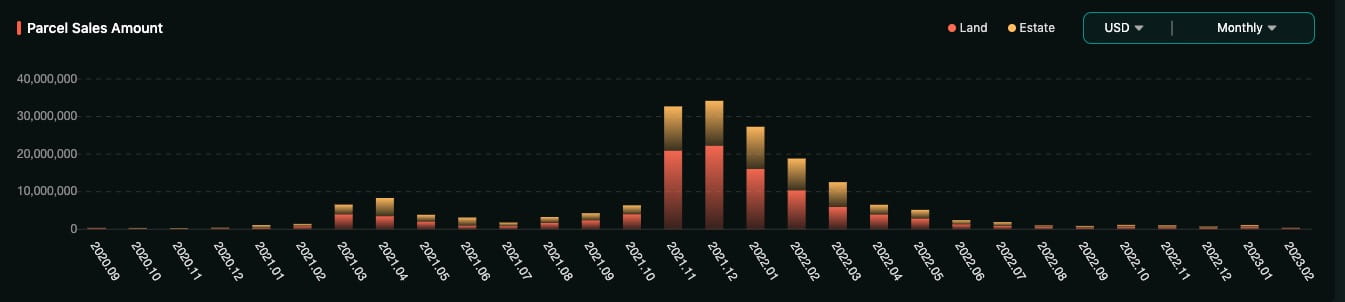
Total Lot Sales Source: Metacat
The slowdown in Decentraland trading activity has something to do with the overall cooling of the market. Metaverse real estate price trends, as measured by Metacat’s Metaverse Virtual Real Estate Index, show that Metaverse real estate prices fell from $11,000 in March 2022 to $3,366 today.
But Decentraland’s market is indeed being divided by other competitors. Metacat data shows that in 2022, Otherside’s land sales will reach US$1.04 billion, followed by NFT Worlds at US$120 million, The Sandbox ranked third with US$85.1 million, and Decentraland ranked fifth with US$48.2 million, accounting for only 3.4% of the total annual turnover. Judging from this year’s sales performance, Otherside still ranks first in the market with US$104 million, accounting for 95.4% of the market share, while Decentraland accounts for 7.7% with US$856,000. Compared to the latecomer Otherside, Decentraland was “underperformed” and even inferior to many other competitors at the same time.
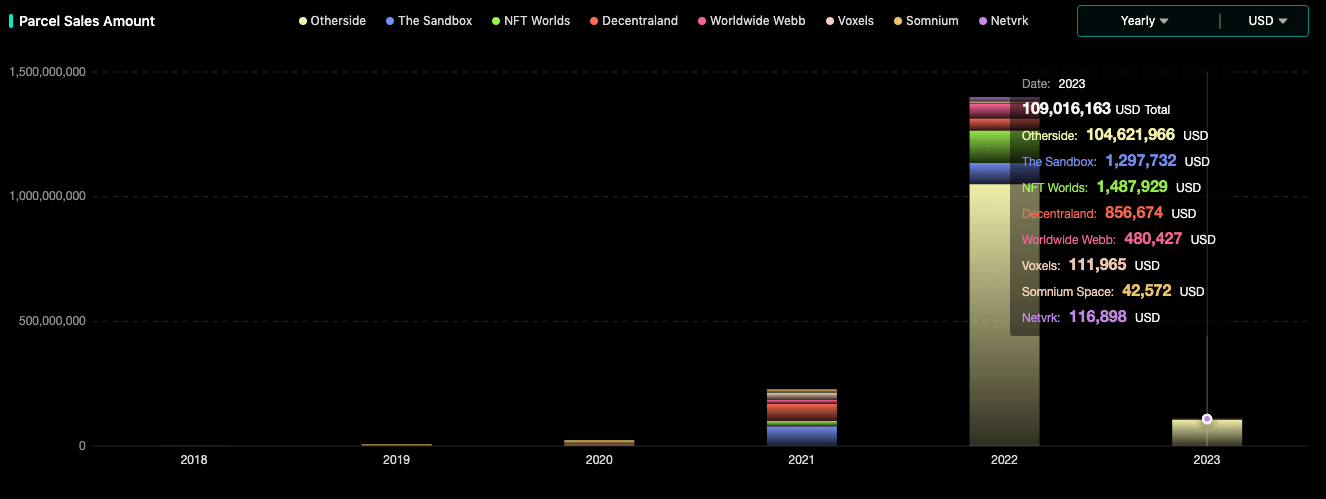
Annual sales of virtual land for mainstream Metaverse projects Source: Metacat
Although Decentraland claims that it is not a company, but a DAO and open source Web3 metaverse platform, it will not regard users as a measure of the success of the product. But from the current point of view, Decentraland is frequently making moves to broaden user traffic entrances, and has designated 2023 as Decentraland’s “Year of the Creator.”
Position public goods and promote decentralization to break the deadlock
“Decentraland’s goal is to be a fun and entertaining platform with a thriving community that educates and guides people into the philosophy and technology of Web3 while empowering creators. Hopefully, when the public realizes the importance of decentralization, Become a viable option and the next iteration of the internet won’t be monopolized by a few companies.”
Decentraland positions itself as a public product in the Internet era and has been exploring feasible paths for community co-creation to gain more favor from the market. However, what Decentraland urgently needs to solve at this stage is how to solve the problems of high creation threshold, expensive virtual real estate, and highly centralized governance. In the past few months, Decentraland has launched many functions to provide an open virtual world for more creators.
For example, because virtual land is too expensive for most ordinary users, large areas of idle virtual land can be seen everywhere, and imperfect construction scenes also mean that it cannot further attract more users. To this end, Decentraland has launched a land rental service. For users without certain financial capabilities, they can rent virtual real estate to host events, establish clubs, etc. The introduction of this function not only brings a source of income to the "owners", but also Lowered barriers to entry. At the same time, Decentraland launched a beta version of the Worlds function, which allows users to build 3D private spaces in the "suburbs" outside Genesis City without purchasing expensive virtual land NFTs. The cost is only about $30, but it cannot be sold or traded.
Of course, in order to attract more creators, Decentraland has also released fool-proof tutorials and easy-to-use SDK components. Of course, Decentraland also often holds various competitions to stimulate the creative enthusiasm of the community, and has held Metaverse Fashion Week, parties, exhibitions, etc., attracting many well-known companies such as Estee Lauder, Tommy Hilfiger, Fidelity, and Mango to join. For example, in November 2022, Decentraland announced the holding of the second Metaverse Music Festival, inviting Chinese idol group SNH48, Japanese girl group Atarashii Gakko, K-Pop band 2AM, etc.; recently, Doritos officially announced the launch in Decentraland Doritos Triangle Studios and more.
According to the 2023 creator roadmap announced by Decentraland, it will provide more tools for scene developers and NFT content creators, including scene developers who will receive a code editor for environmental scenes, a new version of the SDK toolkit, Scene-triggered avatar animation functions, virtual smart wearable devices, etc., and content creators can also obtain tools to more conveniently manage and sell works, as well as legal currency payment channels such as credit cards/debit cards, etc.
On the left hand side, the market performance is unsatisfactory, and on the right hand side, competitors are getting closer and closer. For the virtual world leader with a market value of nearly 1.3 billion US dollars, the prospects are facing a severe test.
Statement: The article only represents the author's personal views and opinions, and does not represent the objective views and positions of the blockchain. All contents and opinions are for reference only and do not constitute investment advice. Investors should make their own decisions and transactions, and the author and Blockchain Client will not be held responsible for any direct or indirect losses caused by investors' transactions.
This article Decentraland’s crisis moment: sales market share drops to 3%, or new governance tokens may challenge MANA’s value first appeared on Blockchain.