


Written by: Saurabh Deshpande
Compiled by: Luffy, Foresight News
Coinbase acquired Deribit for $2.9 billion, marking the largest merger and acquisition event in cryptocurrency history.
The history of the tech sector is similar. To date, Google has acquired 261 companies. These acquisitions birthed products like Google Maps, Google AdSense, and Google Analytics. Perhaps the most significant was Google's acquisition of YouTube for $1.65 billion in 2020. By the first quarter of 2025, YouTube generated $8.9 billion in revenue, accounting for 10% of Alphabet's (Google's parent company) total revenue. Similarly, Meta has made 101 acquisitions to date, with Instagram, WhatsApp, and Oculus being standout examples. Instagram generated over $65 billion in annual revenue in 2024, accounting for over 40% of Meta's total business revenue.

Is it better to buy off the shelf or build it yourself?
The cryptocurrency industry is no longer a new industry. It is estimated that the number of cryptocurrency users has reached 659 million, with Coinbase having over 105 million users, while the global number of internet users is around 5.5 billion. Therefore, cryptocurrency users now account for 10% of total internet users. These figures are important as they help us identify the sources of growth for the next stage.
Increasing the number of users is an obvious growth approach. Currently, we have only developed applications of cryptocurrency in the financial sector. If other applications take blockchain technology as infrastructure, the entire market size will greatly expand. Acquiring existing users, cross-selling, and increasing individual user revenue are some ways existing companies achieve growth.
When the pendulum swings towards acquisition.
Acquisitions solve three key issues that pure financing cannot address. First, in highly specialized fields where experienced developers are scarce, acquisitions help talent acquisition. Second, in an environment where the cost of natural growth is increasing, acquisitions aid user acquisition. Third, acquisitions can facilitate technology integration, allowing protocols to transcend their original use cases. These issues will be further explored in conjunction with industry cases later.
We are in a new wave of mergers and acquisitions in the cryptocurrency space. Coinbase acquired Deribit for a record $2.9 billion; Kraken acquired the CFTC-regulated retail futures trading platform NinjaTrader for $1.5 billion; and Ripple acquired multi-asset prime broker Hidden Road for $1.25 billion, which also attempted to acquire Circle but was rejected.
These transactions reflect the evolving priorities in the field. Ripple seeks distribution and regulatory channels, Coinbase pursues options trading volume, and Kraken is filling product gaps. These acquisitions stem from strategic, survival, and competitive positioning.
The table below can help you understand the considerations existing companies have when deciding whether to build or acquire.
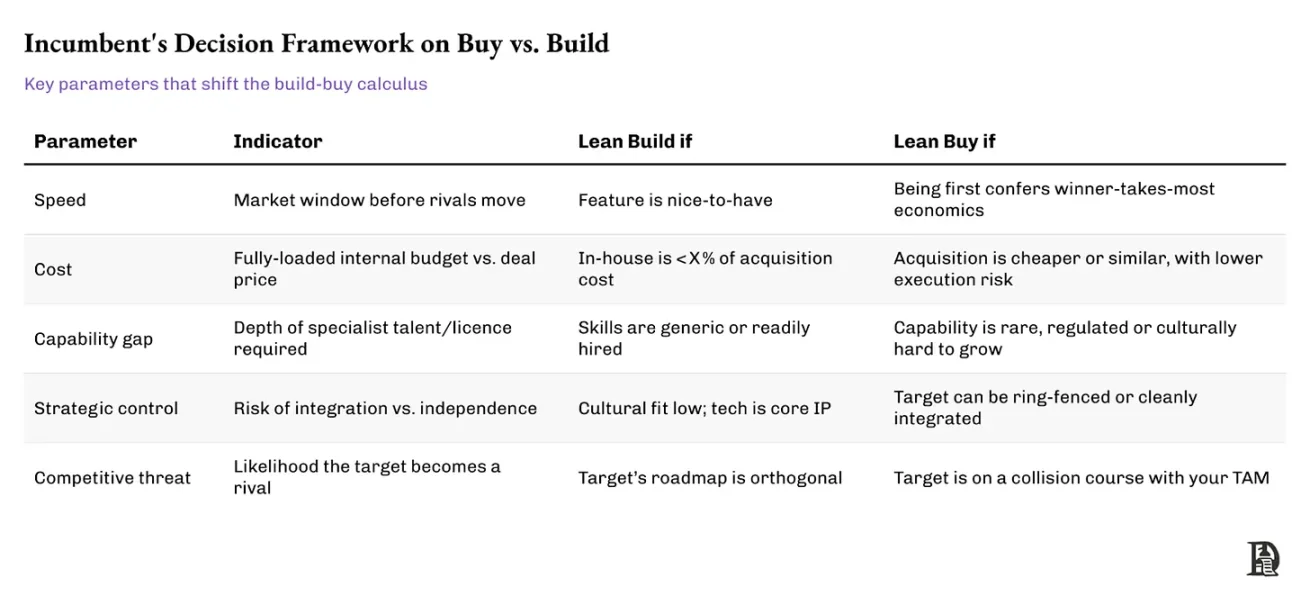
While the table summarizes the key trade-offs in self-building versus acquisition decisions, existing companies often rely on unique signals when taking decisive actions. A good example is Stripe's acquisition of Nigeria's Paystack in 2020. Building infrastructure in Africa means facing steep learning curves regarding regulatory details, local integration, and merchant onboarding.
Stripe chose to acquire. Paystack had already solved local compliance issues, built a merchant base, and proven its distribution capabilities. Stripe's acquisition met multiple criteria such as speed (gaining first-mover advantage in a growing market), capability gaps (local expertise), and competitive threats (Paystack becoming a regional competitor). This move accelerated Stripe's global expansion without diverting attention from its core business.
Before we delve into the reasons behind transactions, two questions are worth considering: first, why should founders consider being acquired; second, why is now an important time to consider this issue.

Successful acquisitions can serve as a booster.
Why is the current macro environment favorable to acquisitions?
For some, this is about liquidity at exit. For others, it is to access more durable distribution channels, ensure long-term growth, or become part of a platform that amplifies influence. For many, it is a way to avoid the increasingly narrow path of venture capital, which is now scarcer than ever, with higher investor expectations and time pressures.
A rising tide does not lift all boats.
The venture capital market lags behind liquidity markets by several quarters. Typically, whenever Bitcoin price peaks, venture capital activity takes several months or quarters to cool off. Venture capital in the cryptocurrency space has fallen more than 70% since its peak in 2021, and median valuations have returned to levels seen in 2019-2020. I believe this is not a temporary pullback.
Let me explain the reasons. In short, venture capital returns have declined, while the cost of capital has risen. Thus, due to the higher opportunity cost, the risk capital chasing deals has decreased. However, from the unique reasons of the cryptocurrency space, market structures have been impacted by the significant growth in the number of assets. I have been keeping an eye on this chart, and most token businesses should be aware of it. Just because it is easy to create new tokens does not mean it is wise to launch them. Capital on the internet is limited. With each new asset issued, the liquidity chasing it diminishes, as shown in the chart below.
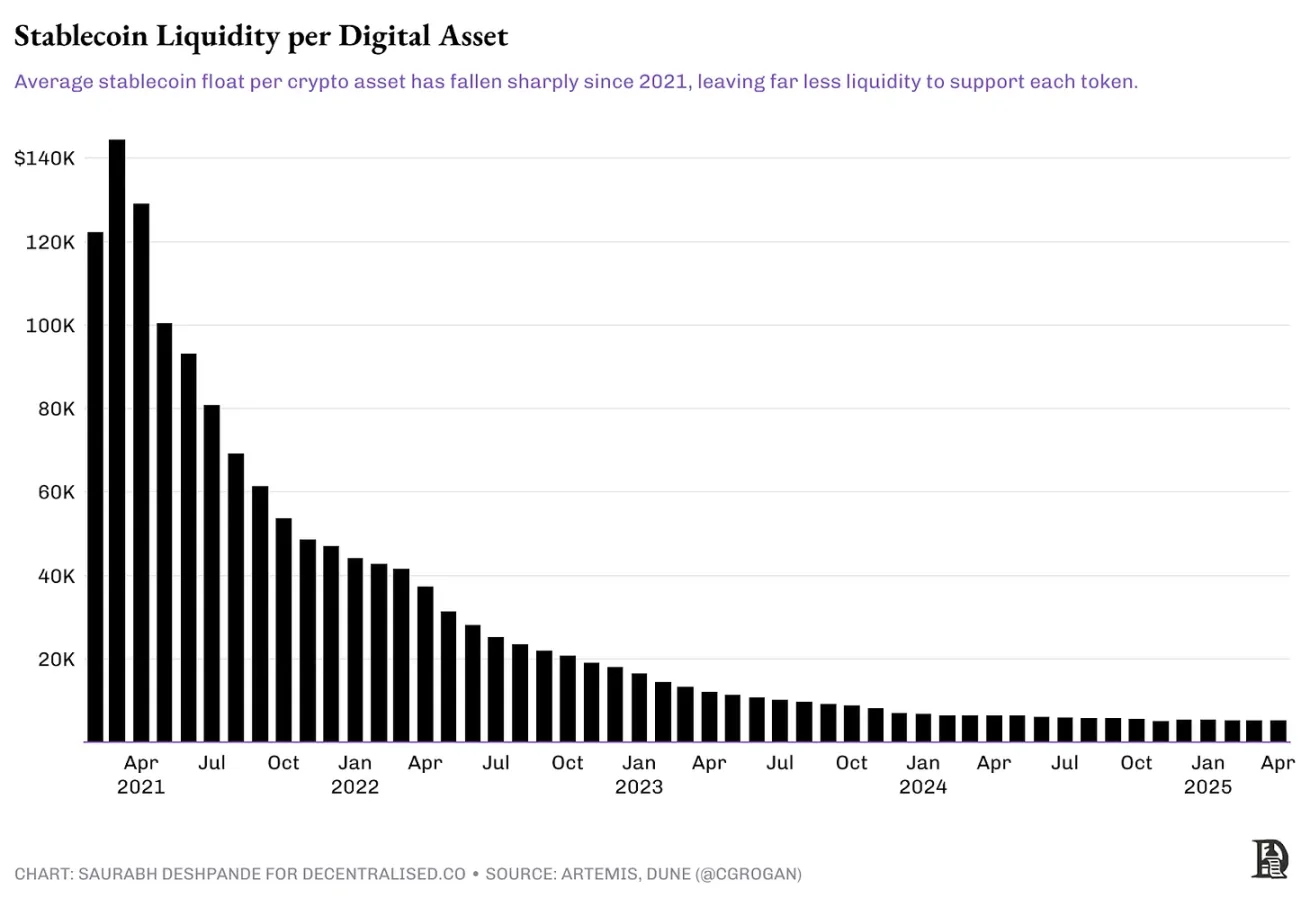
Every venture-backed token launched at a high fully diluted valuation (FDV) requires significant liquidity to reach a multi-billion dollar market cap. For example, EigenLayer's EIGEN token launched at a price of $3.9, with a fully diluted valuation of $6.5 billion. The circulating supply at launch was around 11%, with a market cap of approximately $720 million. The current circulating supply is about 15%, with a fully diluted valuation of around $1.4 billion. After multiple rounds of unlocking, 4% of the supply has entered circulation since the token's initial issuance. Since launch, the token's price has dropped by about 80%. To return to its issuance valuation, the price would need to increase by 400% as the supply increases.
Unless tokens can actually accumulate value, market participants have no reason to chase these tokens, especially in a market with many investment options. Most of these tokens are unlikely to reach their initial valuations again. I looked at the 30-day revenue of all projects on Token Terminal, and only three (Tether, Tron, and Circle) had monthly revenues exceeding $1 million. Only 14 projects had monthly revenues above $100,000. Among these 14 projects, 8 had tokens, meaning they had investment value.
This means that individual investors either cannot exit or must exit at a discount. The overall poor performance of the secondary market has put pressure on venture capital returns. This leads to more cautious investment strategies. So, products must either find product-market fit (PMF) or be something we haven't tried yet to attract investors and achieve valuation premiums. A product with only a minimum viable product (MVP) and no users is unlikely to find investors. So, if you are building another 'blockchain scaling layer', your chances of attracting top investors are low.
We have seen this happen. As mentioned in our (venture capital tracking) article, monthly venture capital inflows into the cryptocurrency space have dropped from a peak of $23 billion in 2022 to $6 billion in 2024. The total number of funding rounds fell from 941 in the first quarter of 2022 to 182 in the first quarter of 2025, indicating a cautious attitude from venture capital funds.
Why now?
So what happens next? Acquisitions may be more meaningful than a new round of financing. Those protocols or companies with some revenue will pursue niche markets that can fill their blind spots. The current environment is prompting teams toward consolidation. Higher interest rates make capital expensive; user adoption rates are stabilizing, making natural growth more challenging; token incentives are less effective than before; and at the same time, regulation is forcing teams to specialize more quickly. All these factors are prompting the cryptocurrency space to view acquisitions as a growth strategy. This time, mergers and acquisitions in the cryptocurrency space seem more thoughtful and concentrated than in previous cycles. We will explore the reasons later.
M&A Cycles
Historically, the traditional financial sector has undergone five to six major waves of mergers and acquisitions, triggered by factors such as deregulation, economic expansion, cheap capital, or technological changes. Early waves were driven by vertical integration and monopolistic ambitions; later waves emphasized synergies, diversification, or global influence. We do not need to delve into a century-long history of mergers and acquisitions—simply put: when growth slows and capital is abundant, consolidation accelerates.

Source: Harvard Law School Forum on Corporate Governance
How can we explain the different phases of mergers and acquisitions in the cryptocurrency space? It's similar to what we've seen in traditional markets over decades. The growth of emerging industries is often wave-like, rather than a straight line. Each wave of acquisitions reflects different demands along the industry maturity curve: from building products to finding product-market fit, to acquiring users, and finally locking in distribution channels, compliance, or defensive capabilities.
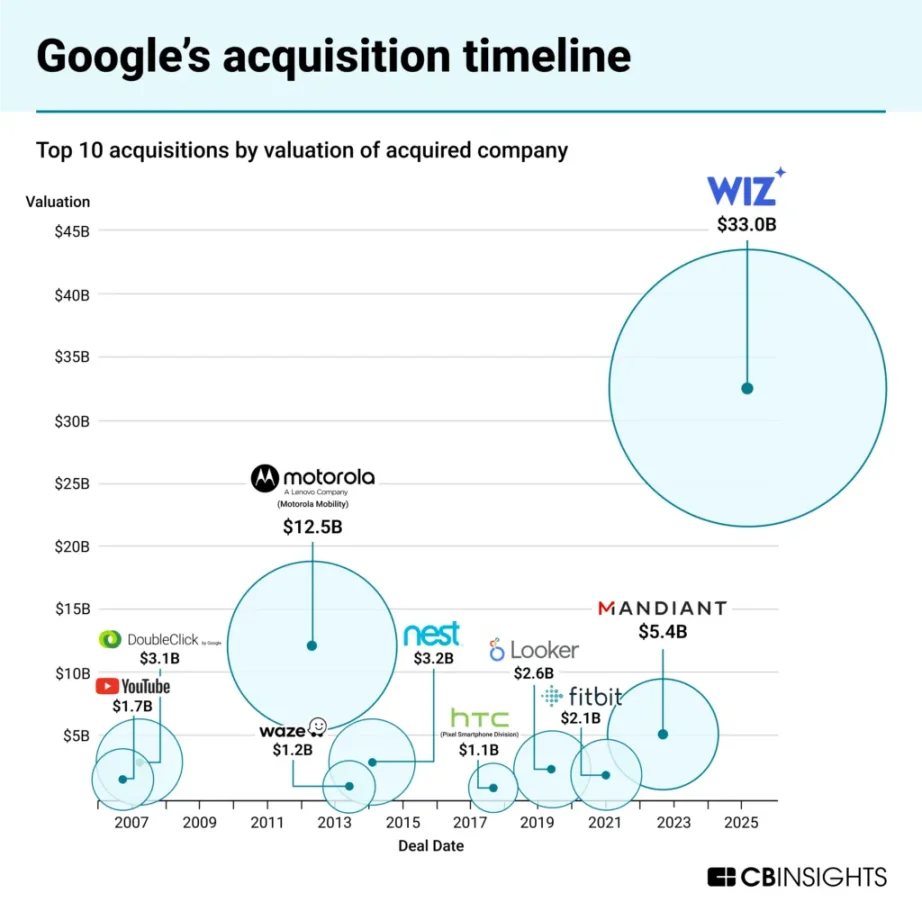
Source: CBInsights
We have seen this in both the early internet era and the mobile internet era. Recall that in mid-2005, Google acquired the Android system. This was a strategic bet that mobile devices would become the dominant computing platform. According to Chet Haase, a long-time Android engineer and Google employee, the book (Androids: Building the Team that Created Android) describes this.
In 2004, global personal computer shipments amounted to 178 million units. During the same period, mobile phone shipments totaled 675 million units, almost four times the number of personal computers, yet their processors and memory performance was comparable to that of personal computers from 1998.
The mobile operating system market was once fragmented and restricted. Microsoft charged license fees for Windows Mobile, the Symbian system was primarily used on Nokia devices, and Blackberry's operating system only operated on its own devices. This created strategic opportunities for the development of open platforms.
Google seized this opportunity by acquiring a free open-source operating system that manufacturers could adopt without paying expensive license fees, nor having to build their own operating systems from scratch. This democratized approach allowed hardware manufacturers to focus on their strengths while tapping into a complex platform that could compete with Apple's tightly controlled iOS ecosystem. Google could have built an operating system from scratch, but acquiring Android enabled it to gain a first-mover advantage and helped it combat Apple's growing dominance. Two decades later, 63% of web traffic comes from mobile devices, with 70% of mobile web traffic generated through the Android system. Google foresaw the shift from personal computers to mobile devices, and acquiring the Android system also helped it secure a leading position in mobile search.
The 2010s were dominated by cloud infrastructure-related deals. Microsoft acquired LinkedIn in 2016 for $26 billion, aiming to integrate identity information and professional data across Office, Azure, and Dynamics. Amazon acquired Annapurna Labs in 2015 to build its custom chips and provide edge computing capabilities for AWS, indicating that vertical integration of infrastructure was becoming crucial.
The emergence of these cycles is due to the different limiting factors that each stage of industry development brings. In the early stages, the key was the speed of product launch. Later, the focus shifted to user acquisition. Ultimately, clarity on regulations, scalability, and durability became critical. Acquisitions represent a way for industry winners to compress time; they buy licenses instead of applying for them, acquire teams instead of hiring, and purchase infrastructure instead of building from scratch.
Thus, the pace of mergers and acquisitions in the cryptocurrency space mirrors that of traditional markets. The technology is different, but the common sense remains the same.
Three waves of cryptocurrency mergers and acquisitions.
Think carefully; mergers and acquisitions in the cryptocurrency space have gone through three distinct phases. Each phase is determined by the market demand and technological conditions at the time.
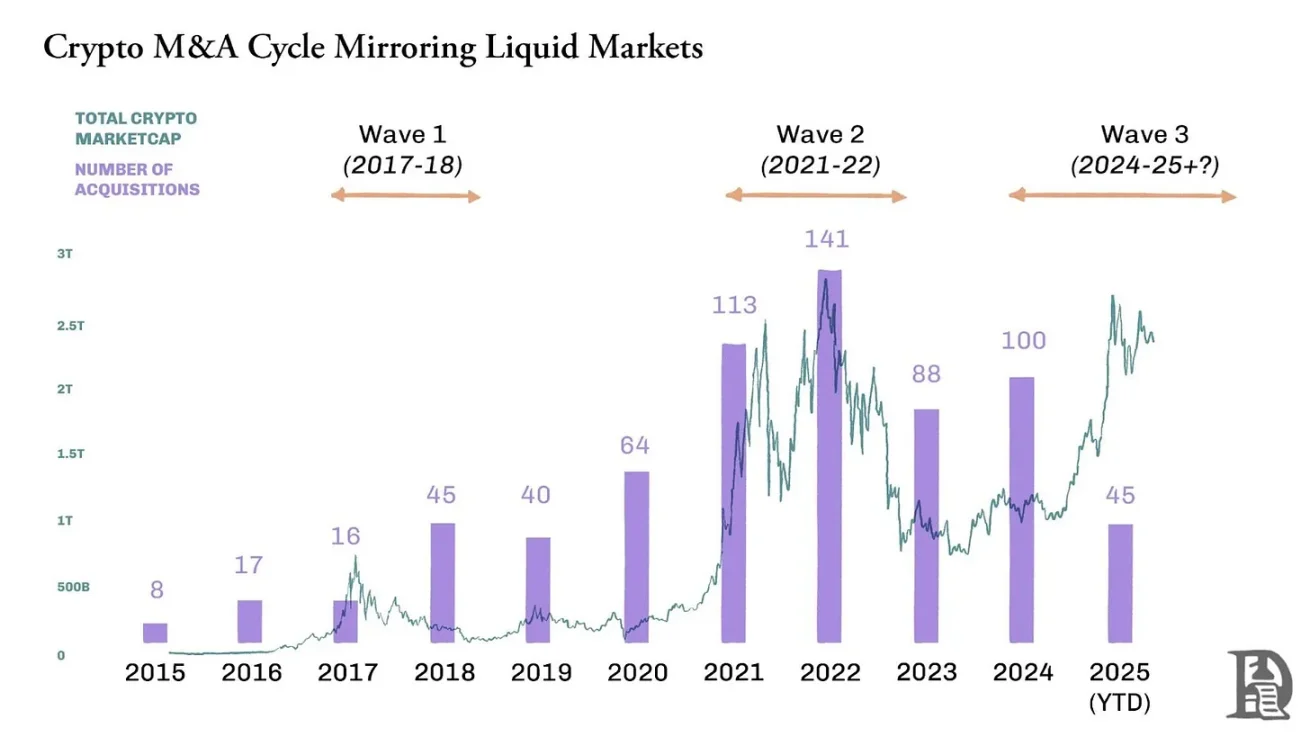
The first wave (2017-2018) — The ICO wave: Smart contract platforms were just emerging, with no decentralized finance (DeFi) yet, and people simply wanted to build on-chain applications that could attract users. Exchanges and wallets acquired smaller front-end platforms to attract new token holders. Notable transactions from this era include Binance's acquisition of Trust Wallet and Coinbase's acquisition of Earn.com.
The second wave (2020-2022) — funding-driven acquisitions: Some protocols, such as Uniswap, Matic (now Polygon), and Yearn Finance, along with companies like Binance, FTX, and Coinbase, found product-market fit (PMF). During the bull market of 2021, their market capitalizations soared, and the valuations of the tokens they held became inflated. The decentralized autonomous organizations (DAOs) of these protocols used governance tokens to acquire related teams and technologies. Yearn's acquisition season, OpenSea's acquisition of Dharma, and the crazed acquisitions by FTX before its collapse (such as LedgerX and Liquid) defined this era. Polygon also undertook ambitious acquisition efforts, acquiring teams like Hermez (zero-knowledge proof scaling solutions) and Mir (zero-knowledge technology) to establish its leadership in zero-knowledge scaling.
The third wave (2024-present) — Compliance and Scalability Phase: With venture capital tightening and regulations becoming clearer, cash-rich companies are snapping up teams that can deliver regulated venues, payment infrastructure, zero-knowledge technology talent, and account abstraction primitives. Recent examples include Coinbase's acquisition of BRD Wallet to strengthen its mobile wallet strategy and user guidance, as well as its acquisition of FairX to accelerate its push into derivatives.
Robinhood's acquisition of Bitstamp aimed to expand its business into other regions. Bitstamp has over 50 valid licenses and registrations globally, which will bring Robinhood customers from the EU, UK, US, and Asia. Stripe acquired OpenNode to deepen its cryptocurrency payment infrastructure.
Why do acquirers acquire?
Some startups are acquired for strategic reasons. When an acquirer initiates a deal, they often hope to accelerate their development roadmap, eliminate competitive threats, or expand into new user groups, technological domains, or regions.
For founders, becoming an acquisition target is not just about getting a return, it's more about achieving scale expansion and business continuity. Well-planned acquisitions can bring teams larger distribution channels, long-term resource support, and the ability to integrate products into the broader ecosystem they are trying to improve. Instead of struggling for the next round of financing or pivoting the business to catch the next wave, becoming an acquisition target may be the most effective way to fulfill the original mission of a startup.
Here is a framework to help you assess how far your startup is from becoming a 'suitable acquisition target'. Whether you are actively considering an acquisition path or just factoring in the possibility of being acquired while building your business, excelling in these parameters will significantly increase your chances of being noticed by the right acquirer.
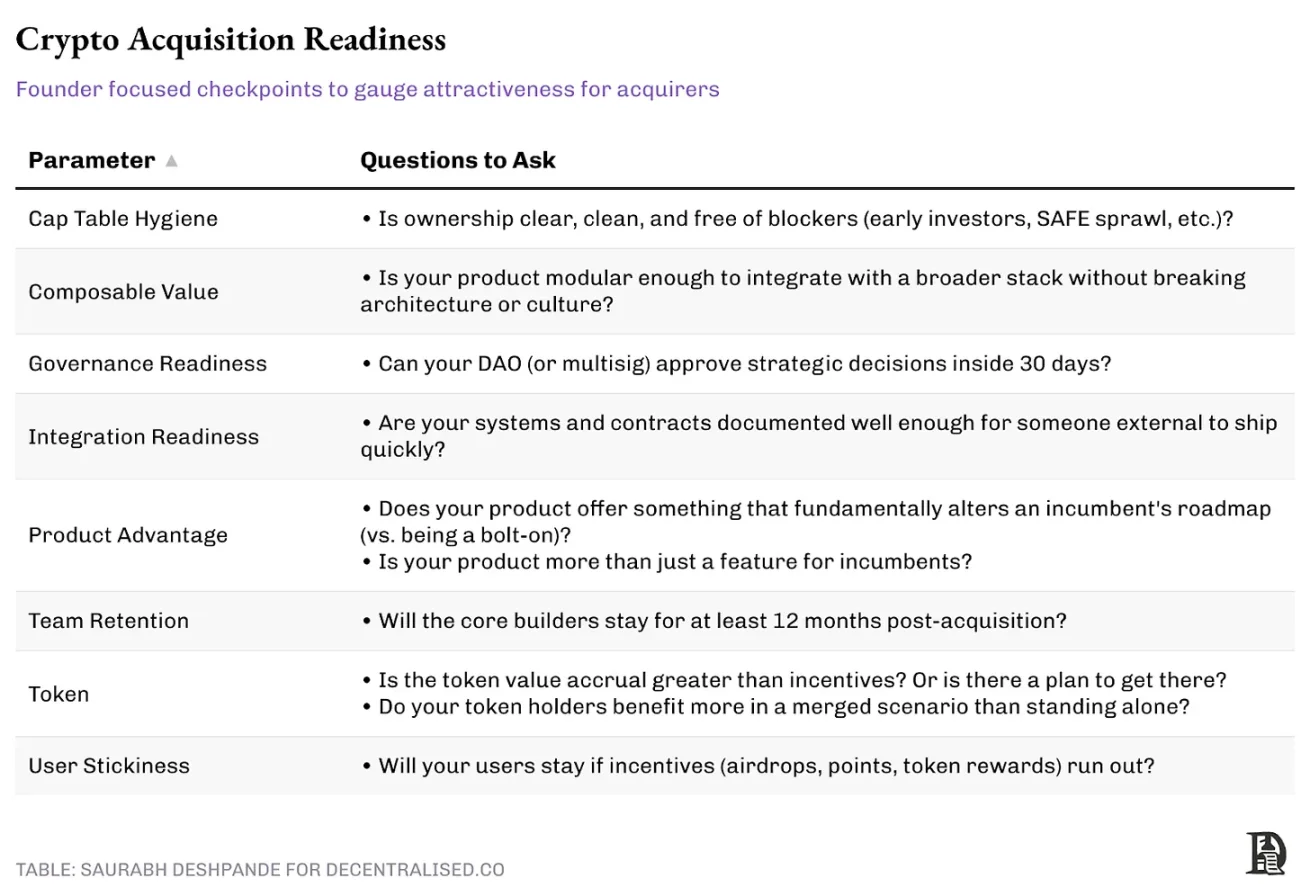
Four models of cryptocurrency acquisitions.
In analyzing major transactions from the past few years, we found that these acquisitions exhibit some noticeable patterns in structure and execution. Each pattern represents different strategic focuses:
1. Talent Acquisition
Vibe coding has emerged, but teams need skilled coders who can build products without relying on AI. We have not yet reached a point where AI can write code and confidently handle millions of dollars in funds. Therefore, acquiring small startups for talent before they become a threat is indeed a reasonable reason for existing companies to acquire startups.
But from an economic perspective, why is talent acquisition reasonable? First, acquirers often gain relevant intellectual property, ongoing product lines, and existing user bases and distribution channels. For example, when ConsenSys acquired Truffle Suite in 2020, it not only absorbed a developer tools team but also acquired key intellectual property, such as Truffle's suite of development tools, including Truffle Boxes, Ganache, and Drizzle.
Secondly, talent acquisitions enable existing companies to quickly integrate specialized teams, often at a lower cost than building a team from scratch in a competitive talent market. As far as I know, there were only about 500 engineers who truly understood zero-knowledge technology in 2021. This is why it made sense for Polygon to acquire Mir Protocol for $400 million and Hermez Network for $250 million. Assuming this talent could be acquired, hiring these zero-knowledge cryptographers individually could take years.
In contrast, these acquisitions instantaneously brought elite zero-knowledge researchers and engineers into Polygon's team, massively simplifying the hiring and onboarding process. Compared to hiring, training, and personnel growth times, the total cost of this acquisition is economically efficient, especially when the acquired team is already launching products.
When Coinbase acquired Agara for $40-50 million at the end of 2021, the deal was more about acquiring engineering talent than about automating customer service. The team in India had deep expertise in artificial intelligence and natural language processing. After the acquisition, many of these engineers were integrated into Coinbase's product and machine learning teams to support its broader AI initiatives.
Although these acquisitions were framed around technology, the real assets were the people: engineers, cryptographers, and protocol designers who could realize Polygon's vision for a zero-knowledge future. Although the full integration and productization of these teams took longer than expected, these acquisitions have provided Polygon with a deep reservoir of zero-knowledge technical talent, a resource advantage that continues to shape its competitive strategy.
2. Capability / Ecosystem Expansion
Some strategic acquisitions focus on expanding ecosystem coverage or internal capabilities. The positioning and market visibility of the acquiring company often help achieve this goal.
Coinbase is a great example of expanding capabilities through acquisitions. It acquired Xapo in 2019 to expand its custody business. This laid the foundation for Coinbase Custody, providing secure and compliant storage solutions for digital assets. The acquisition of Tagomi in 2020 led to the launch of Coinbase Prime, a comprehensive suite of institutional trading and custody services. The acquisitions of FairX in 2022 and Deribit in 2025 have helped Coinbase solidify its position in the U.S. and global derivatives markets.
Take the acquisition of Drip Haus by Jupiter in early 2025 as an example. Jupiter is the leading decentralized trading aggregator on Solana, aiming to expand from decentralized finance (DeFi) into the non-fungible token (NFT) space. Drip Haus established a highly engaged on-chain audience by providing free NFT collectible distribution services for creators on Solana.
Because Jupiter is closely connected to Solana's infrastructure and developer ecosystem, it has unique insights into which cultural products are gaining attention. It views Drip Haus as a key attention center, especially within the creator community.
By acquiring Drip Haus, Jupiter gained a foothold in the creator economy and community-driven NFT distribution space. This move allows it to extend NFT functionality to a broader audience and offer NFTs as incentives to traders and liquidity providers. This is not just about collectibles, but also about controlling the NFT channels that govern Solana's native attention. This ecosystem expansion marks Jupiter's first foray into the cultural and content domains, an area it previously had no business in. This is very similar to how Coinbase has systematically built its custody, prime brokerage, derivatives, and asset management capabilities through acquisitions.
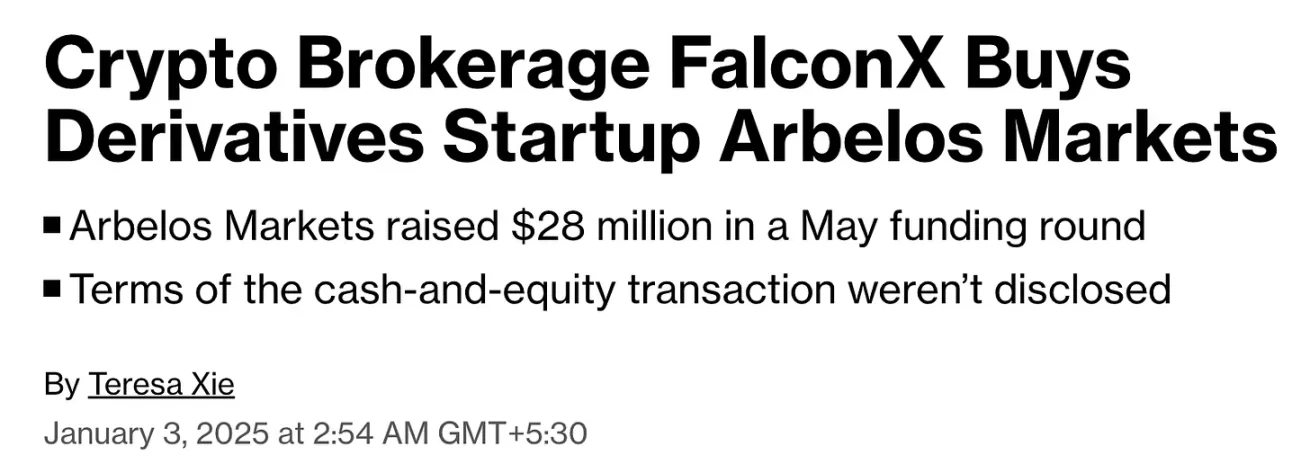
Source: Bloomberg
Another example is FalconX's acquisition of Arbelos Markets in April 2025. Arbelos is a specialized trading firm known for its expertise in structured derivatives and risk warehousing. These capabilities are crucial for serving institutional clients. FalconX, as a leading broker for institutional cryptocurrency funds, understands the derivative trading volume through Arbelos. This may have made it confident that Arbelos was a highly valuable acquisition target.
By bringing Arbelos under its umbrella, FalconX enhanced its capabilities in pricing, hedging, and risk management for complex crypto tools. This acquisition will help them upgrade their core infrastructure to attract and retain mature institutional capital flows.
3. Infrastructure Distribution
In addition to talent, ecosystem, or users, some acquisitions revolve around infrastructure distribution. They embed a product into a broader stack to enhance defensive capabilities and market coverage. A clear example is ConsenSys's acquisition of MyCrypto in 2021. While MetaMask was already the leading Ethereum wallet, MyCrypto brought user experience experiments, security tools, and a different user base focused on advanced users and long-tail assets.
This acquisition was not a complete rebranding or merger; the two teams continued to develop in parallel. Ultimately, they integrated MyCrypto's feature set into MetaMask's codebase. This strengthened MetaMask's market position and helped fend off competition from more agile wallets by directly absorbing innovations.
These infrastructure-driven acquisitions aim to lock in users at critical levels by improving the tool stack and protecting distribution channels.
4. User Base Acquisition
Finally, there is the most direct strategy: buying users. This is particularly evident in the competitive NFT market, where the scramble for collectors has become quite intense.
OpenSea acquired Gem in April 2022. At the time, Gem had about 15,000 active wallets per week. For OpenSea, this deal was a preemptive defensive measure: locking in a high-value 'professional' user group and accelerating the development of an advanced aggregator interface, later launched as OpenSea Pro. In a competitive market, acquisitions are more cost-effective when speed is critical. The lifetime value (LTV) of these users, especially 'professional' users in the NFT space who often spend significant amounts, is likely to justify the acquisition cost.
Acquisitions only make sense when they are economically rational. According to industry benchmarks, the average revenue per NFT user in 2024 is $162. However, Gem's core user group — the 'professional' users — may contribute value several orders of magnitude higher. If we conservatively estimate the lifetime value of each user to be $10,000, then the value of these users would amount to $150 million. If OpenSea acquires Gem for less than $150 million, this acquisition could already break even from a user economics perspective, not to mention the development time saved.
Although user-centric acquisitions are not as eye-catching as talent or technology-driven deals, they remain one of the fastest ways to solidify network effects.
What do these data illustrate?
Here is a macro perspective on the evolution of cryptocurrency acquisitions over the past decade, categorized by transaction volume, acquirer, and target type.
As mentioned earlier, the number of transactions does not completely synchronize with the price movements in public markets. In the cycle of 2017, Bitcoin peaked in December, but the acquisition wave continued into 2018. A similar lag occurred this time as well. Bitcoin peaked in November 2021, but mergers and acquisitions in the cryptocurrency space only peaked in 2022. The reaction in private markets lags behind liquidity markets, often delaying the absorption of market trends.
After 2020, merger and acquisition activity surged, reaching a peak in 2022 in both volume and cumulative value. However, transaction volume does not tell the whole story. While acquisition activity cooled in 2023, the scale and nature of acquisitions changed. The broad wave of defensive acquisitions has passed, replaced by more cautious category investments. Interestingly, despite a decrease in the number of acquisitions after 2022, the total transaction value in 2025 has rebounded. This indicates that the market is not shrinking, but mature acquirers are making fewer, larger, and more targeted deals. The average deal size increased from $25 million in 2022 to $64 million in 2025.
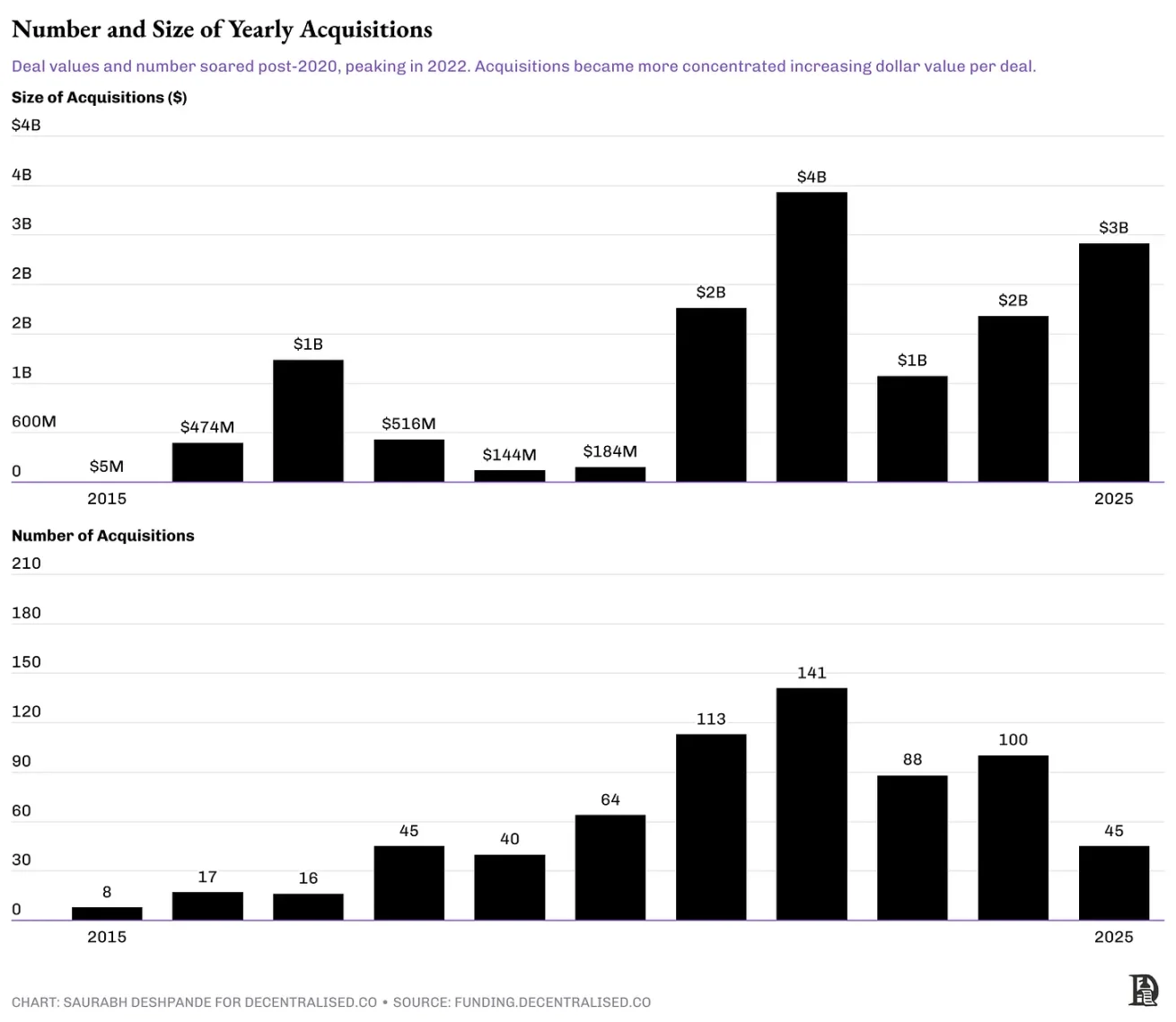
Coinbase's deal with Deribit is not included in this chart.
In terms of target categories, early acquisition targets were more dispersed. Market platforms acquired gaming assets, Rollup infrastructure, and a range of ecosystem investments covering early games, Layer 2 infrastructure, and wallet integration. However, over time, target categories have become more concentrated. During the peak of acquisitions in 2022, transactions focused on acquiring trading infrastructure, such as matching engines, custody systems, and front-end interfaces necessary for enhanced trading platforms. Recently, acquisitions have concentrated on derivatives and user-facing brokerage channels.
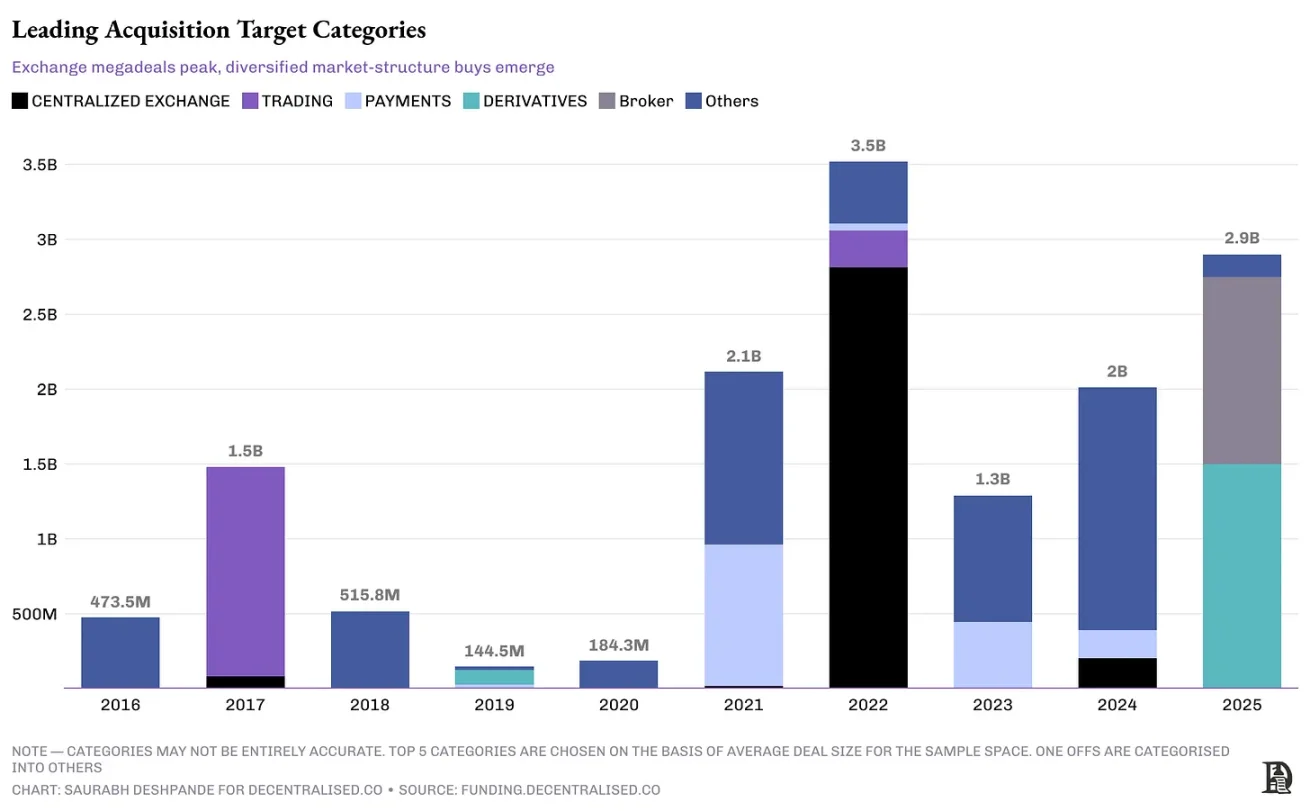
Coinbase's deal with Deribit is not included in this chart.
A deep dive into transactions from 2024-2025 reveals an increasing concentration of mergers and acquisitions. Derivative trading venues, brokerage channels, and stablecoin issuers absorbed over 75% of disclosed transaction value. The Commodity Futures Trading Commission (CFTC) has clarified rules on cryptocurrency futures, MiCA offers a passport for stablecoins, and Basel's guidance on reserve assets has reduced risks in these areas. Giants like Coinbase are responding by acquiring regulatory footholds instead of building them themselves. NinjaTrader provided Kraken with necessary licenses and two million customers in the U.S. Bitstamp provided MiCA-compliant trading coverage, while OpenNode directly integrated USD stablecoin channels into Stripe's merchant network.
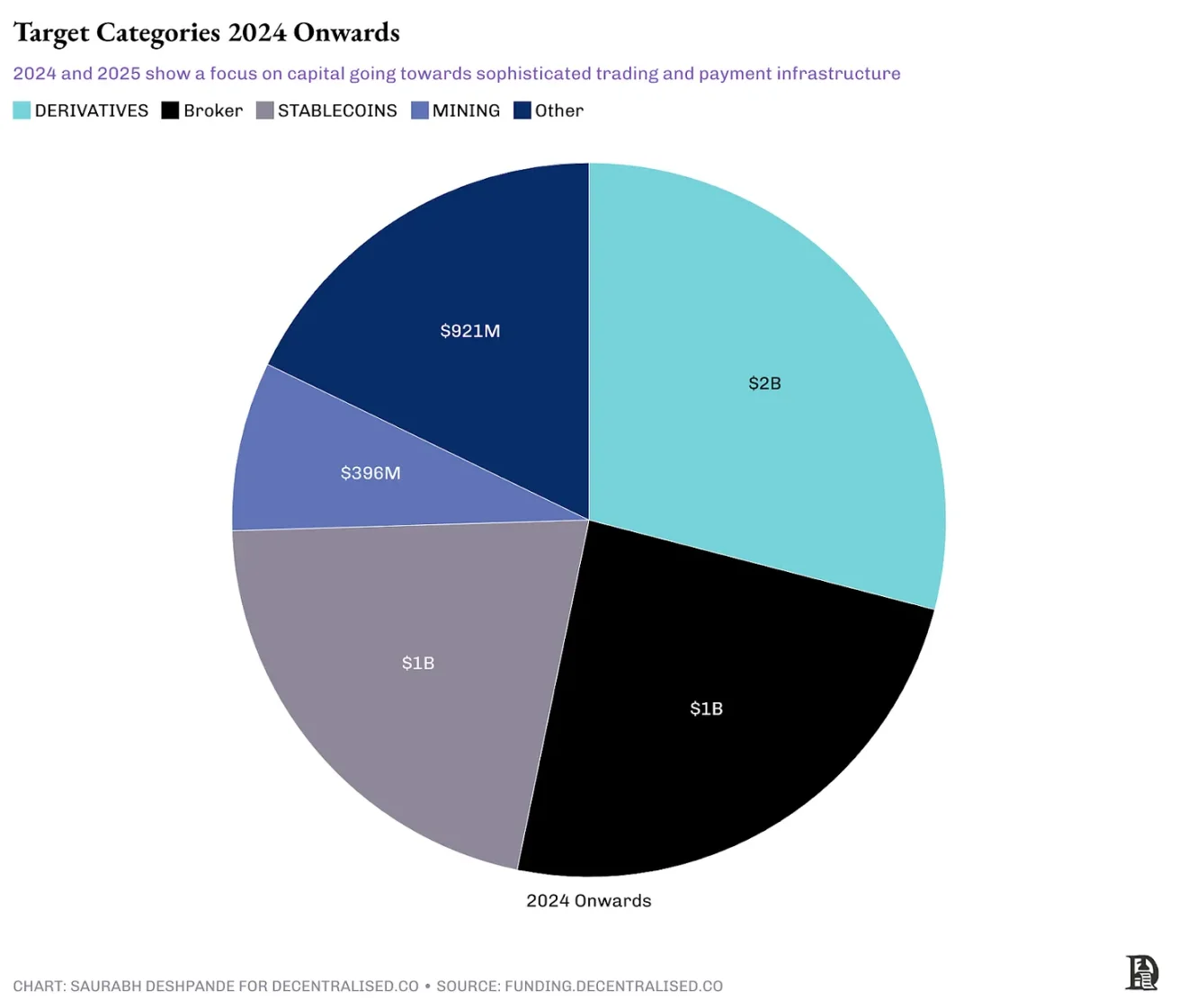
Coinbase's deal with Deribit is not included in this chart.
Acquirers are also continuously evolving. In 2021-2022, exchanges led the acquisition wave by acquiring infrastructure, wallets, and liquidity layers to defend market share. By 2023-2024, the baton was passed to payment companies and financial tool platforms, targeting downstream products like NFT channels, brokers, and structured product infrastructure. However, with regulatory changes and the underserved derivatives market, exchanges like Coinbase and Robinhood have once again become acquirers, acquiring derivatives and brokerage infrastructure.
A common feature of these acquirers is that they have ample funds. By the end of 2024, Coinbase had over $9 billion in cash and cash equivalents. Kraken achieved $454 million in operating profit in 2024. Stripe had over $2 billion in free cash flow in 2024. In terms of transaction value, most acquirers are profitable businesses. Kraken acquired NinjaTrader to control the entire futures trading stack from the user interface to settlement, which is an example of vertical acquisition aimed at controlling more of the value chain. In contrast, horizontal acquisitions aim to expand market coverage at the same level, such as Robinhood's acquisition of Bitstamp to expand geographic reach. Stripe's acquisition of OpenNode combines vertical integration and horizontal expansion.
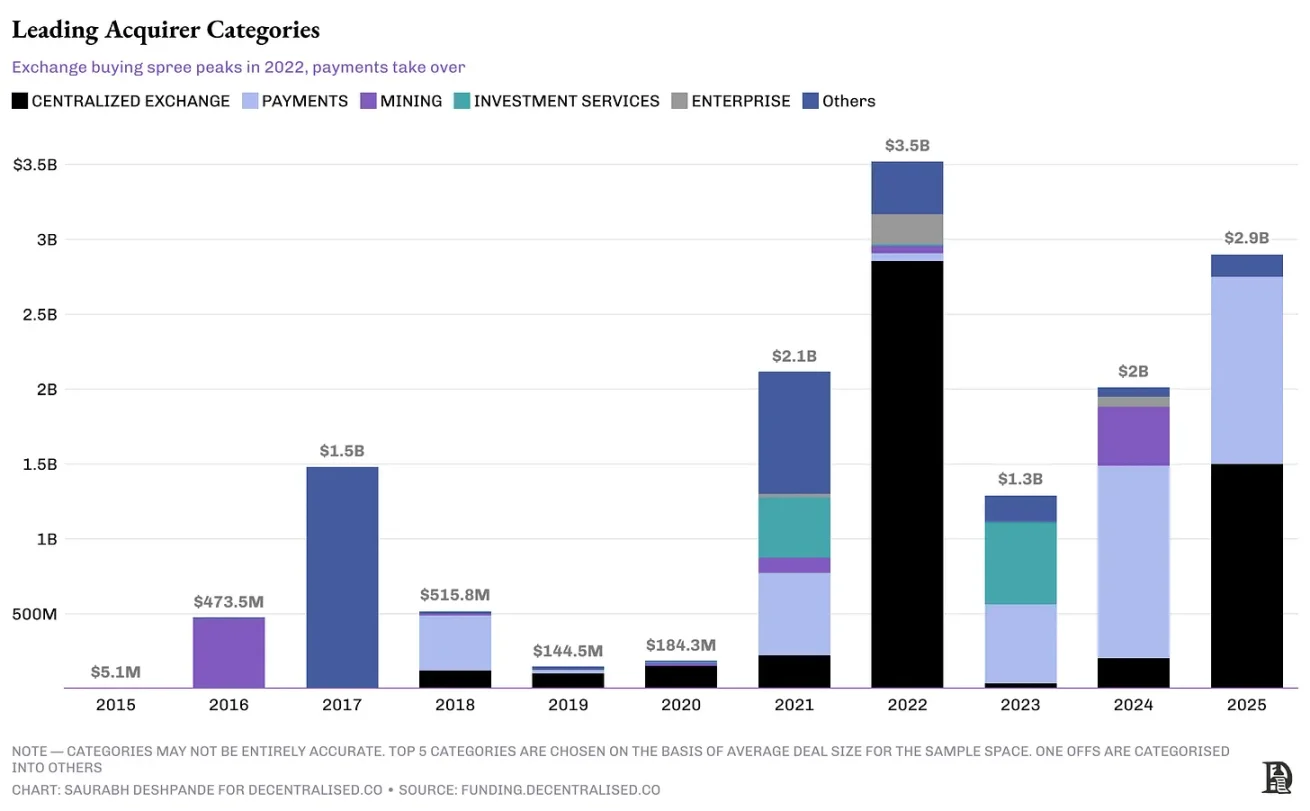
Coinbase's deal with Deribit is not included in this chart.
Remember the story of Google's acquisition of the Android system? Google did not focus on short-term revenue but prioritized two things that simplified the entire mobile experience for hardware manufacturers and software creators. First, it provided a unified system for hardware manufacturers to adopt, eliminating the fragmentation issues that plagued the mobile ecosystem. Second, it offered a consistent software programming model so developers could create applications that would run on all Android devices.
In the cryptocurrency space, similar patterns can be seen. Existing companies with ample funds are not just filling business gaps, but aiming to strengthen their market positions. When you delve into the latest acquisition cases, you will see a gradual strategic shift in both the targets and acquirers. The key is that we are seeing signs of the entire industry maturing. Exchanges are solidifying their moats, payment companies are racing to control channels, miners are strengthening their positions before halving events, and verticals like gaming, once driven by hype, have quietly disappeared from the M&A records. The industry is starting to understand which integrations will actually create compound effects and which will merely consume capital.
The gaming sector is a prime example. In 2021-2022, investors poured billions into supporting gaming-related startups. But since then, the pace of investment has slowed significantly. As Arthur mentioned in our podcast, unless there is a clear product-market fit, investors have lost interest in the gaming sector.
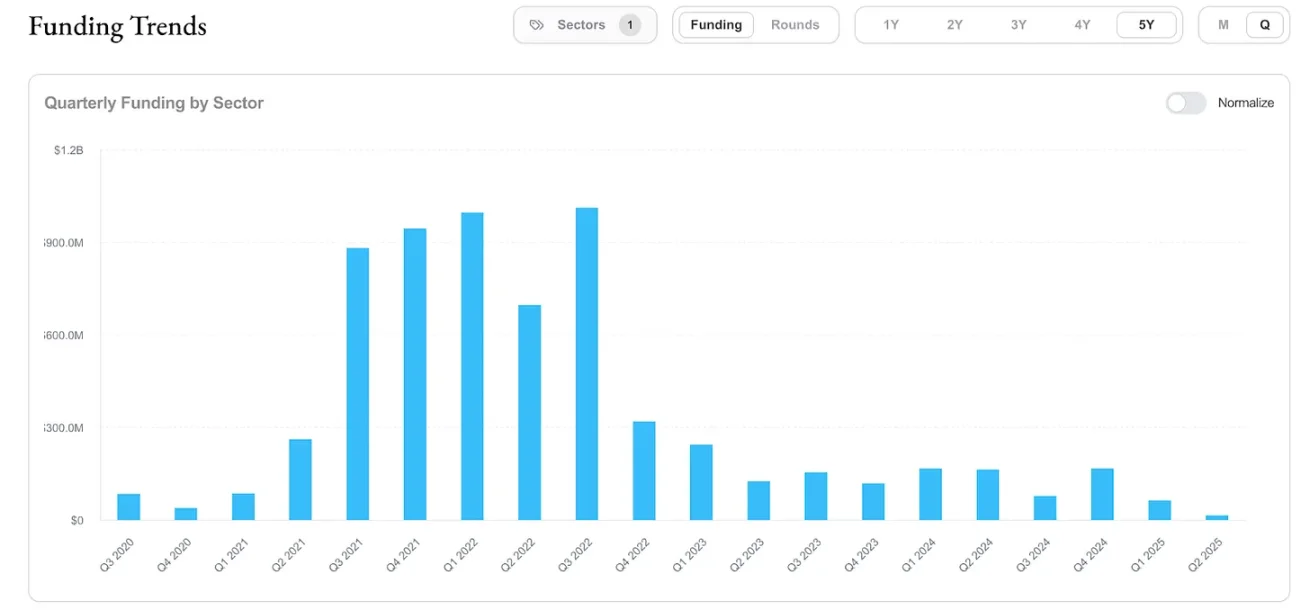
Source: funding.decentralised.co
This context makes it easier to understand why so many merger and acquisition deals, despite strategic intent, fail to achieve the expected outcomes. It's not just about what was acquired, but also about the quality of integration. While cryptocurrency is different in many ways, it cannot escape these issues.
Why do acquisitions often fail?
In the book (M&A Failure Traps), Baruch Lev and Feng Gu studied 40,000 global M&A cases and concluded that 70%-75% of mergers and acquisitions end in failure. They attributed failures to factors such as overly large target companies, excessive target valuations, acquisitions unrelated to core businesses, weak operations of target companies, and misaligned executive incentives.
The cryptocurrency space has also seen some failed M&A cases, and the aforementioned factors apply here as well. For instance, FTX's $150 million acquisition of the portfolio tracking app Blockfolio in 2020 was touted as a strategic move to convert Blockfolio's 6 million retail users into FTX trading users. While the app was rebranded as FTX App and briefly gained some attention, it failed to significantly boost retail trading volume.
Worse yet, when FTX collapsed at the end of 2022, its partnership with Blockfolio nearly vanished entirely. Years of accumulated brand equity turned into nothing. This reminds us that even acquisitions with strong user bases can collapse due to the overall failure of the platform.
Many companies act too quickly when acquiring, making mistakes. The image below shows how fast FTX was when acquiring, perhaps unnecessarily so. It acquired licenses, and the image below shows its post-acquisition company structure.
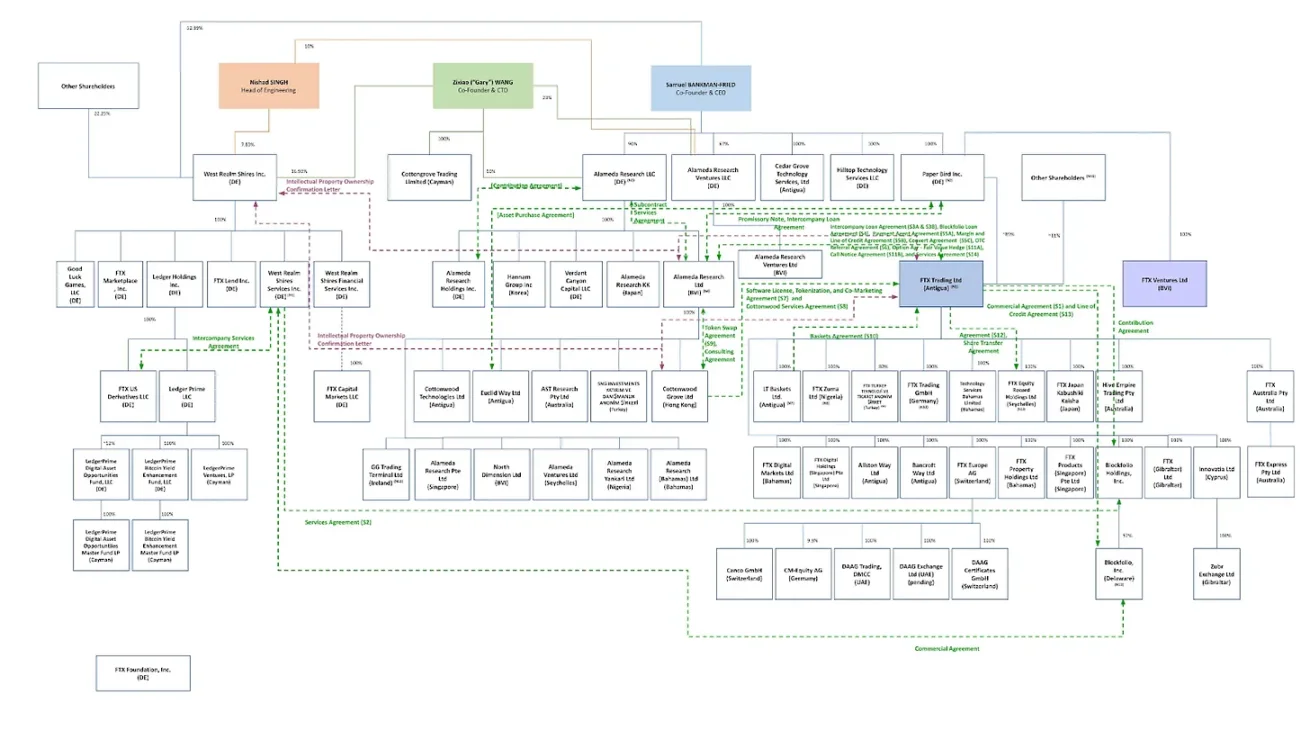
Source: (Financial Times)
Polygon is a notable example of the risks associated with an aggressive acquisition strategy. Between 2021 and 2022, it spent nearly $1 billion acquiring projects related to zero-knowledge proofs, such as Hermez and Mir Protocol. These moves were hailed as visionary at the time. However, two years later, these investments have not translated into meaningful user adoption or market dominance. One of its key zero-knowledge projects, Miden, ultimately spun off into an independent company in 2024. Polygon, once at the center of cryptocurrency discussions, has significantly decreased in strategic relevance. Certainly, these things often take time, but as of now, there is no substantial evidence indicating a return on investment from these acquisitions. Polygon's acquisition spree reminds us that even with ample funds, talent-driven acquisitions can fail without the right timing, integration, and clear downstream uses.
There have also been failed acquisition cases in on-chain native DeFi spaces. In 2021, the merger and token swap of Fei Protocol and Rari Capital occurred under the newly formed Tribe DAO for joint governance. Theoretically, this merger promised deeper liquidity, lending integration, and cooperation between DAOs. However, the merged entity quickly fell into governance disputes and encountered costly vulnerabilities in the Fuse market, ultimately leading the DAO to vote to return funds to token holders.
Nevertheless, the cryptocurrency space has a better advantage than traditional industries in successful acquisitions for three reasons:
Open-source foundations mean that technology integration is often easier. When most of your code is already public, due diligence becomes more straightforward, and there are fewer issues merging codebases compared to merging proprietary systems.
Token economics can create alignment mechanisms that traditional equity cannot match, provided that the tokens have real utility and value capture ability. When the teams of both parties involved in the acquisition hold tokens of the merged entity, their incentives remain aligned long after the deal closes.
Community governance introduces accountability mechanisms that are rare in traditional mergers and acquisitions. When significant changes must be approved by token holders, pushing a deal based solely on executive arrogance becomes much more difficult.
So, where do we go from here?
Built to be acquired.
Today's funding environment requires a pragmatic attitude. If you are a founder, your pitch should not only be 'why we should raise funds' but also 'why someone might want to acquire us.' Here are the three main drivers behind current cryptocurrency M&A activities.
First, venture capital will be more precise.
The funding environment has changed. Venture capital has dropped more than 70% since its peak in 2021. Monad's $225 million Series A round and Babylon's $70 million seed round are outliers and do not indicate a market rebound. Most venture capital firms focus on companies with growth momentum and clear business models. As rising interest rates increase capital costs, and most tokens fail to demonstrate sustainable value accumulation mechanisms, investors have become extremely selective. For founders, this means that while considering increasingly difficult funding paths, they must also consider acquisition offers.
Secondly, strategic leverage.
Existing companies with ample funds are buying time, distribution channels, and defensive capabilities. As regulatory clarity improves, licensed entities have become obvious acquisition targets. But this desire to acquire goes beyond that. Companies like Coinbase, Robinhood, Kraken, and Stripe are pursuing acquisitions to enter new markets more rapidly, secure stable user bases, or condense years of infrastructure building into a single transaction. If what you build can reduce legal risks, expedite compliance processes, or provide clearer paths to profitability or reputation enhancement for acquirers, then you have entered the acquirer's consideration set.
Third, distribution and interfaces.
The missing link in infrastructure is delivering products quickly and reliably to users. The key is to acquire those who can unlock distribution channels, simplify complexity, and shorten time-to-market for products. Stripe acquired OpenNode to simplify cryptocurrency payment processes. Jupiter acquired DRiP Haus to add NFT distribution capabilities to its liquidity stack. FalconX acquired Arbelos to add institutional-grade structured products, which may make it easier to serve different client segments. These are all infrastructure strategies aimed at expanding coverage and reducing operational friction. If what you build can help other companies grow faster, cover more ground, or serve better, then you are on the acquirer's shortlist.
This is a time for strategic exits. When building your company, consider that your future depends on whether others want what you create.