

Source: Bitcoin Magazine; Translated by Bai Shui, Golden Finance
A groundbreaking study by the Cambridge Centre for Alternative Finance (CCAF) indicates that the U.S. currently dominates the Bitcoin mining market, controlling up to 75.4% of the global hash rate. The CCAF report states: "The U.S. has solidified its position as the largest mining center in the world (accounting for 75.4% of reported activity)." This report is based on a survey of 49 mining companies that account for nearly half of the Bitcoin network's hash rate.
This concentration is equivalent to approximately 600 EH/s of the global hash rate of 796 EH/s, raising an urgent concern: Is Bitcoin mining becoming overly concentrated in the United States? What risks does this pose for the future of this emerging asset?
U.S. Secretary of Commerce and former Cantor Fitzgerald CEO Howard Lutnick recently shared his insights on the Trump administration positioning the U.S. as a Bitcoin superpower. "To me, it's like gold; it's a commodity," Lutnick said in an interview with Frank Kova of Bitcoin Magazine, emphasizing Bitcoin's fixed supply of 21 million. He outlined plans to "accelerate" U.S. mining through the Department of Commerce's investment accelerator program, which streamlines the permitting process for miners to build off-grid power plants. "You can build your power plant next to [your data center]. I mean, think about it," he said.
This pro-business stance has fueled the mining boom in the U.S., but CCAF's findings also reveal a downside: centralization. For years, Bitcoin enthusiasts have worried about China's dominance, which peaked at 65-75% of global hash power before the mining ban implemented in June 2021. A 2025 study stated: "In 2019, China dominated global Bitcoin mining, accounting for 65-75% of the total hash rate of the Bitcoin network." When China banned mining, hash power became dispersed globally, with many mines relocating to the U.S., attracted by energy-abundant and policy-friendly states. This shift led to a 50% market correction but also paved the way for a 130% increase by the end of the year, showcasing the market's resilience.
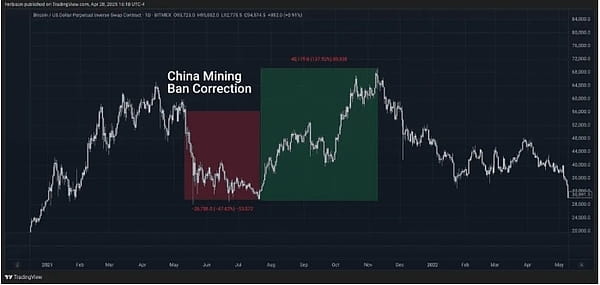
While the historical concentration of hash power in China never led to network abuse, it has always been a worrying issue. Today, with the U.S. controlling 75% of the hash rate, similar risks emerge. The Trump administration was friendly towards Bitcoin, but future governments could turn hostile, using centralized hash power to control the network. Unlike China's ban, future U.S. administrations might attempt to regulate or manipulate mining, using administrative powers like sanctions to censor transactions—while the centralization of mining exacerbates this threat.
The federal system in the U.S. offers a potential safeguard. The division of powers between state and federal governments can effectively resist excessive intervention by the federal government. In states where mining activities are active, officials and the public may believe that manipulating the industry would harm Bitcoin's value, thereby affecting investors. This resistance can help maintain the integrity of the network.
The weakening of the U.S. monetary sanctions regime may work in our favor. Following the seizure of Russian bonds in 2022, some countries that disagreed with U.S. policies reduced their purchases of U.S. bonds, undermining the fiat currency track used in sanctions. The Trump administration is shifting towards controlling goods rather than capital flows through tariffs, which may reduce the threat of currency censorship. This shift gives Bitcoin time to grow, as centralized hash power could easily become a soft target for federal intervention.
Nevertheless, U.S. Bitcoin enthusiasts must remain proactive. Deepening Bitcoin's adoption and integrating it broadly into the economy and globally can deter censorship, as attacks on the network would threaten personal wealth, provoking strong opposition. History also shows that miners adapt when forced to relocate—China's ban proved this—but governments will learn lessons. Future U.S. administrations might not ban mining but may attempt to control it, leveraging centralization.
The Bitcoin industry is at a critical juncture. The U.S. accounts for as much as 75.4% of the hash rate, and even a low estimate of 50% implies significant centralization risks. Should we pursue diversification on a global scale, or rely on the U.S. mining dominance? As Lutnick's vision unfolds, Bitcoin enthusiasts must ensure that this sovereign currency remains resilient, regardless of who holds power.