

Author: David C, Bankless; Translated by: Wuzhu, Golden Finance
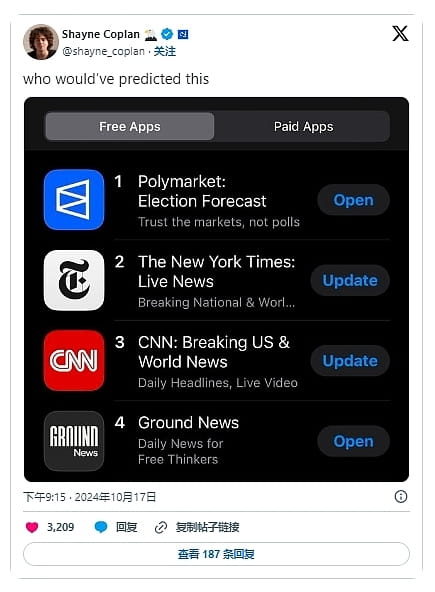
The 2024 U.S. election season has ignited a true frenzy in prediction markets, with Polymarket surging to become the undisputed center of betting activity. Bloomberg has integrated Polymarket into its terminal. Reports indicate that Trump's campaign team is actively monitoring Polymarket's odds in real time. Throughout the year, approximately $3.7 billion worth of election contracts have traded in the entire market.
This success sparked a gold rush, with entrepreneurs and developers launching their own prediction market clones, hoping to cash in. However, despite the influx of new entrants, none have made substantial breakthroughs in front of mainstream platforms.
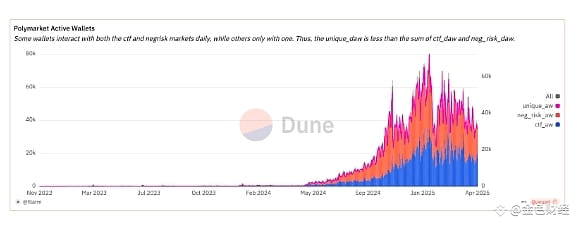
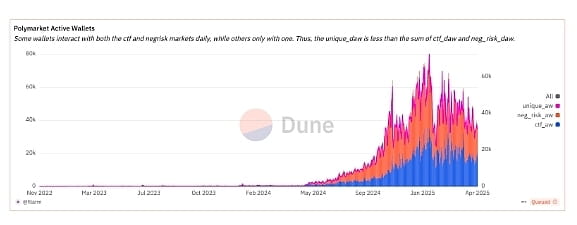
Among the total locked value (TVL) of $162 million tracked by DefiLlama, Polymarket still holds the top spot, capturing about 85% of the share. However, its total locked value (TVL) has fallen from the peak of the election cycle. At that time, the number of daily active wallets reached 50,000, with daily trading volumes exceeding 500,000 transactions, and on November 6 alone, trading volume reached $350 million. In the face of such staggering data, many observers have questioned whether Polymarket can maintain this momentum after the vote counting ends.
Now, six months after the election, Polymarket's trajectory has broken the doubts, demonstrating resilience that lays the groundwork for the next stage of development.
How has Polymarket performed since the election?
With 2025 approaching, the shadow of the Augur prediction market platform looms over Polymarket. For those with short memories, Augur was once thriving during the 2020 election but suffered a catastrophic collapse after the vote counting ended. As users fled in droves, Augur's total value in ETH plummeted by 20 times — from 19,000 ETH to 700 ETH. Worse yet, due to legal disputes and design flaws, market resolutions have been delayed, leaving a few remaining users frustrated as they watched the platform exit.
But Polymarket has never faced such issues.
Polymarket did not sit idly by as its user base evaporated, but instead achieved a more impressive feat: a true transformation. Users initially drawn by predictions of Trump and Harris have steadily shifted to Fed interest rate decisions, geopolitical conflicts, token price trends, and — perhaps most importantly — the sports betting market.
Notably, the daily wallet numbers from users who have never participated in U.S. related markets have surged. These users now account for about a quarter of all activity on Polymarket — a significant and healthy shift in user demographics, helping the platform maintain surprising stability as the number of bettors focusing on elections naturally declines.
Other interesting data includes:
The cumulative number of users is roughly the same as when the election activity heated up in mid to late October last year.
The number of active traders as of April 1 has remained flat since last November.
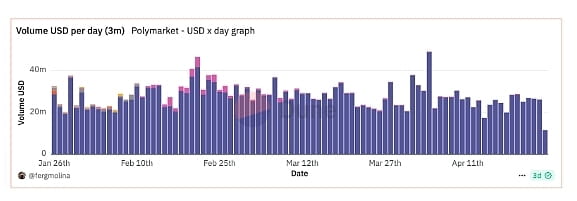
Trading volume presented a similar situation, with daily trading volumes maintaining between $20 million and $30 million over the past three months. Although there has been a decline since the peak, it remains roughly at the same level as last September.
What is Polymarket's prediction accuracy?
In addition to retaining its user base post-election, data scientist Alex McCullough's analysis shows that Polymarket has recently gained attention for its prediction accuracy.
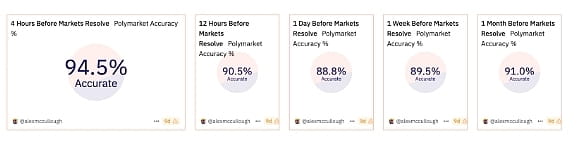
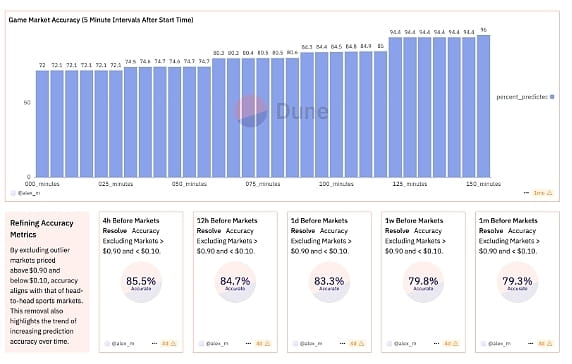
McCullough claims Polymarket's accuracy rate is as high as 94%, excluding bets that are nearly certain (over 90% likelihood) or highly unlikely (under 10% likelihood) because the outcomes of these bets are basically clear but not yet officially announced. His findings (all documented here) include:
The market overestimates event probabilities: The platform sometimes overestimates the probability of events, which may be due to group bias, insufficient liquidity, or speculative risk preferences, raising questions about its reliability.
Sports betting is the most accurate: The sports market is the fastest-growing segment of the platform, becoming Polymarket's most stable predictive indicator with balanced betting, clear standards, and nearly $4.5 billion in trading volume. This may distort the platform's overall predictive ability for other markets.
Long-term predictions appear more accurate than they actually are: Long-term markets often include some results that clearly yield a 'No' answer over time. In an interview with Polymarket, McCullough gave an example such as 'Will Gavin Newsom become president in 2024?', which lasted for months but ultimately became increasingly clear that it would not happen. These extreme cases make Polymarket's overall accuracy appear better than it actually is, as these nearly certain outcomes get counted in the platform's predictive record.
Overall, Polymarket's sustained activity indicates it is not a flash in the pan, but its reliability as a predictive indicator is cautiously optimistic, awaiting deeper scrutiny.
Are these insights actionable?
While we may need more analysis to truly confirm Polymarket's accuracy, McCullough's analysis reveals some interesting and actionable trends in how these markets operate, which anyone can use to improve their betting strategies. Here are some key points from his research that may inspire active users of Polymarket:
Most markets end with 'No'. About three-quarters of the questions will be answered 'No'. Keep this in mind when looking for opportunities to buy potentially undervalued 'No' stocks.
Best price for betting 'No'. When the price of 'Yes' is between $0.20 and $0.50, history indicates that the true opportunity is lower. Buying 'No' stocks at this time can yield the maximum profit. This advantage shrinks but remains until about $0.80.
Prices near the margins are reasonable. If 'Yes' is priced below $0.10 or above $0.95, it is nearing the correct price. Once fees are paid, any gain is small.
Timing can give you an advantage.
Market closing more than four hours before: 'Yes' is often overvalued → Buy 'No'.
Last four hours: Price tightens and approaches accuracy → Only buy now if you are optimistic about this direction 'Yes'.
If you hold 'No', consider selling before the last hour — prices may rebound in the final moments.
Data from the sports market may differ.
The day before the match: The accuracy rate is about 66%. This is a good time to buy 'No'.
After the match starts: Accuracy rises, reaching about 94% after two hours.
Prices usually fluctuate every 30 minutes (30, 60, 90, 120 minutes), meaning these times may be good for adjustments or bets.
Traders prefer to bet on 'Yes'. Traders like to bet on things that are about to happen, following the hype, and the market may be relatively thin. Placing cautious limit orders can help you avoid paying excessive fees.