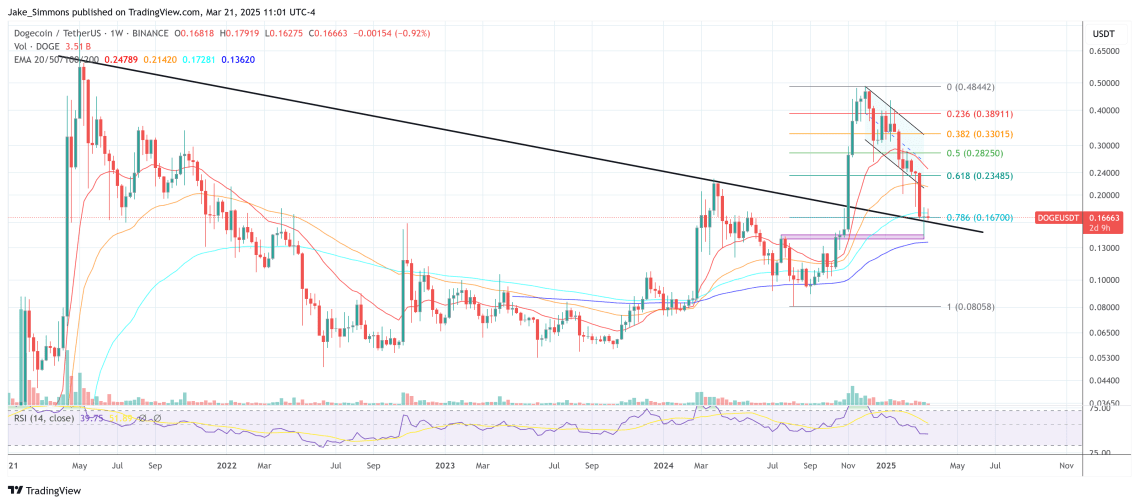

Bloomberg Intelligence's chief commodity strategist, Mike McGlone, has issued a stern warning to Dogecoin holders and the cryptocurrency community at large by drawing comparisons to historical cases of market excess. In a series of recent posts published on X, McGlone referenced the years 1929 and 1999—infamous periods of stock market crashes and the dot-com bubble—to emphasize the risks of speculative "foolishness" in digital assets.
Dogecoin Reflects Risk in the Style of 1929
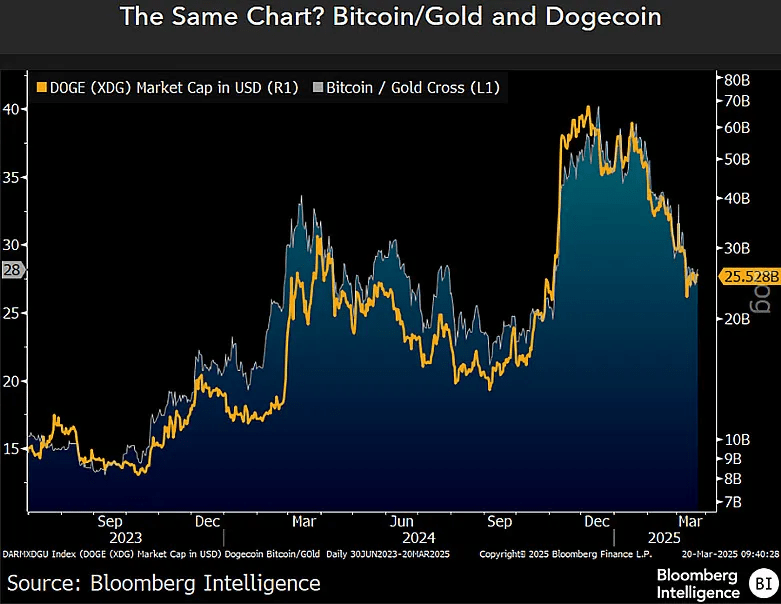
He specifically points out Dogecoin, highlighting its vulnerability to a potential market reversal while also noting gold as the beneficiary if risk appetite continues to deteriorate. “Dogecoin, 1929, 1999 The foolishness of risky assets and gold – The gold ounce to Bitcoin ratio trades almost tick-for-tick with Dogecoin could indicate reverse risk in highly speculative digital assets, with deflationary effects underpinning this metal,” he wrote.
The chart below shows how closely the market capitalization of this meme-inspired cryptocurrency reflects the Bitcoin-gold ratio. Tracking these two metrics shows that whenever the relative value of Bitcoin compared to gold changes, Dogecoin's trajectory will shift dramatically, subjecting it to the same market forces that have historically challenged highly speculative assets.
McGlone's broader thesis does not end with Dogecoin. In another post, he shifts attention to the concept of gold reaching $4,000 an ounce, linking such a possibility to momentum in the bond market and the potential for downturns in risky sectors, including cryptocurrencies.
“What could drive gold to $4,000? 2% Treasury bonds? Melting cryptocurrencies may lead the way – The path to $4,000 an ounce for #gold may require something that is often just a matter of time: a reversal of absurdly expensive risk assets, especially cryptocurrencies,” he stated.
He emphasized that if the U.S. stock market remains under pressure, bond yields could eventually be pulled lower due to the relatively meager yields of 2% or lower in China and Japan. From McGlone's perspective, such a scenario would provide further impetus for gold as the shift from relatively high-yielding Treasury bonds to lower-yielding government bonds abroad could drive investors toward alternative havens.
The chart shared by McGlone reinforces his analysis of waning demand for risky assets. An image titled “U.S. stocks rise, Bond yields vs. China, Japan” shows a persistent divergence between U.S. Treasury bond yields, hovering around 4.19%, and the relatively low government bond yields of China and Japan, at nearly 2% and 1.51%, respectively.
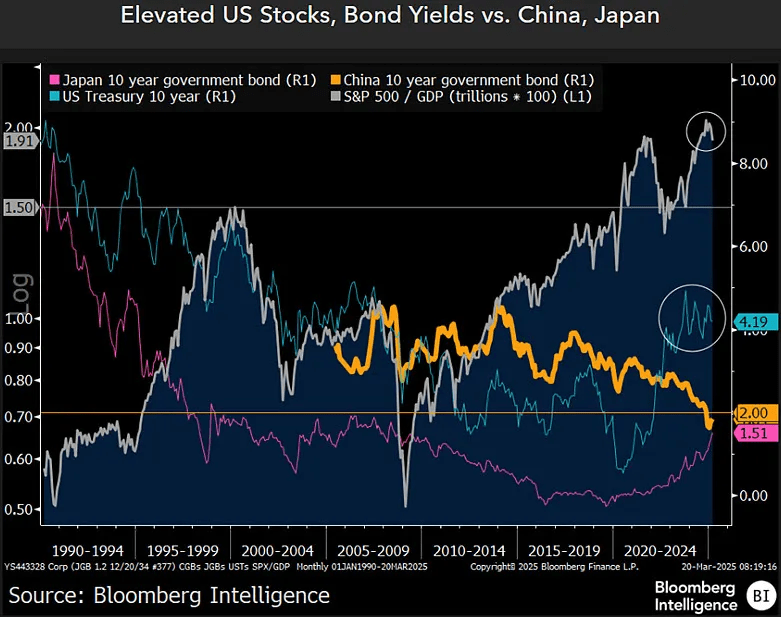
The chart also depicts the market capitalization to GDP ratio of the S&P 500, which remains historically high despite recent volatility. McGlone's conclusion is that ongoing pressure on the stock market, combined with much lower global bond yields compared to U.S. yields, could accelerate the shift toward gold if investors perceive a downturn in "expensive" asset classes, including risky assets like Dogecoin.
The third post addresses the broader altcoin market, with McGlone pointing to Ethereum as a leading indicator of whether the general trend will turn bearish for digital assets. "Has the trend turned bearish? Ethereum may lead - Ether, the second-largest cryptocurrency, is down, with deflationary impacts and the gold backdrop," he noted. At the time of reporting, DOGE was trading at $0.16663.