
By: 0xC&D, @Pepperinvestmentfund Zero-knowledge proof technology has positioned itself as one of the important leaders in scaling blockchains. A hot topic recently is blockchain layer 2 scaling solutions and Rollup, especially on the Ethereum blockchain. In the past few years, we have seen many zero-knowledge proof protocols emerge as scaling solutions. In this article, we hope to introduce how ZK Rollup solutions work and its current investment status in this track.
What is Layer 2 (L2)?
We mentioned that zero-knowledge proof technology can be used for layer 2 scaling solutions, but what is layer 2? Layer 2 is the connected network responsible for off-chain transactions. It is used to help scale application solutions by processing transactions on the Ethereum mainnet (layer 1) while still maintaining the same security measures and decentralization as the Ethereum mainnet. That is, it does not have to compete for precious block space on layer 1. Layer 2 solutions increase throughput (i.e. transaction speed) and reduce gas fees.
Layer 2 solutions are important because they allow for scalability and increased throughput while still maintaining the integrity of the Ethereum blockchain, allowing for full decentralization, transparency, and security while also reducing the carbon footprint (less gas means less energy usage, which equates to less carbon emissions.)
What is L2 Rollup?
Rollups are layer 2 scaling solutions that run off-chain from L1 but still publish transaction data to Layer 1 after executing those transactions. Given that transaction data resides on Layer 1, Rollups are protected by the same Layer 1 security measures. In fact, this is the defining feature that Rollups provide to users.
Layer 2 Rollups have three properties:
• Reduced gas fees: Transactions are executed outside of Layer 1, so no additional gas fee is required.
• Security maintenance: Transaction data and proofs reside on Layer 1, so blockchain security can be maintained.
• Transaction Delegation: Rollup smart contracts on Layer 1 can enforce correct transactions on Layer 2 by using transaction data stored on Layer 1.
Rollups require users to stake a deposit in the rollup smart contract, which encourages users to correctly verify and execute transactions. Rollups are useful because they can reduce fees, increase transaction throughput, and expand participation.
Zero-Knowledge (ZK) Rollup:
ZK rollups is a solution to scale computation using proofs of validity. It runs computation off-chain and submits proofs of validity to the main chain. ZK rollups bundle thousands of transactions on the Ethereum mainnet and create cryptographic proofs called SNARKs (Succinct Non-Interactive Argument of Knowledge), which are verified by Ethereum smart contracts. Therefore, every transaction is fully verified by all Ethereum full nodes before the block is finalized.
ZK rollup’s smart contracts keep all transferred data on layer 2, and data can only be edited using proofs of validity. This means that ZK Rollup only requires proofs of validity, not all transaction data. This feature reduces transaction costs as less data is included. With ZK rollup, there is little hesitation when transferring assets from layer 2 to layer 1, as the proof of validity has already been approved by ZK rollup and has authorized the transaction.
Some notable advantages of ZK rollups include:
• Transfer of assets is almost instant.
• Provides strong privacy and security due to the use of zero-knowledge proofs.
• Maintain security while still being secure and decentralized.
What is zkEVM?
The zkEVM is a virtual machine that executes EVM smart contracts in a way that is compatible with ZK Proof computations. There are multiple types of zkEVM, so we must distinguish between these types of solutions.
• EVM compatibility = Solidity/Vyper level compatibility
• EVM equivalence = EVM bytecode level compatibility + Ethereum execution clients (Geth etc.)
• Full-size zkEVM = EVM spec-level compatibility
They all have one thing in common, they have added in-circuit support for the EVM in their own way, with various trade-offs. Note that smart contract code written in high-level languages (such as Solidity/Vyper) needs to be compiled into EVM bytecode in order to be deployed to the Ethereum blockchain.
The way these solutions work is relatively simple:
• For EVM compatibility, you transcompile the Solidity/Vyper code to the VM’s bytecode and then prove the validity of the execution trace in the circuit.
• For EVM equivalence, you decompile or interpret the EVM bytecode into the VM’s bytecode and then prove the validity of the execution trace online.
• For a full zkEVM, you prove the online validity of EVM execution traces.
For most existing zkEVMs, such as Polygon Hermez and zkSync (we will briefly introduce these projects in the next section), they run different bytecodes through an interpreter/compiler that reflects all the features of the EVM bytecode, but is not a full EVM equivalent bytecode. Therefore, EVM-compatible ZK Rollup compiles Solidity/Vyper to bytecode targeting a custom VM instead of the EVM.
EVM tool compatibility is important at the security tradeoff level because adding additional layers of complexity can add new vulnerabilities.
Brief introduction of some ZK track projects
ZK rollups have many applications that you can integrate into your own dapp. We briefly cover some of them and their recent status in this post. Note that we cover their latest versions as some of them are still in development progress and testing.
Aztec
Aztec is a privacy-focused private L2 Rollup solution. It enables efficient private interactions with L1 smart contracts and liquidity through a process called DeFi aggregation. It uses Plonk as the underlying zk-SNARK scheme, adding privacy and significant gas savings to any L1 protocol via its Aztec Connect bridge.
The Aztec Connect bridge is an L1 reliability contract deployed on the mainnet that makes DeFi protocols conform to the interface of Aztec rollup. This allows Aztec Rollup contracts to interact with DeFi protocols through the bridge. The bridge contract models any L1 DeFi protocol as an asynchronous asset exchange. You can specify up to two input assets and two output assets for each bridge.
How does Aztec Rollup work?
Aztec users who own shielded assets on Aztec can construct a zero-knowledge proof that instructs the Aztec rollup contract to make an external L1 contract call. It provides batched multiple L2 transaction intentions on the Aztec network in the form of a Rollup. The Rollup contract then aggregates transactions against the L1 DeFi contract and returns the funds to the user on L2.
The source of funds for any Aztec Connect transaction is Aztec protected assets. When users interact with the Aztec Connect Bridge contract, their identities are hidden, but balances sent to the bridge are public. Aztec uses the concept of virtual assets to represent shares of assets held by the Bridge contract. This is much more efficient than mining ERC20 tokens. These are used when the bridge has assets that Aztec does not support.
After the launch of Aztec 2.0 in June 2021, its highest TVL reached $14 million and is now stable at around $4 million. Compared with other projects such as Tornado Cash, Aztec does not have many users, probably because of its high threshold. In addition, due to the Tornado Cash incident, products that interact with the Ethereum mainnet and focus on privacy are affected and worried about their security.
zkSync
zkSync is Ethereum’s scaling and privacy engine. Its current functionality includes low-gas transfers of ETH and ERC20 tokens within the Ethereum network, atomic swaps and limit orders, and native L2 NFT support.
The zkSync architecture design combines the following 2 technological breakthroughs:
1) zk EVM: The engine that drives EVM-compatible zkRollup, the only solution that supports L1 security and reliable smart contracts.
2) zkPorter: An off-chain data availability system that is 2 orders of magnitude more scalable than rollups.
Because zkEVM and zkPorter are interoperable and composable, zkSync is able to significantly outperform all other scaling solutions.
The consensus currently used by zkSync is Eth2 data sharding, which provides an exponentially larger data availability layer without sacrificing throughput and decentralization to reach 100,000+ TPS. zkSync uses PLONK as the underlying zk-SNARK in its Rollup strategy.
In the zkSync 1.0 phase, it produced the Zinc programming language and the corresponding SyncVM, a zk virtual machine. Now in the zkSync 2.0 phase, the team has switched to support the new zkEVM programmed in Solidity/Vyper.
As of February 2022, the zkSync 2.0 testnet is now live (the mainnet will also be launched in Q4), which contains smart contracts in Solidity or reuses existing Solidity code.
From the moment zkSync announced its EVM bytecode compatibility, it attracted the attention and support of many dApp projects, such as 1inch, Yearn Finance, Aave, Chainlink and The Graph.
Regarding the zkSync ecosystem, it includes many different types of products, such as wallets, Defi, infrastructure, and bridges. The block explorer from the zkSync testnet has submitted and verified more than 100,000 blocks, and more than 11 million transactions have been published on the chain. We believe that once the zkSync mainnet test is launched, it will attract more users to develop new products using L2 solutions.
Polygon Hermez
Hermez is an open-source ZK Rollup solution optimized for low-cost token transfers on the Ethereum blockchain. Recently, Hermez merged with Polygon to become Polygon Hermez and expanded Polygon's suite of Ethereum scaling solutions. The latest release is Polygon Hermez 2.0, a decentralized Ethereum Layer 2 scalability solution that leverages cryptographic zero-knowledge technology to provide verification and fast finality of off-chain transaction computations.
Hermez 1.0 went live in March 2021 and is decentralized, permissionless, and scalable to 2000 TPS. As such, it successfully achieved what it was designed to do, which is to scale payments and transfers of ERC-20 tokens. The team has been working on developing Hermez 2.0 using their own zkEVM, a virtual machine that executes Ethereum transactions in a transparent manner, including smart contracts with zero-knowledge proof verification. Although it was a difficult decision to adopt such a revolutionary design approach, the goal was to minimize friction for users and dApps when using the solution.
Hermez 1.0 used a decentralized Proof of Donation consensus mechanism, while Hermez 2.0 is currently using a Proof of Efficiency consensus mechanism. The core of the Hermez zkEVM is its zkProver, which contains a primary state machine executor, a secondary state machine (STARK recursive component), a STARK builder, and a SNARK builder (a zk-SNARK prover). The primary state machine executor converts EVM bytecode into polynomial constraints through zero-knowledge assembly language and encodes the corresponding polynomial constraints using a polynomial identification language. The secondary state machine splits the state transitions corresponding to zkEVM transactions, and then uses multiple state machines to calculate and verify the correctness of these transactions. The STARK proof generator is used to efficiently generate STARK proofs, while the SNARK proof generator is used to calculate SNARK proofs (very small). The SNARK protocol can be PLONK or Groth16.
To summarize, Hermez is a L2 scaling solution that combines the Plonkup lookup protocol with Starkware's STARK protocol and uses Proof of Efficiency consensus. They are almost ready to launch the testnet in Q3 2022 and the mainnet in Q4 2022.
ZK Rollups Investment Status
We briefly introduced the Aztec, zkSync and Polygon Hermez projects above from a technical perspective, because they are representatives of the ZK Rollup investment track and are in good shape. We also noticed that there are many other excellent ZK rollup projects. We made a table to give their current investment status (based on disclosed data, and note that some data is not disclosed).
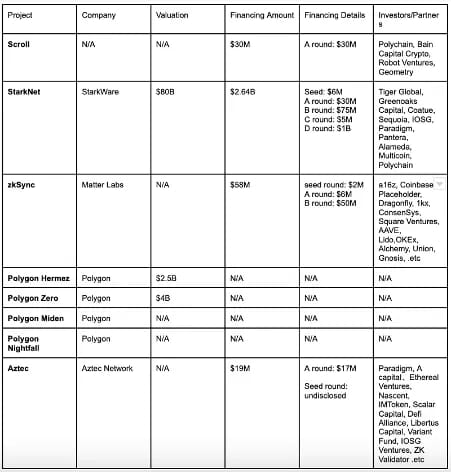
In addition to the above projects, there are many projects under construction to improve L2 ZK Rollup solutions. Some of them are building on top of the above projects to explore more applications, such as dYdX, Sorare, Immutable X, etc.
Additionally, we can note that Starkware has the highest valuation in the ZK rollup track compared to other projects due to their strengths in STARK protocol, circuit language, and zkVM development. It has been considered as the foundation for many StarkNet-based applications.
From a secondary market perspective, there are currently no ZK rollup projects that list tokens/cryptocurrencies, but we noticed an Optimistic Rollup project that lists tokens with FDVs between $20B and $95B.
Although zero-knowledge technology has a high threshold and entry level for software developers (because software developers should have both cryptography and blockchain backgrounds), many breakthroughs have been made in academia and industry in recent years. Therefore, investors are enthusiastic about this track and confident about its future. In addition, zero-knowledge technology, especially zk-SNARKs, has many applications in other scenarios such as lightweight blockchains such as Mina protocol, decentralized identity in Web3 applications, and privacy-preserving blockchains in addition to the ZK rollup track. Therefore, this track has great potential in the future, and we are optimistic about the future of the ZK rollup project.
About AvatarDAO
The first venture capital community without a GP, 100% owned, governed and driven by the DAO community, is committed to building a borderless Web3 decentralized venture capital fund that benefits more people. AvatarDAO was initiated by crypto VCs, investors, entrepreneurs, and OGs. Its members include consensuslab, BTXCapital, MintVenture, K24Ventures, Dahuzi.eth, bitlodar, and OKX's former overseas CEO-Cryptojames, etc., and has 50+ member institutions and 7,000+ community members. We discover more early project opportunities through active independent researchers and investment managers, a diverse and extensive resource network to support the development of startups, and automated contracts to manage fund investments.
About Pepper Ventures
Pepper Ventures is a Web3.0 investment and acceleration firm formed by Wall Street veterans and Crypto OGs. We use our unique scientific approach to enhance builders' powerful weapons for success and are committed to becoming the best in Web3.0 VC. In addition to investment, we also provide technical (e.g., smart contract security review, cryptography review, engineering, Tokenomics and business design) and growth (e.g., post-investment management, compliance and listing) consulting and services.
We have the support of large miners and multinational communities. Our team members come from cutting-edge investment and technology companies such as UBS, Capital Group, PwC, Coinbase, Chainlink Labs, etc.
Contact: Chase.wang@Hercules.global & Daniel.zhou@Hercules.global