
“Hello everyone, this is the blockchain game community initiated by the ladies. We mainly share blockchain game/NFT related new issuance information and tutorials. Let’s play and earn together! 🎮💰”
Binance Research released an in-depth research report on GameFi token economics on December 8, 2022. We think it is very meaningful for reference and learning, and now we have compiled and translated it into Chinese for your reference. (Warm reminder: This article is a long article of 10,000 words, and you need to be patient to read and study)
🔗Binance Research original link:
https://research.binance.com/en/analysis/gamefi-tokenomics
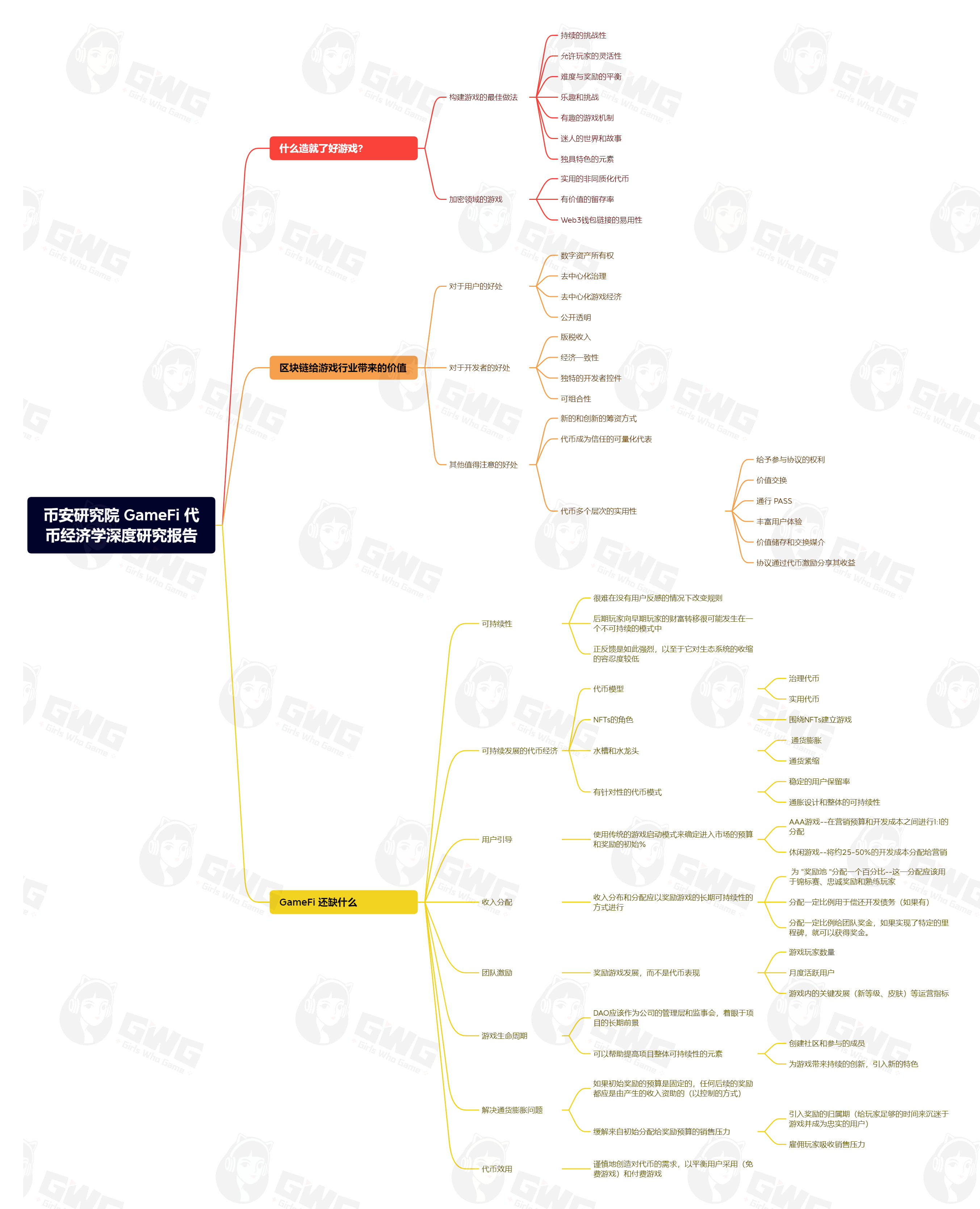
👀If you don’t want to read the version that’s too long, we have compiled a mind map so you can also understand the summary~
【introduction】
A while ago, we published a report titled “A Deep Dive into Token Economics”. In that report, we defined token economics as the study of identifying and evaluating the economic characteristics of crypto tokens. We then examined key characteristics of token economics, explored the supply and demand dynamics of tokens, and delved into many aspects of token design. However, given the complexity of this field, we left out one key area of token economics - namely, the token economics of games. While also influenced by aspects of classic token economics design, GamFi token economics are slightly different in some aspects, which is why we felt they deserved a separate report. Many of the concepts covered in the original token economics report apply here, and we encourage you to check it out if you haven’t already.
🔗《Token Economics - A Deep Dive》Original link:
https://research.binance.com/en/analysis/tokenomics-deep-dive
If you have (or you’re interested in gaming), you probably already know that games and the utility of GameFi tokens are very different from decentralized finance applications.
In this report, we will dive into key aspects of the gaming world and think about the key elements that a crypto-native game should bring. We will further think in detail about token economics in the context of gaming and discuss elements such as inflation and the overall sustainability of token economics. In addition to this, we will propose a sustainable token economics design for crypto games. However, before getting into all of this, let’s take a closer look at the history and evolution of gaming.
【Background】
Games have been around for quite some time. Ever since the dawn of humankind, there is evidence that we seem to be hardwired to play. Prehistoric and ancient civilizations originally used bones to shape early dice. The first pair of dice, found in Shandong province, dates back 5,000 years and interestingly had 14 irregular sides instead of the current six. The evolution of dice is just one example of the role that games have played in human history.
Perhaps the most influential genre of gaming throughout human history is the video game. The origins of video games began in the 1950s, when computer scientists began to simulate and design simple games on microcomputers and mainframes. Soon after came the first home video game console, the Magnavox Odyssey, and the first arcade video games, Computer Space and Pong. However, it wasn't until the 1990s that we saw the introduction of optical media through CD-ROMs and real-time 3D polygonal graphics rendering.
Games have always been one of the ways we apply different technologies - in the 90s, Microsoft Solitaire taught us how to use a mouse to click, drag and drop, and interact with a graphical user interface, and now it's almost intuitive. Sony's decision to include a Blu-ray player in their PlayStation 3 was one of the deciding factors in the high-definition disc format war between HD DVD and Blu-ray. Many people's first use of a VR headset may be due to the immersive gaming experience. Games will likely do the same for blockchain technology, educating users on how to operate a wallet, pay gas fees for transactions, and interact with smart contracts.
From 2000 to 2010, casual gaming and streaming have become an overwhelming force in the gaming industry and have become more mainstream consumers. The gaming industry has moved from handheld consoles to smartphones and tablets. In addition, gaming has touched nearly every geographic region in the world and is growing beyond the traditional borders of North America and Western Europe.
A staggering 3.2 billion gamers are expected to consume video games in 2022, generating approximately $185 billion in revenue. By 2025, this number will grow further to approximately 3.5 billion gamers, generating approximately $210 billion in revenue (Figure 1).
While the COVID-19 pandemic is still severe in some parts of the world, many countries have lifted restrictions. This means that consumers are no longer confined to their homes and are ready to participate in daily activities that they did before the COVID-19 pandemic. Naturally, we have seen a slight slowdown in game sales growth this year compared to 2020 and 2021. However, players are very sticky to games because many gamers tend to connect with the characters, storylines, and game objectives. We expect games to continue to grow in the long run, despite the recent decline in user stickiness.
The nature of gaming is rooted in the human anatomy. As the development of dice and video games shows, gaming continues to evolve and adapt to the most pervasive technological mediums of the day. For these reasons, we should pay close attention to how gaming is taking shape in the context of blockchain.
Figure 1: Market share of the global gaming industry
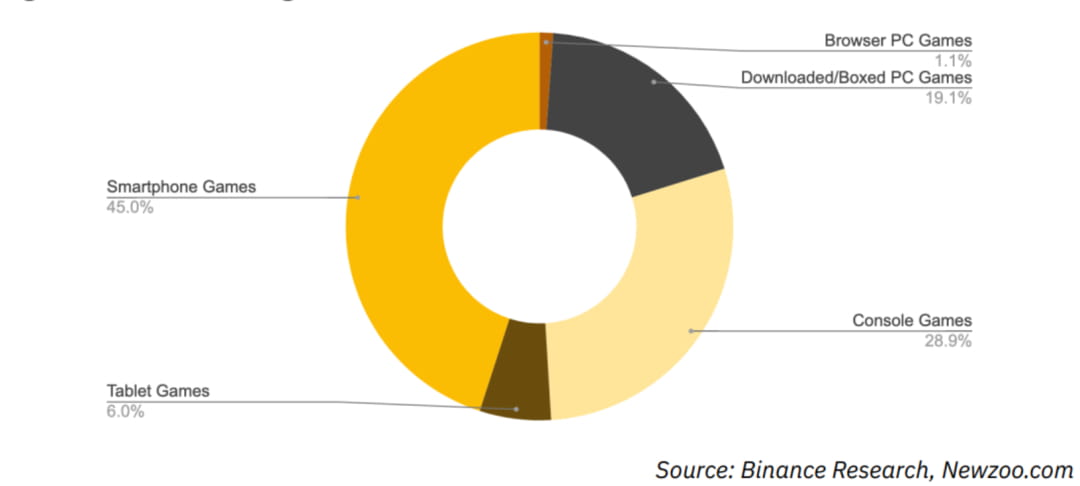
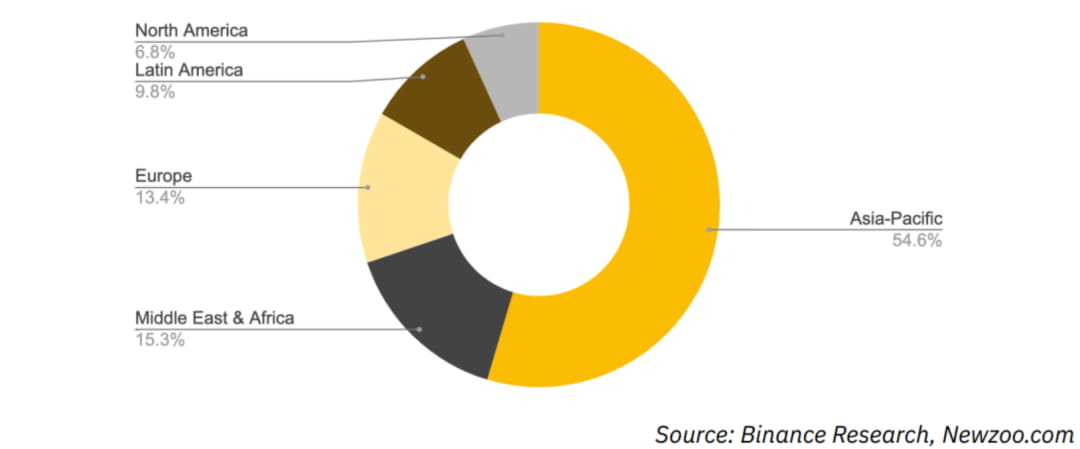
If we consider tablet and smartphone gaming as a broad mobile market, we can see that this category accounts for more than 50% of the entire $200 billion+ market this year. Looking more closely at the geographic breakdown, Asia Pacific is by far the largest market. That said, Latin America and the Middle East and Africa are all growing rapidly and are likely to account for a larger share in the coming years.
Figure 2: Global gaming industry distribution
One area of gaming that has proven to be well suited to the blockchain environment is play-to-earn ("P2E") games. P2E refers to games that effectively pay players to play. P2E is not a completely new concept for gaming - gold farms in World of Warcraft were widely reported over 10 years ago. The freedom of asset ownership and transfer brought about by blockchain technology makes it more viable. More specifically, P2E games on the blockchain offer cryptocurrency in exchange for in-game achievements, items, and other forms of engagement. In order to pay players, most P2E games require a crypto wallet to play.
In its current form, the P2E space feels relatively immature; the market is dominated by economically driven P2E games whose core focus is to experiment with economic incentives rather than the gameplay itself. Most current games suffer from sustainability issues. Players do not participate in the game for reasons other than financial gain, leading to a system that can only be sustained as long as there is a constant influx of players (and money) into the game. As a result, P2E games have received a lot of criticism from the gaming community.
However, it is important to remember that this progression is natural. Games take time to evolve and become more complex (just as we went from dice to pong to full story RPGs). Over time, we believe the P2E space will become increasingly competitive. As a result, blockchain games will attract top developers and eventually challenge traditional AAA games in terms of technical complexity and player base. More importantly, we will witness how blockchain technology can elevate games in their current form to a more engaging level. In order to overcome the current weaknesses in the P2E blockchain gaming space, we must explore more deeply the qualities of a great game.
What makes a good game?
If you are a game developer, you know that designing a successful game is a very difficult task. A successful game must have a lasting appeal, leading players to return to the game again and again to complete certain tasks. At the same time, a game can have the best graphics, gameplay, and controls, such as Star Wars™ Battlefront™ II, but it can be ruined by an in-game economy that encourages players to spend money to win. Therefore, a successful game must attract and excite players in ways that other games do not.
For games built on the blockchain, there is another special requirement for creating a successful game: complementary token economics. Incorporating token economics into a game introduces a whole new level of complexity for game developers. It is important that the token mechanics complement the overall game design - if the token mechanics are carelessly integrated, player incentives can easily be misaligned and potentially overshadow the intrinsic value of the game.
In this section, we will introduce the best practices for making a successful game in the traditional field. In addition, we will also propose how to properly integrate token economics into game design.
Best practices for building games
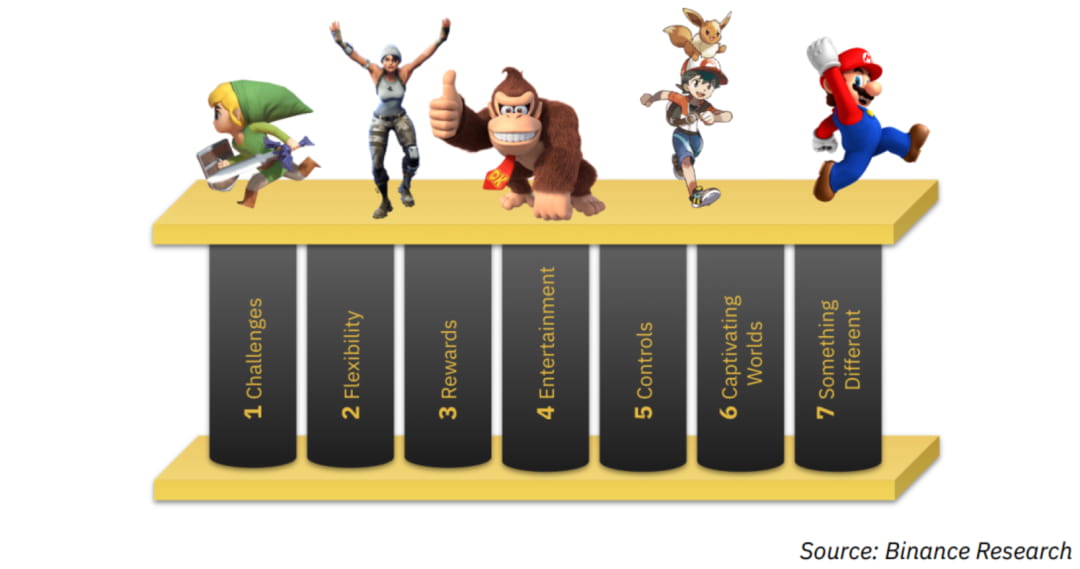
1) Challenges
Who doesn't love a good challenge? Take Demon's Souls, for example. It's considered one of the hardest games ever, which is one of the reasons it attracts players. Good game designers give players constant challenges, leading from one challenge to another, keeping them addicted to the game. Most of these challenges meet some kind of learning goal. This may include answering questions, completing a part of a map, or obtaining a new game item.
A good game should be easy to play but difficult to master.
2) Flexibility
Everyone has their own way of approaching things, and limiting player flexibility often results in people being more frustrated than expected. Therefore, it is important to allow for flexibility by ensuring there are many different ways to achieve each goal. Rather than designing a step-by-step progression, it allows each player to develop their own ultimate strategy while keeping the game challenging.
3) Rewards
To make games feel rewarding, successful players can earn new abilities, skills, and equipment. In-game rewards can be a great motivator for players. The value of a game isn't just about winning it, but about keeping the player playing and collecting the rewards. A challenge most game designers face is finding the perfect balance between difficulty and reward.
4) Entertainment
Too much realism can be boring. There is nothing wrong with making incorrect assumptions about how the world works, or allowing unrealistic behaviors or skills. Most gamers are looking for ways to escape reality, and fun is a key element that keeps them coming back for more. It is the fun and challenge elements that keep players coming back for more. We should keep this in mind when thinking about how to design sustainable GameFi experiences.
5) Game Mechanics
Even if your game is excellent, it means nothing if your players can't interact with it effectively. Therefore, designing controls that are suitable for game enhancement is one of the key factors in cultivating an addictive gaming experience. This also includes the use of any tokens in the game. They should be intuitive to use and not add a new barrier to entry. If you remember Super Mario 64, you will know what we mean by excellent controls. If the main game mechanics are not fun, your game may as well be a movie.
6) Fascinating World
Nailing down the gameplay is certainly important. However, the visuals of the game and creating an engaging world are still secondary factors to the success of the game. Two games that not only create stunning visuals, but also create a mesmerizing world are Skyrim and The Legend of Zelda. Excellent games usually have a level design that complements the main game mechanics. Well-designed levels will help to advance the storyline while keeping the player engaged as they face new challenges.
Additionally, whether your game is narrative-heavy or not, your game should include characters that are not ordinary or memorable. You want to be able to relate to your protagonist. This means designing characters that are visually interesting, well-written, and relatable to the player. Most storytellers would even say that the difference between a good story and a great story lies in the characters, not the plot or setting. After all, humans love to be moved, entertained, and inspired by interesting stories with intriguing characters, plot twists, and so on. Because games are interactive, they also have the ability to be a storytelling medium that other games cannot.
7) Unique Elements
Finally, it’s great if the game is unique. While following the same formula of other great games may seem like a profitable idea, it’s these games that introduce something unique that draws the audience in. Every game designer should strive to create a game that offers players a fresh experience they can’t get elsewhere, even if that means just adding a few tweaks to an existing game genre or style.
Clearly, there are many elements that go into designing a great game. This also makes it clear why the job of a game designer is not an easy one. Further adding cryptocurrencies to this equation adds another layer of complexity, making it even harder to achieve all of the above while also maintaining sustainability and effective token economics.
Figure 3: The seven pillars of game design
Games in the crypto space
At this point, we have a better understanding of how to design a good game. However, placing a good game in a crypto context adds new complexities. Looking at games in a more cryptocurrency context, we can see that the main reason people want to participate is still similar to traditional games. It's not for financial gain, but to play a fun game. After all, users are willing to spend time installing, setting up the game, and learning how to operate it. Therefore, we can also point to fun and entertainment as key elements of crypto-native games. While this is a necessary condition for the success of almost all games, the introduction of token economics and blockchain technology often distracts people from this fact.
Let’s look at this a little deeper in the context of cryptocurrencies. Non-fungible tokens (“NFTs”), if available in games, can be viewed as tools with in-game utility. They can be collectibles (collectible art with potential use cases across platforms, like StepN Asics sneakers, rather than random-looking sneakers) or items that provide some form of utility. Interestingly, most blockchain primitives, like ERC-721, were inspired by traditional games. Vitalik Buterin explained that one of his main motivations for creating an unforgeable token standard was an update to World of Warcraft (“WoW”). In 2010, the 3.1.0 patch for WoW made him “realize what kind of horrors centralized services would bring,” prompting him to create Ethereum just two years later and allow items to also have unforgeable characteristics.
Players play games not to make money, but to have fun.
Retention is one of the most important key performance indicators (“KPIs”) for crypto game developers. This is very similar to the free-to-play space, where we often monetize in the form of advertising. When to measure retention is up to you — and different retention rates can bring valuable information about your game’s performance. Measuring one-day retention can show whether you are effectively attracting new users and give you an idea of what kind of first impression your game leaves on people who just downloaded it. In contrast, seven-day user retention can help you determine how many people like your app — observing user churn from day one to day seven can help you understand your app’s performance and help determine how long people will play your game or use your app. After a month, your user base may have shrunk dramatically. The remaining users may be using the game regularly, which is a valuable revenue driver — an ideal segment for crypto-native games.
One barrier to adoption for crypto games right now is the need for a web3 wallet connection. Considering that time spent installing and setting up games can hurt sales (mobile games have a huge advantage in this regard), we must note that ease of use should be a focus in the GameFi space.
Assuming the GameFi space will continue to grow, we expect to see more high-quality games entering the market. Games of similar quality should be able to attract players from traditional markets, thus establishing crypto gaming as a key onramp for people to enter web3 and cryptocurrency.
【Blockchain’s value proposition】
Now, we’re really getting started. After all, this paper is about GameFi token economics. To better understand the need for strong and sustainable token economics, let’s look at the value that blockchain technology brings to the gaming industry.
Benefits for Users
1) Digital asset ownership
There are huge benefits for users who choose to get involved with GameFi: ownership over your assets, the ability to earn in-game rewards, and decentralized governance power, to name just a few.
Let’s take the popular video game Fortnite as an example. Fortnite is a free-to-play game that generates revenue through in-game purchases. Purchases do not provide any additional benefits to the game, but rather enhance the appearance of the character, such as skins and accessories - the community element is crucial to Fortnite’s success. However, these skins are not unique, and there is no way to verify ownership. If Epic Games (the developer of the game Fortnite) wanted to permanently deactivate any purchased skins, they could easily do so and leave you in a difficult position, just like World of Warcraft did to Vitalik. If you decide to quit the game and intend to sell your in-game purchases, you will usually face many challenges and unsatisfactory results.
In contrast, let’s take a closer look at a classic game built on the blockchain. Typically, similar to Fortnite, players can either play the game for free or purchase skins. A key difference may be that you will not be able to earn rewards for playing the game unless you purchase the skins. Also, unlike Fortnite skins, these skins are actually NFTs owned by the player. As players advance in rank, their earning potential also increases, further increasing the value of the NFT. If you want to sell your skins, you can usually do so through popular NFT marketplaces.
Having ownership of your assets means you can transfer your skins, characters, or items to another game or other games developed by the same project, giving you more freedom than before.
2) Governance
Another key aspect to focus on is control. Going back to the Fortnite example, the developers are the ones who have full control over the direction and roadmap of the game. With the emergence of emerging decentralized organizational structures such as DAOs, crypto-native games can allow users to have input into the development of the game’s direction and roadmap driven by token ownership. DAOs can not only help guide development but also help projects gain access to capital and community-based growth strategies. Tokens allocated to the DAO treasury can be used for further development.
3) Decentralized game economy
By creating a decentralized game economy, players have the ability to receive a portion of the game's revenue, thereby increasing player retention and reducing user acquisition costs. In addition, due to the decentralized nature, players do not have to rely on a centralized party and can contribute to the game themselves.
4) Openness and transparency
A key factor in preventing fraud is avoiding the so-called double-spending problem. The double-spending problem is the result of spending the same money more than once. Of course, it is also possible for digital coins to be spent twice, which would instantly render them useless. Therefore, overcoming the double-spending problem is a key milestone in the implementation of blockchain technology. With cryptocurrency, you do not need to rely on a third party to confirm transactions. Instead, blockchain makes it possible to solve the double-spending problem algorithmically and introduces the concept of digital scarcity.
Putting this in the context of crypto gaming, we can see that users have little understanding of how the supply of their in-game currency is managed. As a result, they also have little understanding of how the value of their in-game currency fluctuates. By double-spending or minting more in-game currency, hackers or even game developers themselves can increase the supply of in-game currency without the user's knowledge. As a result, users can be negatively impacted as their holdings of in-game currency become diluted. In web3 games, there is more transparency around the supply side of in-game currency. Web3 games often come with a whitepaper that provides an in-depth analysis of the tokenomics of the game's in-game currency. Additionally, the circulating supply and total supply can be verified by tracking the contracts for the in-game currency.
Finally, the blockchain technology itself prevents double spending by maintaining consensus among a group of validators/miners. Therefore, no malicious actor can spend the same game currency twice in a row, or reduce the expected value of the currency.
Benefits for Developers
1) Royalties
In addition to user value, game developers can also gain a lot of value from this. In the current model, game revenue is driven entirely by actual purchases of the game and in-game purchases (if any). Through embedded smart contracts, blockchain-backed models also allow for revenue to be generated when assets are transferred, adding a new revenue stream for developers. Users are free to transfer assets as they wish, while developers can receive royalty income from transaction fees (if they decide to do so). This and other profit opportunities are particularly lucrative for developers. In blockchain games, developers are often able to retain more of the value they create and benefit from on-chain royalties.
2) Economic consistency
In theory, allowing players to receive part of the game's revenue can improve player retention and reduce user acquisition costs. Although it is still controversial to this day, receiving revenue in the game can be seen as a net incentive for players.
3) Unique developer controls
Developers can effectively regulate the game economy through smart contracts, setting specific predetermined conditions to control in-game transactions. This ensures that transactions are conducted fairly and can limit over-saturation of the in-game market.
Blockchain platforms also have the potential to provide a more secure environment for building. They use strong data encryption to protect transactions, and hackers cannot compromise a decentralized blockchain network because there is no single central server or group of servers to compromise. Beyond that, blockchain allows developers to communicate more openly with players and listen to their feedback.
4) Composability
Composability is a key benefit for both users and developers. Allowing completely different games to interact with each other can help unlock new directions for gaming that haven't been possible before. It can further consume the total amount of skins and NFTs. From an individual game developer perspective, the main benefits are often the most significant, as they can ensure the composability of the game skins and actions they develop on the same blockchain.
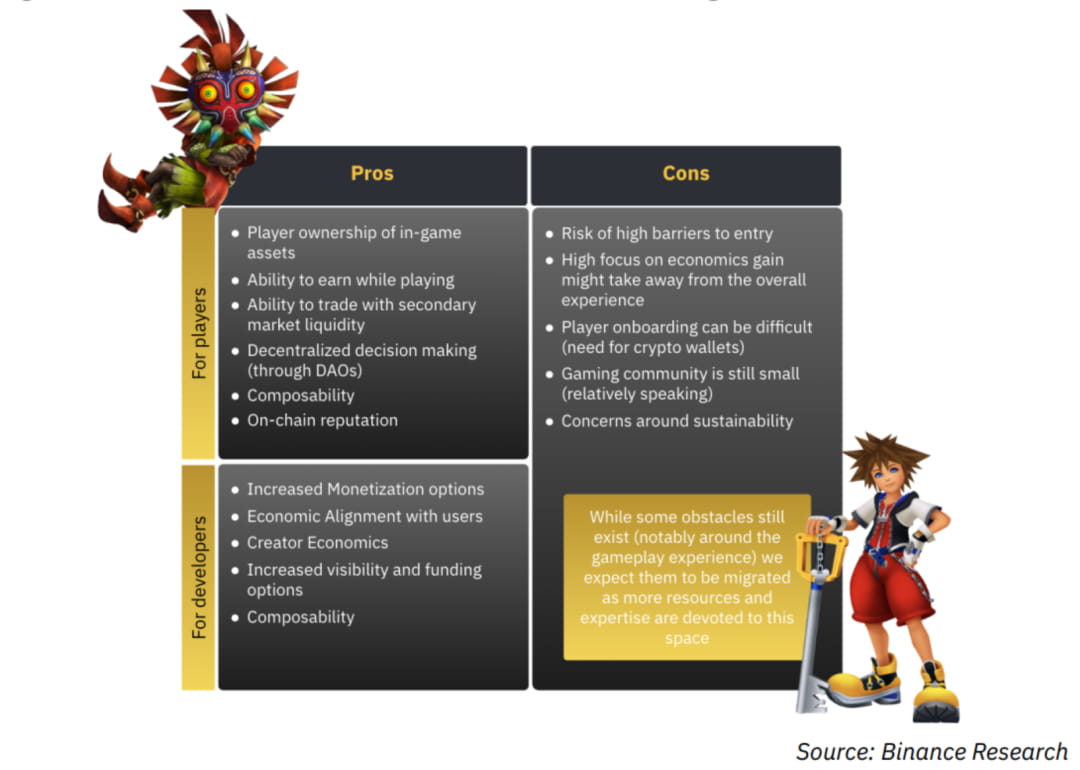
Figure 4: The advantages and disadvantages of blockchain for games
Other noteworthy benefits
It’s also important to note other benefits that apply to many forms of tokenized projects. While these benefits are not exclusive to crypto games, we think they’re still worth mentioning.
1) Raising funds
Tokens can be an innovative way to raise capital, further bringing benefits that may not be possible with more traditional methods. For example, a significant advantage of token financing over equity financing is that it allows early contributors/users to invest in the project and earn revenue, whereas traditionally only accredited investors can do so at the initial public offering ("IPO") stage Make an investment. This can take many years, often much longer than the time required to create and distribute the tokens. This inclusivity and the potential for active community governance are an important factor for both game developers and investors. Additionally, given that smart contracts allow you to encode mechanisms into tokens, this has clear technical advantages over traditional markets. This means that tokens can be more dynamic and offer more use cases than other financing methods.
2) Trust
In general, almost every type of value can be managed through a dedicated virtual token. It is important to remember that when a token represents a right to access a game (or service), or allows participation in voting in a regulated ecosystem, the token holder is placing trust in the token issuer. In the case of a token representing a right, the trust lies in the enforceability of that right. Ultimately, a token can be defined as a quantifiable manifestation of trust in decentralization and disintermediation.
3) Practicality
The potential for early adopters of a project is a very advantageous marketing tool, which is likely one of the reasons why we are seeing an increase in token allocations to early adopters. By providing a solution to a problem, having a loyal and engaging community, and other innovative features, a project may see its demand grow.
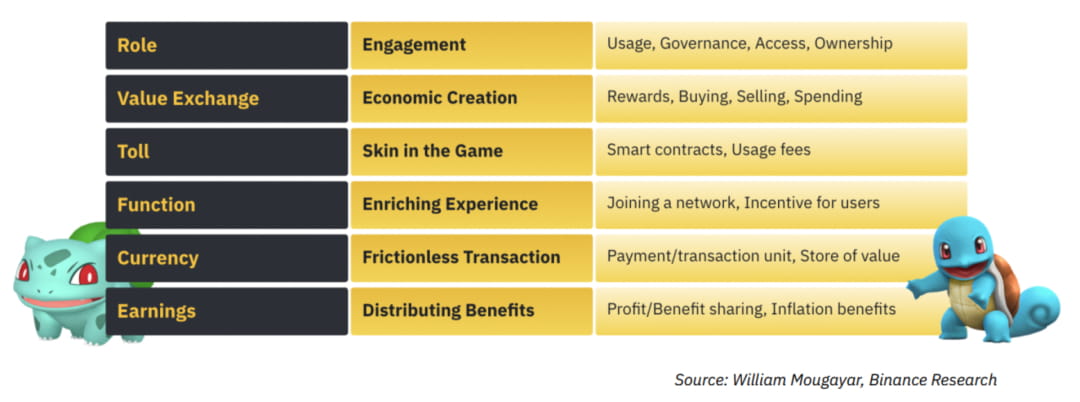
Currently, the main roles that tokens play in the crypto space include: rights, value exchange, tolls (or fees), functions, currencies, or means of profit. We will discuss these aspects in more detail below. Looking closely at utility tokens, we can see that there are multiple layers of utility that can be applied here.
❖ Rights - Tokens can provide rights to use the protocol. This can come in many forms. Governance is the most common one, allowing changes and voting on the direction of the project. They can further provide access to the protocol and allow product usage or provide ownership
❖ Value Exchange - The use of tokens can lead to the creation of a “mini” economy. Within this, tokens can facilitate the creation and existence of an economy by allowing buying and selling, as well as rewards for work and commitment
❖ Tolls - Tokens cause participants, investors, and users to participate in the game. Typically, security deposits or usage fees help create barriers to entry when running a smart contract platform or protocol.
❖ Functionality - Tokens can often enrich the user experience by allowing users to join the network, participate in games, connect with users and other participants, and even incentivize them to participate.
❖Currency - Whether it is a game or a DeFi protocol, usually tokens can be used as a form of currency, as a store of value and a medium of exchange
❖ Revenue - The protocol shares its revenue through token incentives and distributes benefits to the protocol’s participants. This helps promote the growth and development of the ecosystem
Figure 5: Token Utility Overview
【What is GameFi still missing? 】
GameFi and P2E have become increasingly popular terms over the past two years with the early success of projects like StepN and Axxie Infinity. Since then, many games have begun experimenting with GameFi. However, most current GameFi incentives induce high inflation, which leads to questions around the sustainability of these systems. Before learning how to create more sustainable game token economics, we must understand more about what GameFi and P2E encompass.
What is GameFi?
GameFi is an acronym that combines the terms gaming and decentralized finance ("DeFi") and relates to how games can be monetized in a decentralized system. P2E projects allow players to earn in-game rewards (usually tokens) by completing tasks and passing different game levels. Unlike traditional game rewards, self-custodial ownership of in-game rewards means that players can easily place orders to sell them on decentralized marketplaces. Therefore, the value of the rewards is easily traded on the open market. The financialization of blockchain games has proven to be a powerful means of attracting players. With the possibility of monetizing in-game rewards, crypto enthusiasts are joining the game to earn rewards. The recent financialization of the gaming industry represents a huge change from traditional games, where the only motivation for playing games is simply fun.
Current measures
We can distinguish between two approaches. One is casual games, similar to many mobile games, which are mainly aimed at players who play once in a while (for example, on the way home or on their commute). The other is AAA games, which focus on players who play games as a free-time activity.
1) Casual Games
The first approach is casual games. This category of players may only play occasionally and are in the market just to socialize or "kill time". Casual players are a large group and games targeting them should have a low barrier to entry and simple operation. Because of this, especially for blockchain-native games, it is important to make it easy to use tokens in the game. Sometimes this means that not everything needs to be done directly on the blockchain, the free elements are simple code, and only NFT technology is used for paying users.
An example of a casual game is Axie Infinity — one of the largest P2E games on the blockchain. In Axie Infinity, players are tasked with collecting, breeding, and training creatures called “Axies.” Ultimately, players can test their Axies by participating in player vs. environment or player vs. player battles. Due to its widespread popularity and relatively non-mainstream gameplay, Axie Infinity can be classified as a casual game. Axie Infinity built a two-token GameFi model, where one token is used to provide in-game utility ($SLP) and the other token serves as a standard for participating in DAO governance ($AXS). Several years later, the two-token GameFi model has proven to be an industry standard that can be found in a large number of games on the blockchain.
2) AAA games
The second model for blockchain gaming is AAA games. This model is most likely to appeal to typical gamers who are not used to the web3 environment. There is a lot of hype surrounding upcoming AAA games that are expected to have industry-grade gameplay. However, there may be some barriers for traditional players to land on the blockchain. Therefore, focusing on strong game design and industry-grade gameplay that is better than traditional platforms, but leveraging blockchain technology may be the best approach here. Similar to casual games, in-game purchases should be seen as an enhancement to the user experience rather than creating barriers that make the game unenjoyable. Compared to casual games, AAA games are more sustainable in the long run because they are able to create a loyal user base (similar to League of Legends) that enjoy the essence of the game. This should be an overall net positive because it will likely mean that people are willing to hold tokens and NFTs for longer.
Illuvium is a highly anticipated AAA role-playing game. In the world of Illuvium, players are tasked with traversing seven different graphic-rich alien landscapes to capture wild beasts known as Illuvials. Players in Illuvium can also place bets on battles between Illuvials and purchase land to build homes and upgrade their Illuvials. Illuvium was created to fill the gap of “AAA games with movie-quality 3D special effects” on the blockchain. As a AAA game, players of Illuvium should expect high-quality visuals and game mechanics. Unlike Axie, Illuvium will follow the single-token GameFi model, where it has only one native token ($ILV) for governance. For in-game utility, Illuvium players must use ETH or convert their $ILV into synthetic $ILV (at a 1:1 ratio).
What is GameFi missing?
Designing games using crypto is not easy. As mentioned above, token economics often distract developers from focusing on the key elements of creating a good game. Simplifying the seven pillars we listed earlier, we can see that game developers are in a dilemma between how to optimize challenge, satisfaction, and user stickiness.
Figure 6: The Web3 gaming trilemma
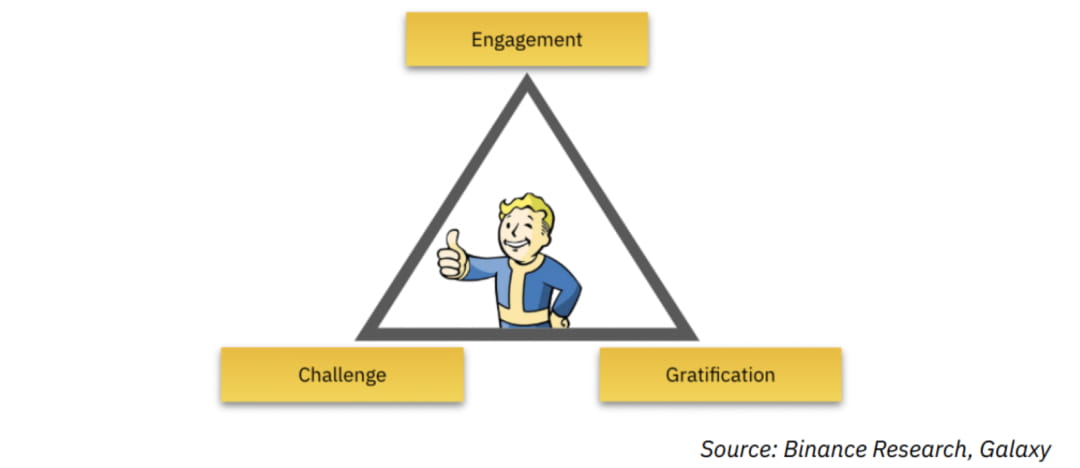
It is important for game developers to continue to emphasize these three aspects rather than optimizing just one of them. Tokens in the gaming ecosystem may pose risks, limiting the ability to optimize these elements, and control of the game economy may be compromised. A key factor to pay close attention to is sustainability.
Sustainability
A key issue facing P2E games is sustainability, as most players are too focused on the ability to earn tokens rather than enjoying the game itself. As such, GameFi is currently at a stage where “just want to earn” is still part of the ecosystem, and while it will likely remain that way for the foreseeable future, it’s important to allow players to enjoy the game for what it is — a fun gaming experience.
Figure 7: Advantages and disadvantages of blockchain in gaming
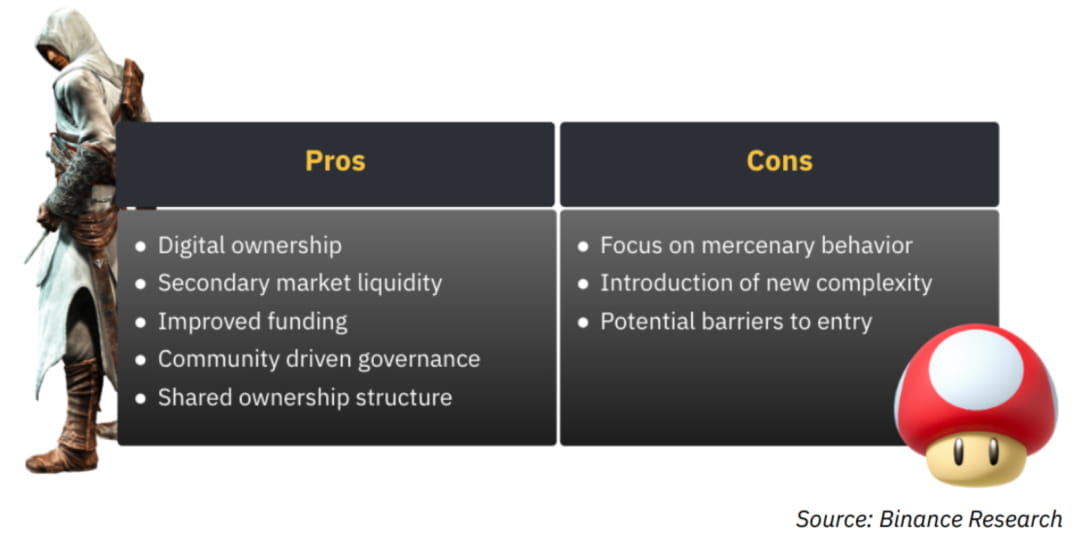
Current web3 gaming projects aim to reach gamers on a larger scale, but so far they have struggled to acquire users in traditional markets. Mobile gaming is an important market due to its ease of use. Especially if these games are integrated into the existing web3 ecosystem. As our society becomes more digital and people around the world have more access to affordable smartphones, successful GameFi projects can build a large user base on mobile through a simple token economics model.
However, a key point so far has been to create token economics without considering the sustainability of its mechanisms, which in the worst case scenario can result in unsustainable token economics.
Figure 8: Unsustainable Token Economy
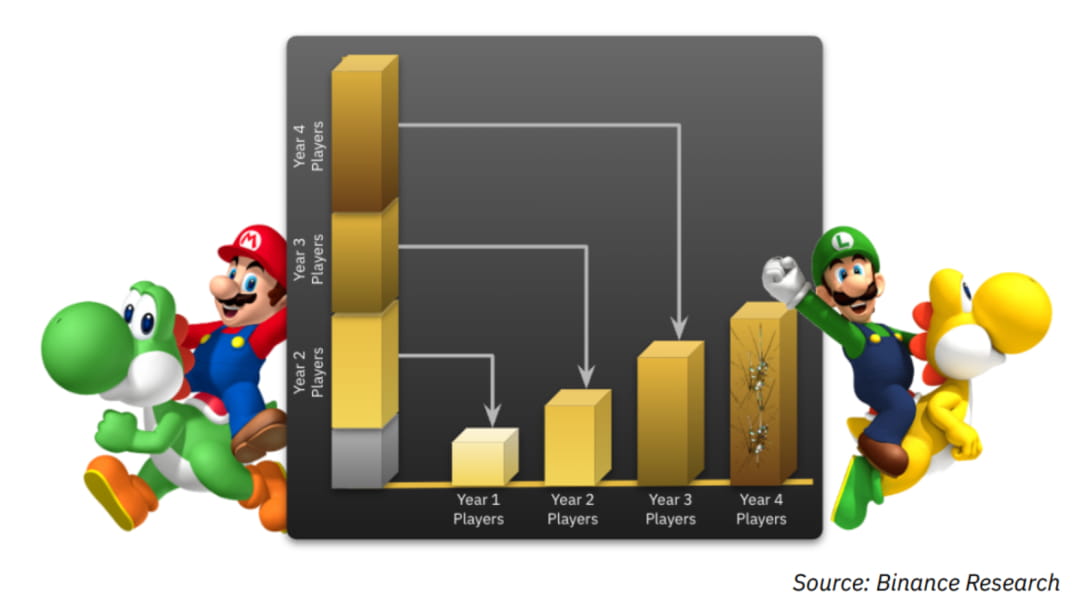
Token design becomes more difficult when players develop their avatar or character over the long term and their income depends on it. There are many reasons for this. Some notable reasons are:
❖ It’s difficult to change the rules without causing a backlash from users — especially if the decision is driven by developers rather than the DAO
❖ The transfer of wealth from late players to early players is likely to occur in an unsustainable model
❖The earning effect is so strong that it has a low tolerance for ecosystem contraction
How to create a sustainable token economics
After understanding some of the key factors in the gaming ecosystem and blockchain space, let’s dive into the main sections of this report: How to create a sustainable token economics GameFi project with a good foundation.
Single Token vs. Dual Token Model
To facilitate the development of token economics, dual-token and n-token models can be used to separate the functionality of tokens. The dual-token model is the most common form of multi-token ecosystem. The dual-token model offers two different tokens at the same time. This helps to specialize the use case of each token by separating the "ecosystem" from the "purpose" the token solves. In most cases of dual-token models, we have a utility token and a governance token. The utility token provides utility across most of the network to perform a specific task (for example, allowing in-game transactions). The governance token helps decide the direction of the project by allowing voting on proposals.
Governance Tokens - Governance tokens help manage a protocol without affecting the price of the utility token. This becomes very important when we consider a dual token model in games, where the game design could be negatively impacted if a single token model is used. If you want to conduct transactions in the game (such as purchasing collectibles), but only have one token for governance, the game design could be adversely affected due to speculation and price volatility. In extreme cases, this could lead to some gamers being excluded from the game due to high barriers to entry. Therefore, the main "mission" of a governance token is to help decentralize the management of a project separate from the rest of the aspects that should be considered.
Utility Tokens - This type of token is used only within the game. With this type of token, investors cannot raise funds as it is a specific purpose based on the platform architecture. Utility tokens enable specific actions or provide specific rights within the platform or GameFi project. The best way to think about utility tokens is to imagine them as in-game currency, where you don’t want to see huge price fluctuations that exclude the vast majority of gamers, and have an unlimited supply to be able to scale the game without the negative impact of scarcity.
Evaluating these pros and cons, we believe that reducing dilution of the governance token is a key advantage of the dual token model. Conceptually, when rewards are given in the second token, we should not have a dilutive effect on the first token. Additionally, a separate utility token can allow for unlimited issuance, which is a key factor to consider, especially for games. Therefore, the second token and the separation between the governance token and the utility token can help control the inflation of the utility token. This is also important in turn because you want to be able to maintain a growing economy without causing high barriers to entry due to excessive token prices. Additionally, in some cases, limiting supply can be favored by investors. Therefore, separating the use cases may help tailor tokens for the right audience.
Despite the benefits that a dual token model can bring, we must also be aware of some drawbacks. The use cases of the tokens are separate — which can lead to unnecessary complexity. Furthermore, this complexity can lead to false expectations. So far, some investors expect the tokens to be correlated in some way, which should not be the case.
Each model has some advantages and disadvantages, depending on the use case. For some games, we think the advantages of the dual-token model outweigh the disadvantages. The separation between governance tokens and utility tokens brings obvious benefits that are important for games — like controlling inflation and incentives through a fixed supply for investors. However, given the disadvantages of the dual-token model mentioned above, we think that for projects with well-designed token economics, running on a single-token model is sufficient — especially if they leverage the use of NFTs and other innovations, and especially if the game is actually fun to play. In the end, both offer two independent approaches that can work well depending on the specific design features.
The Role of NFTs
Another area to focus on is NFTs. NFT collectibles are a perfect fit for the GameFi environment because they can represent characters, items, and even land. It is not always necessary to own NFTs to earn in P2E games, but in most cases, it is a way to maximize revenue. Because each NFT is unique, the digital item is yours until you sell it.
A key question about NFTs is whether people will want to hold them if there are no games built around them. While this works for very popular games or unique designs, most NFTs have little value outside of the game itself.
Game Pool and Faucet
Another key factor we want to talk about is the issue of gaming pools. The purpose of gaming pools and faucets is to bring about a balance in the flow of value in gaming. Simply put, gaming pools remove digital assets from circulation, while faucets bring them in.
We can distinguish two types of game pools
❖ Inflationary Game Pool: What you pay sinks immediately, but what you earn is minted in the long term
❖ Deflationary Game Pool: Voluntary Consumption without Monetary Benefits
Thinking about game pools and faucets from a web3 perspective, we can see that introducing more and more inflationary game pools without a deflationary counterpart could be a dangerous endeavor as it could negatively impact the sustainability of the project.
That said, combined with deflation, regulation mechanisms can have many benefits as they incentivize traditional players to stay because they can leverage ownership and status. If players do not have in-game activity to spend their tokens, the supply of those tokens will create enough inflationary pressure to drive down the price of game tokens. The simplest and most effective way to do this is to sell extremely rare collectibles.
Targeted Token Model
Key idea: If a game cannot maintain a stable user retention rate, it cannot be sustainable in the long run
When designing the GameFi token economics, a key aspect was its inflation design and overall sustainability. Similar to traditional games, marketing budgets are limited and must rely on a steady stream of incentives to provide renewable solutions for games on the platform. Instead, we should focus on overall innovation in game design and gameplay (including new characters, skins, and levels) to keep players engaged. Therefore, we believe that the GameFi project is justified in allocating a higher initial token to its treasury as this will help fund future development and growth.
As mentioned above, there may be benefits to using a dual token model, and depending on the game design, splitting the governance and utility tokens can benefit investors by reducing overall dilution and leading to a larger overall supply for user onboarding. However, we do not believe that a dual token model is a necessity for crypto games.
We believe that for a truly fun game, one token is enough.
This can provide many benefits. Two notable benefits are:
❖ It minimizes clutter and dilution of in-game utility
❖ It helps to efficiently pool market demand (and market making resources)
Currently, a potential problem with the dual token model is that it can lead to a death spiral. Therefore, if developers incorporate tokens, they should carefully design these tokens to avoid this. Additionally, the dual token model relies on a constant balance between the two tokens, as seen in Axie Infinity, which relies on constant adjustments of breeding fees in SLP and AXS to maintain demand for both.
Another potential drawback of the dual token model is managing the token price of a base token that has a large supply, a key risk factor that could lead to a death spiral.
Figure 9: Death spiral
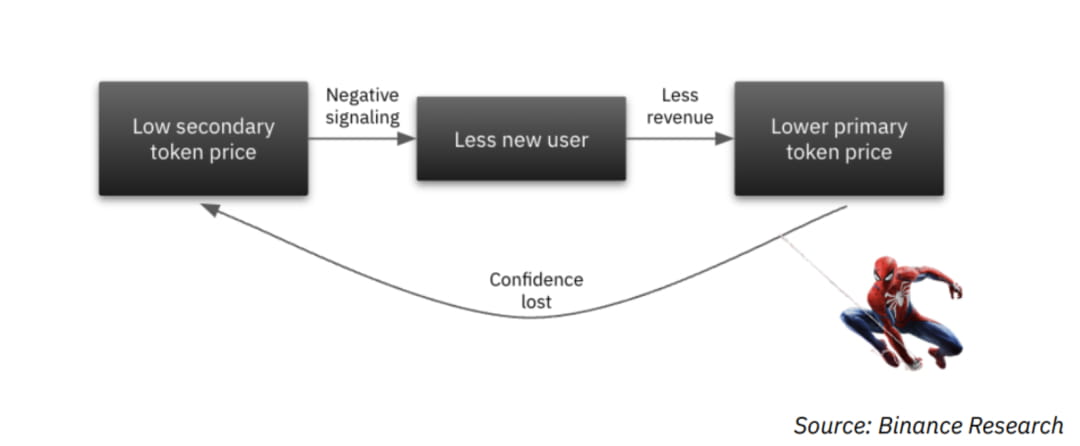
To create a healthy balance, we recommend the following:
❖ Limit reward tokens to a fixed percentage of total supply, distributed over a predetermined period of time (e.g. 1 year) to limit governance dilution
❖ To create a sustainable design, any future increase in reward token allocations from the treasury or revenue should be contingent on key user and revenue metrics (e.g., calculating user acquisition cost, revenue per user, and percentage of paying users). Only then can the overall budget be determined, and a model of diminishing marginal returns should be considered
❖ We believe that initially higher allocations to the finance and development community are justified to fund further development and innovation
In summary, we believe there are valid reasons for both single-token and dual-token models, and they both have their own benefits and drawbacks. Therefore, decisions about the model should be made in the context of the specific project. We believe that for a truly interesting game, one token is enough. Creating a dual-token model without designing healthy mechanics could introduce new risks to the game.
User Guide
Key idea: Use traditional game publishing models to determine initial percentages of marketing budgets and rewards
Onboarding and attracting new users is a key element for both traditional and crypto-native games. Initial and ongoing user onboarding can often determine the overall success of a project and should therefore play a key role in the overall strategy. We believe that initial marketing budgets for traditional games and blockchain platform games should be comparable. The focus here is on the initial launch. Therefore, we see the rationale for similar funding allocations or marketing allocations to traditional games.
❖ AAA games: 1:1 split between marketing budget and development costs
❖ Casual games: allocate about 25-50% of development costs to marketing
Figure 10: Guided allocation

When thinking about user onboarding, the initial goal should be to acquire a base of users that can create a network effect for the game. Therefore, we consider reaching the first 50,000-100,000 users to be a key milestone for the project. Considering that retention rates can vary greatly, and user acquisition costs can be higher for more complex (and niche) games, we think a realistic assumption should be that 10-25% of users will be retained. Word of mouth marketing is a key factor in attracting more users in the future.
At its peak, StepN had approximately 3 million monthly active users ("MAUs"), with the primary growth driver coming from word of mouth.
We further believe that due to the niche nature and user behavior of GameFi, the overall new user acquisition cost should be higher, slightly higher than traditional mobile games.
In our view, creating a healthy balance between dilution of ownership and overall marketing is key. Once healthy bootstrapping is established, it is important to further incentivize and generate revenue from users, not the treasury.
Income Distribution
Key idea: Revenue distribution should be done in a way that rewards the long-term sustainability of the game
Once a project is launched and has a base of monthly active users, it is important to manage revenue in a sustainable way. Therefore, the structure of revenue and distribution should reward long-term sustainability by incentivizing the team to continue developing the token, rather than using a buyback and burn mechanism that causes economic contraction. While this benefits token holders in the short term, we believe it contradicts the overall idea of sustainability in the context of GameFi.
In our view, revenue should accrue entirely (100%) to the DAO, which should be controlled by token holders. Furthermore, any distribution of revenue from a token generation event should follow the following rules:
❖ Allocate a percentage to the "reward pool", this allocation should be used for tournaments, loyalty rewards and active players
❖ Allocate a percentage to repay development debt, if any.
❖ Allocate a certain percentage to team bonuses, which can be obtained if specific milestones are achieved.
Team Motivation
Key idea: Reward game development, not token performance.
Let's move on to talking about team incentives. The general idea should be that the team's performance is not just encouraged by the overall token performance, but by the game development. Therefore, key milestones should incentivize continued development, creating a more sustainable environment than many games today. Therefore, operational metrics such as the number of game players, monthly active users, or key in-game developments (new levels, skins) should be the most important.
One way to do this is to agree to pre-defined milestones, such as new maps, number of users, etc. It is important that the DAO adjusts these milestones based on the overall performance and direction of the game. The goal should not be to make these milestones easier to reach, but to create continuous momentum.
Game Lifecycle
Key idea: The DAO should act as the management and supervisory board of the company, focusing on the long-term future of the project.
If we look at web2 games, we see that they are often in a loop, and without innovation, the overall game lifecycle is limited. This is especially true if we compare console games, which see little change after release, to online and mobile games like League of Legends, which have extended their lifecycles through constant innovation.
Figure 11: Comparison of Google Trends for different games
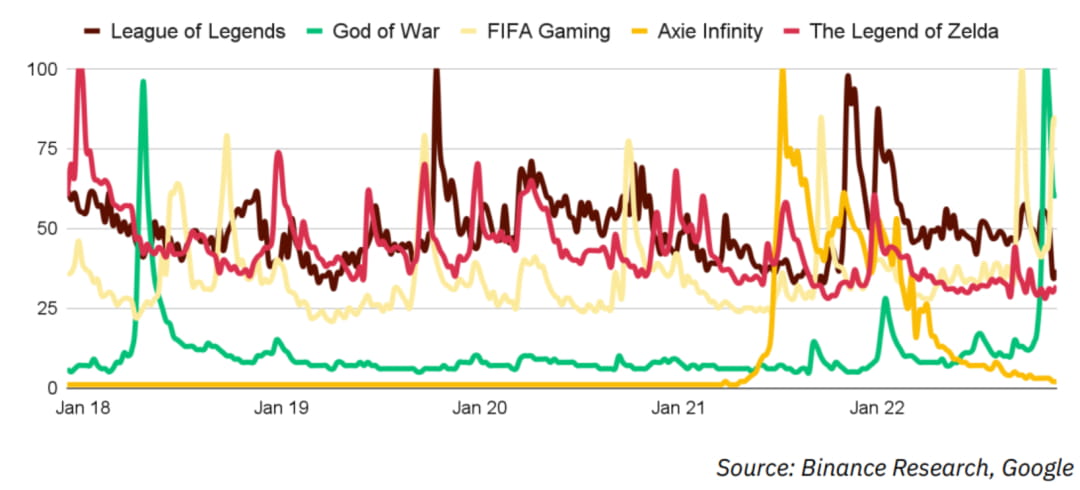
As we can see, the life cycle of a game is not infinite, and only constant change and innovation (which is easier in mobile and online games) can help a project stay alive. That being said, from the traditional gaming world, revenue from sales of early games often helps to fund future projects.
Given the lifecycle of a game, the DAO should serve as the management and board of directors of a company, focused on the long-term future of the project. It is important to note that this future is not necessarily defined by one game, but can include multiple iterations of the same or different games. This can help incentivize the community and core developers to continue investing in the project, thus extending the lifecycle of the token.
Some game elements have also been shown to extend the life cycle of a game, and focusing on these elements can help improve the overall sustainability of a project.
❖ Social Elements - Creating communities where players play not just for the graphics, but for the gaming community (similar to what Counter-Strike and League of Legends have created) can add an extra "sticky" element to the game, thus extending the entire game lifecycle
❖Features - As mentioned above, constant innovation of the game, introduction of new features and content helps to extend the life of the project
Once the popularity of the game dies down, it may help if the DAO and (the community behind it) allocate new reward schemes from the revenue for content development. This is a key factor in improving the demand for tokens. Therefore, we should view gaming projects more as symbols of game developers creating continued innovation and games that people enjoy.
inflation
Key idea: If rewards are provided by income in a controlled and calculated way, inflation should not be a problem in the long term.
While inflation may not always be a problem, it is definitely a critical factor for the dual token model. Inflation in the context of the dual token model is important because inflation of the secondary token can trigger a death spiral that is difficult to reverse once it occurs.
In terms of inflation control, it is important to note that if the budget for initial rewards is fixed, and any subsequent rewards are funded by the revenue generated (in a controlled manner), then inflation should not be a long-term problem for the project.
However, there is still a need to mitigate the selling pressure from the initial budget allocated for rewards. This can be achieved by introducing a vesting period for rewards (giving players enough time to get addicted to the game and become loyal users) or by taking selling pressure off mercenary players. With enough controls, selling pressure should be reduced compared to the incentive program of the dual token model.
Figure 12: Issuance rate control
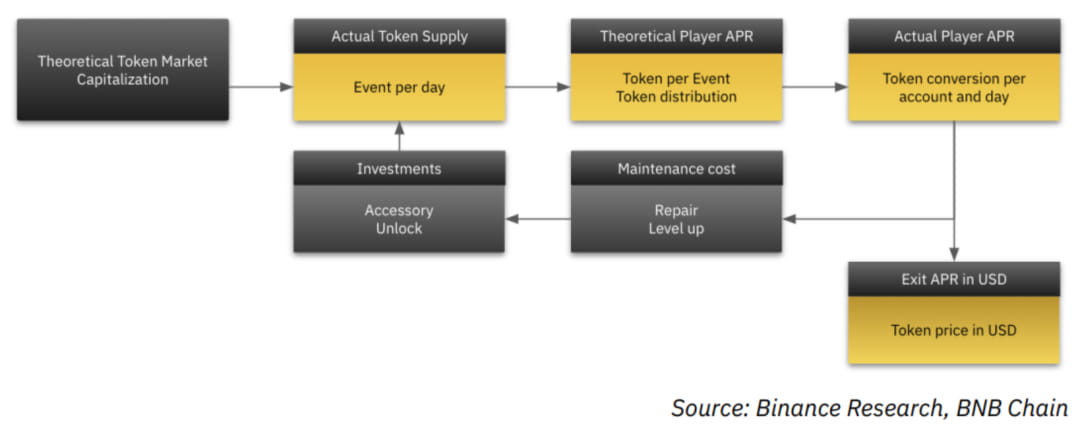
As we can see in Figure 12, reinvesting in the game and building ongoing improvements are key ways to mitigate inflation risk. Therefore, the key thing to remember is that if developers incorporate tokens, they should at least be careful that these tokens do not trigger a vicious cycle.
Token Utility
Key idea: Carefully create token demand to balance user demand (free-to-play) and paid-to-play.
As mentioned in previous chapters, utility is a key aspect of every token economics design. In the gaming space, it is important to create a reason for players to buy tokens and play games. In terms of tokens, the most straightforward way to do this can be to accept tokens as a medium of payment (rather than using stablecoins).
To create utility and demand outside of the crypto environment and attract traditional gamers, fiat on-ramps can be an important application that helps users pay with credit cards — even though the underlying mechanism is crypto-native. Therefore, fiat only allows you to buy tokens, which in return can be used to operate transactions within the game.
Figure 13: Fiat entrance ramp
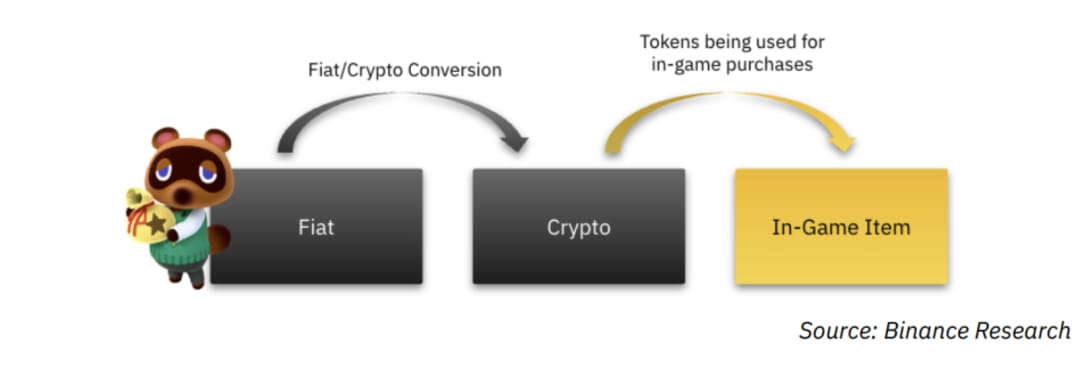
One factor to consider here is Know Your Customer (KYC), which is why it may be beneficial for the game to manage the fiat onboarding steps for players, rather than players doing it themselves.
When considering designing a token economy, developers are often faced with the decision of whether to price everything in dollars and pay for it with tokens, or to price everything directly in tokens.
It can be seen that if everything is priced in USD but paid with native tokens, users may be reluctant to spend tokens on in-game items if the tokens appreciate in value. However, this can be balanced by introducing new rare items and continuous innovation, so that users have a higher value pursuit for items.
For the second case, if everything is priced in tokens and paid for in tokens, we risk creating an environment where entry requirements become higher as the token appreciates, creating an unfair gaming experience and barrier to entry. Therefore, we believe the best solution is to price in USD, as overall gameplay is less impacted. However, this is in stark contrast to most games today.
Currency decoupling is a key element of game economy design. The goal is to decouple the in-game currency from its base currency.
Additionally, we believe it is necessary to create a healthy balance between the addictive free-to-play elements and the paid monetization features of the game. Ideally, payments should only affect the skin (like League of Legends) and not the game itself. To go down this path, patience is a key factor, as monetization will only happen as the popularity of the game develops. For social games, payments should only add convenience and not negatively affect the overall experience.
To evaluate the effectiveness of the metrics, we believe a more quantitative approach is appropriate, which can be based on traditional game data to predict user attraction, retention, paying rate, and revenue per paying user.
When a well-funded game studio wants to develop a web3 game without worrying about token design, they can also choose not to issue a new token at the beginning and only use stablecoins such as BUSD and USDC, although we believe this option will limit the overall design and mechanics of the game.
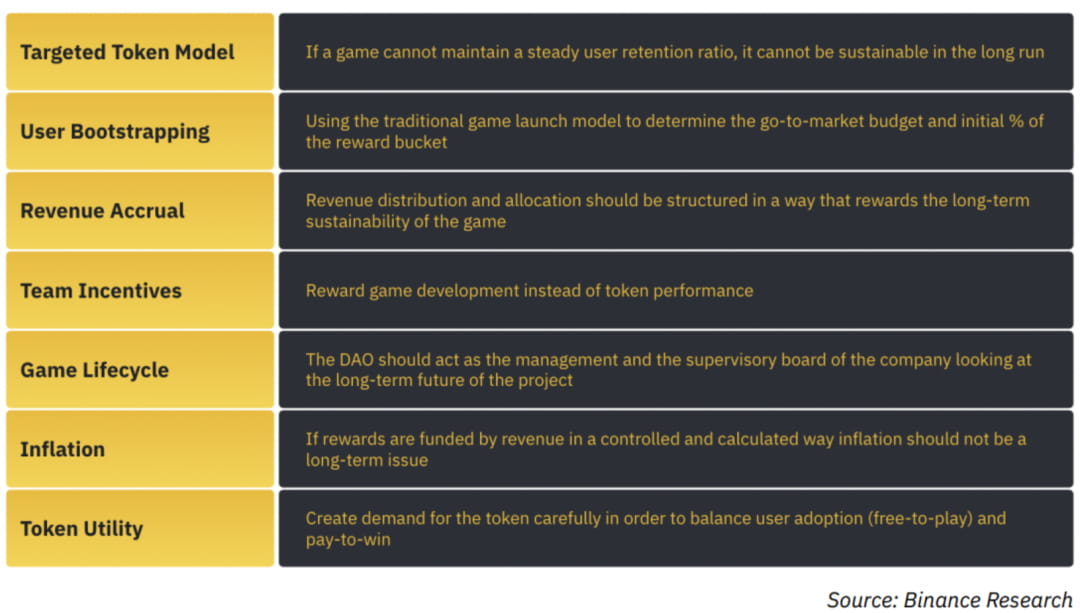
Figure 14: Summary of key ideas in GameFi token design
【Summarize】
Designing games is hard. Designing games on the blockchain, while bringing a lot of new innovations, may be even harder. Incorporating token economics into games adds a whole new layer of complexity for game developers. However, the numerous benefits make it a worthwhile endeavor.
We have seen how important it is for game developers to design token economics that truly complement the overall game design rather than being haphazardly integrated. In the worst case, player incentives become skewed and can overshadow the game’s intrinsic value, which will negatively impact the game’s overall longevity.
While it’s still early days for web3, we believe web3 games can do for blockchain technology what card games did for computers in the 1990s — drive further adoption and education. By educating users on how to operate wallets, pay gas fees for transactions, and interact with smart contracts, crypto games could be the next key driver of growth and adoption in the crypto space.
Looking at the token economics element in more detail, we believe that fun and entertainment are still key factors to consider - and token economics should complement rather than distract from it. A key issue facing P2E games is sustainability, as most players are too focused on the ability to earn tokens rather than enjoying the game itself. Therefore, we see that while the dual token model has benefits, it is not a fundamental necessity for a game to be successful. We instead see that truly fun games can design sustainable token economics with a single token.
One of the obvious challenges in creating sustainable web3 games is tokenizing all game assets without sacrificing control over the game economy. It’s important to remember that just because an in-game asset can be turned into an NFT or fungible token, doesn’t mean it should. Instead, it’s important to consider how this will impact the overall gaming experience and whether it will be a net benefit. Every asset introduced into a game needs to justify its existence and bring value to user acquisition and retention.
#GameFi #NFT #Web3 #crypto2023
If you like the article we compiled, please give us a like! You can also leave a comment to tell us which blockchain game you want to test, and the ladies will give priority to test it!
*This article is edited by GWG_DAO contributors Yodully and Shelley. Please do not plagiarize, rewrite or abuse the original work. Please indicate the source for reprinting.
💕Welcome to click on the avatar to follow us! Discover early quality blockchain games and share valuable information~